1 Jan – 28 May 2026
€95,470.88 in Meta ad spend. €573,222.05 in tracked sales.
Tracked in Meta Ads Manager.
Facebook & Instagram ads · Measuring
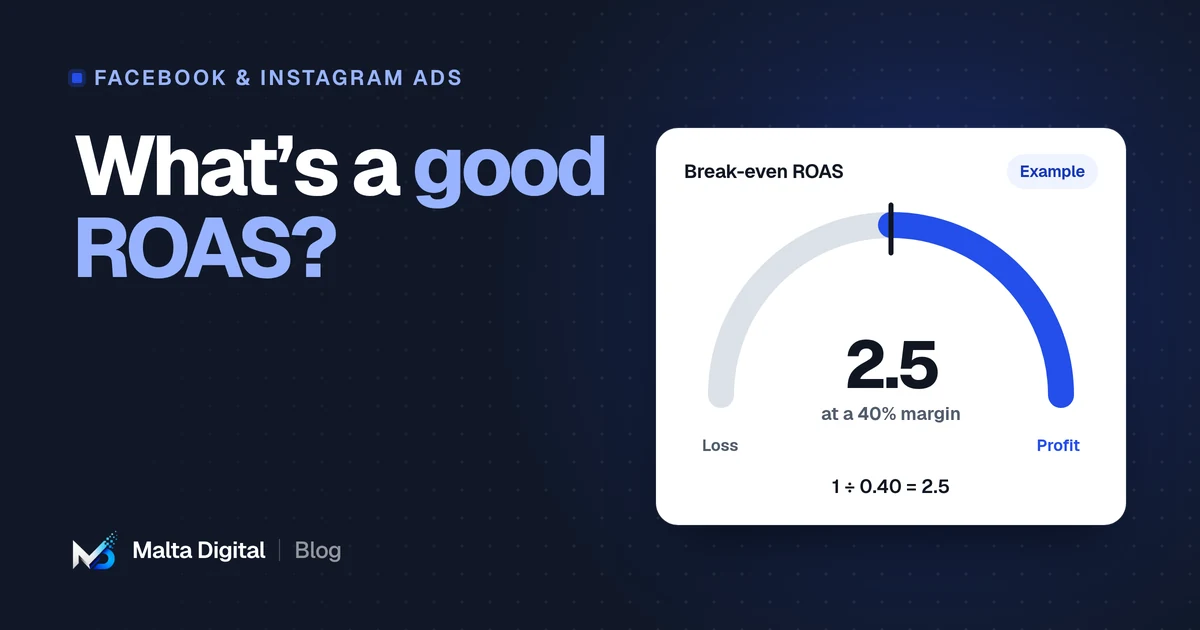
A good ROAS is one that leaves a profit after your product costs and ad spend, so it depends on your margins. Work out your break-even ROAS by dividing 1 by your gross margin: at a 40% margin, break-even is 2.5. Anything comfortably above that is good for you, as long as the tracked sales are real.
By Malta Digital · Published · Updated · 5 min read
In this article
The meaning
ROAS stands for return on ad spend. It is the sales value tracked from your ads divided by what you spent on them. If Meta reports €3,000 in sales from €1,000 of ad spend, the ROAS is 3, sometimes written as 3x or 300%.
It is a quick way to compare campaigns and ads. On its own it says nothing about profit, because it ignores what the products cost you to make, buy or deliver.
Break-even
Your break-even ROAS is the point where the gross profit on the sales just covers the ad spend.
Gross margin is what is left from a sale after the cost of the product, packaging and delivery, as a percentage of the price.
At a 50% margin, break-even ROAS is 2. At 40%, it is 2.5. At 25%, it is 4.
Include management fees and other campaign costs in the spend if you want a full picture.
Aim comfortably above break-even, to leave a profit after everything else.
VAT in Malta
If the purchase values sent to Meta include VAT, the ROAS in Ads Manager is higher than your real return. VAT is collected for the government, not earned by your business.
Malta’s standard VAT rate is 18%. If your tracked sales include it, divide by 1.18 to get the value before VAT. A reported ROAS of 3 becomes about 2.54 before VAT.
A worked example
An illustration with round numbers. Use your own figures.
€1,000 in a month.
€3,540, so Meta shows a ROAS of 3.54.
€3,540 divided by 1.18 is €3,000, so the ROAS before VAT is 3.
€1,200.
€200, before management fees and other costs.
The same campaign looks much better in Ads Manager than in your accounts. Neither number is wrong. They answer different questions.
Reading Meta’s numbers
Meta credits sales within a set time after someone clicks or views an ad. Longer windows credit more sales to ads.
Meta reports the sales it can connect to its ads. Some of those people might have bought anyway.
Blocked tracking means some sales are not reported. A Conversions API setup reduces the gap.
Total sales divided by total ad spend across all channels, from your own accounts. A useful check on what the platforms report.
Use Meta’s ROAS to compare campaigns and ads inside the account. Use your own sales figures to decide whether advertising is paying overall.
By campaign type
Do not expect the same ROAS from every campaign in the account.
Usually a lower ROAS, because these people did not know you. This is where future customers come from.
Usually a higher ROAS, because these people already visited. But some would have come back anyway.
Often the highest ROAS, with the smallest audience.
Judging each campaign by the same target pushes budget towards retargeting until the pool of new visitors dries up. Judge the account as a whole, and give new-customer campaigns their own, lower target.
Beyond one sale
These are deliberate choices. Make them knowing your numbers, not because nobody checked.
Improving ROAS
New images, video and angles are usually the biggest lever. Test them regularly.
Bundles, free-delivery thresholds and add-ons make each sale worth more.
Faster pages, clearer prices and fewer steps to checkout turn more clicks into sales.
Missing purchase data makes campaigns optimise worse. Fix it first.
Offers for people who already bought usually return more than cold audiences.
Cutting the budget often raises ROAS, because you only reach the easiest buyers. It can also mean fewer sales and less profit overall. Watch both.
Leads, not sales
Many service businesses in Malta do not sell online. Their ads bring enquiries, and the sale happens later by phone, in a meeting or in the clinic.
In that case, track enquiries in Meta, then record in your CRM which enquiries became customers and what they spent. Sending those outcomes back to Meta through the Conversions API helps it find more people who actually buy.
Real figures
For context, these are results from campaigns we manage, as tracked in Meta Ads Manager.
1 Jan – 28 May 2026
Tracked in Meta Ads Manager.
2025
Tracked across the year in Meta Ads Manager.
1–9 June 2026
Nine days of campaigns, tracked in Meta Ads Manager.
Platform-attributed purchase value is not profit. These examples are not a guarantee of future results.
A few straight answers
One that is comfortably above your break-even ROAS, which is 1 divided by your gross margin. There is no single number that suits every business.
Divide 1 by your gross margin as a decimal. A 40% margin gives a break-even ROAS of 2.5.
It includes whatever value your tracking sends. If that includes Malta’s 18% VAT, divide the sales value by 1.18 to compare with your revenue before VAT.
Attribution windows, sales Meta cannot track, people who would have bought anyway, VAT and delivery charges all cause differences. Check both.
Often not. For enquiries, track the cost of enquiries and how many become customers, using your CRM.
Keep reading
Tracking, catalogue ads, new customers, retargeting and what to measure for an online shop.
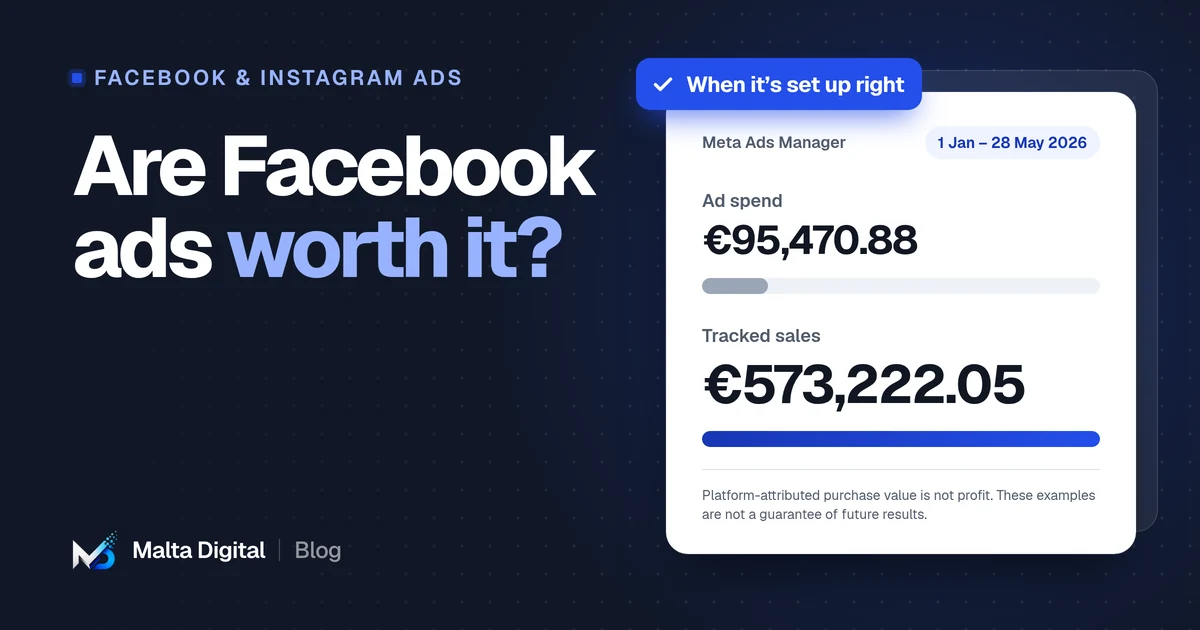
When Facebook and Instagram ads pay off, when to wait, and how to judge results honestly.
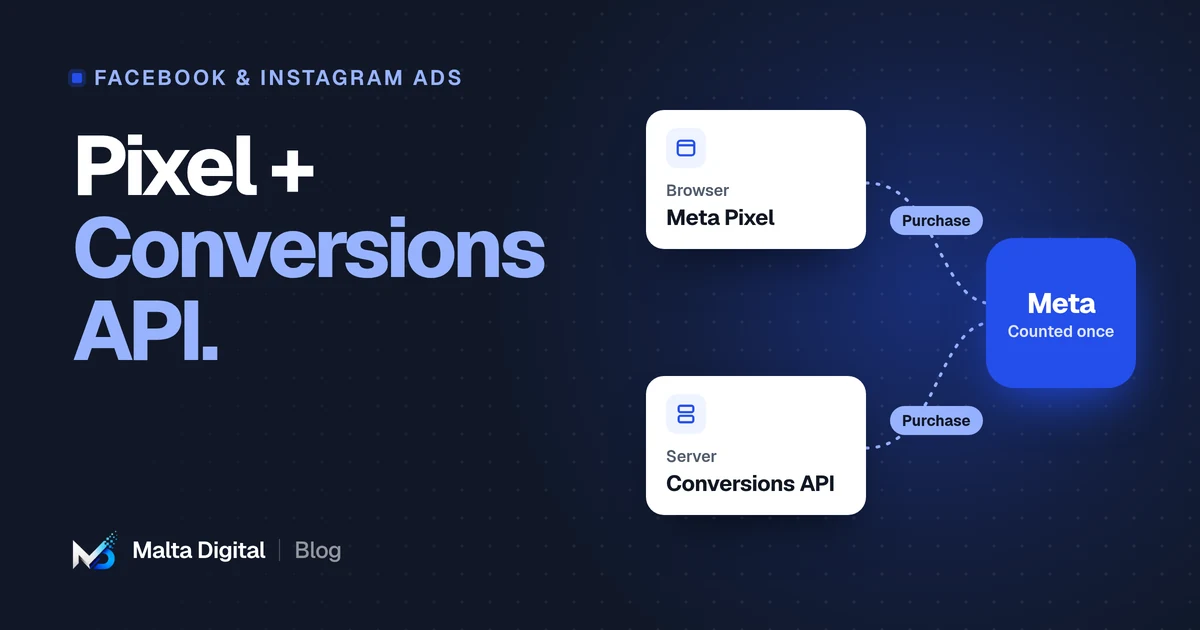
What the Pixel and the Conversions API do, why the Pixel alone misses sales, and how to check your setup.
A useful first step
Send us your Ads Manager results and margins. We’ll explain what the numbers mean for profit. Initial review at no charge.