
Quote and invoice automation
Send quotes and invoices that get paid.
Systems · Invoicing and payments
Malta law lets you charge interest and a €40 fee when a business pays you late, without even sending a reminder. This guide explains the rate for each half year, the 30 and 60 day rules, what to do when a client still will not pay, and a free calculator.
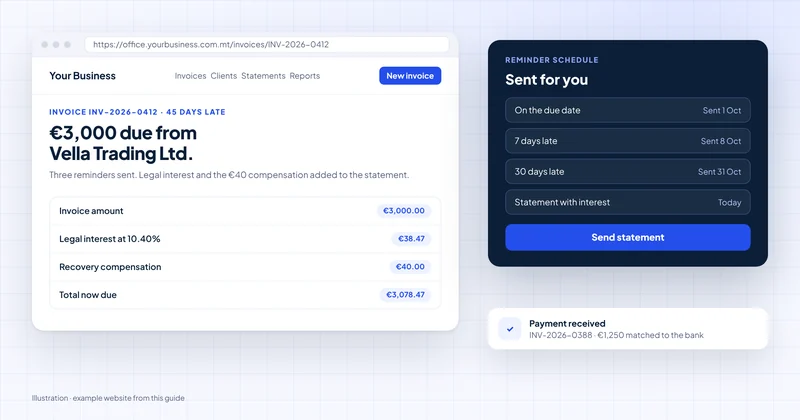
In Malta, a business paid late by another business or a public authority can charge legal interest from the day after the due date: the ECB reference rate plus 8 points, 10.40% a year for July to December 2026, plus at least €40 for recovery costs (Commercial Code, articles 26A to 26E). Business payment terms are capped at 60 days unless expressly agreed. We build invoicing systems that chase for you as part of business systems in Malta.
The short version
Yes. When another business or a public authority pays you late, the Commercial Code lets you charge interest from the day after the due date, without sending a reminder first. The legal rate is the ECB reference rate plus 8 points, which is 10.40% a year for July to December 2026, and you can also claim at least €40 for your recovery costs.
These rules cover business to business sales, sales to public authorities, and main contractors paying their suppliers and subcontractors. They do not cover sales to consumers. This guide explains the payment term limits, the rate for each half year, a free calculator and the steps to get paid.
It is part of our work on business systems in Malta, where we build invoicing systems that send reminders and statements for you.
The rate
Article 26A of the Commercial Code defines legal interest for late payment as simple interest at the ECB reference rate plus at least 8%. The reference rate for January to June is the one in force on 1 January, and for July to December the one in force on 1 July.
The ECB set its main refinancing rate at 2.40% from 17 June 2026, so the rate for July to December 2026 is 10.40%. The ECB moved the rate to 2.65% on 16 September 2026, but that change only counts for Malta’s late payment rate from 1 January 2027, if it is still in force that day.
Payment terms
| Situation | When interest starts | The rule |
|---|---|---|
| The contract sets a payment date | The day after that date | Article 26C(3) |
| No payment date in the contract | 30 days after the client receives the invoice | Or 30 days after the goods or service, if later or uncertain |
| Longest term in a business contract | 60 days | Longer only if expressly agreed and not grossly unfair to you |
| Public authority as the client | 30 days | Up to 60 days only if expressly agreed and objectively justified, or for public health entities |
| Paying in instalments | Only on the instalment that is late | Article 26F |
A clause that removes interest for late payment is treated as grossly unfair under article 26G, and one that removes the recovery compensation is presumed to be grossly unfair. Such clauses may not be enforceable.
Tired of chasing the same clients every month? Apply now for a business system
Free tool
Enter the invoice amount, the due date and the date it was paid, or today. The calculator applies the right legal rate for each half year, adds the €40 compensation and shows what a month of late invoices costs you.
Use your own figures. Nothing you type is sent anywhere.
Your result appears here as you type.
The legal rate is a minimum. Your contract may set a higher rate, as long as it is not grossly unfair to the client.
Example
A supplier in Qormi invoices a restaurant group €3,000, due on 1 October 2026. The money arrives on 15 November 2026, 45 days late. At 10.40% a year, the interest is €3,000 × 10.40% × 45 ÷ 365 = €38.47. Add the €40 compensation, and the supplier can claim €78.47 on top of the invoice.
| Item | Amount |
|---|---|
| Invoice | €3,000.00 |
| Days late | 45 |
| Legal interest at 10.40% a year | €38.47 |
| Compensation for recovery costs | €40.00 |
| Total the client owes | €3,078.47 |
Small amounts add up. Five late invoices like this every month means about €4,700 a year in interest and compensation you are entitled to, and usually never ask for.
Getting paid
Start with clear, polite reminders. Most late invoices are paid once someone asks. If that fails, Malta law gives you two faster routes before a full court case.
| Route | For debts | How it works |
|---|---|---|
| Reminders and a statement | Any amount | Show the invoice, interest and €40 with a payment link |
| Judicial letter, article 166A of Cap. 12 | Up to €25,000, certain, liquidated and due | Confirmed on oath and served on the debtor; if there is no reply within 30 days it can become an executive title |
| Small Claims Tribunal, Cap. 380 | Up to €5,000 | A simpler tribunal for smaller money claims |
| Courts | Above those limits or when disputed | With a lawyer |
Your lawyer will advise on the right route. What helps every route is a clean record: the invoice, proof of delivery, the reminders sent and the dates.
Automation
Chasing payments by hand is slow, awkward and easy to forget. An invoicing system can send reminders on set days, add interest and the €40 to a statement, include a payment link and flag the clients who are always late.
| Feature | What it saves |
|---|---|
| Reminders before and after the due date | Hours of emails and calls each month |
| Interest worked out at the right rate | Mistakes and arguments over the amount |
| Statements with a payment link | Days of waiting for a bank transfer |
| A history of every reminder | The evidence a lawyer or tribunal will ask for |
| A list of slow payers | Better terms or deposits for the next job |
Our guides to quote and invoice automation and payment gateways in Malta show how to get paid faster in the first place.
Mistakes
Process automation can cover more than invoices. See our guide to business process automation.
How we help
We build invoicing and payment systems for Malta businesses: invoices from your quotes or jobs, reminders on the days you choose, statements with interest and the €40 worked out, payment links and a clear list of who owes what.
We have 18 Google reviews from Malta businesses. See what we build on our business systems in Malta page.
Ready to get paid on time without the awkward calls? Apply now for a business system
A few straight answers
Yes, for invoices to other businesses and public authorities. Under article 26C of the Commercial Code you can charge interest from the day after the due date without sending a reminder first, as long as you delivered what you agreed. It does not apply to sales to consumers.
The legal rate is the ECB reference rate plus 8 points: 10.15% a year for January to June 2026 and 10.40% for July to December 2026. The rate for January to June 2027 depends on the ECB rate in force on 1 January 2027.
Article 26E of the Commercial Code entitles you to at least €40 as compensation for your recovery costs when a business client pays late, plus other reasonable costs above that. You can claim it without sending a reminder.
60 days. A longer term is allowed only if both sides expressly agree and it is not grossly unfair to the supplier. If no date is agreed, payment is due 30 days after the client receives the invoice.
30 days after receiving the invoice. Up to 60 days is allowed only if it is expressly agreed and objectively justified, or for certain public bodies such as public health entities.
Start with reminders and a statement. For a certain, liquidated debt up to €25,000, a judicial letter under article 166A of Cap. 12 can become an executive title if the debtor does not reply within 30 days. The Small Claims Tribunal handles claims up to €5,000.
Malta Digital builds custom business systems from €7,500, with a first working version in 2 to 4 weeks and bigger systems live within 2 to 3 months at most. You own the code and the data.
Keep reading
Send quotes and invoices that get paid.

Take card payments online.
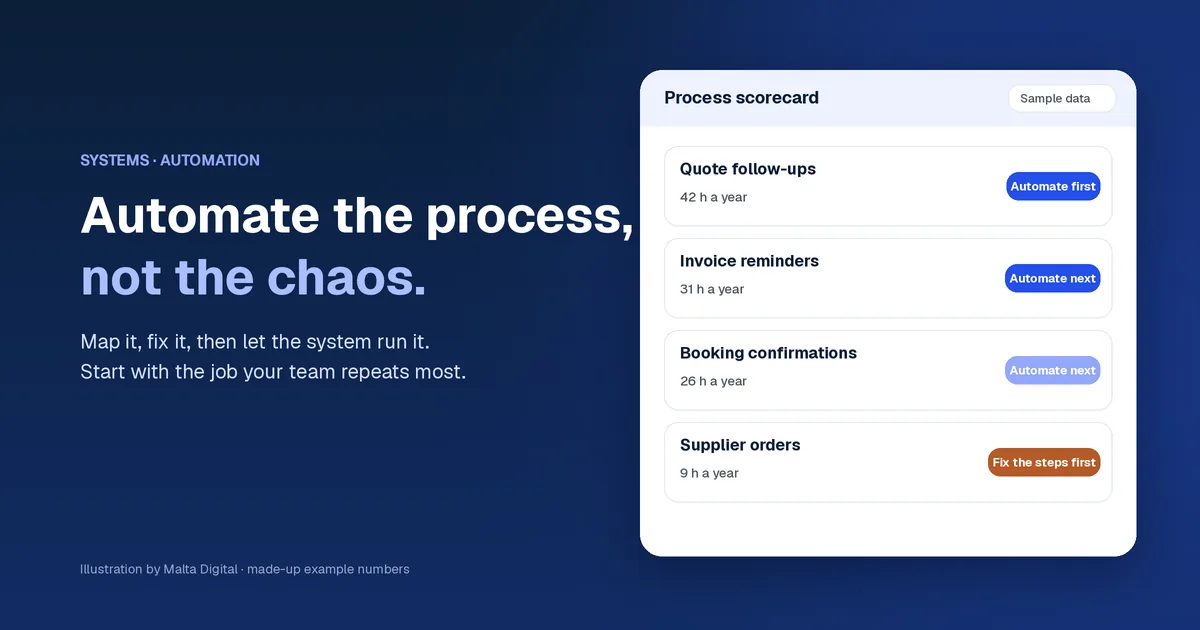
Hand repetitive work to a system.
A useful first step
Custom business systems from €7,500, with a first working version in 2 to 4 weeks. Tell us how you invoice and chase today and we reply with what we would build.
Step 1 of 2
A few quick questions, about a minute. We usually reply within 2–3 hours.