
Quote and invoice automation
From request to paid invoice, with fewer steps and faster payment.
Systems & automation · Automation
Most small businesses do not need more software. They need the software they already pay for to pass work along without someone retyping it. Malta Digital builds that as part of our custom business systems in Malta work, and this guide shows how to pick the first process and get it right.
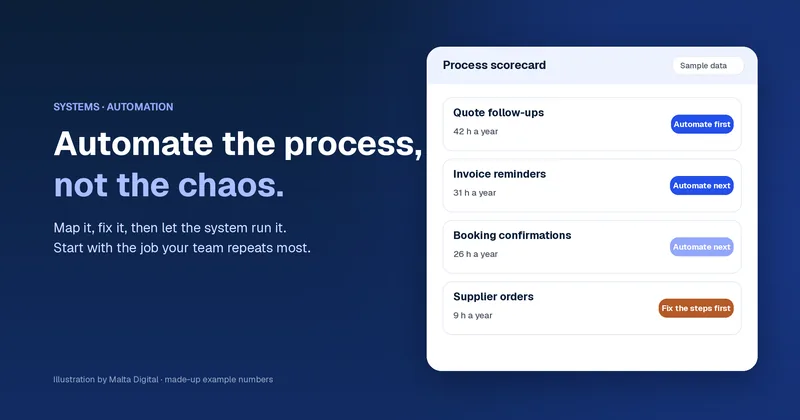
Business process automation means a system runs the repeat steps of a process, such as moving an enquiry into a quote, an invoice or a reminder, while people make the decisions. Start with the process that eats the most hours and follows the same steps every time. Malta Digital builds connected systems for this as part of our custom business systems in Malta service, from €7,500.
The basics
A process is a job your business does the same way again and again. An enquiry becomes a quote. A quote becomes a job. A job becomes an invoice. Each step has a trigger, a task and a hand-over to the next person.
Business process automation, often shortened to BPA, means a system does the triggers and hand-overs for you. When a quote is accepted, the job is booked. When a job is done, the invoice is made. When an invoice is late, a reminder goes out. People still approve, decide and do the work.
| Term | What it does | Good for |
|---|---|---|
| Process automation | Follows your rules: when this happens, do that | Steps that are the same every time |
| AI automation | Reads, sorts or drafts when inputs vary | Free-text emails, documents, chats |
| Robotic process automation (RPA) | Software clicks through screens like a person | Old systems with no way to connect |
This guide is about the first one, because it is where most small businesses should start. When messages or documents vary too much for rules, see AI automation in Malta.
Malta data
Malta businesses already use more business software than most of Europe. Eurostat’s 2025 survey (Eurostat isoc_eb_iipn2 (business software by activity, 2025)) shows 39.8% of Malta businesses with 10 or more staff use CRM software, against 28.5% across the EU. Business intelligence is at 24.4% against 16.3%. ERP is level, at 46.3% against 46.5%.
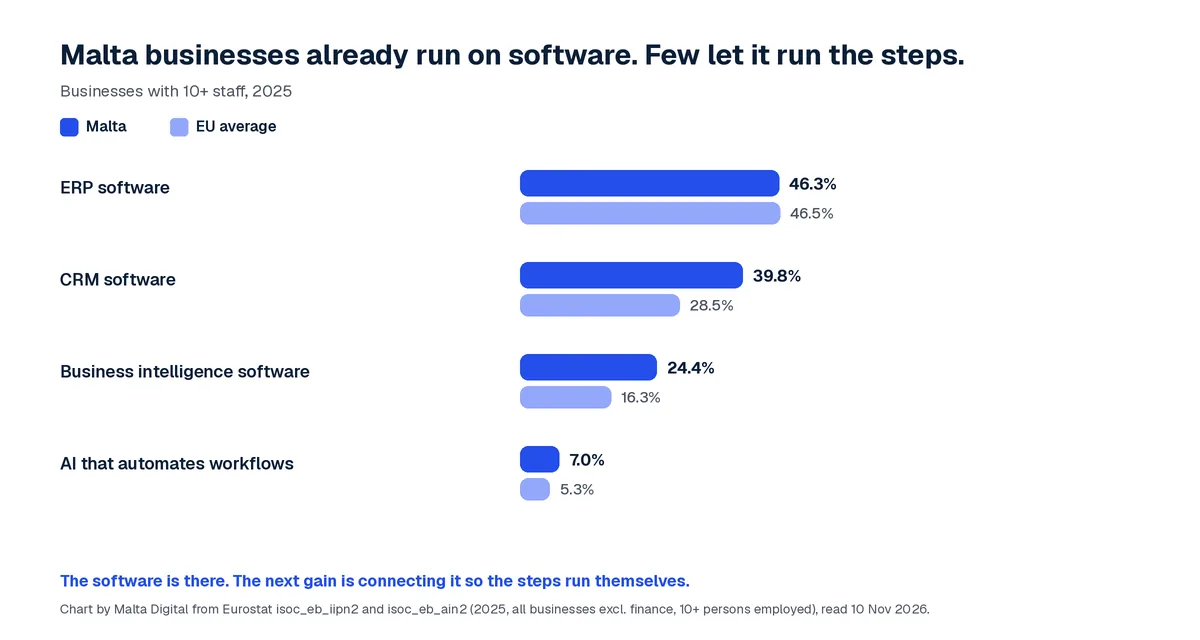
But owning software is not the same as letting it run the work. Only 7.0% of Malta businesses use AI that automates workflows or helps with decisions (Eurostat isoc_eb_ain2 (AI use by activity, 2025)). That is above the EU’s 5.4%, and it is still a small share.
The European Commission sees the same gap. Its European Commission: Malta’s 2026 Digital Decade Country Report says SMEs face challenges in digitalisation, and recommends helping them adopt advanced technologies. For a small business, the first step is rarely advanced. It is getting the tools you have to talk to each other.
Step one
The biggest mistake is automating a messy process. You get the same mess, faster. So before any software, draw the process on one page. It takes an hour with the people who do the work.
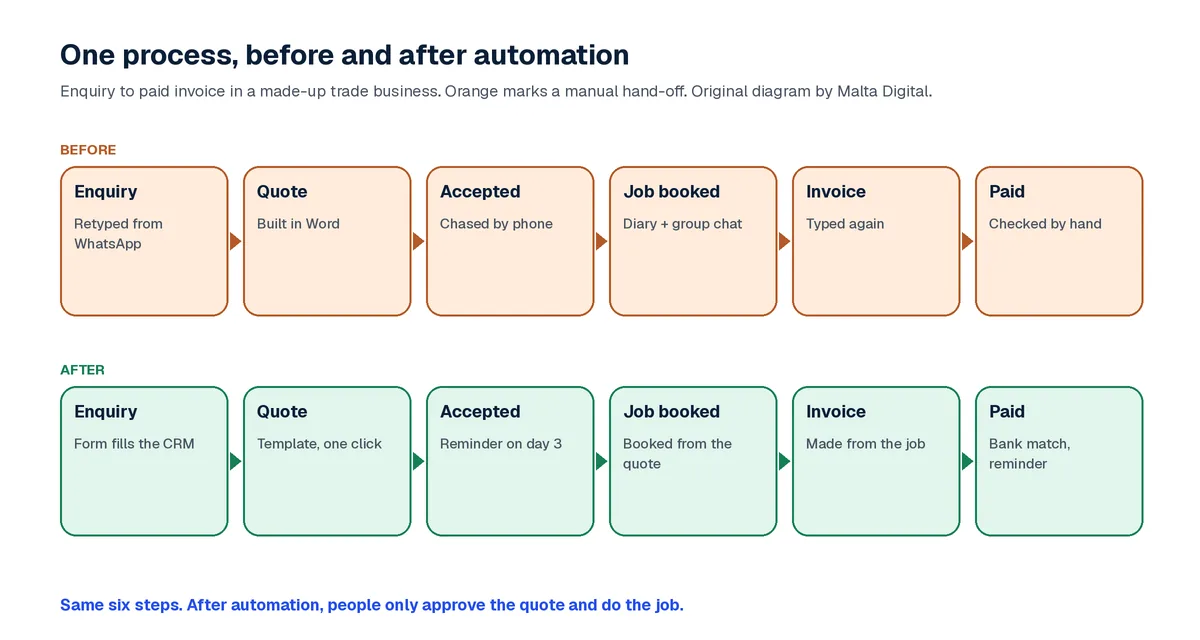
In the example, the six steps stay the same. What changes is the five hand-overs between them. That is where the hours were going.
Priorities
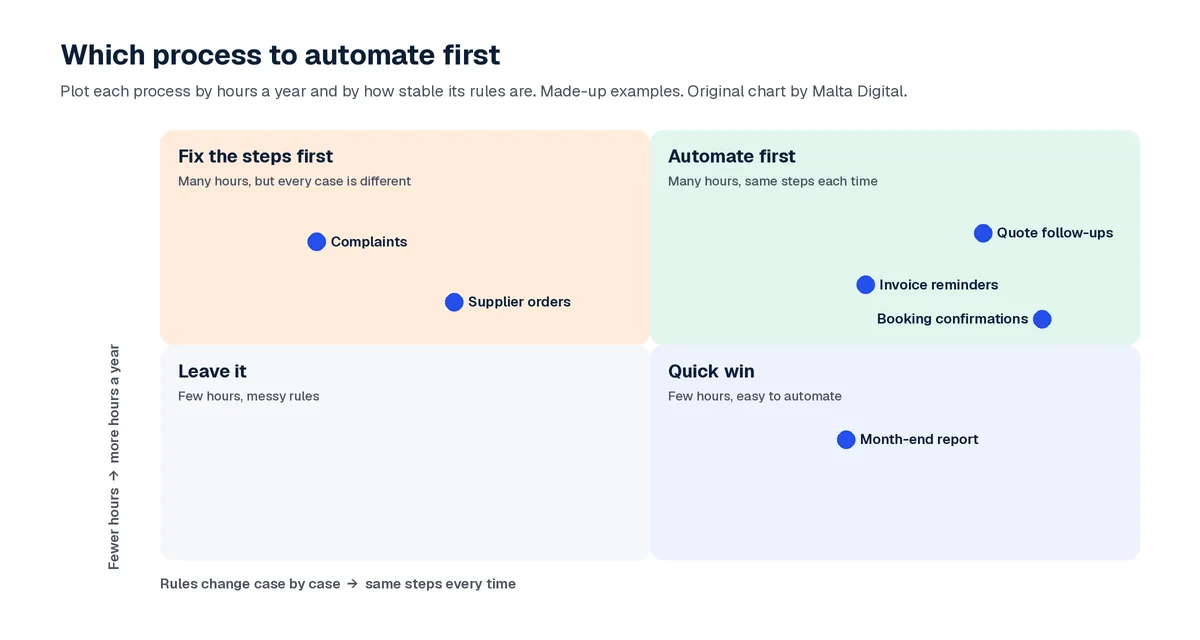
You will find more processes than you can automate at once. Two questions sort them: how many hours does it take a year, and does it follow the same steps every time?
| Question | Points to automate | Points to wait |
|---|---|---|
| How often? | Daily or many times a week | A few times a month |
| Same steps every time? | Yes, with clear rules | Every case is different |
| How many tools involved? | Two or more, with retyping | One tool |
| Cost of a mistake? | Lost money or a missed booking | Small and easy to fix |
| Who owns it? | One named person can agree the rules | Nobody, or everybody |
Complaints are a good example of a process to leave with people. They take time, but every case is different, and a customer with a problem wants a person. Logging them in one place helps. Answering them automatically does not.
Apply now and tell us the jobs your team repeats every week. We will map one with you and show you what a system would change.
Free tool
Put in up to three processes your team repeats. The scorer works out the hours each one takes a year, what a system could take off your hands, and which to start with. Add a build quote to see a rough payback.
Up to three processes. Worked out on your device. Nothing is sent anywhere.
This calculator needs JavaScript. By hand: times a week × 52 × minutes ÷ 60 = hours a year. Multiply by the share a system could do and by your hourly cost. The biggest number goes first.
Here is the example. Staff cost €18 an hour. Quote follow-ups happen 25 times a week at 6 minutes each: 130 hours a year. If a system handles 80%, that is 104 hours, worth about €1,872. Invoice reminders, 15 times at 8 minutes, take 104 hours; at 70% plus two €40 mistakes a month avoided, that is about €1,982. Booking confirmations, 40 times at 3 minutes, take 104 hours; at 90% that is about €1,685.
Together that is about 270 hours and €5,539 a year. Against a €7,500 build, that pays back in about 16 months, before running costs. Hours saved are only money saved if the time goes to paid work.
Examples
These come up again and again when we map small businesses in Malta and Gozo. Each one starts with a trigger you can name.
| Process | Trigger | What the system does | Read more |
|---|---|---|---|
| Enquiry intake | A form, email or WhatsApp message | Creates one record, assigns it, replies in minutes | Lead follow-up |
| Quotes | An enquiry is qualified | Builds the quote from a template, follows up on day 3 | Quotes and invoices |
| Bookings | A slot is chosen | Confirms, reminds, reschedules | Booking systems |
| Invoices and payment | A job is marked done | Makes the invoice, sends reminders, matches payment | Quotes and invoices |
| Stock and orders | Stock falls below a level | Alerts or drafts the supplier order | Inventory systems |
| Client onboarding | A contract is signed | Requests documents, tracks what is missing | Client portals |
Notice what they share. Each one is boring, frequent and rule-based. That is what makes them worth automating, and safe to automate.
Your options
There are three ways to automate a process. The cheapest one that works is the right one.
| Common route | How Malta Digital does it | |
|---|---|---|
| First step | Buy a new tool | Map the process and use what you already pay for |
| Connections | A chain of connector apps, each billed monthly | One system that holds the record and the rules |
| When a step fails | Found weeks later | Every record has a status; failures show on a dashboard |
| Rules | Spread across several tools | Written down once, agreed with you |
| First working version | Depends on the tool | In 2–4 weeks for a focused system |
| Ownership | You rent each tool | You own every line of code we build for you |
Built-in automations in your CRM, booking app or accounting software are a fine start. Connector apps are useful for two or three simple links. When the chain grows long, breaks quietly or holds your own business rules, one connected system is easier to trust.
If you are weighing a ready-made tool against a build, our custom software vs off-the-shelf guide goes through the trade-offs.
Limits
Automation is for the steps, not the judgement. Draw the line before you build, and write it into the rules.
| Decision | Why |
|---|---|
| Prices outside your standard list | Margin and relationships |
| Refunds, credits and write-offs | Money leaves the business |
| Complaints and unhappy customers | People want a person |
| Anything that seriously affects a customer | GDPR Article 22 limits fully automated decisions |
| Exceptions the rules did not foresee | The system should flag them, not guess |
A good system makes overriding easy and visible. If a person overrides a rule, the system asks for a reason and saves it. If your process touches customer data, which most do, our CRM and GDPR guide covers the basics.
Want help drawing the line between rules and people? Apply now for a business system
Proof
A skip hire and waste business took bookings through a website form, a Facebook button, phone calls and Messenger. Each booking needed back-and-forth for the address, dates, placement and size. Nobody could see the day’s capacity in one place.
We built one system with three views. Customers book on their phone with a size helper. The office sees capacity, schedules and the status of every skip. Drivers see the day’s jobs in order and report back from the road. If the office overrides a full day, the system asks for a reason and saves it.
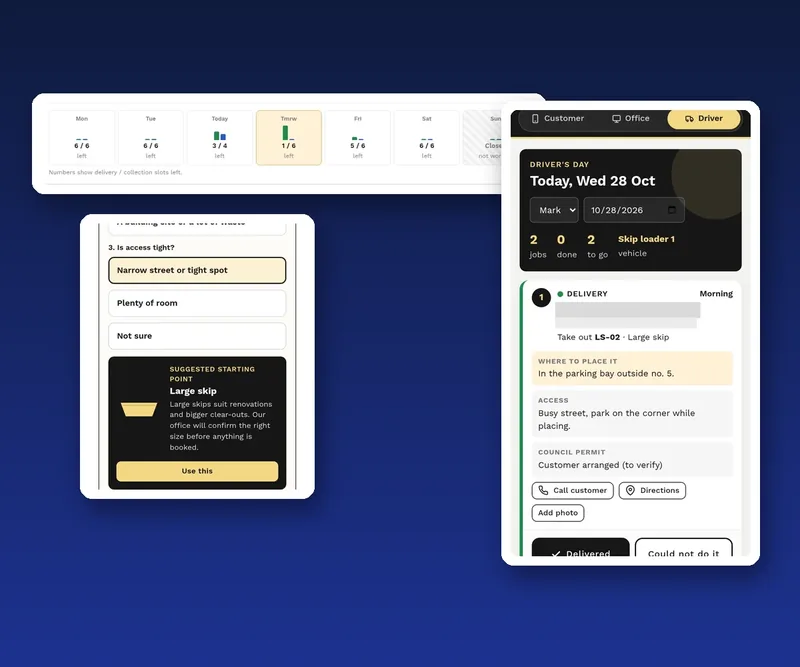
It is being rolled out, so there are no results to claim yet, and the screens use sample data. It shows the pattern this guide describes: the steps run themselves, the decisions stay with people, and nothing depends on one person’s memory.
Pricing
Custom systems start from €7,500 for one clear process. Wider projects that connect several teams are scoped as larger projects. You get a fixed, itemised quote after we map the process with you. We start as soon as the first payment is made. A focused system has its first working version in 2–4 weeks. Bigger systems are live within 2–3 months at most.
You own every line of code we build for you. Running costs depend on hosting, the support plan you choose and any usage fees, such as messaging. Malta Digital has 18 Google reviews from businesses in Malta and Gozo.
Bigger projects may get public support. The fondi.eu: Digitalise your SME page says the scheme part-finances digitalised processes “such as product and process design and engineering, end-to-end procurement, supply chain/distribution and after sales”. Its minimum grant is €25,000. The Malta Enterprise: Business Development scheme page lists “Business RE-engineering and Digital Transformation” among eligible projects, with support of up to 75% of eligible costs and €300,000 over three years.
The funding bodies decide eligibility, and work must not start before approval. Our grant-backed digital transformation projects page explains how to plan a project around a grant.
A few straight answers
It is when a system runs the repeat steps of a business process, such as turning an enquiry into a quote, sending reminders or creating invoices, so people only handle the decisions. It usually connects tools you already use, and it does not have to involve AI.
Process automation follows fixed rules: when this happens, do that. AI automation adds judgement, such as reading a free-text email or drafting a reply. Most small businesses get the quickest win from rules first, then add AI where messages or documents vary.
The one that takes the most hours a year and follows the same steps every time. Quote follow-ups, booking confirmations and invoice reminders are common first picks. Fix a process that changes every time before you automate it.
Built-in features and connector tools can cost little. A custom connected system from Malta Digital starts from €7,500 as a one-off project, plus hosting and support. We start as soon as the first payment is made. A focused system has its first working version in 2–4 weeks. Bigger systems are live within 2–3 months at most.
Possibly. Digitalise your SME covers digitalised processes and has a minimum grant of €25,000. Malta Enterprise’s Business Development scheme lists business re-engineering and digital transformation. The funding body decides eligibility, and work must not start before approval.
It replaces typing, copying and chasing, not judgement. In most small businesses, the hours saved go back into serving customers and doing paid work. Keep people in charge of money, refunds, complaints and anything unusual.
Not always. Start with the automation features in the tools you already pay for. A custom system makes sense when the work crosses several tools that do not talk to each other, or when the rules are your own.
Sources
Keep reading
From request to paid invoice, with fewer steps and faster payment.

Reply to every enquiry fast without sounding like a robot.

Twelve real uses of AI for small businesses, and where it does not fit.
A useful first step
Tell us the jobs your team repeats and the tools you use. We reply with the process we would start with, what the system would do and what it would cost.
Step 1 of 3
A few quick questions, about a minute. We usually reply within 2–3 hours.