CRM for clinics
Enquiries to booked patients, treatment plan follow-up, recalls and reviews, with health data kept safe and clinical notes out of the CRM.
Systems & automation · CRM and GDPR
No CRM is GDPR compliant on its own. The software can give you the tools, such as EU hosting, user roles, consent fields, export and deletion, but compliance depends on how you use it: knowing why you hold each contact, sending marketing only to people who agreed or bought from you, letting only the right staff see each record, deleting what you no longer need and answering requests within a month. In Malta the rules are the EU GDPR and the Data Protection Act (Cap. 586), overseen by the Information and Data Protection Commissioner (IDPC). This guide turns them into settings and habits for your CRM.
Contact record · consent
Source: website form
Email offers: Yes · 12 MarWhatsApp offers: NoExport or deleteNo CRM is GDPR compliant by itself. In Malta a CRM is compliant when every record has a lawful basis and source, marketing goes only to people who consented or bought from you, data sits in the EU under a processor contract, staff see only what their job needs, old records are deleted and requests are answered within a month. Malta Digital builds those rules into the CRM.
The short answer
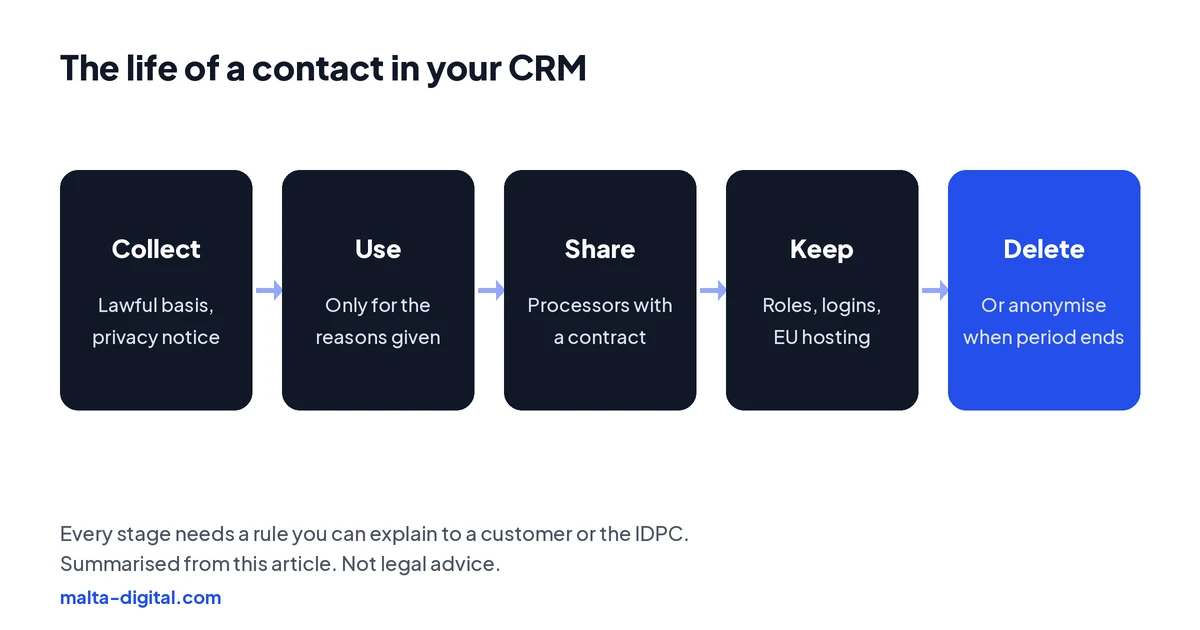
A CRM is simply an organised place for personal data: names, phone numbers, emails, WhatsApp chats, quotes, notes about what a customer wants. GDPR does not stop you keeping any of that. It asks five things of you. Know why you hold each piece of data and on what legal basis. Tell people what you do with it. Protect it, so only the right people see it. Keep it only as long as you need it. And let people see, correct or remove their data when they ask.
A good CRM makes all five easier than a spreadsheet or a phone full of chats, because everything sits in one place with a history. When a customer asks what you hold about them, you open one record instead of searching three phones, a laptop and an inbox. When a member of staff leaves, you switch off one login instead of hoping they delete a spreadsheet.
The common mistake is to treat “GDPR compliant” on a vendor’s website as the end of the job, then import every number from every staff phone, with no source, no basis and no end date. The vendor is responsible for its part; the decisions about your customers’ data are yours.
Lawful basis
Every record in your CRM needs a lawful basis under Article 6 of the GDPR. For most small businesses in Malta, three cover almost everything. Contract covers customers you are serving and people who asked you for a quote. Legitimate interests covers sensible follow-up, such as replying to an enquiry someone sent you or keeping the contact details of a business you deal with. Legal obligation covers what the law makes you keep, such as invoices and, for some sectors like estate agents, anti-money-laundering records. Consent is the fourth, and it is the one you need for marketing to people who are not customers.
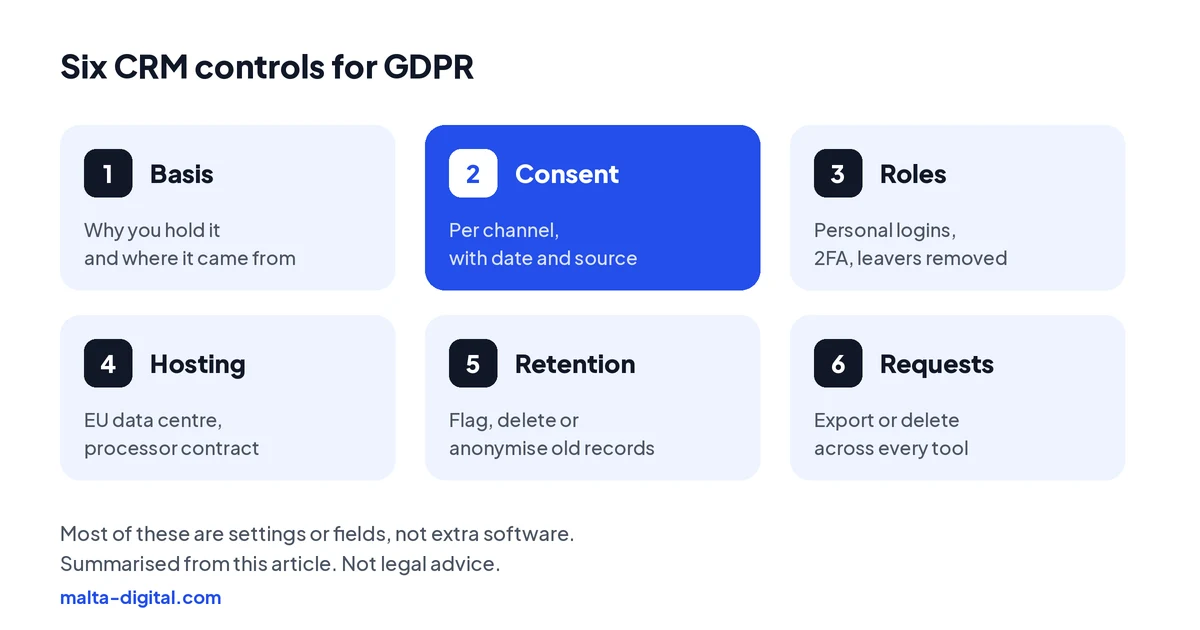
Write the basis and the source into the record when it is created. A field that says “Facebook lead form, 14 March, asked for a quote on a kitchen” tells you, a year later, why the person is there and what they agreed to. Most CRMs let you add these as custom fields, and imports from website forms and lead ads can fill them in automatically.
Two Malta habits cause most problems. The first is a list with no basis at all: numbers collected from a WhatsApp group, a trade fair sign-up sheet with no notice, or a list someone bought. The second is relying on consent for everything, including customers you have a contract with, which means that when someone withdraws consent you are unsure whether you can still send their invoice. Use consent where it fits and the other bases where they fit.
Marketing
Marketing by email and SMS in Malta is covered by Subsidiary Legislation 586.01, alongside the GDPR. The rule is prior consent, with one exception, often called the soft opt-in: if you got someone’s email address when they bought from you, you may send them marketing about your own similar products or services, as long as you offered a simple, free way to opt out when you collected it and in every message after. A person who only enquired and never bought usually needs to give consent first.
WhatsApp has its own rules on top. Meta’s WhatsApp Business policies require people to opt in before you message them first, and marketing templates sent through the WhatsApp Business Platform are charged per message. Keep a separate consent field for each channel, email, SMS and WhatsApp, with the date and where it was given, because someone happy to receive appointment reminders may not want offers.
In the CRM, that means three practical things. Separate service messages, such as a booking confirmation, a reminder or the quote someone asked for, from marketing. Make unsubscribes flow back: when someone clicks unsubscribe in your email tool or types STOP on WhatsApp, the CRM record should update by itself. And keep a suppression list of people who opted out, so a later import does not add them back. The mistake we see most is a single “subscribed” tick that is meant to cover every channel and every kind of message.
Where data lives
Your CRM provider is a processor: it holds and handles your customers’ data on your instructions. Article 28 of the GDPR requires a written contract with it, usually called a data processing agreement or addendum. Most established CRM vendors publish one that you accept with your account, and some let you download a signed copy. Keep it on file with the date.
Then check where the data is stored. Many vendors offer EU data centres, sometimes only on paid plans or if you choose the region when you open the account. Storing data outside the European Economic Area is allowed, but only with a safeguard, such as an EU adequacy decision (the EU–US Data Privacy Framework for certified US companies is one) or the EU’s standard contractual clauses. For most small businesses in Malta, choosing EU hosting is the simplest answer. Our HubSpot vs Zoho vs Pipedrive comparison notes what each says about EU data.
The part people forget is everything connected to the CRM. Your email marketing tool, the WhatsApp provider, the form builder, the automation tool that copies leads from Facebook, the accounting software: each one is another processor with its own servers and its own terms. List them, check each one, and remove connections you no longer use.
Access and security
Article 32 asks for security that fits the risk. In a CRM, most of that is settings. Give every person their own login, never a shared one. Turn on two-factor authentication. Set roles so that staff see what their job needs: a sales person sees their own leads, the office manager sees everything, the accounts person sees invoices but not private notes. Switch off a leaver’s access on their last day. Many small and family businesses in Malta share one password for years; it is the easiest thing on this list to fix.
Watch the free-text fields. Notes are where sensitive data creeps in: a copy of an ID card pasted into a note, a remark about someone’s health, a comment you would not want the customer to read. Remember that anyone can ask to see what you hold about them. Write notes as if the customer will read them, and keep ID documents in a restricted file area, not in the notes.
Limit exports too. Every spreadsheet downloaded from the CRM is a copy outside your controls, often emailed around and never deleted. If your CRM can restrict exports to managers and keep an audit log of who viewed or downloaded what, use it.
Retention
The GDPR does not give a number of years. It says you keep personal data only as long as you need it for the reason you collected it, and you decide and write down those periods. A sensible approach is to set one rule per type of record: enquiries that never became customers, active customers, past customers, staff and suppliers, and anything the law makes you keep longer, such as tax records or, for some businesses, anti-money-laundering files. For legal minimum periods, ask your accountant or adviser rather than guessing.
A CRM can enforce the rule for you. Add a “last activity” date, run a monthly view of records past their period, and either delete them or anonymise them: keep the deal value and the source for your reports, remove the name, phone and email. That way you can still see how many leads came from Facebook last year without keeping the people.
The mistake is keeping everything forever “in case they come back”. Old leads from five years ago are a risk, not an asset: if there is a breach, they are part of it, and if they get a marketing message they never agreed to, they complain.
Apply now and tell us which CRM or spreadsheets you use and where your enquiries come from. We’ll show you what we’d change in the setup first, or message us on WhatsApp.
Requests
People have the right to see the data you hold about them, to have it corrected, to have it deleted in many cases, to object to marketing and to take their data elsewhere. You must reply without undue delay and within one month, which you can extend by two further months for complex requests if you tell the person within the first month. Requests do not need a special form. A message on Facebook, an email to a staff member or a WhatsApp saying “please delete my details” counts.
A CRM turns these from a hunt into a routine. Open the record, export what it holds, including notes, messages and files, and send it. For deletion, delete in the CRM and in every connected tool, and log that you did it. Keep a short request log with the date received, what was asked and the date you replied, so you can show you met the deadline.
Train whoever answers your messages to spot a request and pass it on the same day. In a small business the risk is not refusing a request; it is the message sitting unread in someone’s phone for six weeks.
Breaches
A personal data breach is any loss, leak or unauthorised access: a staff phone with business WhatsApp chats left in a taxi, a customer export emailed to the wrong address, a former employee still logging in, a hacked account. Under Article 33 you must report a breach to the IDPC within 72 hours of becoming aware of it, unless it is unlikely to put people at risk, and tell the people affected if the risk to them is high. Keep an internal record of every breach, including ones you decide not to report.
Fines under the GDPR can reach €20 million or 4% of worldwide annual turnover for the most serious cases, but for a small business the bigger cost is usually trust. A CRM lowers the risk in practical ways: you can log people out remotely, see who accessed which records, and avoid copies on personal phones and laptops in the first place.
Proof
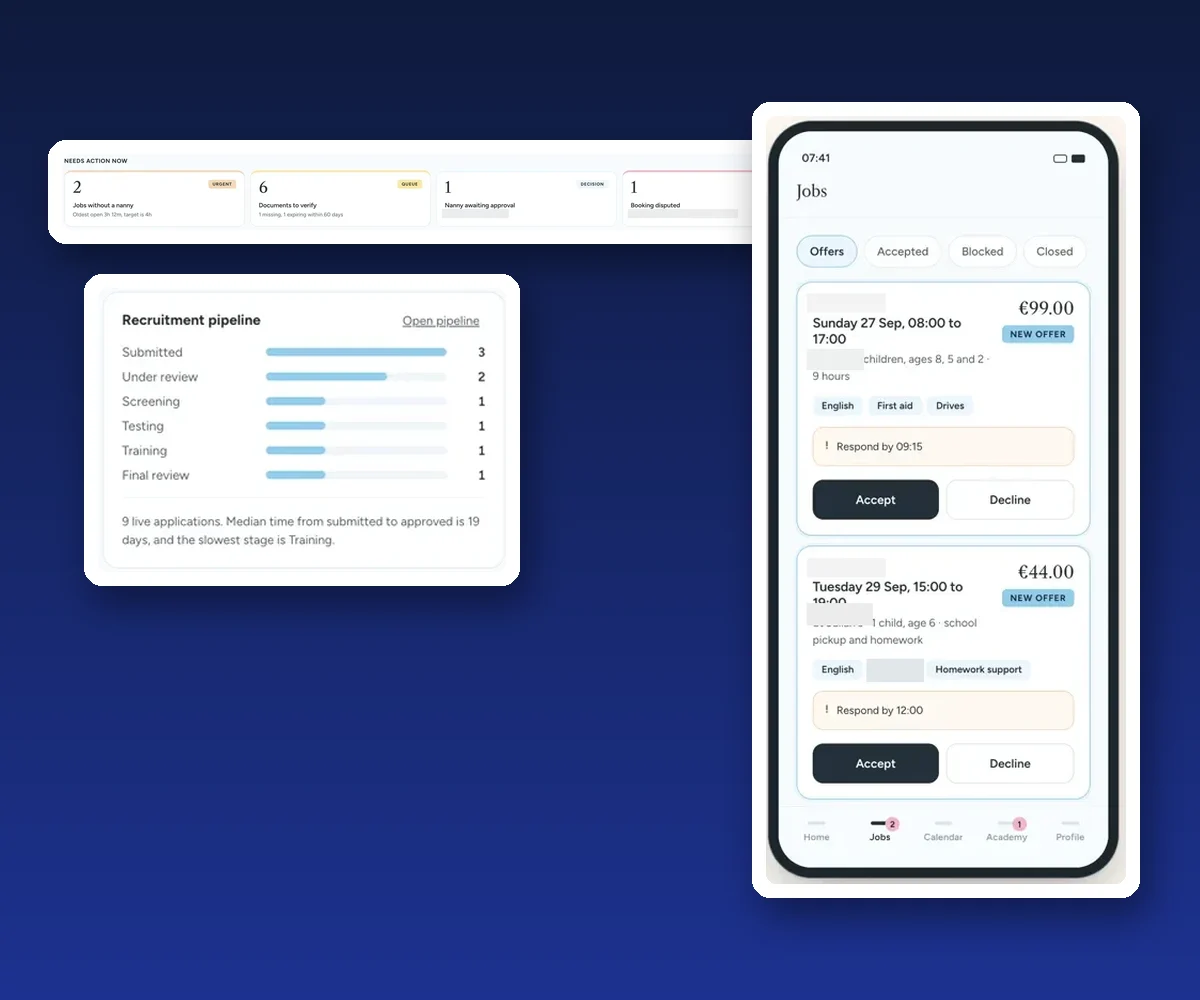
A childcare and nanny agency came to us with bookings, nanny applications, documents and payments spread across messages, spreadsheets and email. We designed one platform with three connected parts: a command centre for the office, a portal where nannies apply and accept job offers, and a booking app for parents. Each side sees only what it needs: parents see their own bookings, nannies see their own offers and documents, and the office sees everything.
It is a new system, so we do not publish results or usage figures for it. It shows the point of this article in practice: when roles and permissions are designed in from the start, data protection becomes part of how the system works rather than a policy nobody reads.
Want a CRM where every person sees only what they should? Message us on WhatsApp
Ten checks
Use this as a quick review of the CRM you have, or as a brief for the one you are choosing. It is not legal advice, and the IDPC’s own online self-assessment tool is worth an hour of your time as well.
| Check | What good looks like |
|---|---|
| 1. Basis and source | Every record shows why you hold it and where it came from |
| 2. Privacy notice | Forms, lead ads and your website link to a notice that mentions the CRM and its tools |
| 3. Consent per channel | Separate email, SMS and WhatsApp marketing fields, with date and source |
| 4. Opt-outs sync | Unsubscribes and STOP replies update the CRM automatically; a suppression list exists |
| 5. Processor contracts | A data processing agreement with the CRM and every connected tool |
| 6. Hosting | EU hosting, or a documented safeguard for any transfer outside the EEA |
| 7. Roles and logins | Personal logins, two-factor authentication, roles by job, leavers removed the same day |
| 8. Retention | Written periods per record type, with a monthly view of records to delete or anonymise |
| 9. Requests | Staff can spot a request; one-click export; deletion across tools; a request log |
| 10. Breaches | A plan for the 72-hour rule and an internal breach record |
How we do it
We start by mapping your data: where enquiries and customers come from, which tools they pass through, who needs to see what and how long you need each type of record. Then we build that into the CRM, whether it is a ready-made one we set up or a custom system: source and basis fields, consent per channel, roles, EU hosting, retention views, export and deletion that reach every connected tool, and opt-outs that sync by themselves.
We are not lawyers, and we will tell you when a question needs one, such as the wording of your privacy notice or a sector rule. What we do is make the system follow the rules you set, so your team does not have to remember them. Custom CRM systems start from €7,500, excluding VAT. See the CRM page for what is included, and our CRM cost guide for how projects are priced.
A few straight answers
No software is compliant on its own. A CRM can give you the tools, such as EU hosting, roles, consent fields, export and deletion, but compliance depends on how you use it: your lawful basis, your marketing consent, your retention rules and how you handle requests.
Usually not. Customers and people who asked you for a quote can be held under contract or legitimate interests. You need consent mainly for marketing to people who are not customers.
Email and SMS marketing needs prior consent under S.L. 586.01, except the soft opt-in for existing customers about your own similar products, with an opt-out in every message. WhatsApp also requires opt-in under Meta’s policies.
Not strictly, but data stored outside the EEA needs a safeguard such as an adequacy decision or standard contractual clauses. EU hosting is the simplest choice for most small businesses in Malta.
The GDPR sets no fixed period. Decide a period you can justify, write it down, and delete or anonymise old leads when it ends. A CRM can flag them automatically.
Within one month, extendable by two further months for complex requests if you tell the person within the first month. Requests can arrive by any channel, including WhatsApp or Facebook.
Most small businesses do not. A DPO is required when your core activities involve large-scale monitoring of people or large-scale processing of special data such as health data, and for public bodies. Check the IDPC guidance if you are unsure.
Keep reading
Enquiries to booked patients, treatment plan follow-up, recalls and reviews, with health data kept safe and clinical notes out of the CRM.

A fair comparison on free plans, WhatsApp, EU hosting, setup and fit, and what to do when none of the three fits.

A free, printable checklist from choosing a CRM to GDPR, data import, WhatsApp and lead ads, launch and funding.
A useful first step
We set up a ready-made CRM or build a custom one with source and consent fields, roles, EU hosting, retention rules and opt-outs that sync by themselves. Custom CRM systems from €7,500, excluding VAT.