Lost leads and time cost calculator
Estimate what missed enquiries and manual admin cost you each month, using only your own numbers.
Systems & automation · CRM cost
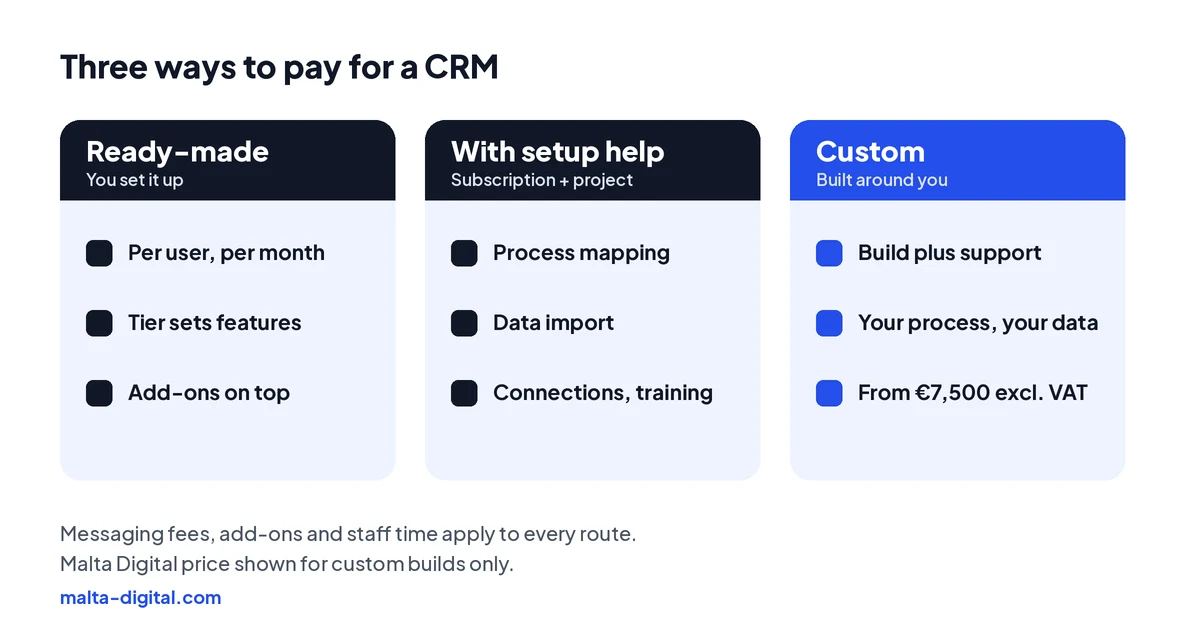
A CRM costs three things: the software, the work to set it up around your business, and the cost of running it. Ready-made CRMs charge a subscription per user per month, and some are free for two or three users. Setup covers mapping your process, importing and cleaning your data, connecting WhatsApp, forms, lead ads, email and accounting, and training your team, and for most small businesses in Malta and Gozo it matters more than the subscription. Running costs add messaging fees, add-ons, support and changes. This guide shows what each part covers, what pushes the price up and how to budget without surprises.

A CRM costs three things: the software, setting it up and running it. Ready-made CRMs charge per user per month, and some, such as HubSpot and Zoho CRM, are free for two or three users; setup, data import, connections and training are usually the bigger cost. Malta Digital builds custom CRM systems from €7,500, excluding VAT, and says so when a ready-made CRM is enough.
The short answer
When people ask how much a CRM costs, they usually mean the monthly price on a software website. That is only the first of three parts. The second is setup: someone has to decide your pipeline stages and fields, move your customers in from spreadsheets and phones, connect the channels your enquiries come from and show your team how to use it. The third is running it: the plan you outgrow, the add-ons you need later, WhatsApp messaging fees, support, and the hours your staff spend keeping it up to date.
The split changes with the route you take. With a ready-made CRM you pay a subscription and do the setup yourself, or pay someone to do it. With a custom CRM you pay mainly for the build, because the system is designed around how your business already works, and then for hosting and an agreed support plan. Neither is automatically cheaper over time. It depends on your team size, how many channels you need connected and how much your process differs from a standard sales pipeline.
The common mistake is comparing monthly prices and ignoring everything else. A CRM nobody uses because it was never set up properly is the most expensive option of all: you pay for the software and still lose the enquiries.
Ready-made CRM
Almost every ready-made CRM charges per user, per month, with several plan tiers. The lower tiers cover contacts, a pipeline and basic reminders; the higher tiers unlock automation, several pipelines, custom fields, advanced reports and permissions. Paying yearly usually costs less per month than paying monthly. Some products also price by the number of marketing contacts, so the bill grows with your mailing list as well as your team.
Free plans exist and are worth knowing about. As of October 2026, HubSpot offers free CRM tools for up to two users and 1,000 contacts, and Zoho CRM has a free edition for up to three users. Pipedrive has no free plan but offers a free trial. For a one or two-person business with a simple process, a free plan can be all you need for a while. Check each vendor’s current price page before you decide, because plans and prices change.
The trap is choosing the cheapest tier and finding that the one feature you bought the CRM for sits higher up. WhatsApp is the usual example in Malta. HubSpot’s WhatsApp inbox needs a Professional or Enterprise Marketing Hub or Service Hub plan, and Pipedrive’s WhatsApp integration is on the Growth plan and above. On top of the CRM, Meta charges for template messages sent through the WhatsApp Business Platform. Write down your must-haves first, then look for the lowest plan that covers all of them.
Setup
Setup is where a CRM either becomes part of the day or quietly dies. It starts with decisions only your business can make: what counts as a new enquiry, which stages a deal goes through, who owns each lead and what has to happen before a quote goes out. Then come the practical jobs: creating fields and stages, importing customers from spreadsheets, email and phones, removing duplicates, connecting website forms, Facebook and Instagram lead ads, WhatsApp, email and your accounting tool, setting up reminders and permissions, and training everyone who will use it.
You can do this yourself. Many owners try, usually in the evenings, and get as far as importing a contact list. The cost is your time and the weeks in which the old spreadsheet and the new CRM run side by side, with nobody sure which one is right. Or you pay someone to do it as a one-off project. Either way, it is a real cost and belongs in your budget from the start.
Picture a typical Maltese service business: enquiries arrive through WhatsApp on the owner’s phone, Facebook lead forms that someone downloads once a week, calls to the office and the website form. The subscription is the easy part. The work is getting all four into one list, each with an owner and a next step, without asking staff to retype anything. Our CRM setup checklist lists every step in order, and the lost leads calculator puts a figure on the admin time you would save.
Custom CRM
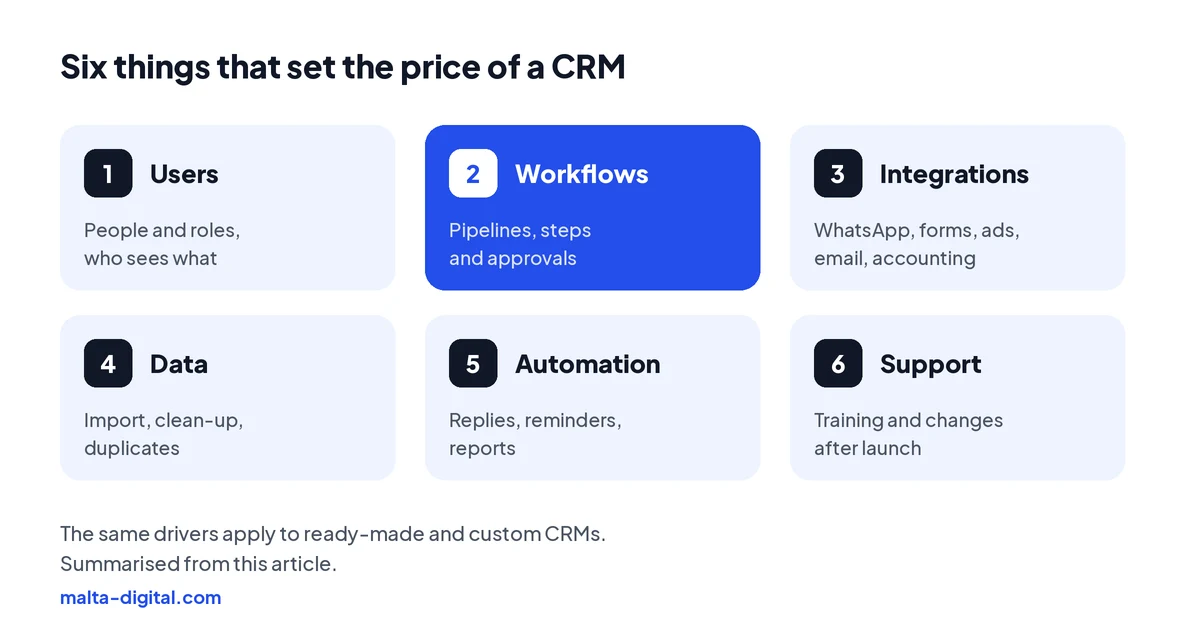
A custom CRM is designed and built around how your business works, rather than adapted from someone else’s template. At Malta Digital, custom CRM systems start from €7,500, excluding VAT. The final price depends on how many people and roles use it, how many workflows it runs, which tools it connects to, how much data has to be moved and cleaned, and whether it includes extras such as a customer portal, bookings or quotes.
Most of the cost is not the screens. It is the thinking before anything is built: mapping how enquiries arrive and who does what, agreeing the stages and rules, then designing, building, connecting and testing the system with your staff, moving your data and staying on after launch. That is why a custom build costs more than switching on a ready-made CRM, and why it fits better when your process is not standard.
Custom is worth it when a ready-made CRM forces workarounds: a spreadsheet kept next to the CRM, several teams with different steps, a customer or partner side that needs its own portal, or connections that ready-made tools do not offer. It is not worth it for a one or two-person business with a simple process and nothing to connect. In that case we will tell you so and point you to a ready-made option.
Side by side
The table below sums up the three routes. It uses no vendor prices, because they change often and depend on your plan and team size. Check each vendor’s own price page for the current figures.
| Ready-made on your own | Ready-made with setup help | Custom CRM | |
|---|---|---|---|
| Best for | One or two people, one or two channels, a simple sales process | A small team with a standard process and several channels to connect | Several teams or steps, a process that does not fit a template, portals or deep connections |
| What you pay | A subscription per user per month; some products have free plans for small teams | The subscription plus a one-off setup project, quoted after a short call | Malta Digital: from €7,500, excluding VAT, plus hosting and an agreed support plan |
| Who does the work | You and your team | The setup partner, with your input | We map, build, connect, migrate, test and train |
| Watch out for | Features you need sitting on a higher tier; nobody owning the setup | Paying per user as the team grows; connections the tool cannot make | A rushed scope; any provider who skips mapping and testing |
Apply now and tell us how enquiries reach you and who handles them. We’ll tell you whether a ready-made CRM is enough or what a custom one would involve, or message us on WhatsApp.
Proof
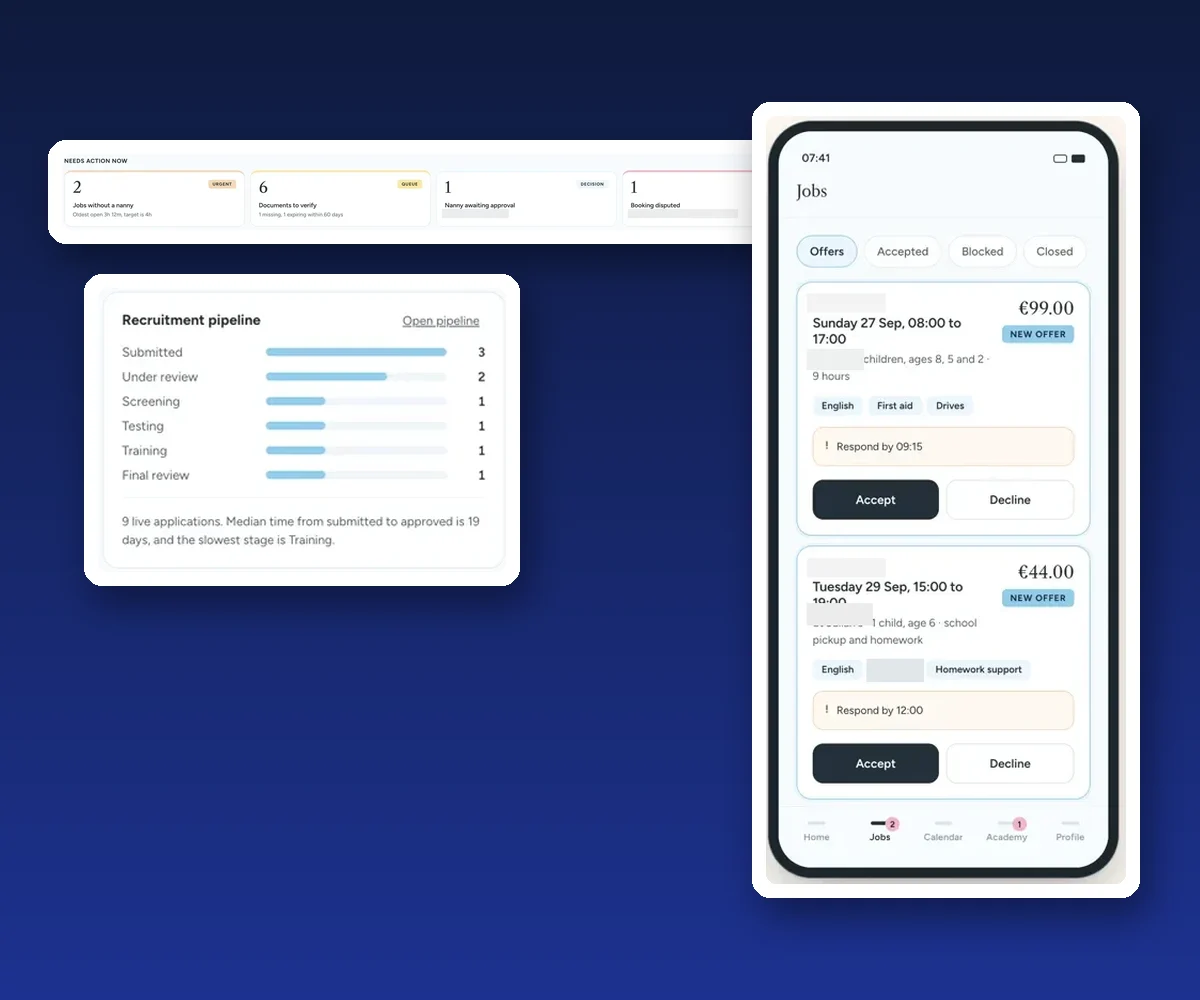
A childcare and nanny agency came to us with bookings, nanny applications, documents, training and payments spread across messages, spreadsheets and email. We designed and built one platform with three connected parts: a command centre for the office that opens on what needs action now, a portal where nannies apply, train and accept job offers, and a guided booking app for parents.
It is a new system, so we do not publish results or usage figures for it. The case study shows what we built and how the parts work together, which is what a custom CRM budget pays for: one record for every booking, person and payment instead of five tools that do not talk to each other.
Want to know what a CRM built around your business would involve? Message us on WhatsApp
Budget
Work out the total for the first two or three years rather than the monthly price. For a ready-made CRM, that is the subscription for every user on the tier that covers your must-haves, times the months, plus the setup, any add-ons, WhatsApp messaging fees and the hours your team spends on it. For a custom CRM, it is the build plus hosting and the support plan. Put the same staff-time line in both, because training and adoption take time either way.
Then compare that with what doing nothing costs. If one in five enquiries gets a late reply or none at all, the lost sales usually dwarf any software bill. Our free lost leads and time cost calculator works this out from your own numbers, with no industry averages.
Before you sign with anyone, ask five questions. Can we export all our data at any time? Where is it hosted, and is it in the EU? What happens to the price when we add users or contacts? What does support cover, and how fast do you reply? Who owns the setup, the automations and any custom code? Clear answers to these matter more than a small difference in price.
Funding
Possibly, for larger projects. Digitalise your SME, run by the Measures and Support Division through fondi.eu, treats custom software as an eligible cost, and its guidance names CRM among enterprise systems. For subscription software, two years of the subscription count as the eligible cost. The grant covers up to 50% of eligible costs in Malta and up to 60% in Gozo, for projects from €25,000 to €120,000 plus a 7% flat rate. A CRM on its own is often smaller than that, so it usually fits as part of a wider digitalisation project.
The funding body decides who qualifies, and figures can change between calls. Read the current call and guidance notes before you sign anything, and plan the CRM as part of the whole project rather than as an afterthought.
How we do it
We start with a call about how customers reach you today and where enquiries get lost. If a ready-made CRM is enough, we say so and can set it up for you. If it is not, we map your process with the people who do the work, then send a written proposal with the scope, what is included, the price and the timeline before any work starts. Custom CRM projects start from €7,500, excluding VAT.
The build follows the map: pipeline and tasks, your channels connected, your data moved and checked against the source, roles and reports, staff training and support after launch. See the CRM page for everything that is included, and our case studies for systems we have built.
A few straight answers
Ready-made CRMs are charged per user per month, and the plan tier decides which features you get. As of October 2026, HubSpot offers free CRM tools for up to two users and 1,000 contacts, Zoho CRM is free for up to three users, and Pipedrive offers a free trial. Check each vendor’s current price page.
Malta Digital’s custom CRM systems start from €7,500, excluding VAT. The final price depends on users and roles, workflows, integrations, data migration and extras such as portals or bookings.
Setup and data clean-up, a higher plan for a feature you need, add-ons, WhatsApp messaging fees charged by Meta, training, and the staff time spent running the old system and the new one side by side.
For one or two people with a simple process and one or two channels, often yes. Once several people share customers or you need WhatsApp, lead ads and accounting connected, a paid plan or a custom CRM usually pays for itself.
Setting up a ready-made CRM configures someone else’s software. A custom CRM is mapped, designed, built, connected, tested and supported around your process, and most of the cost is that thinking and testing.
Custom software, including CRM, is an eligible cost under Digitalise your SME, at up to 50% of eligible costs in Malta and 60% in Gozo for projects from €25,000. The funding body decides who qualifies.
Compare the total over two or three years, including setup, add-ons, messaging and staff time, and ask about data export, EU hosting, price changes as you grow, support and who owns the setup.
Keep reading
Estimate what missed enquiries and manual admin cost you each month, using only your own numbers.

Answer 8 quick questions and see whether a ready-made CRM, a ready-made CRM with setup help, or a custom CRM fits, and why.

How to compare cost, fit, risk and ownership, and when a mix of both makes most sense.
A useful first step
We map your process, then set up a ready-made CRM or build a custom one, with your channels connected, your data moved and your team trained. Custom CRM systems from €7,500, excluding VAT.