“Everything is in WhatsApp.”
Put every enquiry in one list.
Leads from WhatsApp, email, forms and ads land in one place, each with an owner and a next step.
CRM software · Malta & Gozo
Leads in WhatsApp. Customer details in a spreadsheet. Follow-ups in someone’s head. We build custom CRM systems and set up CRM software for businesses in Malta and Gozo, so every enquiry gets an owner, a next step and a reply.
★ 18 Google reviews · From €7,500 · CRM case study
Short answer: Malta Digital builds custom CRM systems for businesses in Malta and Gozo, from €7,500, with a first working version in 2 to 4 weeks. Every enquiry, customer and follow-up lives in one system connected to your website forms, Facebook and Instagram lead ads, WhatsApp, email and accounting. You own the code. 18 Google reviews.
By Johnny M
“Everything is in WhatsApp.”
Leads from WhatsApp, email, forms and ads land in one place, each with an owner and a next step.
“We forgot to call them back.”
Tasks and reminders, so enquiries get a reply while the customer is still interested.
“Only one person knows the history.”
Notes, calls, quotes and bookings saved against each customer, visible to the right people.
“We can’t see what’s in the pipeline.”
Know how many enquiries, quotes and sales are open, and where they get stuck.
Transcript: Your enquiries come in from everywhere: WhatsApp, email, Facebook, and your website. Some get a reply. Some get forgotten. A CRM brings every enquiry into one place, the moment it arrives. Each lead gets a status, so you can see who is new, who has a quote, and who said yes. Each lead gets an owner, so your team knows who replies. And a reminder, so no follow-up is ever missed. Nothing slips through the cracks. Book a free CRM consultation at malta-digital.com.
Who it’s for
A CRM pays off when enquiries, quotes and repeat customers drive your sales. It is the right project if several of these sound familiar.
Enquiries arrive by WhatsApp, phone, email, website forms and ads, and nobody sees them all in one place.
Two or more people handle customers, and handovers depend on memory.
Quotes go out, and nobody follows up the ones that went quiet.
You run ads or get steady referrals, and want to know which source brings paying customers.
A ready-made CRM forces workarounds, or the team still keeps a spreadsheet next to it.
You want the CRM connected to bookings, quotes, invoices or a customer portal.
You want staff to actually use it, so it has to match how they already work.
You are planning a larger digitalisation project that may qualify for co-funding.
Being honest
A one or two-person business with a simple sales process and nothing to connect. A ready-made CRM will do the job, and we will tell you so.
You need it live next week. A system your team relies on every day takes weeks to map, build and test properly.
The lowest price is the main goal. Our work is scoped for depth and quality, so a basic platform setup may suit you better.
Nobody on the team will own it. Every CRM needs one person who makes sure it is used.
The sales process itself is not agreed yet. We can help map it first, but software cannot fix a process nobody has decided on.
CRM software options
A good fit when your sales process is fairly standard. We can help set it up, import your data and connect your forms.
Built around how your business works, when ready-made tools need too many workarounds or cannot connect to your other systems.
A CRM connected to your website, bookings, customer portal and automation. Our larger digitalisation projects include this.
Tell us how you work today. If ready-made CRM software is enough, we’ll say so.
| Ready-made CRM software | Custom CRM | |
|---|---|---|
| Best for | A fairly standard sales process | A process ready-made tools cannot follow without workarounds |
| What you pay | The provider’s monthly fees, plus setup help if you want it | A project price, from €7,500, then hosting and the support plan you choose |
| Fit to how you work | You adapt to the software | The software is built around your steps |
| Connections | Whatever the provider supports | The integrations agreed in your scope, such as forms, lead ads, WhatsApp and accounting |
| Who owns the data | You, within the provider’s terms | You, in a system built for you |
| Time to start | Days to a few weeks | First working version in 2–4 weeks. We start right away |
General guide, not a quote. Ready-made software fees are set by each provider.
Before you choose a CRM path
What other CRM routes in Malta usually include, next to ours. No names, and compare ownership as well as the fee.
| What to check | Published by other Malta providers | With Malta Digital |
|---|---|---|
| Ready-made setup | Fixed-price installs of Pipedrive, Bigin, Zoho or HubSpot, with the software billed separately | We can help set up ready-made CRM software when it fits. A custom CRM starts from €7,500, with a fixed, itemised quote first |
| Software subscription | A fee per user every month, billed by the software vendor, rising as the team grows | No per-user software fee on a custom CRM. Hosting, access and support are set out in the proposal |
| Custom build, entry price | A lower entry price for a focused contacts-and-pipeline system, with integrations, reporting and a portal priced on top | From €7,500, including discovery, a prototype, the integrations in your scope, data migration, testing, launch, training and handover. You own the code |
| Time to go live | Ready-made installs typically 6 to 8 weeks. Custom builds 6 to 10 weeks for a focused system, or 3 to 5 months for a larger one | A first working version in 2–4 weeks, once the first payment is made. Bigger systems live in 2–3 months at most |
| After launch | A separate monthly care or optimisation retainer | Support after launch is agreed in your plan, in writing, before work starts |
Based on the public CRM pages of Malta providers. Compare what each route includes and whether you own the system.
Choosing CRM software
Five checks we run with every client before anyone pays for a licence. They work for any CRM, ready-made or custom.
In Malta most enquiries come by WhatsApp, Facebook and Instagram messages and phone calls, not email. Pick CRM software that can take those in, or at least log them in one click, or the team will keep working from their phones.
Most CRM software charges per user per month. Multiply by your users and by 36 months, then add setup, data import, add-ons and messaging fees. Our CRM cost guide walks through every part.
A customer list is personal data under GDPR. Ask where the data is stored, sign the data processing agreement and set who can see what. Our guide to CRM and GDPR in Malta turns the rules into settings.
Before you buy, save a few contacts such as Ċensu or Ġorġ from Ħamrun with numbers in +356 format. Search, duplicate checks and WhatsApp links should all still work.
Software alone does not change habits. Someone has to agree the stages, move your data and train the team. We do this for ready-made CRM software too, not only for custom builds. Comparing the big names? Read HubSpot vs Zoho vs Pipedrive.
Malta in numbers
Malta firms use CRM software more than the EU average, but most still do not. We pulled the latest Eurostat figures on 11 November 2026. They cover enterprises with 10 or more staff, outside finance.
| Measure | Malta | EU |
|---|---|---|
| Use CRM software, 2023 | 39.2% | 25.8% |
| Use CRM software, 2025 | 39.8% | 28.5% |
| Use any of ERP, CRM or business intelligence, 2025 | 58.4% | 53.5% |
Two things follow. Malta CRM use barely moved between 2023 and 2025, so about six in ten firms still keep customers in inboxes, phones and spreadsheets. And the firms that do use one compete on reply speed. If you are deciding between a CRM and an ERP first, read ERP vs CRM.
Custom CRM development
When ready-made software needs too many workarounds, we build the CRM around your business. We map how enquiries arrive and who handles them, then build one system for leads, customers, follow-ups and the jobs that come after.
We start right away: a focused CRM has its first working version in 2–4 weeks, and bigger systems are live within 2–3 months at most. Custom CRM projects start from €7,500, and you get a fixed quotation after the mapping. See what is included and try the quiz and calculator first.

CRM for larger companies
When several teams, branches or brands share customers, a CRM stops being a contact list. It becomes the system that decides who owns each customer, what each person can see, and which numbers the board trusts. This is how we plan it for larger Maltese and EU businesses.
One customer record shared across branches, brands and departments, with separate pipelines, targets and reports for each. Head office sees the whole picture. Each team sees its own work.
Access set by role, team and site, down to which fields a person can see or export. Every change to a record is logged with who made it and when, so questions from finance or a data request have a clear answer.
Accounting or ERP, Microsoft 365 or Google Workspace, your website, booking tools, lead ads and WhatsApp. We agree which system owns each piece of data, so customer details, orders and invoices stay in step.
Pipeline, conversion by source, reply times and revenue by branch, from the same live data the team works in. Where the systems allow it, data also flows to the reporting tool your finance team already uses.
We map every field, run test imports on a copy, compare record counts with the old system and agree a cut-over date. Old and new can run side by side for a short time, so sales never stop during the switch.
A data processing agreement before personal data moves, hosting location agreed in writing, role-based access, backups with a tested restore, and access removed the day someone leaves.
A support plan that sets out how issues are reported, the response time for each priority level, your named contact and how change requests are priced. No guessing after launch.
Training by role, short how-to guides, admin training for your internal CRM owner, and a review after go-live to fix whatever slows people down.
| Stage | What happens | What you receive | Who signs off |
|---|---|---|---|
| 1. Map | Workshops with each team. Current tools, data and handovers reviewed. | Process map, data map, list of integrations and risks | Project owner and team leads |
| 2. Scope | Phase one chosen. Later phases listed. | Written scope and a fixed quotation for each phase | Managing director and finance |
| 3. Prototype | Your real stages, fields and screens, tested by key users. | A working direction to click through | Key users |
| 4. Build and test | Build, integrations, test imports and permission tests on a copy. | A test system and test results | Team leads and IT |
| 5. Go live | Final import, cut-over and training by role. | Live system, user guides and admin guide | Project owner |
| 6. Support and improve | Support plan, review after launch, next phase planned. | Agreed support levels, change log, documentation | Project owner and operations |
Custom CRM projects start from €7,500 for one team and one clear process. Multi-team and multi-site CRM work is usually scoped as a Digitalisation Project (from €15,000) or an Advanced Business System (from €20,000). A full growth and automation system starts from €50,000. Larger projects are phased, each phase with its own fixed quotation, and eligible projects may qualify for Digitalise your SME co-funding.
Planning a CRM for several teams or sites? Tell us your teams, sites and the tools that must connect. We reply with a clear first step and a price range.
What’s included
You don’t get a login and a manual. You get a working system that fits your business, with your data in it and your team trained to use it.
We plan, build, connect and launch it. Your team gives input and tests it, but nobody has to configure software in the evenings.
We start by mapping how enquiries arrive, who handles them, what a quote looks like and what “won” means for you. Fields, stages, statuses and screens follow your process, not a template made for another industry.
A pipeline with your own stages, an owner and a next step on every lead, and reminders before anything goes cold.
We move customers, contacts and history from spreadsheets, an older CRM, email or exports. We remove duplicates, map every field and check the result against the source before you switch over.
Every enquiry form on your site creates a record by itself, with the page and campaign it came from.
Instant form leads land in the CRM as they arrive, assigned and followed up, instead of waiting in Meta’s Leads Center for someone to download them.
Through the WhatsApp Business Platform and an approved provider, chats and follow-ups are linked to the right customer. We confirm what the platform allows for your number before it goes into the scope.
Gmail or Microsoft 365 connected, so emails with a customer are saved against their record, and templates and follow-ups go out from the system.
Customers, quotes and invoices kept in step with the accounting tool you use, where it offers a connection, so nobody types the same details twice.
Each person sees what their role needs. Owners see live numbers on enquiries, sources, quotes and sales without building a spreadsheet.
Hands-on training for each user group, short how-to guides and a check-in after go-live, so the system is used from the first week.
Fixes, help for your team and small changes, plus an agreed support plan for new automations, reports and connections.
What we connect
A CRM only helps if enquiries actually reach it. We check which channels your customers use, then connect what the platforms allow.
We confirm each integration, its access and its limits before it goes into a proposal.
CRM automation
Send a first reply and alert the right person as soon as an enquiry arrives.
Give each lead an owner and a next step, with reminders when it is due.
Remind customers about open quotes, and remind staff when to call.
Weekly numbers on enquiries, sales and sources, without anyone copying data.
Example 1
Say 15% of enquiries never get a reply because they sit in WhatsApp or a shared inbox. That is 18 lost a month. If an automatic first reply and a reminder save half of them, and 1 in 4 books a treatment worth €200, that is about 2 extra patients and €450 a month. Try your own numbers in the lost-leads calculator.
Example 2
An 8-person team on ready-made software at €30 per user a month pays €2,880 a year, or €8,640 over three years, before setup and add-ons. A custom CRM starts from €7,500, plus hosting and the support plan you choose, and you own the code. Compare three years, not the first month. Our CRM cost calculator runs this for you.
Free CRM tools
Two free tools that run in your browser, so nothing you type is sent to us. The quiz tells you whether a ready-made CRM, setup help or a custom CRM fits. The calculator estimates what missed enquiries and admin cost you now, using only your own numbers.
8 quick questions · about 2 minutes · your answers stay in your browser
Use your own numbers. Nothing you type is sent anywhere.
38 steps, in order, from choosing a CRM to GDPR, data import, WhatsApp and lead ads, launch and grant funding. Use it on screen or print it.
Apply now
Tell us how customers reach you today and where things get lost. We’ll reply with an honest view of what your CRM should do, and whether custom makes sense for you.
Why it costs more
A basic platform setup configures someone else’s software: an account, a standard pipeline, a contact import and a few automations. For a simple sales process, that can be the right choice.
A custom CRM is a different job. Before anything is built, we map how your business really runs. Then we design a system around it, build it, connect it to the tools you depend on, move your data, test it with your staff and stay on after launch. Most of the cost is the thinking, building and testing that make it fit.
Custom CRM projects start from €7,500. The final price depends on users, workflows, integrations and data.
Staff work in one system instead of a CRM plus a spreadsheet plus a WhatsApp group, so information stops falling between tools.
Every lead has an owner, a next step and a reminder, so replies go out while the customer is still interested.
Bookings, quotes, a customer portal or AI automation can be added later on the same customer data.
Running costs are hosting and the support plan you choose, plus any third-party services such as a WhatsApp provider, agreed up front.
CRM prices
Larger CRM projects may qualify for Digitalise your SME co-funding, subject to eligibility and approval. Read our grant guide →
From€7,500
Project price
For one important part of your business that needs a better way to work.
From€15,000+
Project price
For a wider change across your team, customers and the tools you already use.
From€20,000+
Project price
For a business that wants advertising, website and internal systems fully connected and running on autopilot.
From€50,000+
Project price
Your website, customer system, CRM and automations built together around your business. Instead of enquiries in WhatsApp, customers in spreadsheets and staff doing everything manually, we connect the parts of your business that should work together.
Potentially suitable for Digitalise your SME funding on qualifying eligible expenditure, subject to applicant eligibility, assessment and approval.
Final cost depends on workflows, users, integrations, data and support needs. Larger projects can be phased. There is no fixed upper limit.
Process and timeline
We start right away: a focused CRM has its first working version in 2–4 weeks, and bigger systems are live within 2–3 months at most. Larger systems are launched in phases, so your team uses the first part while the rest is built. You get a timeline with the quotation.
Workshops on how enquiries arrive, who handles them, how you quote and what you need to see. You get a written scope and a fixed quotation.
Fields, stages, roles and screens agreed. You click through a working prototype early, while changes are still quick.
We build the system, move your data and connect the agreed channels: forms, lead ads, WhatsApp, email and accounting.
Your team tests it with real cases, gets trained and switches over. Then support begins.
Proof
Most CRM builders stop at the software. We also run Facebook and Instagram ads, so we build the system knowing exactly how ad leads arrive and what has to happen next.
A Facebook and Instagram lead generation campaign, 1 May to 25 July 2026, from €4,625.31 of ad spend. Leads like these need a system that answers and follows up quickly.
Read the case study€95,470.88 of ad spend for an online store, 1 January to 28 May 2026. Every figure is read straight from Meta Ads Manager.
Read the case studyFigures from Meta Ads Manager. Platform-attributed results are not profit.
GDPR and EU data
A CRM holds personal data, so the GDPR and Malta’s Data Protection Act (Cap. 586) apply. We plan for it from the first workshop, not after launch.
Custom systems are hosted in EU data centres. For ready-made platforms we choose the EU data region where the provider offers one, and confirm it in writing.
Individual logins, and each user sees only what their role needs. Sensitive fields can be limited to named people.
Fields for where a contact came from and what they agreed to, so marketing messages, including WhatsApp templates, respect opt-in.
Find, export or delete a person’s data quickly when they ask, as the GDPR requires.
Agreed rules for how long records are kept, so old personal data does not pile up.
Regular backups, encrypted connections and a clear plan for what happens if something goes wrong.
Your privacy policy and data protection decisions stay yours. We build the system to support them. Malta’s regulator, the Information and Data Protection Commissioner, publishes guidance for organisations. This is not legal advice.
Grant co-funding
Digitalise your SME (Call 2) can cover up to 50% of eligible costs in Malta and 60% in Gozo. Grants run from €25,000 to €120,000, plus a 7% flat rate, so up to €128,400. Read our Digitalise your SME guide →
Custom software is an eligible cost, and the scheme guidance names CRM among enterprise systems.
The minimum grant is €25,000, so it suits wider projects: typically a CRM that is part of an eligible digitalisation project of around €50,000 or more.
AI cost items can get an extra threshold of up to €107,000, including the flat rate. Read the AI grant guide.
The remaining 2026 cut-off dates are 13 November, 30 November and 14 December 2026. Work must not start before the grant agreement is signed. How to apply, step by step.
The funding body decides eligibility. We scope the project so it can be described clearly. We never promise approval.
CRM by type of business
Patient enquiries, appointments, treatment follow-ups and recalls, with strict access by role.
Enquiries from calls and WhatsApp, site visits, quotes, jobs and repeat customers.
Buyer and tenant enquiries, matching to properties, viewings, offers and landlord contacts.
Group and event enquiries, proposals, deposits and returning guests.
Leads, proposals, onboarding, documents and renewals.
Applications, intakes, attendance, fees and follow-ups.
Bookings, contracts, deposits, returns and repeat customers, often next to a booking system.
Case study
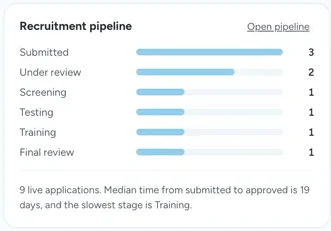
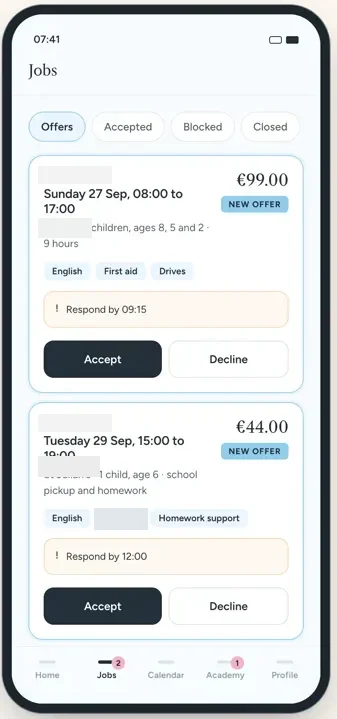
One platform with an office command centre, a nanny portal and a parent booking app. See the problem, what we built and how it works.
A few straight answers
Custom CRM projects by Malta Digital start from €7,500. The final price depends on the number of users, your workflows, the integrations and how much data needs moving. Ready-made CRM software has its own monthly fees, paid directly to the provider.
A basic setup configures existing software with a standard pipeline. A custom CRM includes mapping your process, designing and building the system around it, connecting your tools, moving your data, testing with your staff, training and support. You pay for a system that fits your business, instead of a team that works around one.
If a ready-made CRM fits how you sell, start there, and we will tell you so. A custom CRM makes sense when you need many workarounds, keep a spreadsheet next to the CRM, or need it connected tightly to bookings, quotes, invoices or a customer portal.
We start right away: a focused CRM has its first working version in 2–4 weeks, and bigger systems are live within 2–3 months at most. Larger systems are launched in phases, so your team uses the first part while the rest is built. You get a timeline with the quotation.
Usually, yes. We move customers, contacts and history from spreadsheets, an older CRM, email or exports. We check the format and quality first, remove duplicates, map every field and check the result against the source before you switch over.
Yes, through the WhatsApp Business Platform and an approved provider, conversations and follow-ups can be linked to the right customer. The free WhatsApp Business app has limits, so we confirm what is possible for your number before it goes into the proposal.
Yes. Lead ad forms can send each new lead to the CRM as it arrives, where it is assigned to a person and followed up. Because we also run Facebook and Instagram ads, we set up the form, the CRM and the follow-up together.
Website forms, Facebook and Instagram lead ads, the WhatsApp Business Platform, Gmail or Microsoft 365, calendars, booking systems and accounting or invoicing tools that offer a connection. We confirm each integration, its access and its limits before it goes into the proposal.
Security and GDPR are part of the scope: EU hosting, access by role, consent fields, backups, and tools to export or delete a person’s data on request. Your data protection decisions stay yours. We build the system to support them. See the IDPC guidance for organisations.
That is the main reason we build around the way your team already works. Each user group gets hands-on training and short guides, and we check in after go-live to fix anything that slows people down.
We stay on. Support covers fixes, help for your team and small changes, and an agreed support plan covers ongoing improvements, such as new automations, reports or connections.
Custom software is an eligible cost under Digitalise your SME, and the guidance names CRM among enterprise systems. Grants run from €25,000 to €120,000 plus a 7% flat rate, at up to 50% of eligible costs in Malta and 60% in Gozo. The funding body decides eligibility. Read our Digitalise your SME guide and the AI grant guide.
Everything from first map to a trained team: mapping your process, a prototype, the build, moving your data, and connections to website forms, Facebook and Instagram lead ads, WhatsApp, email and accounting. Roles, reports, staff training and support after launch are included. Custom CRM projects start from €7,500.
Ready-made software suits a fairly standard sales process. A custom CRM suits you when the tools need too many workarounds or cannot connect to your other systems. If ready-made software is enough, we will tell you.
Yes, when WhatsApp is connected through the official WhatsApp Business Platform. A WhatsApp chatbot can answer, book and save each chat to the customer’s record, with a clear way to reach a person.
Yes. We can help set up ready-made CRM software, import your data and connect your forms. We only suggest a custom CRM when it fits better.
There is no single best one. A small team with a simple process usually does well with ready-made CRM software that handles WhatsApp and lead ads. If your process has its own steps, bookings or a customer portal, a custom CRM fits better. The quiz on this page gives a first answer in two minutes.
Take the price per user per month, multiply it by your number of users and by 36 months, then add setup, data import, add-ons and WhatsApp messaging fees. Compare that total, not the monthly price. Our free CRM cost calculator does the sum for you, including new hires and price rises. Custom CRM projects with us start from €7,500.
It depends on your team. A small team with a standard process usually pays less on a subscription. A growing team, or one losing hours to workarounds, often pays less with a custom CRM within two to three years, because there is no per-user fee. Check your own numbers with our CRM cost calculator.
Yes. We set up ready-made CRM software and build custom CRM systems for single teams and for companies with several departments, branches or brands. Larger projects start with a mapping stage and are delivered in phases, each with a fixed quotation. See our guide to CRM for large companies.
In most cases, yes. We map every field, run test imports on a copy, compare record counts and totals against the old system and agree a cut-over date with you. Our guide to CRM data migration explains each step.
Yes. We can sign an NDA before you share details of your process, and a data processing agreement before any personal data is moved.
Through a support plan agreed before the build. It sets out how issues are reported, the response time for each priority level, your named contact and how changes are priced.
You do. You own every line of code we build for you, and the CRM is hosted where you want it. Ownership, scope, price and support are agreed in writing before work starts.
A ready-made CRM is rented: the vendor bills a fee per user every month, and setup is a separate project. That suits a standard sales process. Malta Digital’s custom CRM starts from €7,500, with a first working version in 2–4 weeks, no per-user licence fee, and you own the code.
The usual first set: every new enquiry from a form, lead ad or WhatsApp gets an owner by rule, the customer gets a first reply within minutes, a reminder fires if nobody replies within a day, open quotes get follow-ups on day three and day seven, and every deal closes as won or lost with a reason. Weekly reports arrive without anyone copying data.
According to Eurostat, 39.8% of Malta enterprises with 10 or more staff used CRM software in 2025, against 28.5% across the EU. In 2023 the Malta figure was 39.2%, so about six in ten Malta firms of that size still work without one.
CRM guides
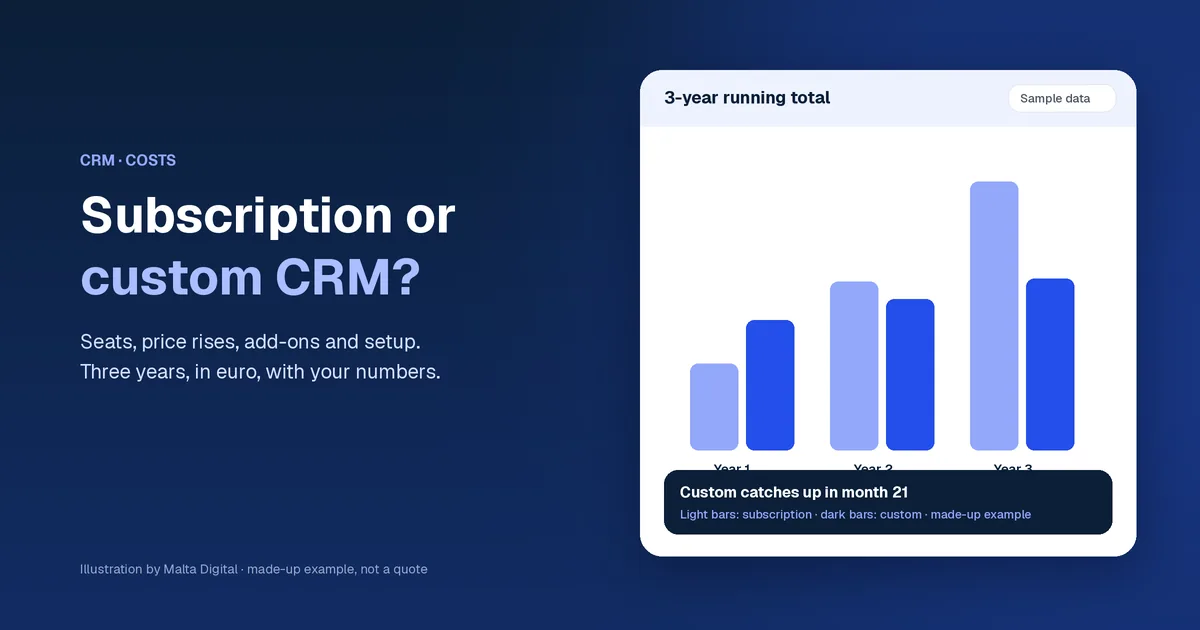
Subscription or custom CRM over three or five years, with seats, price rises and workaround hours.
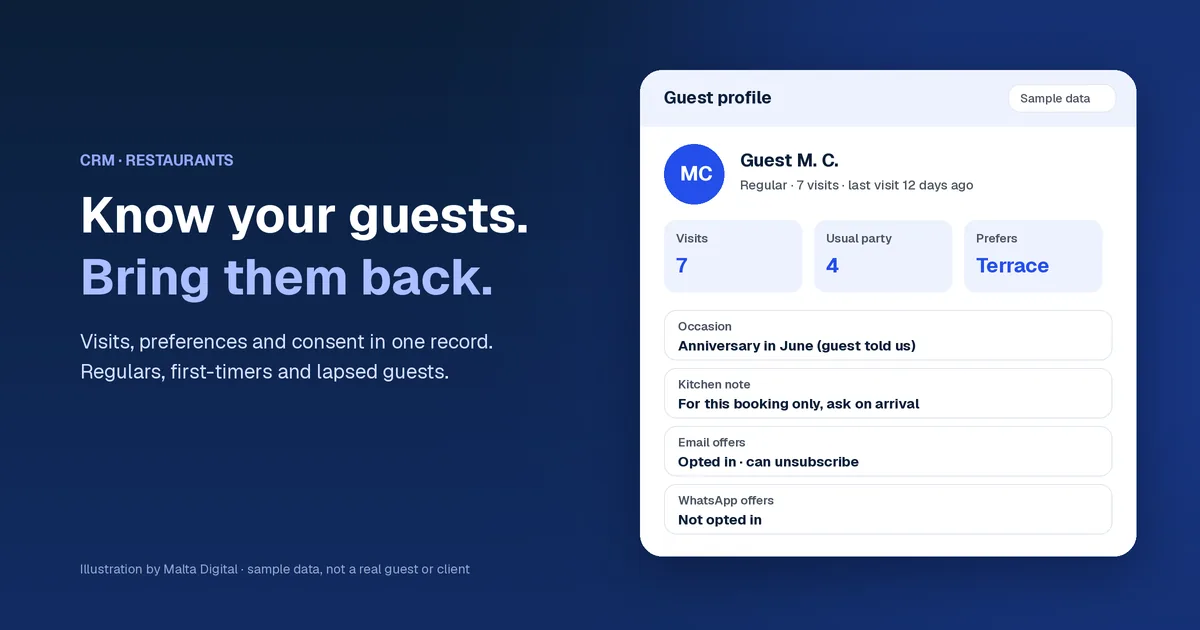
Guest profiles, regulars and lapsed guests, consent rules and a free win-back calculator.
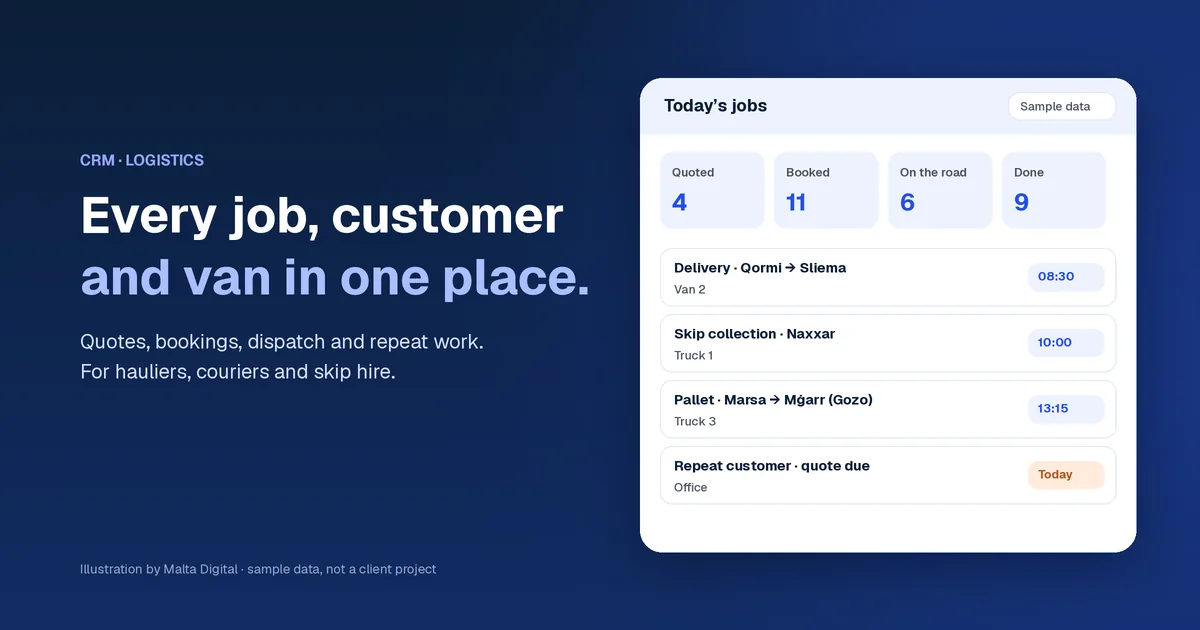
Quotes, jobs, dispatch, proof and repeat orders for hauliers, couriers and skip hire, with Malta data.
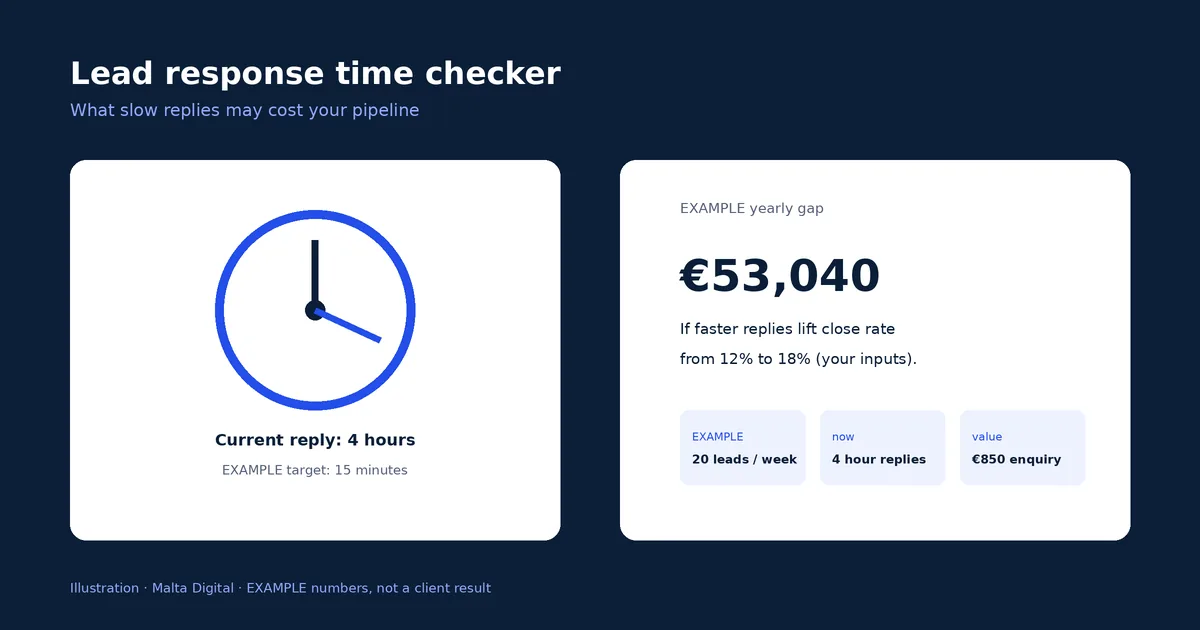
Type your own reply time and weekly enquiries. See late replies, overnight waits and an example cost.
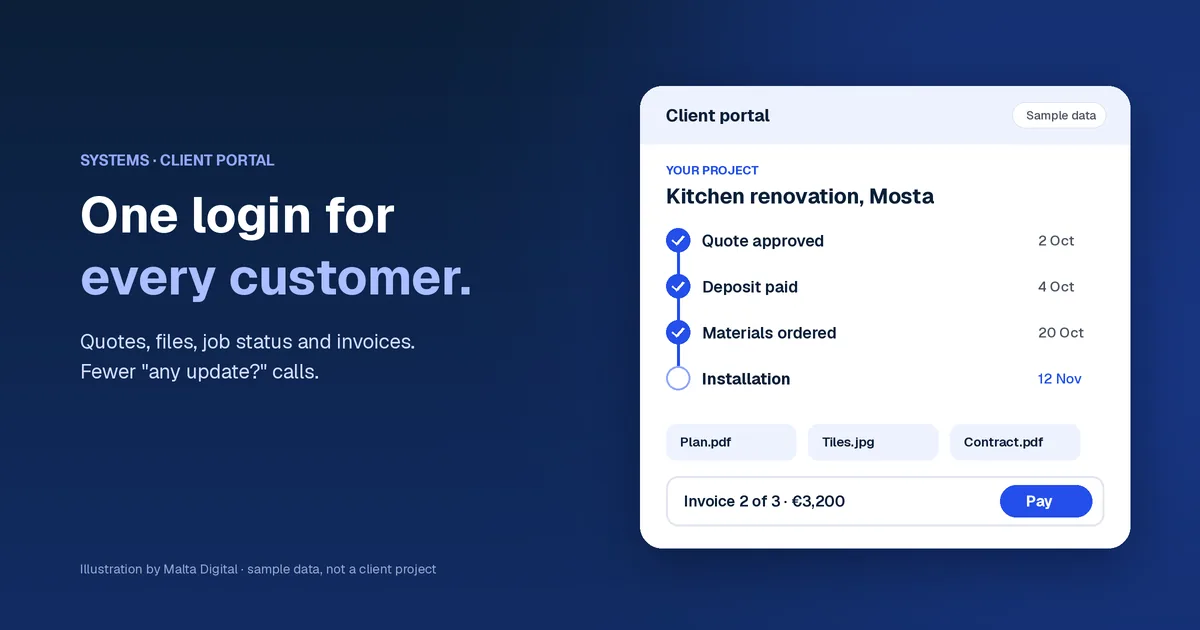
Let customers approve quotes, share files, see status and pay invoices from one login, with a free time-cost calculator.
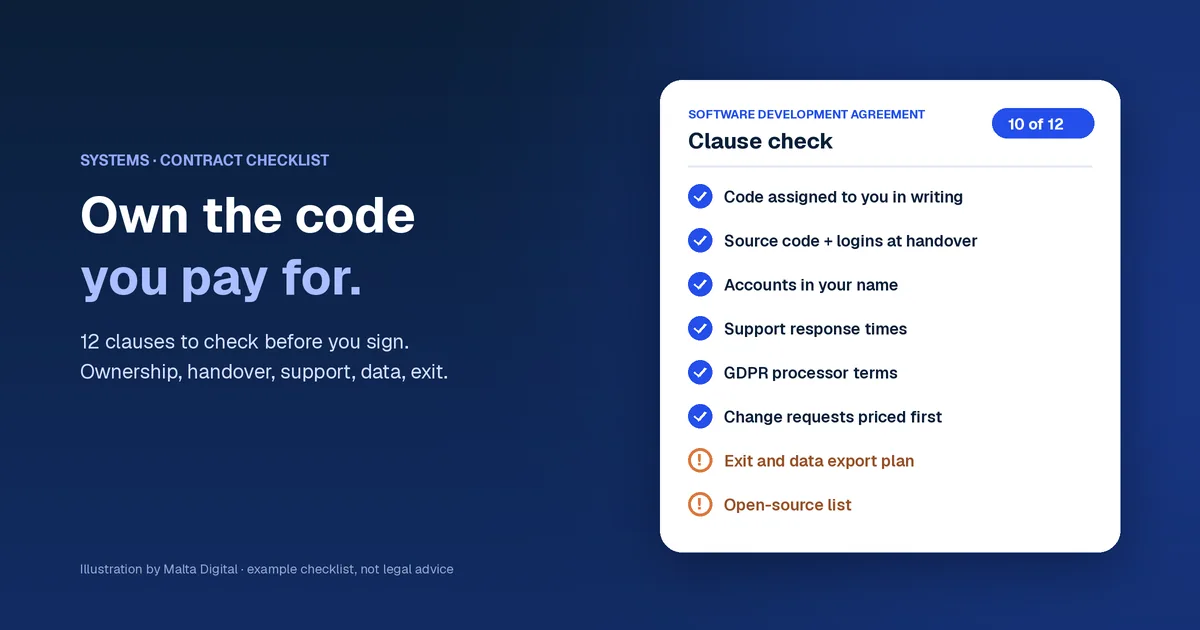
The 12 clauses to check before a custom CRM build: code ownership, handover, support, GDPR and exit.
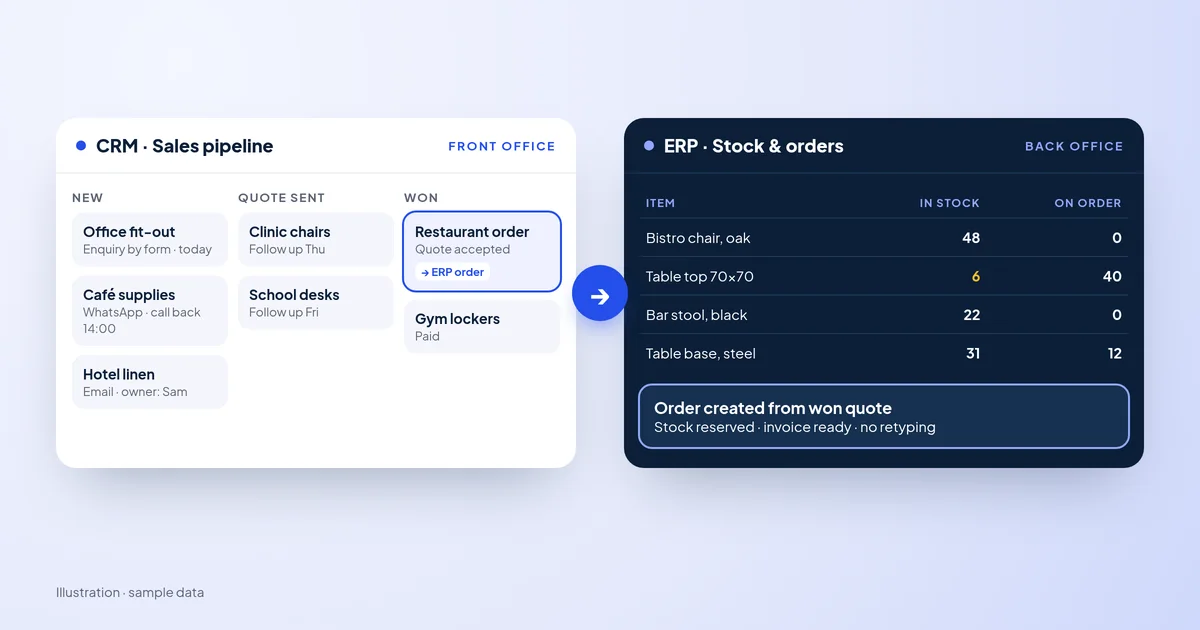
What each one does, Malta’s 2025 Eurostat figures and a quick check to see which you need first.
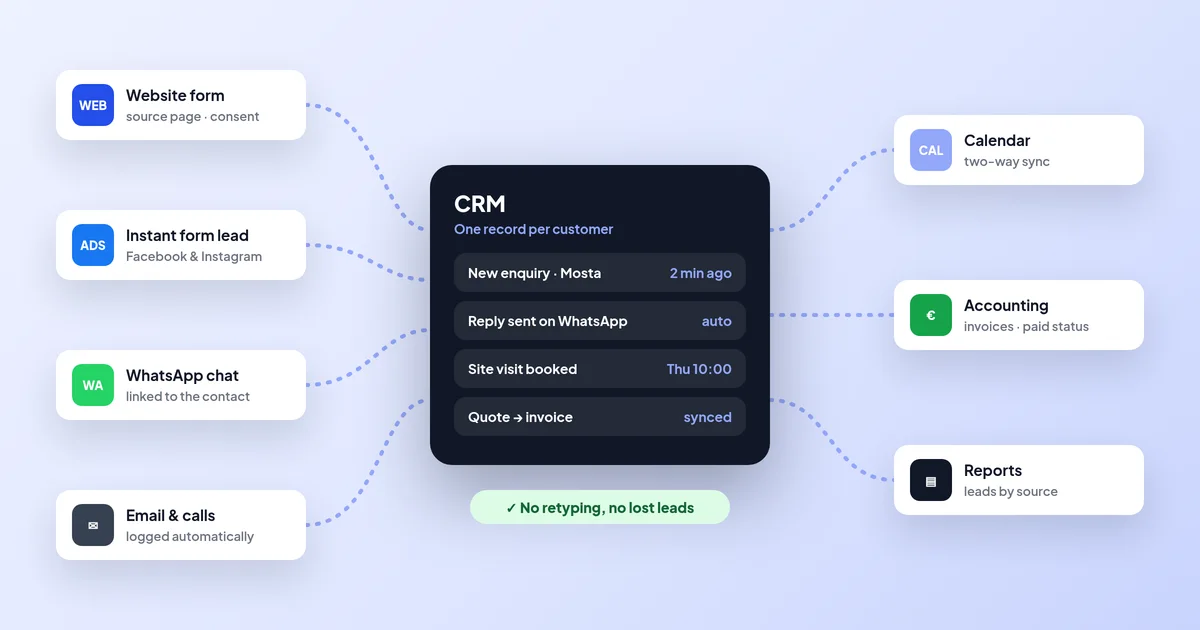
Website forms, Facebook lead ads, WhatsApp, calls, calendar and accounting connected to one record.
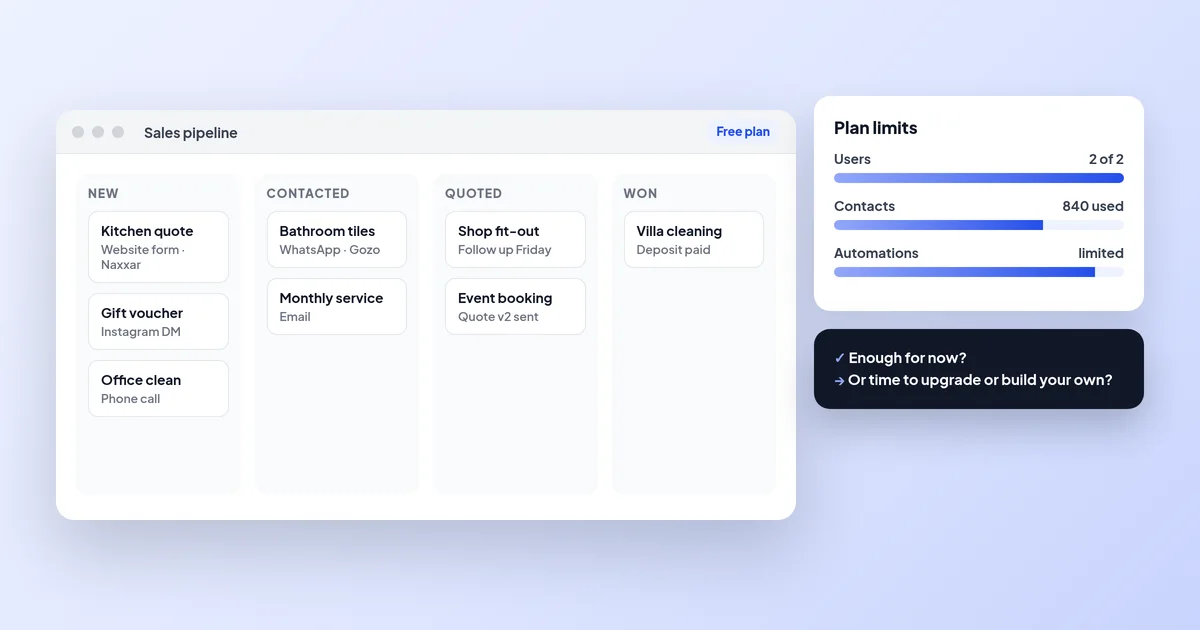
What free plans include, the limits to check, a one-week setup and when to move on.

Enquiries, site visits, quote versions, stage payments, subcontractors and aftercare in one system.
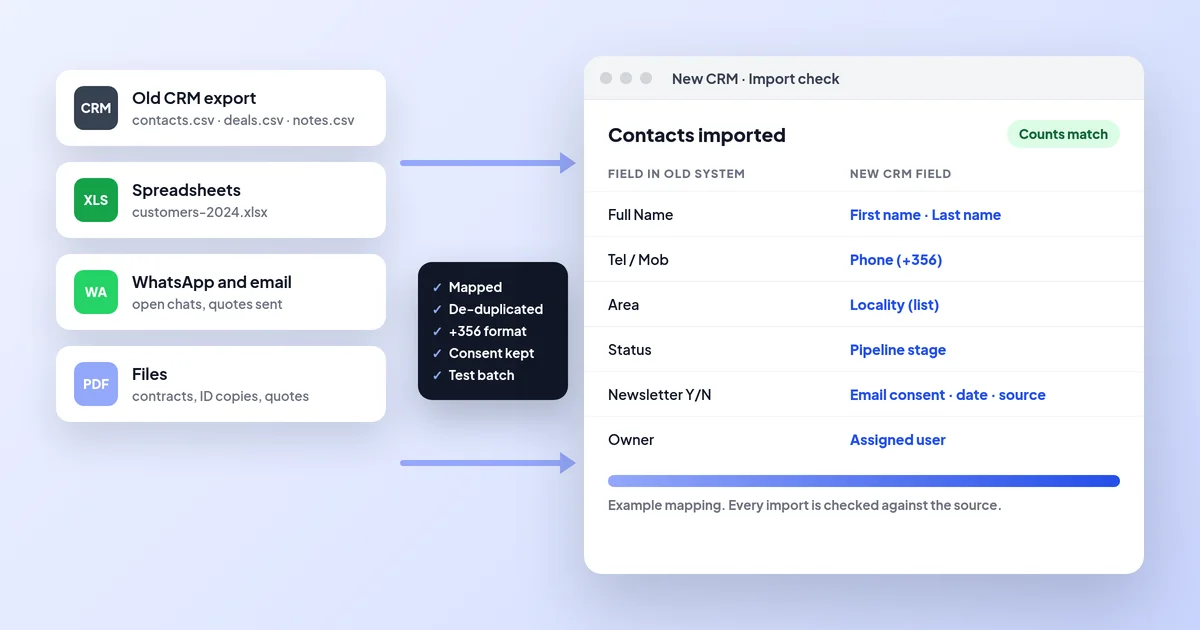
Moving from an old CRM or spreadsheets: mapping, clean-up, test imports and a safe cutover.
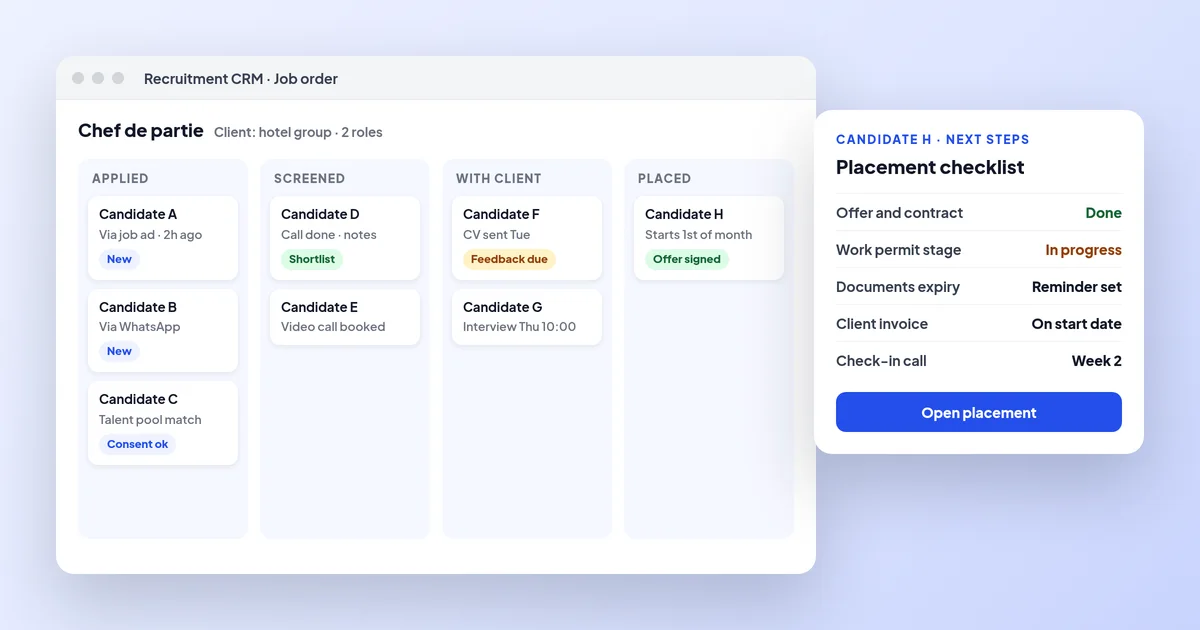
Candidates, clients and job orders, placements, permit stages and document dates.
Lawful basis, marketing consent, EU hosting, roles, retention and data requests, as CRM settings.

Leads, buyer matching, viewings, konvenju dates, lettings and FIAU checks in one system.
Enquiries, treatment plans, recalls and reviews, with health data protected.

Subscriptions, setup, data and running costs explained, and what sets the price of a custom CRM.

When a spreadsheet is enough, the signs it has stopped working and how to move without losing data.

A fair comparison for small businesses in Malta: free plans, WhatsApp, EU hosting and fit.

Answer 8 quick questions and see whether a ready-made CRM, setup help or a custom CRM fits, and why.
Estimate what missed enquiries and manual admin cost you each month.

From choosing a CRM to GDPR, data import, WhatsApp and lead ads, launch and funding.

What a CRM does, the signs you need one, ready-made vs custom, and GDPR basics in Malta.

How to compare cost, fit, risk and ownership, and when a mix of both makes most sense.

Reply to every enquiry in minutes, follow up on a schedule that stops when they book, and use AI only where it helps.

The free app, the WhatsApp Business Platform, templates, opt-in and connecting to your CRM.

Quotes from your price list in minutes, follow-ups on open quotes, invoices on acceptance, payment reminders, VAT and e-invoicing.

Form setup, follow-up and judging cost per customer, not just cost per lead.
Sources
Start with your customers
You explain how customers reach you today. We’ll show you what a CRM should do for your team, and what it would take to build it.