What is a CRM?
What a CRM does day to day, the signs you need one, free vs ready-made vs custom, what to connect, and GDPR basics in Malta.
Systems & automation · CRM
Both are business software, but they fix different problems. Here is what each one does, how Malta businesses use them, and a quick check to see which you need first.
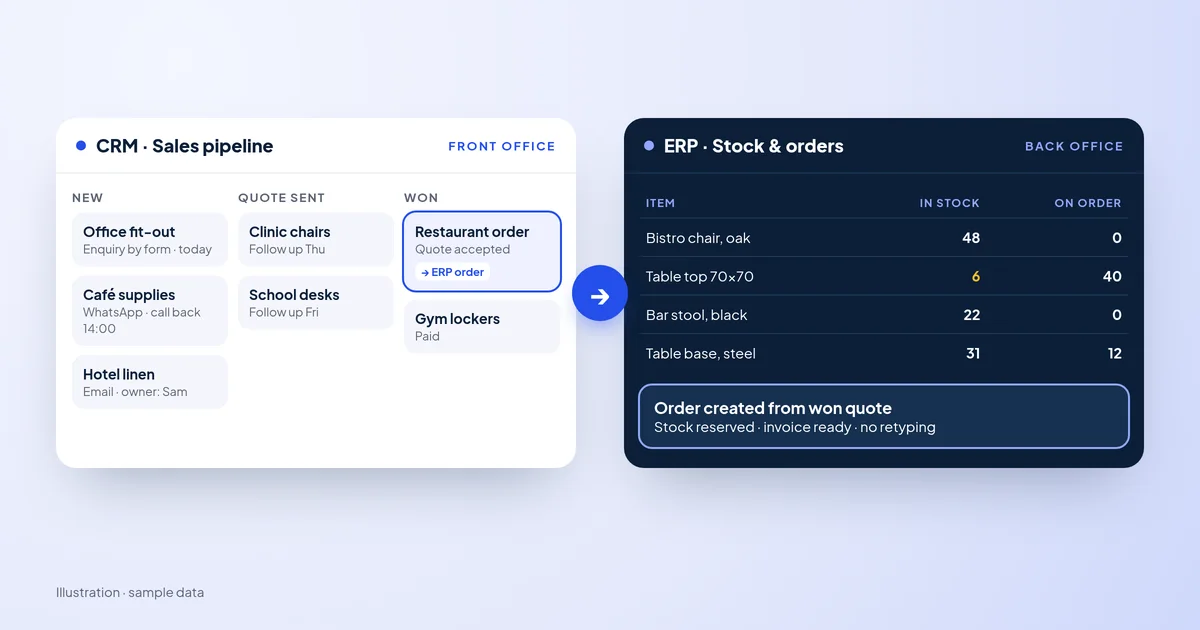
A CRM manages customers and sales: enquiries, quotes and follow-ups. An ERP manages the back office: stock, orders, buying and finance. Most service businesses need a CRM first; businesses that hold stock often need an ERP. Malta Digital builds custom CRM systems in Malta and connects them to ERP and accounting tools.
Plain words
Think of a business as two halves. The front office wins and keeps customers. The back office delivers, counts and gets paid.
A CRM (customer relationship management) runs the front office. Every enquiry lands in one place. Each one has an owner, a next step and a date. Nobody has to remember who said what. Our guide what is a CRM explains it from scratch.
An ERP (enterprise resource planning) runs the back office. It tracks products, stock, orders, suppliers and invoices in one system. When a sale happens, stock goes down and the invoice is ready, without retyping.
| CRM | ERP | |
|---|---|---|
| What it manages | Customers and sales | Stock, orders, buying and finance |
| Main question it answers | Who should we call, and what did we promise? | What do we have, what do we owe, what did we make? |
| Who uses it most | Sales, front desk, account managers | Office, warehouse, accounts, managers |
| Typical records | Enquiries, contacts, quotes, follow-ups | Products, stock levels, orders, invoices, suppliers |
| What it usually replaces | Inbox searching, notebooks, a contacts spreadsheet | Stock sheets, retyped orders, separate tools that do not talk |
| Usual first trigger | Leads go cold or get lost | Stock is wrong, or orders get typed twice |
| Project size | Smaller, faster to start | Bigger, touches more of the business |
Malta in numbers
We pulled the latest figures from Eurostat on 3 November 2026. They cover 2025 and businesses with 10 or more staff, outside finance.
| Software | Malta, 10+ staff | EU, 10+ staff | Malta, 10–49 staff | EU, 10–49 staff |
|---|---|---|---|---|
| ERP | 46.3% | 46.5% | 39.2% | 41.1% |
| CRM | 39.8% | 28.5% | 35.5% | 24.7% |
| Business intelligence | 24.4% | 16.3% | 19.5% | 11.5% |
| Any of these | 58.4% | 53.5% | 52.0% | 48.3% |
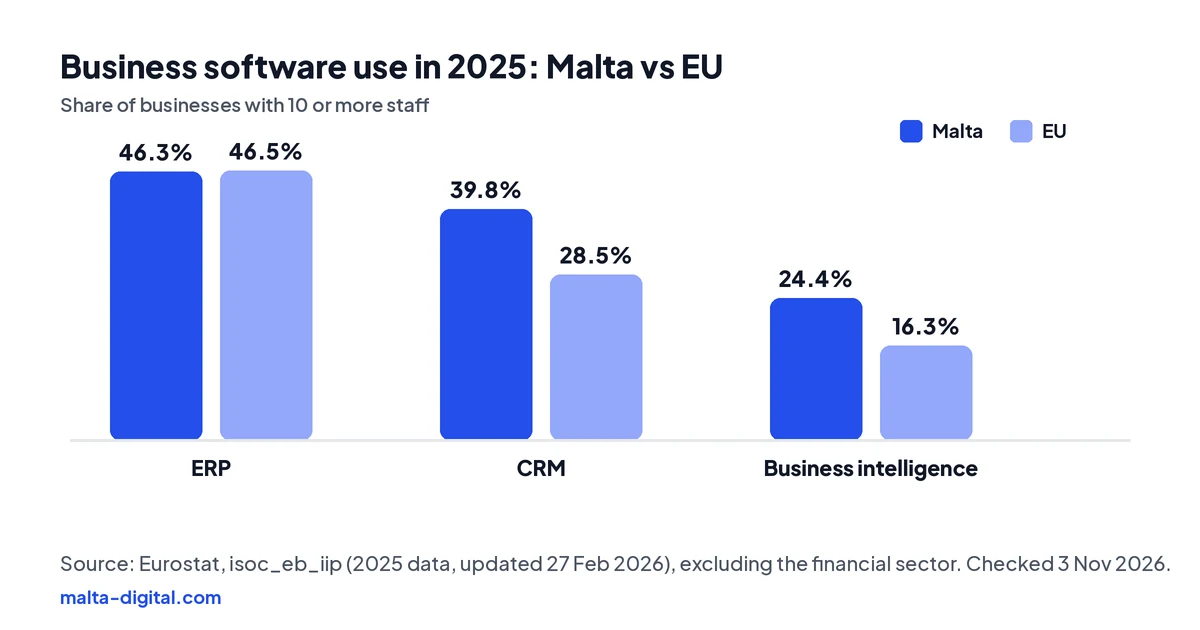
Two things stand out. Malta businesses use CRM far more than the EU average: almost four in ten, against under three in ten. ERP use is about the same as the EU. And among smaller firms with 10 to 49 staff, CRM is nearly as common as ERP.
The figures leave out businesses with fewer than 10 staff, which is most of Malta. For them, the question is usually simpler: which one problem costs the most today?
CRM first
Start with a CRM if these sound familiar:
This is the most common case for service businesses: clinics, salons, trades, agencies and schools. They sell time and skill, not stock. Not sure which CRM fits? Try our CRM quiz. Want to know if it pays? Use the CRM ROI calculator.
Losing track of enquiries? Apply now for a CRM
ERP first
Start with an ERP, or accounting plus stock tools, if these sound familiar:
This is common for importers, wholesalers, shops, catering suppliers and manufacturers. A full ERP is a bigger project. A small team may be fine with good accounting software and a stock add-on first.
Quick check
Answer six yes-or-no questions. The check shows where your pain is and what to fix first. It runs on your device and sends nothing.
Tap yes or no. The answer updates on your device. Nothing is sent anywhere.
1. Do enquiries ever get lost, forgotten or answered late?
2. Do you send quotes, or sell again to the same customers?
3. Do you hold stock, or buy goods to resell?
4. Are orders, stock or invoices typed into more than one place?
5. Do you run more than one site, shop or warehouse?
6. Are fewer than 10 people working in the business?
This check needs JavaScript. By hand: questions 1 and 2 point to a CRM. Questions 3, 4 and 5 point to an ERP.
Both
Many growing businesses need both. The risk is two systems that do not talk, so staff retype orders. The fix is to connect them, or use one system that does both.
When we connect a CRM to an ERP or accounting system, we agree three things first:
Our guide to CRM integration goes deeper. Before you start, run through the CRM setup checklist.
Apply now and tell us how enquiries, orders and invoices flow today. We’ll tell you honestly which one to fix first, or whether you need either yet.
Ready-made or custom
There are good ready-made ERP and CRM packages. They suit businesses whose way of working matches the package. You pay a monthly fee per user and adapt to the software.
Custom makes sense when your process is what makes you different. Or when a package would need so many add-ons that it gets slow and costly. A common mix is a custom CRM on top of a ready-made accounting system. Compare both in custom software vs off-the-shelf, and see the price ranges in custom software cost in Malta and how much a CRM costs.
Grants
The Digitalise your SME Guidance Notes, read today, name ERP and CRM as enterprise systems. The grant covers up to 50% of eligible costs, or 60% in Gozo, for grants of €25,000 to €120,000 plus 7%. Ready-made and custom software can both count. For subscription software, two years of fees count.
Micro Invest can also help with smaller projects, as a tax credit. See our grant guide for the rules and dates.
Proof
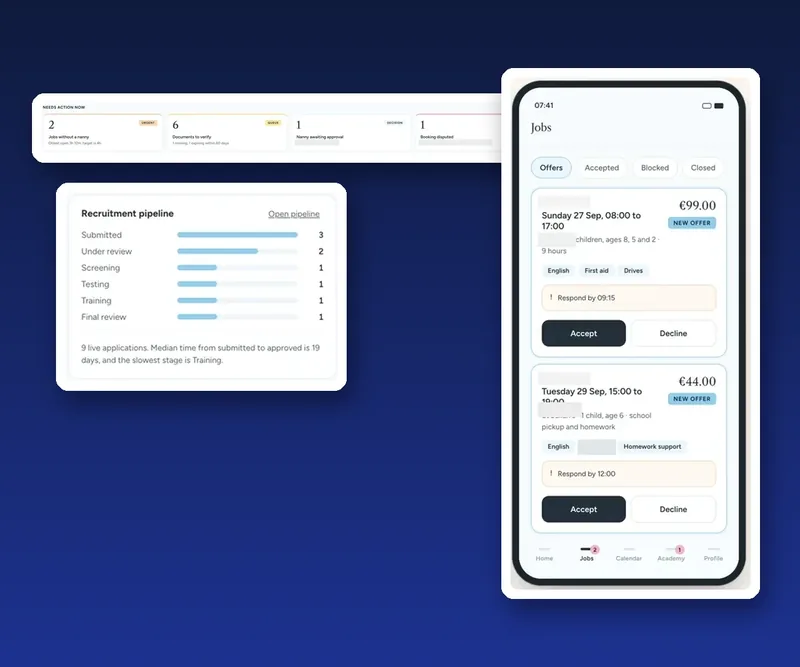
One agency we built for ran its work across messages, spreadsheets and email. Nothing showed the office what needed attention first. That is a front-office problem, so the answer was CRM-style: one record per customer.
We built one platform with three parts: a command centre for the office, a portal for nannies and a booking app for parents. Every booking, nanny and parent now has one record. It is a new system, so the case study shows what we built and how it works, not results.
Want one record for every customer? Apply now for a CRM
Next step
We start by mapping how work flows today, from first enquiry to paid invoice. That shows which half hurts most. Then we build the CRM, connect it to your accounts or ERP, and show you a prototype before the full build.
Custom systems start from €7,500. See our CRM service, our business systems service and our case studies.
A few straight answers
A CRM manages customers and sales: enquiries, quotes and follow-ups. An ERP manages the back office: stock, orders, buying and finance.
Most service businesses need a CRM first, because their pain is lost enquiries and slow follow-up. Businesses that hold stock often need an ERP, or accounting with stock tools, first.
Yes. Connect them so each customer has one ID and a won quote becomes an order once, automatically. Or use one system that does both.
In 2025, 39.8% of Malta businesses with 10 or more staff used CRM software, against 28.5% across the EU, according to Eurostat.
No. In 2025, 39.2% of Malta firms with 10 to 49 staff used ERP software, according to Eurostat. Very small teams often start with accounting software instead.
Often, yes. Digitalise your SME names ERP and CRM as enterprise systems and covers up to 50% of eligible costs, or 60% in Gozo.
Yes. We build custom CRM and business systems and connect them to the accounting or ERP tools you already use. Systems start from €7,500.
Keep reading
What a CRM does day to day, the signs you need one, free vs ready-made vs custom, what to connect, and GDPR basics in Malta.
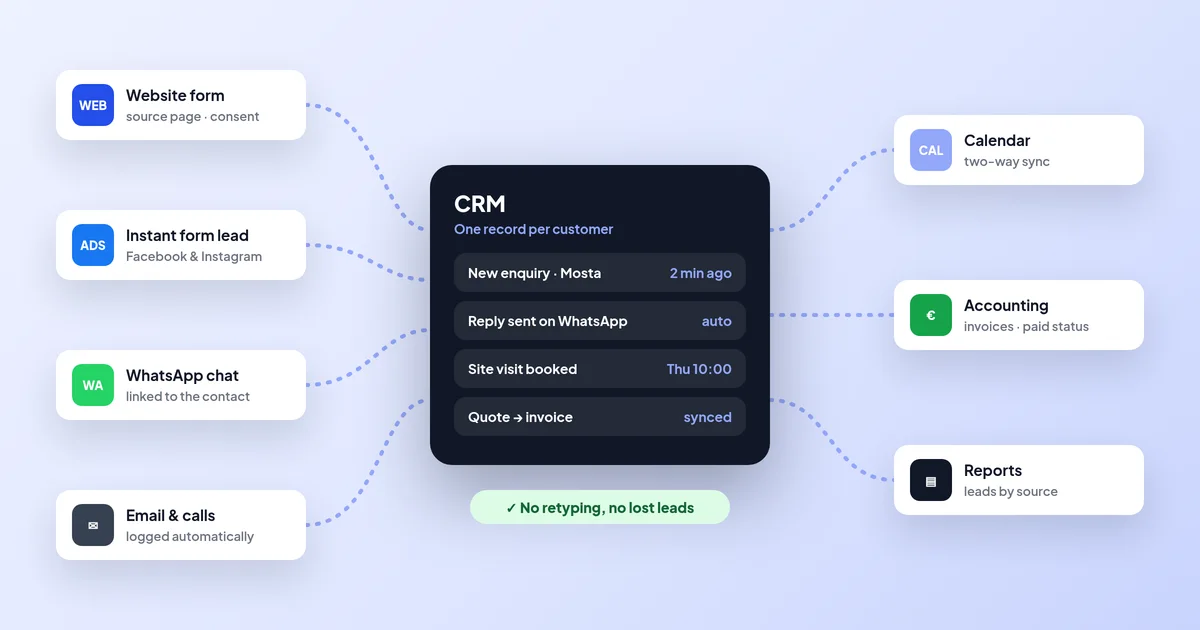
Connect website forms, Facebook lead ads, WhatsApp, calls, calendar and accounting to your CRM: native, connector or custom, and what breaks.
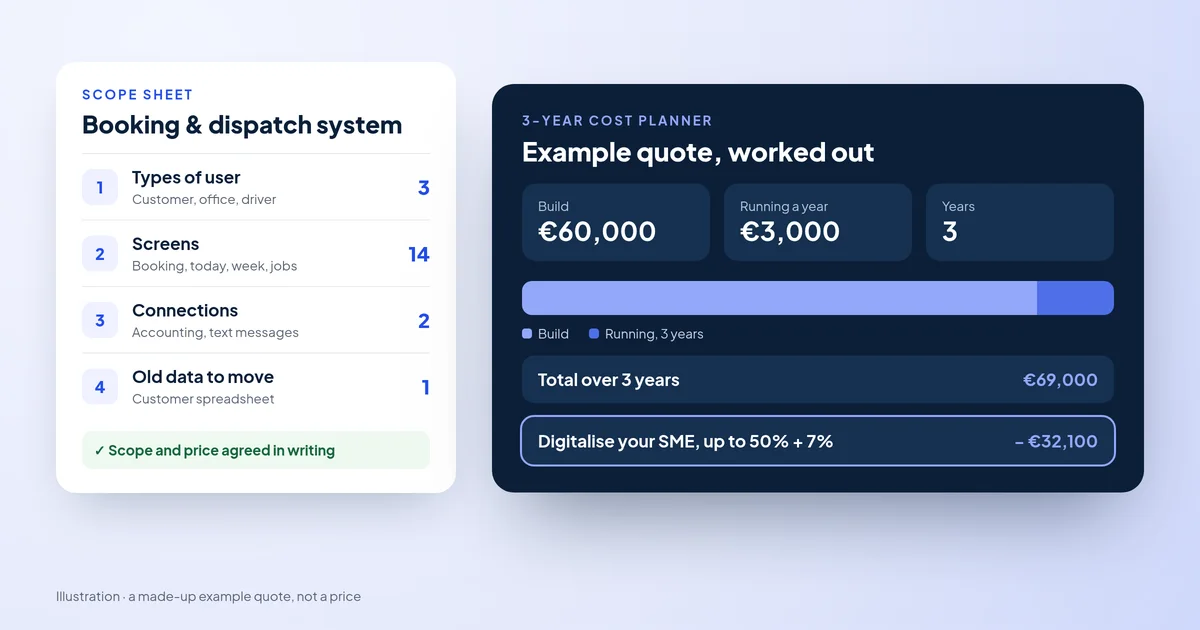
What moves the price, the running costs, the grant maths and a free planner for your own quote.
A useful first step
We build custom CRM and business systems and connect them to the accounting or ERP tools you already use. Custom systems from €7,500.
Step 1 of 3
A few quick questions, about a minute. We usually reply within 2–3 hours.