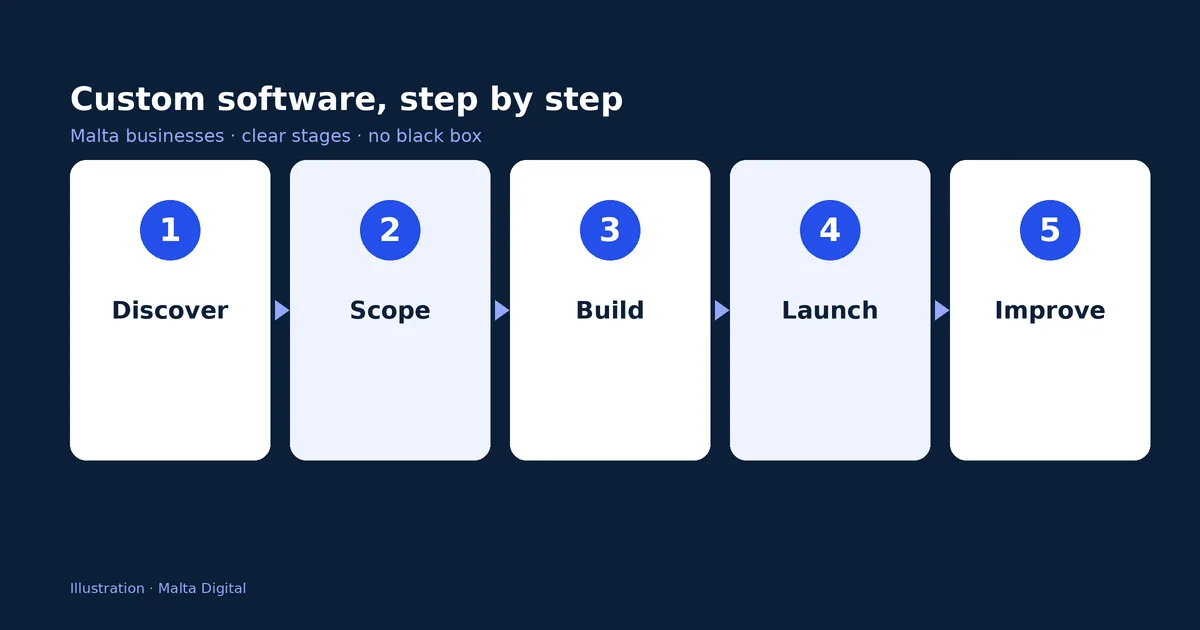
Custom software development process
Discover, scope, build in slices, launch and improve.
Systems & automation · Contracts
In Malta, the contract decides who owns software you pay someone else to build. This checklist covers the 12 clauses that matter: ownership, handover, scope, payments, support, data and exit. Malta Digital clients own every line of code we build for them.
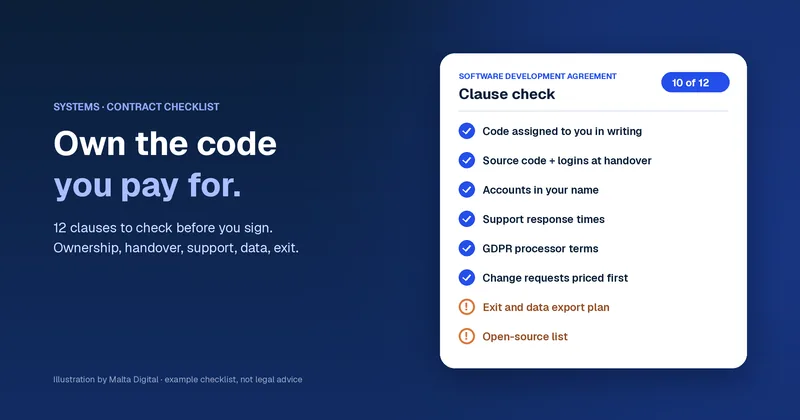
Before you sign, make sure the contract assigns the code to you in writing and lists what you get at handover. It should also set support times and prices, include GDPR processor terms and explain how you can leave. At Malta Digital, you own every line of code we build for you; see business systems in Malta.
The problem
Many owners assume that paying for software means owning it. In Malta, that is not automatic. The Copyright Act says copyright starts with the author. There is one exception for computer programs. If your own employee writes the code as part of their job, the economic rights pass to you as the employer.
An outside developer is not your employee. So the contract has to do the work. The same Act, at Article 24(4), says an assignment of copyright, or a licence, has no effect unless it is made by an agreement in writing. A handshake and a paid invoice are not enough. You can read both articles in the Copyright Act, Chapter 415 of the Laws of Malta (legislation.mt).
Example sceneA Gozo tour operator pays for a booking system. Two years later, it wants a new developer to add features. The old supplier says the code is theirs, and the contract only gave a licence to use it. This is a made-up example, but it shows why the wording matters.
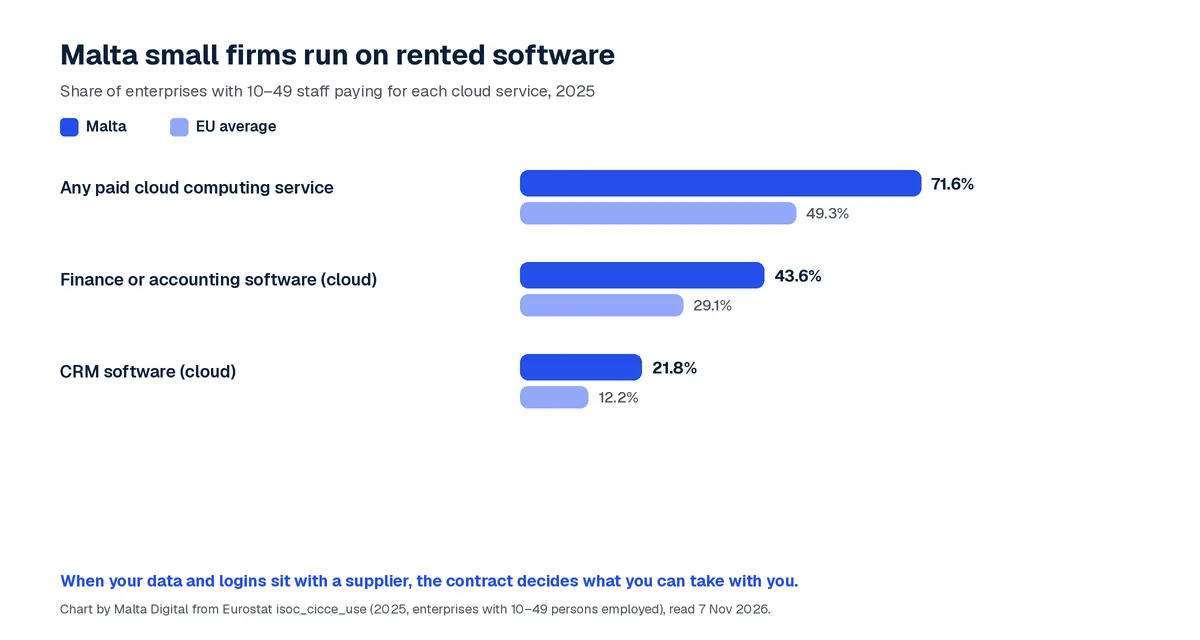
This matters more in Malta than in most of Europe. In 2025, 71.6% of Malta businesses with 10 to 49 staff paid for cloud services, against 49.3% across the EU. 43.6% rented their finance or accounting software, and 21.8% their CRM. When your data and logins sit with a supplier, the contract decides what you can take with you.
This page is a checklist, not legal advice. Use it to ask better questions, then have a lawyer read the final draft. For the wider choice of what to build, see business systems in Malta.
The checklist
A fair contract answers six questions. Who owns it? What do I get at the end? What exactly is being built? When do I pay? Who fixes problems? And how do I leave with my data?
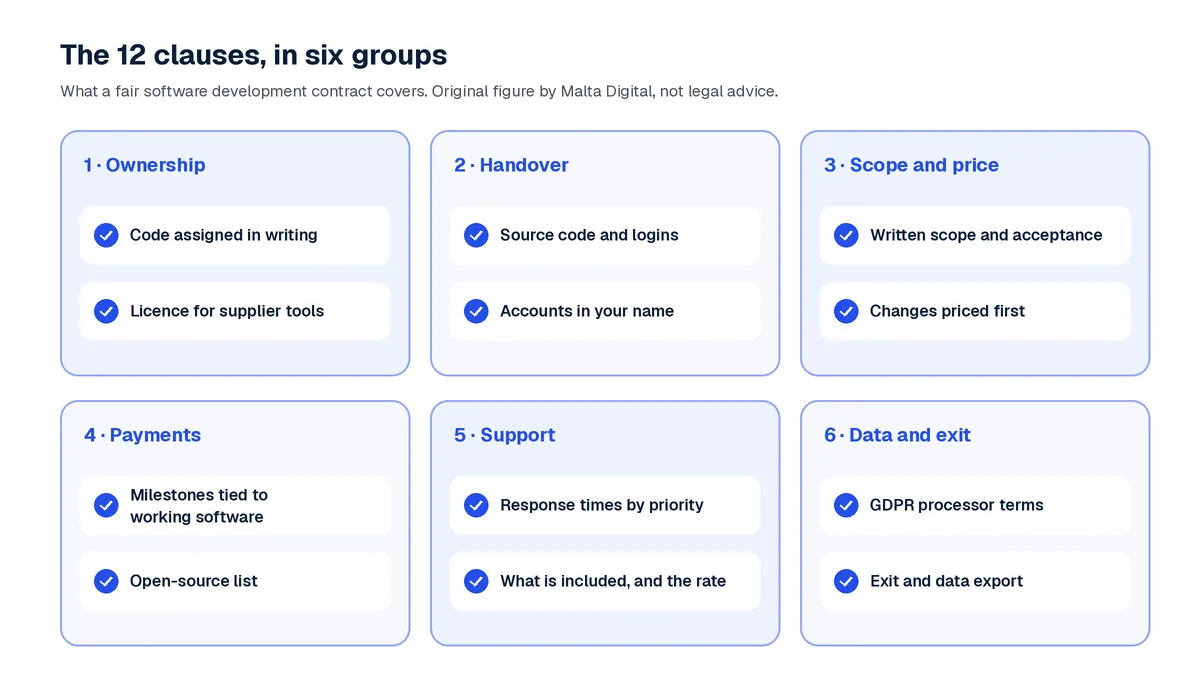
| Clause | What good looks like | Red flag |
|---|---|---|
| Ownership | Code, designs, database and documents assigned to you in writing | “The client may use the software”, which is only a licence |
| Supplier tools | A permanent licence for any reused tools inside your system | The licence ends when support ends |
| Handover | Source code, admin logins and set-up notes delivered | “Code available on request” |
| Accounts | Domain, hosting and app store accounts in your name | Everything registered to the supplier |
| Scope | Screens, rules and sign-off tests written down | Scope lives in emails and chats |
| Payments | Each payment follows a working part you can test | Most of the price paid before any screens |
| Support | Response times by priority and a clear monthly price | “Best efforts” with no times |
| Data and exit | GDPR processor terms and a data export plan | No word on deletion or leaving |
Free tool
Open your draft contract or proposal. Tick each clause it already covers. Every line you leave unticked becomes a plain question to send your developer. You can copy them all in one tap.
Tick what your draft contract already says. Worked out on your device. Nothing is sent anywhere.
This checker needs JavaScript. Without it, use the list as a plain checklist. Every unticked line is a question to ask before you sign.
Do not panic about gaps. Most drafts miss two or three lines, usually the open-source list and the exit plan. A good supplier will add them without a fight. If a supplier refuses to put ownership in writing, that tells you something too.
Apply now and tell us what you want to build. We put scope, price, ownership and support in writing before any work starts.
The law
Malta’s rules follow the EU Directive 2009/24/EC on the legal protection of computer programs (EUR-Lex). It protects computer programs as literary works. Only the code’s expression is protected, not the ideas behind it. So nobody owns the idea of a booking calendar. They can own the code that runs yours.
The directive also gives every lawful user some rights a contract cannot remove. You can make a back-up copy where you need it to use the program. You can observe and test how it works. Without other terms in the contract, you may also fix errors so the program works for its purpose.
Those are floors, not a full plan. They do not give you the source code, the logins or the right to hire a new developer to change the system. Only the contract does that. That is why the first clause on this list is ownership in writing.
Running it
Support is where many contracts go vague. Ask for response times by priority. An urgent issue, like checkout or bookings failing, needs a reply within hours. A minor label change can wait for the next update. Ask what the monthly fee includes, such as hosting, updates and small fixes. Then ask the hourly or daily rate for anything else.
Data needs its own clause. If the supplier hosts your system, it handles personal data for you. Under GDPR, Regulation (EU) 2016/679, Article 28 (EUR-Lex), that needs a written contract. It must cover your instructions, confidentiality, security, any sub-processors, help with data requests, and deleting or returning the data when the service ends.
Finally, plan the exit on day one. The EU Data Act has applied since 12 September 2025. One aim is to make it easier for customers to switch between cloud providers. Read the European Commission: the Data Act summary. Your contract should still say, in plain words, how and in what format you get your data back.
Proof
Clear contracts start with a clear scope. For a skip hire and waste business, the scope named three views: customer, office and driver. It listed a seven-step mobile booking flow, a skip size helper, daily delivery and collection slots, and a one-tap driver update.
With a list like that, sign-off is simple. Each part either works or it does not. The system is now being rolled out, so there are no results to share yet. The screens below use sample data.
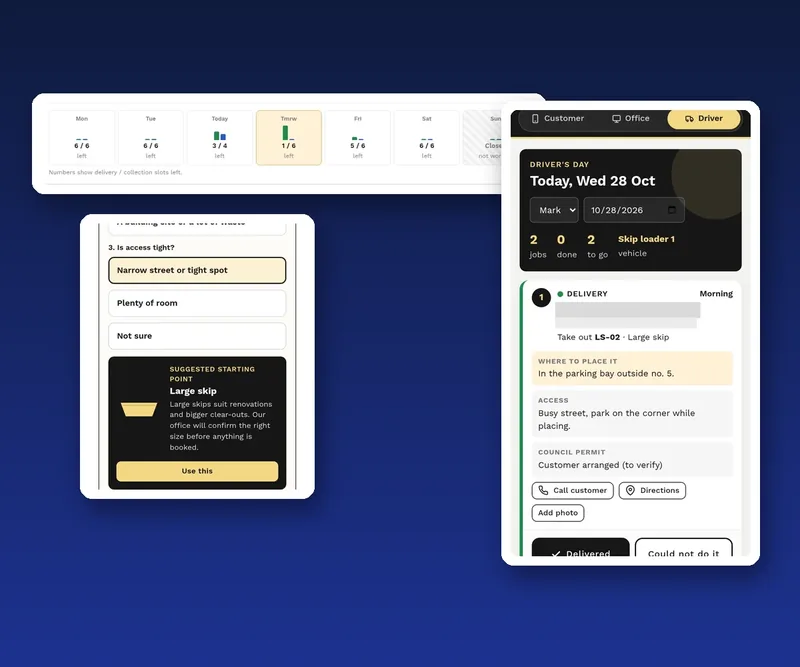
Want a written scope like this before you pay for anything? Apply now for a custom system
How we do it
| Common route | How Malta Digital does it | |
|---|---|---|
| Ownership | A licence, or ownership only after the last payment | You own every line of code we build for you |
| Start | Weeks of meetings before work starts | We start as soon as the first payment is made |
| First screens | After months of build | First working version in 2–4 weeks |
| Bigger systems | Open-ended timelines | Live within 2–3 months at most |
| Hosting | The supplier’s choice | Where you want it hosted |
| Leaving | Unclear, and sometimes costly | Code, documents and logins handed over |
We put scope, price, ownership and support in writing before work starts. The only waiting is for government payouts, if you use a grant. On 7 November 2026, fondi.eu listed Digitalise your SME grant cut-offs of 13 November, 30 November and 14 December 2026.
If your project is a CRM, our which CRM is right for me quiz and CRM ROI calculator help you size it first. Then the CRM setup checklist keeps the launch on track. We handle the build and the paperwork, so you can relax.
Want a contract you can read in ten minutes? Apply now for a custom system
A few straight answers
Under Malta’s Copyright Act, copyright starts with the author. The automatic transfer to an employer covers employees only. An outside developer keeps the copyright unless it is assigned in writing.
No. A right to use is a licence. Ownership needs a written assignment of copyright. Article 24(4) of the Copyright Act says an assignment has no effect unless it is in writing.
Yes. Ask for the full source code, admin logins and set-up notes. Without them, you cannot move to another developer or fix problems yourself.
Background IP means tools the developer had before your project and reuses in it. They often keep ownership of those tools. Ask for a permanent licence so your system keeps working.
Response times by priority, what the monthly fee covers, the rate for extra work, and who pays for hosting and outside licences.
Yes, if the developer hosts or handles personal data for you. GDPR Article 28 requires a written processor contract covering instructions, security, sub-processors and deletion.
Yes. You own every line of code we build for you. We put scope, price, ownership and support in writing before work starts.
Sources
Keep reading
Discover, scope, build in slices, launch and improve.
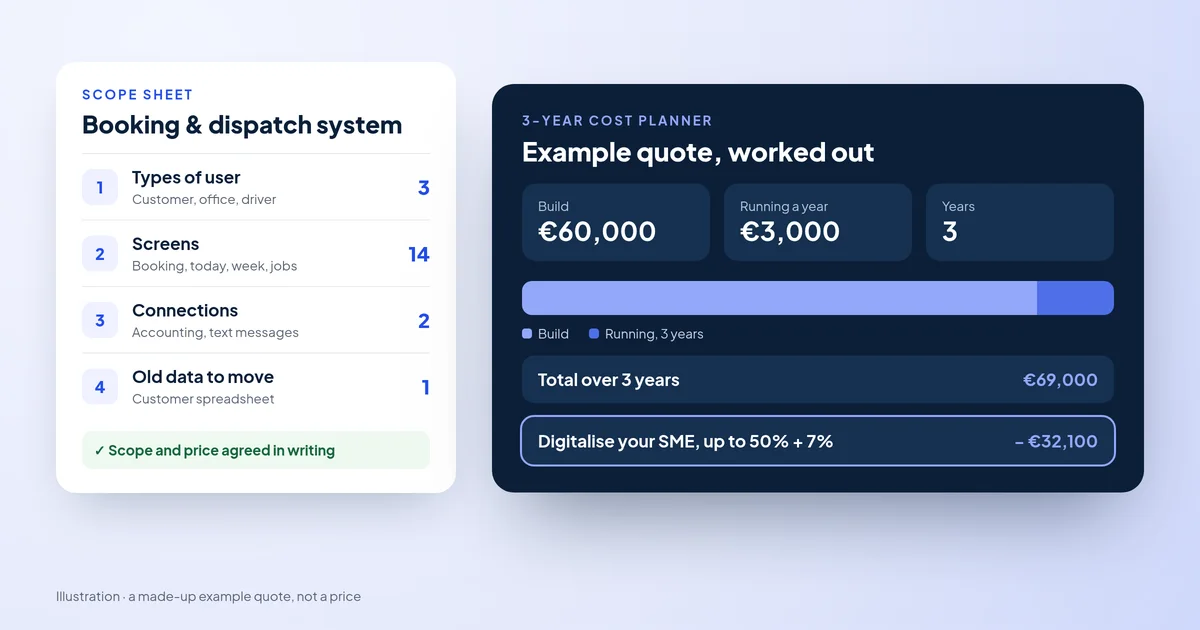
What drives the price, running costs and grant co-funding.
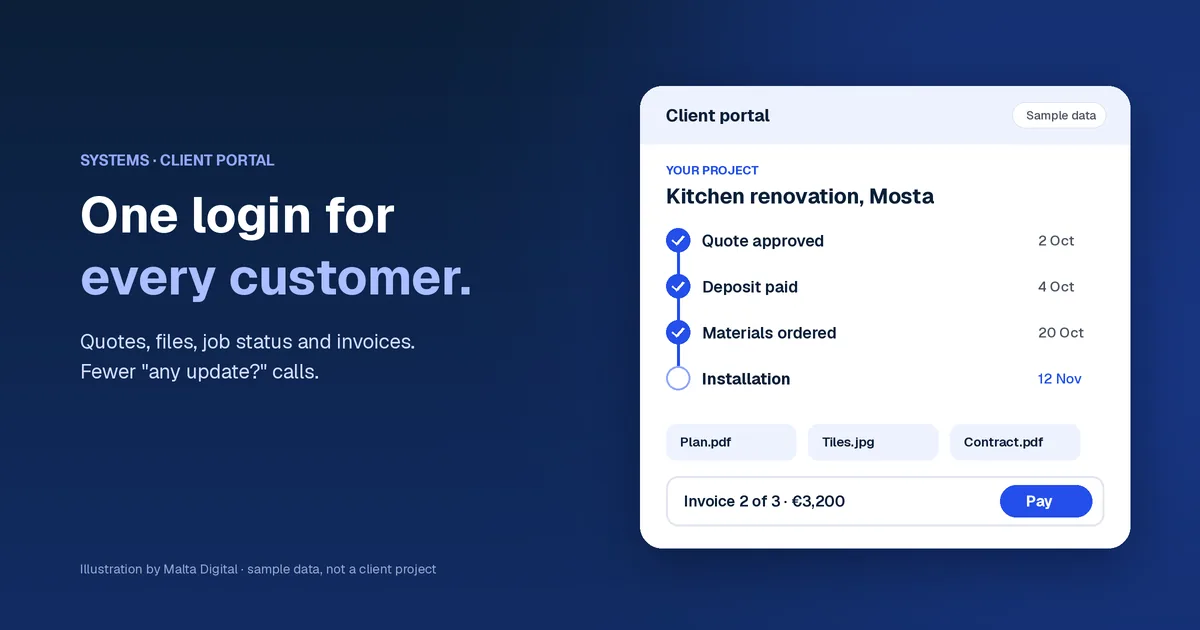
Quotes, files, status and invoices in one customer login.
A useful first step
Describe the workflow, who uses it and which tools you already pay for. We reply with a clear next step, in writing.
Step 1 of 3
A few quick questions, about a minute. We usually reply within 2–3 hours.