
Facebook ads for real estate in Malta
The four property audiences, ad formats, housing ad rules and a simple 90-day plan.
Systems & automation · Real estate CRM
A CRM for real estate agents in Malta keeps buyers, tenants, owners and properties in one system and links them together. Every enquiry from a portal, your website, a Facebook or Instagram lead form, WhatsApp or a signboard call lands in one list with an owner and a reply time. Buyer requirements are matched to new listings, viewings and feedback are logged, and each sale is tracked from offer to konvenju to final deed, with the deadlines in between. It also handles lettings and keeps a record of who did the due diligence on each client. This guide shows what to look for and when custom is worth it.

New listing · 3 matches
Maisonette, finished
Budget fits · Locality fitsNot yet sent to buyerSend by WhatsAppA real estate CRM links buyers and tenants, properties and owners. For agencies in Malta it should catch every portal, website, lead ad and WhatsApp enquiry, match buyer requirements to new listings, log viewings and feedback, track each sale from offer to konvenju to deed and handle lettings and FIAU due diligence. Malta Digital sets up ready-made tools or builds custom CRMs for agencies.
The short answer
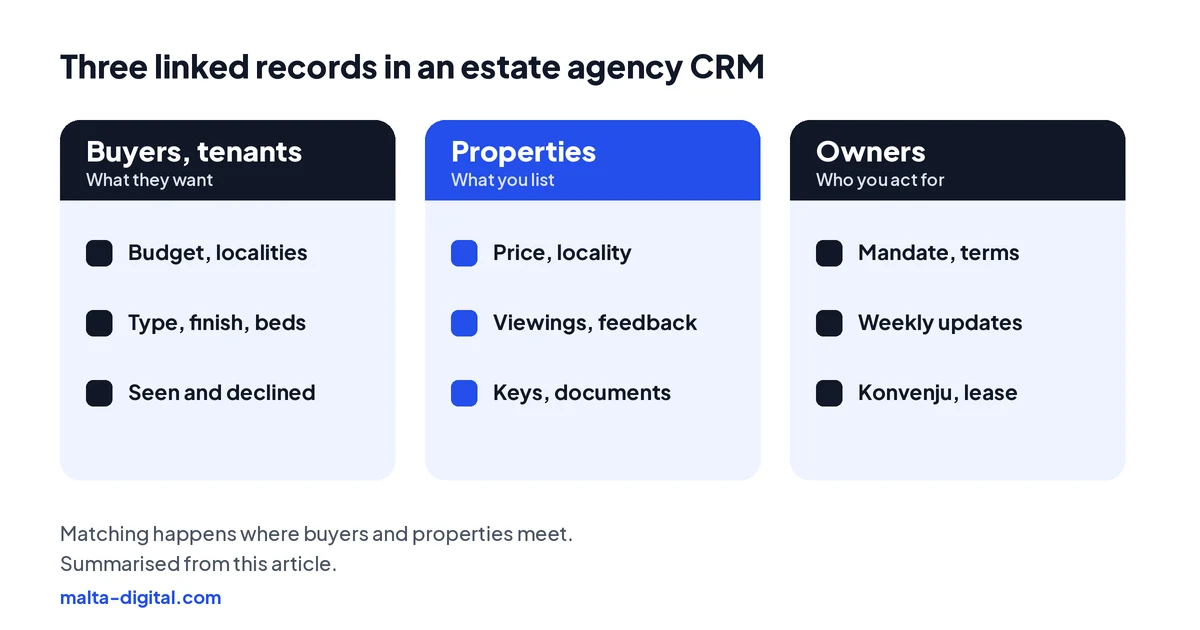
A standard CRM is built around one thing: a contact moving through a sales pipeline. Estate agency work has two sides that meet in the middle. On one side are people: buyers, tenants, owners selling and landlords letting. On the other are properties, each with a price, a locality, a finish and a history of viewings. The value of a real estate CRM is in the links: which buyers fit this new listing, which properties this buyer has already seen and turned down, which owner needs an update this week.
Malta makes this matter more. The market is small, the same buyer often registers with several agencies, and the same property is often listed by more than one. The agency that replies first, remembers what the buyer actually wants and calls back with the right property is usually the one that closes. That depends on memory, and memory does not scale past a few consultants without a system.
The mistake is forcing a generic sales pipeline onto property work, with no property records and requirements written as free text. It works for a month, then nobody can search it.
Leads
Property enquiries in Malta arrive everywhere at once: property portals, your own website, Facebook and Instagram lead forms, WhatsApp chats started from a listing, calls from a signboard, walk-ins and referrals from past clients. The first job of a CRM is to catch all of them in one place, with the source and the property reference attached, and give each one an owner, usually by locality, by language or in turn.
Speed is the next job. A reply template that goes out within minutes, by WhatsApp or email, with the consultant’s name and a link to book a viewing, keeps the buyer talking to you rather than the next agency on the list. If the consultant has not called within an agreed time, the CRM reminds them and then their manager.
The quiet problem in many agencies is personal phones. When enquiries live in a consultant’s own WhatsApp, the buyer leaves with the consultant. Connecting WhatsApp to the CRM, or at least logging every chat against the contact, keeps the relationship with the agency. Our guide to Facebook ads for real estate in Malta covers the ads and lead forms that feed this list.
Matching
Matching only works if requirements are stored as fields, not notes. For a buyer or tenant, that means: buy or rent, budget range, localities (Sliema and St Julian’s, the north around Mellieħa, the south, Gozo), property type (apartment, maisonette, penthouse, townhouse, house of character), bedrooms, finish (shell, semi-finished or finished), must-haves such as a lift, a garage, outside space or sea views, the move-in date and whether finance is arranged.
With those fields in place, the CRM can do the work consultants never have time for. When a new listing goes in, it shows every active buyer who fits. When a price drops, it lists the people who were just above the old price. When a buyer has been quiet for a month, it suggests what has come onto the market since. You send the shortlist by WhatsApp or email, and the CRM records what was sent, so nobody sends the same property twice.
“Wants something nice up north, not too expensive” is the free-text requirement we see most often. It cannot be searched, matched or handed over. Five minutes on proper fields at the first call saves hours later.
Viewings
Viewings are where the time goes. A CRM puts them on each consultant’s calendar, sends the buyer a confirmation and a reminder with the address and a map link, and tells the owner or tenant in occupation when to expect you. If your agency holds keys, a simple key log against each property saves the morning phone calls asking who has them.
After each viewing, the consultant logs the buyer’s feedback in a few taps: interested, wants a second viewing, too small, price too high. That feedback does two jobs. It updates the buyer’s requirements, and it builds the owner report. Owners selling in Malta want to know what is happening; a weekly summary of viewings and feedback, produced from the CRM rather than typed up, keeps them with you and makes the conversation about price easier when it is needed.
Sales pipeline
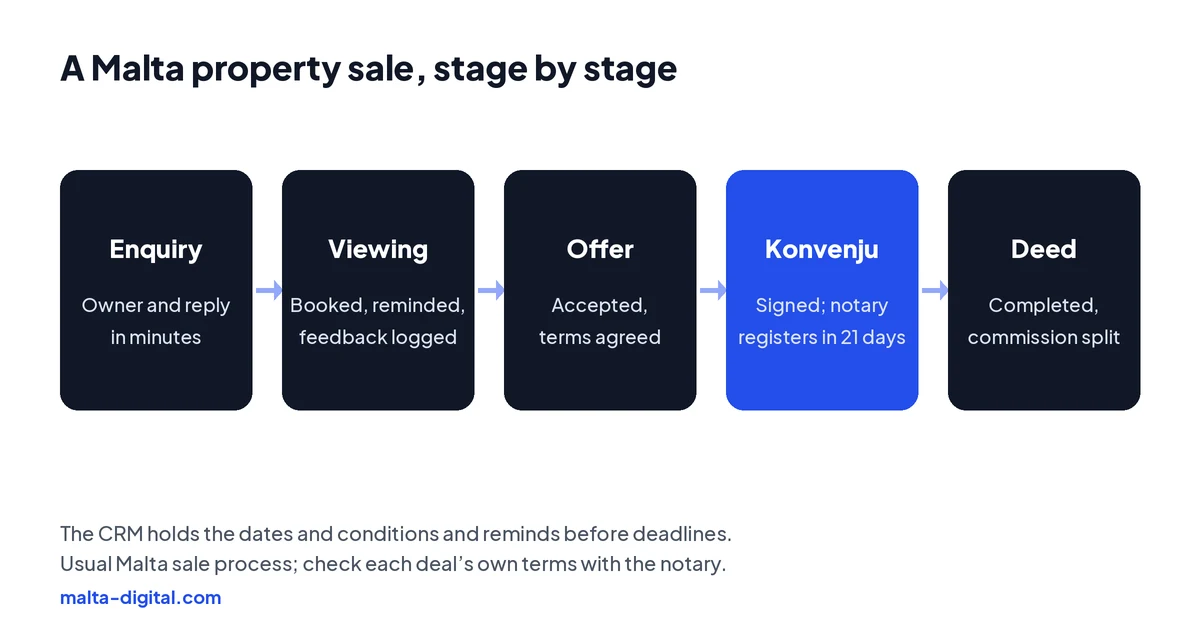
A Maltese property sale has its own stages, and a CRM should use them. An offer is made and accepted. The promise of sale, the konvenju, is signed, usually with a deposit, a validity period written into it and conditions such as the buyer’s bank loan or a permit. The notary must register the konvenju with the tax authorities within 21 days of signing, with a provisional payment of duty. Searches and finance follow, and the sale completes on the final deed.
Each of those stages has dates that matter, and missing one is expensive. A CRM can hold the konvenju date, its expiry, the conditions and who is responsible for each, and remind the consultant well before the deadline. It can store the documents, show every deal at each stage on one board, and calculate the commission and any split between consultants or branches when the deed is signed.
The common mistake is tracking deals in a spreadsheet updated on Friday afternoons. It shows where deals were last week, not which one has a konvenju expiring on Tuesday.
Lettings
Lettings work differently from sales and deserve their own pipeline. Tenant requirements are similar to a buyer’s, with move-in date, pets and maximum rent at the top. Once a let is agreed, the dates take over. Under the Private Residential Leases Act (Cap. 604), private residential leases must be registered with the Housing Authority within 30 days of the start of the lease; the obligation is the landlord’s, and many agencies help with it. The law also expects an inventory, which can be photographs with captions.
A CRM can turn each lease into a set of reminders: registration, the end of the term, notice periods agreed in the contract and renewals. Malta’s rental market has a lot of movement, with many tenants staying a year or two, so a good tenant who moves out today is often your next applicant, or your next buyer. Keep the history and ask them first.
Apply now and tell us how many consultants you have and how enquiries, viewings and deals are tracked today. We’ll tell you which route fits your agency, or message us on WhatsApp.
Compliance
Since the Property Market Agency Act (Cap. 644), every real estate agent, property broker, branch manager and property consultant in Malta needs a licence from the Property Market Agency. A CRM will not do that for you, but it does keep a clear record of which licensed person handled each client and each deal, which is what you need if a question ever comes up.
Estate agents are also subject persons under Malta’s anti-money-laundering rules. The FIAU’s guidance says that when an agent brokers a deal, both the buyer and the vendor count as customers for due diligence, and lettings are covered where the monthly rent is €10,000 or more. A CRM can hold the due diligence status and risk rating for each customer, remind you before a deal moves forward without it, and keep identity documents in a restricted area that only the people responsible can open. It supports your procedures; it does not replace them or your compliance officer.
Then there is customer data. Buyers’ budgets, finances and ID copies are sensitive, so use personal logins, roles and EU hosting, and send listings by WhatsApp or email only to people who asked for them. Our guide to CRM and GDPR in Malta covers the settings in detail.
Ready-made or custom
There are three routes. Ready-made estate agency platforms, including some built for Malta, come with property records, matching and website feeds out of the box; they suit agencies whose process fits the product. General CRMs such as HubSpot, Zoho or Pipedrive are strong on contacts and pipelines but need custom objects or add-ons for properties and matching. A custom CRM is built around your agency: your stages, your commission rules, your website and portals, sales and lettings in one place.
Custom is worth it when you have several branches or teams with different steps, sales, lettings and property management in one business, your own website that should update from the CRM, or rules the ready-made tools cannot follow. It is not worth it for a single agent with a handful of listings. At Malta Digital, custom CRM systems start from €7,500, excluding VAT, and our CRM quiz gives a quick, honest first answer.
| Estate agency software | General CRM | Custom CRM | |
|---|---|---|---|
| Best for | Agencies whose process fits the product | Small teams that sell more than they list | Several branches, sales and lettings, own website or rules |
| Property records and matching | Built in | Needs custom objects or add-ons | Built around your fields |
| Konvenju and lease dates | Depends on the product | Set up as custom stages and tasks | Built in, with your reminders |
| Watch out for | Data export and what you can change | Paying per user as the team grows | A rushed scope; skipping mapping and testing |
Proof
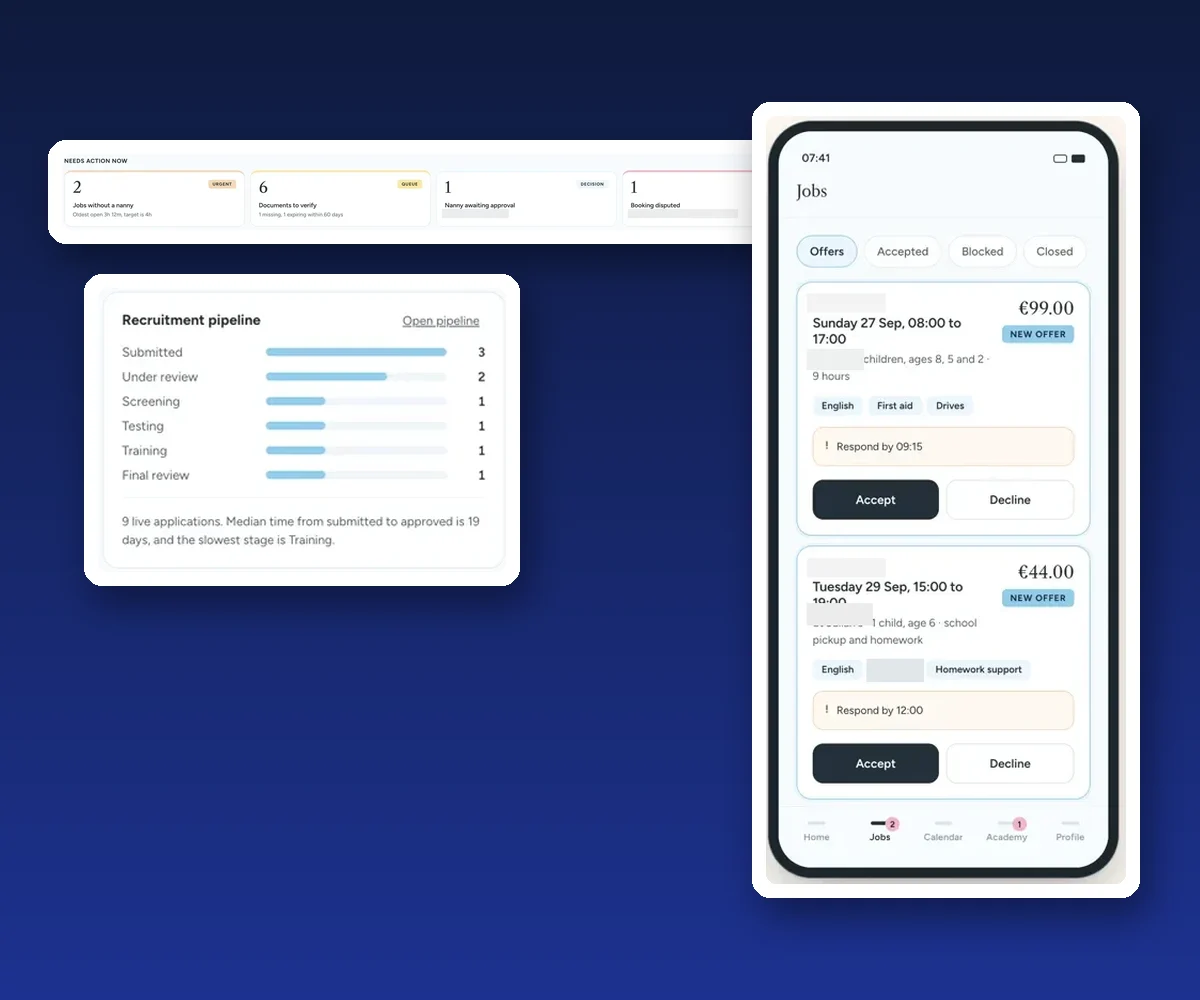
Our clearest example is from a different industry, with the same building blocks. A childcare and nanny agency had bookings, applications, documents and payments spread across messages, spreadsheets and email. We built one platform with a command centre for the office that opens on what needs action now, a pipeline for applicants and a phone app where people accept offers. Swap nannies for properties and families for buyers, and the structure is close to what an estate agency needs: two sides matched, every step tracked, each person seeing only their part.
It is a new system, so we do not publish results or usage figures for it. The case study shows what we built and how the parts connect.
Want a CRM that matches buyers to your listings automatically? Message us on WhatsApp
How we do it
We start with a session with your consultants and your office, not just the owner, to map how enquiries, viewings, offers and lettings really run today. We then propose the route that fits: setting up a ready-made tool, or a custom system with your record types, stages, matching rules and reports. Everything is written down, with a price and a timeline, before work starts.
The build follows the map. We import your contacts and listings from spreadsheets or your old software and check them against the source, connect your website forms, lead ads and WhatsApp, set roles for consultants and managers, and train the team on real deals. See the CRM page for what is included.
A few straight answers
The one that fits how your agency works. Small agencies often do well with ready-made estate agency software; agencies with several branches, sales and lettings, or their own website and rules often need a custom CRM. Take the free CRM quiz for a quick first answer.
Yes, if buyer requirements are stored as fields: budget, localities, type, bedrooms, finish and must-haves. The CRM then lists matching buyers for every new listing or price drop.
Yes. Lettings need their own pipeline, with tenant requirements, lease dates, the 30-day registration with the Housing Authority and renewal reminders.
Yes. It can store the signing date, validity period, conditions and the 21-day registration, and remind the consultant well before each deadline.
It can record each customer’s due diligence status and risk rating, remind you before a deal moves forward without it and restrict access to ID documents. It supports your AML procedures but does not replace them.
Yes. The aim is to log chats against the contact or connect a WhatsApp Business number to the CRM, so conversations stay with the agency when a consultant leaves.
Ready-made tools charge a subscription, usually per user. Malta Digital’s custom CRM systems start from €7,500, excluding VAT, depending on users, workflows and integrations.
Keep reading
The four property audiences, ad formats, housing ad rules and a simple 90-day plan.

Lawful basis, marketing consent, EU hosting, roles, retention, data requests and breaches, turned into CRM settings and habits.

Subscriptions, setup, data, WhatsApp and add-ons explained, plus custom CRM systems from €7,500, excluding VAT, and how to budget without surprises.
A useful first step
We connect your portals, website, lead ads and WhatsApp, match buyers to listings and track every deal from offer to deed, with lettings in the same system. Custom CRM systems from €7,500, excluding VAT.