
AI chatbot for business
What a website chatbot should and should not answer, GDPR and the AI Act, costs and how to start.
Systems & automation · Lead follow-up
Lead follow-up automation means every new enquiry, from a Facebook lead form, your website, WhatsApp or a missed call, gets a useful reply within minutes, lands in one list with a clear owner, and is followed up on a set schedule until the person books, buys or says no. For a small business in Malta it is usually the cheapest way to win more customers from the leads you already pay for. Automate the first reply, the reminders and the record keeping; keep prices, promises and real conversations with a person.
New lead · AC service, 3 units, Gozo
Thanks Mark! Thursday 10:00 or Saturday 9:00 for a visit? Reply 1 or 2.
The short answer
Every business that advertises or has a contact form gets enquiries. The follow-up is everything that happens after: the first reply, the questions you ask, the quote, the reminder when the person goes quiet, and the final “shall we close this?” message. Lead follow-up automation takes the routine, repeatable parts of that and makes them happen on time, every time, without someone having to remember.
In practice it is a small chain of steps. A lead arrives and is saved in one place. An instant reply goes out on the channel the person used, usually WhatsApp or email, with a clear next step such as a booking link or two short questions. The right person on your team gets a notification. If nobody has replied within a set time, the system nudges them. If the lead goes quiet, a polite follow-up goes out after a day or two, and the sequence stops the moment they reply or book.
It is not spam and it is not a robot pretending to be you. Done well, the customer simply experiences a business that answers quickly and does not forget them, which in Malta is still rarer than it should be.
The problem
Most lost leads are not lost to a competitor’s better price. They are lost to silence. A plumber in Birkirkara is under a sink when the enquiry comes in, a clinic receptionist is with a patient, the owner of a Sliema boutique sees the message at 11pm and means to reply in the morning. By the time someone answers, the person has asked two other businesses and booked whoever replied first.
Speed matters more than most owners think. A widely cited Harvard Business Review study of online sales leads found that companies that tried to contact a lead within an hour were nearly seven times as likely to qualify that lead as companies that waited even an hour longer. On a small island where people ask several businesses at once, often in the same WhatsApp session, that gap is even sharper.
The second problem is scatter. Leads arrive in Facebook’s Leads Center, a Gmail inbox, three staff phones on WhatsApp and the office landline. Nobody can see which ones were answered, which were quoted and which were forgotten. The common mistake is to fix this by buying more ads, when the leads you already have are going cold.
How it works
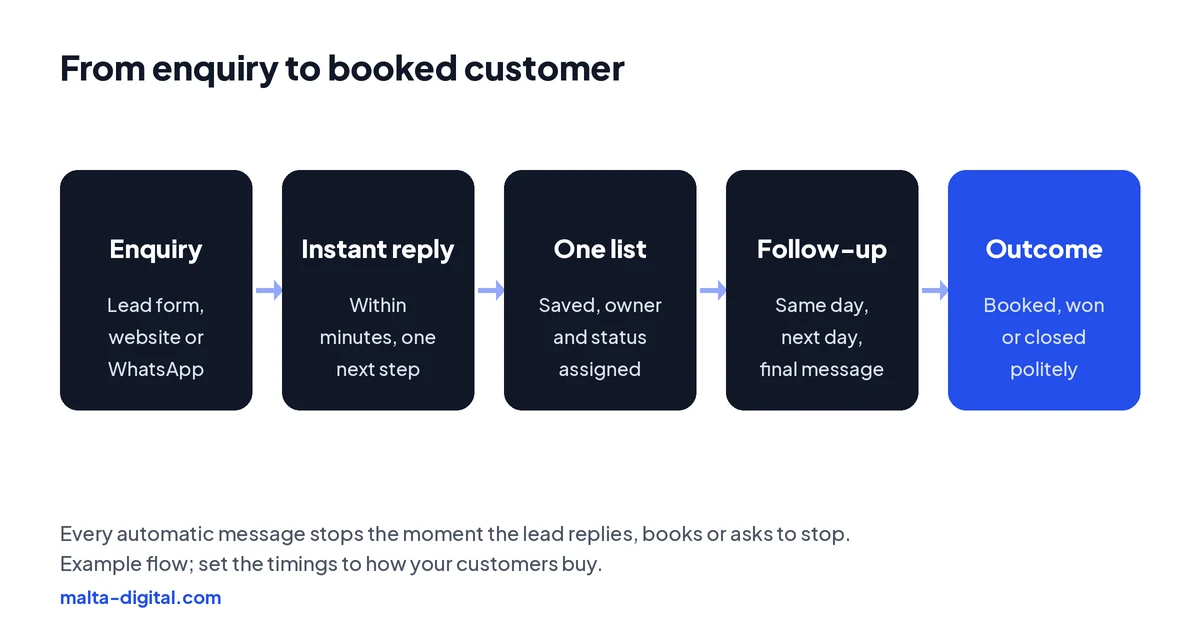
The first step is capture. Every source feeds one list: Meta lead forms through an integration, website forms by email or webhook, WhatsApp through the WhatsApp Business Platform, and missed calls through your phone provider. Meta only keeps lead form data available for download for a limited time, so leads should be sent automatically to your own system rather than downloaded now and then.
The second step is the instant reply. It should come within minutes, use the person’s name and service, and ask for the one thing you need to move forward: “Thanks Maria, for the kitchen in Mosta, could you send a photo and rough size? We’ll reply with a quote today.” A reply that only says “we received your message” wastes the moment when the person is most interested.
The third step is ownership and timing. Each lead gets an owner and a status, such as new, contacted, quoted, booked or closed. The system reminds the owner when a call is due, follows up automatically when the lead goes quiet, and closes the lead politely after the last attempt so your list stays clean.
The follow-up schedule
A good schedule is short and useful. A sensible starting point for a service business is an instant reply, a call or personal message the same day, a follow-up the next day with something helpful such as prices, photos of similar work or available dates, and a final message a few days later asking whether to keep the request open. After that, stop, unless the person has agreed to hear from you again.
Each message should give a reason to reply. “Just checking in” rarely works; “We have Thursday at 10:00 or Saturday at 9:00 free, which suits you?” often does. In Malta, a short voice note or a message that mentions the locality, the date of the event or the property they asked about feels personal, because it is.
The most important rule is the stop rule. The moment a lead replies, books, buys or asks you to stop, every automatic message must stop. A “still interested?” message sent to someone who booked yesterday makes the whole business look careless, and it is the most common mistake we see in automated follow-up.
| When | What happens | Who |
|---|---|---|
| Within minutes | Instant reply on the channel they used, with one clear next step | The system |
| Same day | A call or personal message from the lead’s owner | Your team |
| Next day | A helpful follow-up: prices, photos of similar work or free dates | System or team |
| A few days later | A final message asking whether to keep the request open | The system |
| Any time | They reply, book, buy or ask to stop: all automatic messages stop | The system |
Proof
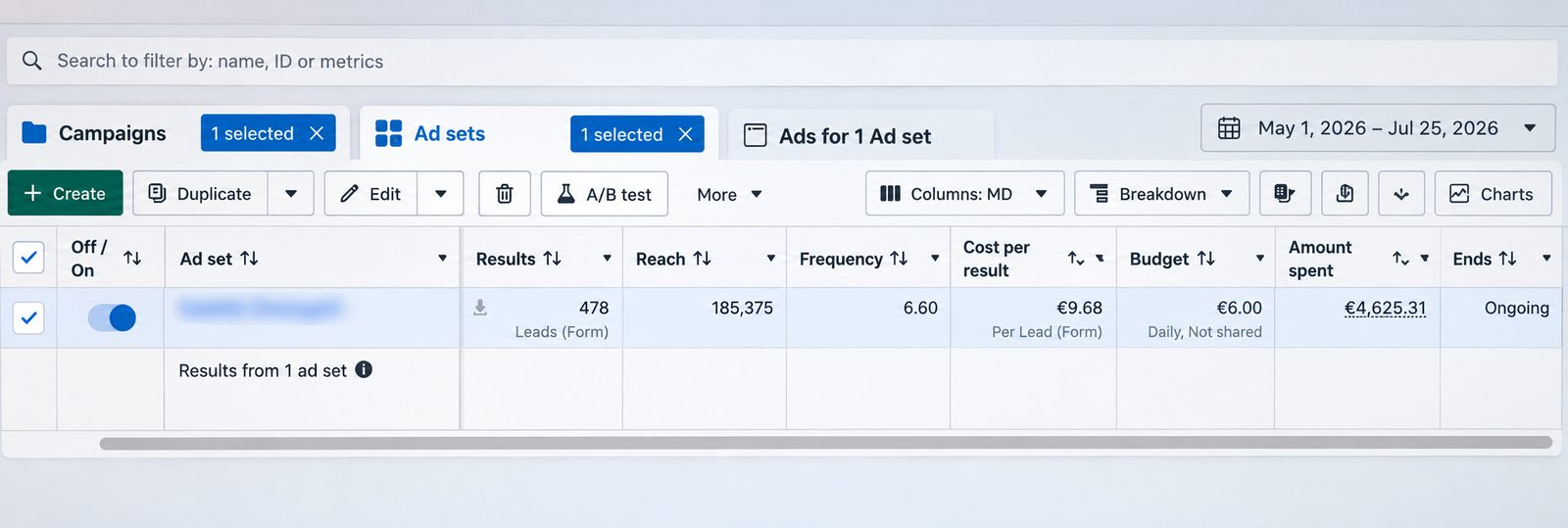
This is a lead generation campaign we ran on Facebook and Instagram from 1 May to 25 July 2026. It brought 478 form leads from €4,625.31 of ad spend, which is €9.68 per lead, on a €6.00 daily ad set budget. The screenshot is straight from Meta Ads Manager, with the ad set name blurred.
Want more of your leads to turn into customers? Message us on WhatsApp
Tell us on WhatsApp where your enquiries come from and how fast they’re answered today. We’ll show you where leads go cold and what we’d automate first. Free, no obligation.
WhatsApp and email
In Malta, WhatsApp is where most customers expect a reply, so it is usually the main follow-up channel. On the official WhatsApp Business Platform you can reply freely within 24 hours of the customer’s last message. Outside that window you must use a pre-approved message template, and marketing messages need the person’s opt-in. That suits follow-up well: reply fast while the chat is open, and use a short approved template for the reminder the next day.
Email carries the detail: a quote, a PDF price list, a booking confirmation. Replies to an enquiry the person made are fine under GDPR, because they asked you. Putting them on a newsletter is a different purpose and needs consent. Keep a note of where each lead came from and what they agreed to, and give an easy way to stop messages.
Avoid the shortcuts. Unofficial WhatsApp automation apps that control a normal WhatsApp account can get the number banned, and copying leads into a personal phone means the business loses them when a staff member leaves.
Where AI helps
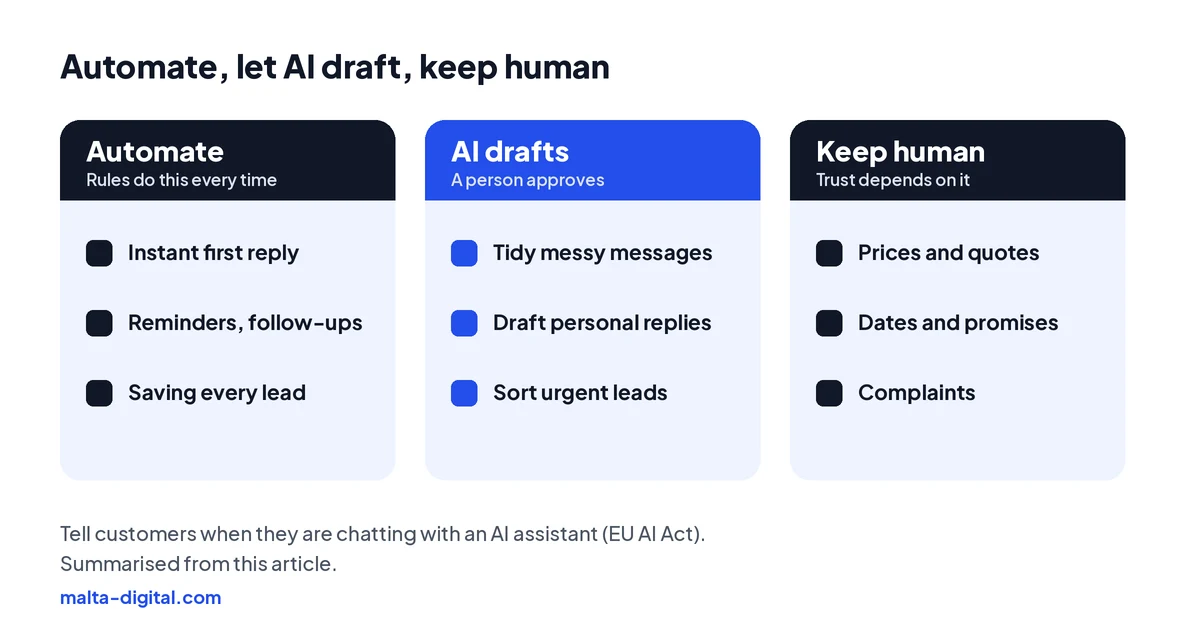
AI is useful in three places. It can read a messy message such as “hi how much for ac service 3 units in gozo next week” and turn it into a clean lead record with service, quantity, locality and timing. It can draft a personal first reply or follow-up in English, Maltese-English mix or Italian, ready for the team to send or approve. And it can sort leads, so urgent and high-value requests reach a person first.
It should not invent prices, promise dates it cannot see or argue with an unhappy customer. Keep those with a person. Under the EU AI Act, if an AI chats directly with customers, they must be told they are dealing with AI unless that is obvious, so an AI assistant on WhatsApp should introduce itself as one.
A safe way to start is draft mode: the AI writes, a person approves with one tap. After a few weeks of clean drafts, let it send the routine messages on its own, such as confirmations and the first reply, and keep approval for everything else.
Measuring it
You only need three numbers to know if your follow-up is working. Time to first reply: how long, on average, between the enquiry and a useful answer. Contact rate: the share of leads you actually spoke to or exchanged messages with. And lead-to-customer rate: the share that booked or bought. Measure them for a month before you change anything, so you can see what the automation really changed.
If replies get faster but bookings do not move, the problem is usually the message or the offer, not the tool. If the contact rate is low, check phone numbers and form questions. If one source sends many leads that never buy, tell your ad manager; it may be the targeting or the form, and it is worth fixing before spending more on ads.
How we do it
We start with a short look at where your leads come from today, how fast they are answered and where they get lost. Then we build the simplest setup that closes the gap: every source into one list or CRM, an instant reply on WhatsApp and email, owners and reminders for your team, a short follow-up schedule with a proper stop rule, and AI drafting where it saves real time. We test it with real enquiries before it goes live and show your team how to use it in an afternoon.
When we also run your ads, follow-up automation can be part of our Customer Acquisition System package, from €2,449 a month plus ad spend, excluding VAT, where scoped. Custom systems with deeper automation start from €7,500, excluding VAT. We quote after a short call.
A few straight answers
A system that saves every new enquiry in one place, sends a fast first reply, reminds your team and sends timed follow-ups until the person books, buys or says no.
Within minutes if you can. A widely cited Harvard Business Review study found leads contacted within an hour were far more likely to be qualified than leads contacted later.
Yes, on the official WhatsApp Business Platform. Reply freely within 24 hours of the customer’s last message; after that, use an approved template, and get opt-in for marketing.
For most service businesses, three or four over about a week: an instant reply, a same-day personal contact, a helpful follow-up and a final message. Stop as soon as they reply or book.
You need one place where every lead, its owner and its status is visible. For a small team that can be a simple CRM; a shared spreadsheet works only at very low volume.
AI can draft replies, tidy messy messages into lead records and sort urgent leads. Keep prices, promises and complaints with a person, and tell customers when they are chatting with AI.
Keep reading
What a website chatbot should and should not answer, GDPR and the AI Act, costs and how to start.
The Business Platform, Meta’s 2026 AI rules, the 24-hour window, costs and Malta examples.

Answering calls, booking appointments and taking messages, with the rules, costs and simpler options.
A useful first step
We connect your lead forms, website and WhatsApp to one list, set up instant replies and follow-ups that stop when people book, and add AI only where it helps. Custom systems from €7,500, excluding VAT.