WhatsApp AI chatbot for business
The Business Platform, Meta’s 2026 AI rules, the 24-hour window, costs and Malta examples.
Systems & automation · AI chatbots
An AI chatbot for business is a chat window on your website, or in WhatsApp or Messenger, that answers customers’ questions in plain language using your own information: services, prices, opening hours, delivery areas and policies. A good one answers the common questions at any hour, collects the details you need for a quote or booking, and hands the conversation to a person when it should. In Malta it must also be honest about being AI, which the EU AI Act now requires, and careful with personal data under GDPR.

Do you deliver a sofa to Xagħra on Saturdays?
Hi, I’m the shop’s AI assistant. Yes, we deliver to Gozo on Saturdays. Shall I pass your details to the team?
The short answer
Older chatbots worked like a menu: press 1 for prices, 2 for opening hours. They broke the moment a customer typed something the menu did not expect. An AI chatbot understands ordinary sentences, such as “Do you deliver a sofa to Xagħra on Saturdays?”, finds the answer in the information you have given it and replies in a normal, friendly way.
The key words are “the information you have given it”. A business chatbot should answer from your own content, not from the whole internet. You load your services, price lists or price ranges, policies, FAQs and opening hours, and the chatbot uses them to answer. When it does not know, it should say so and offer to pass the question to your team.
It is not a replacement for good service. It is a way to make sure the simple questions get answered straight away, including at 10pm on a Sunday, so your team can spend their time on the conversations that need a person.
What it can do
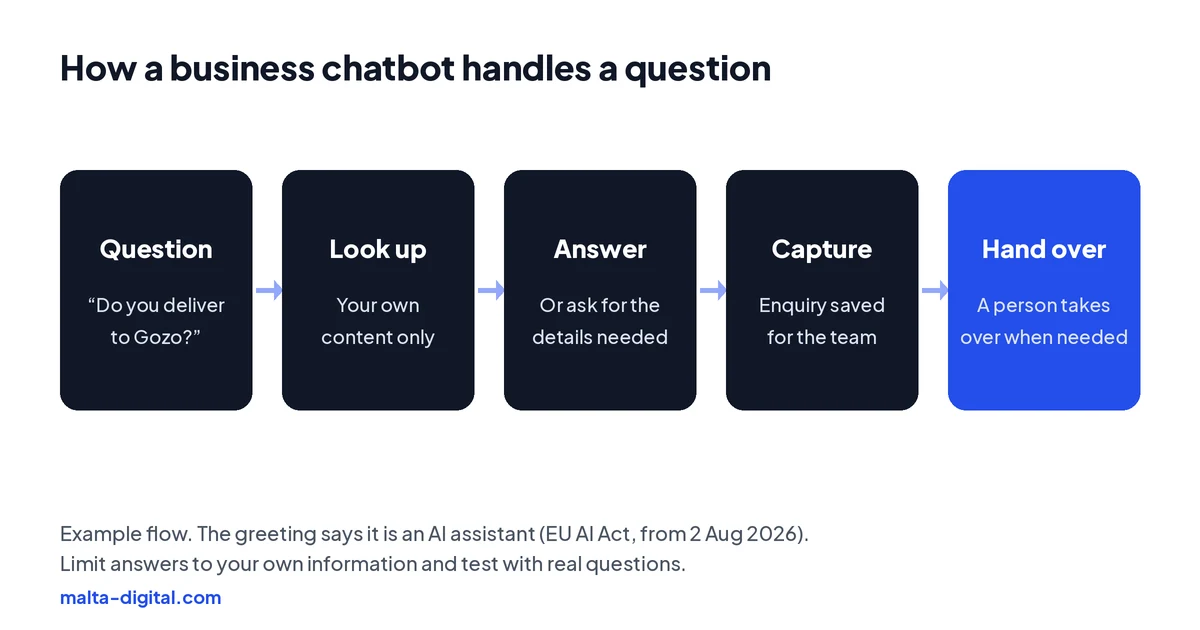
The best uses are the repetitive ones. Answering the questions you hear ten times a day: prices, availability, delivery, parking, what to bring. Collecting the details for a quote, such as measurements, photos, dates or the number of guests, so your team receives a complete enquiry instead of “please call me”. Pointing people to the right page, product or booking link. And taking a message out of hours with a promise of a reply in the morning.
For many Malta businesses the chatbot also handles languages. A guesthouse in Gozo or a diving school in Mellieħa hears from English, Italian, German and French speakers, and AI models handle these well. Maltese is supported by some models but less reliably, so test it properly before you promise it.
A chatbot can also be connected to your systems, so it can check a diary, create a lead in your CRM or send a booking link. That is where it moves from answering to doing, and where it needs the most care.
What it should not do
A chatbot should not make promises your business cannot keep. The well-known failure is a bot that invents a discount, a refund rule or a price because a customer asked cleverly. A business is responsible for what its chatbot tells customers, so limit it to your own information and tell it to hand over when a question goes beyond that.
Keep a person in charge of anything sensitive or high-stakes: complaints, refunds, medical questions, legal or financial advice, and anything where a wrong answer could hurt someone. A clinic’s chatbot can explain opening hours and how to book; it should not advise a patient on symptoms.
The handover itself must be easy. A customer who types “I want to speak to someone” should get a person, or a clear promise of when one will reply, not another round of questions.
The rules
Since 2 August 2026, the EU AI Act requires that people are told clearly, at the latest at the start of the conversation, when they are talking to an AI system rather than a person, unless that is already obvious. In practice, say it in the chat window’s greeting: “Hi, I’m the shop’s AI assistant. A person can take over at any time.”
GDPR applies to everything the chatbot collects. Say in your privacy notice that you use a chatbot, what it collects and why, and which provider processes the data. Collect only what you need for the enquiry, set a sensible retention period, and make sure your provider has a data processing agreement and a clear answer on where the data is stored and whether it is used to train their models. Malta’s data protection regulator is the Information and Data Protection Commissioner (IDPC).
Be especially careful with health data, children’s data and payment details. A chatbot should never ask for card numbers in the chat; send a secure payment link instead.
See it working
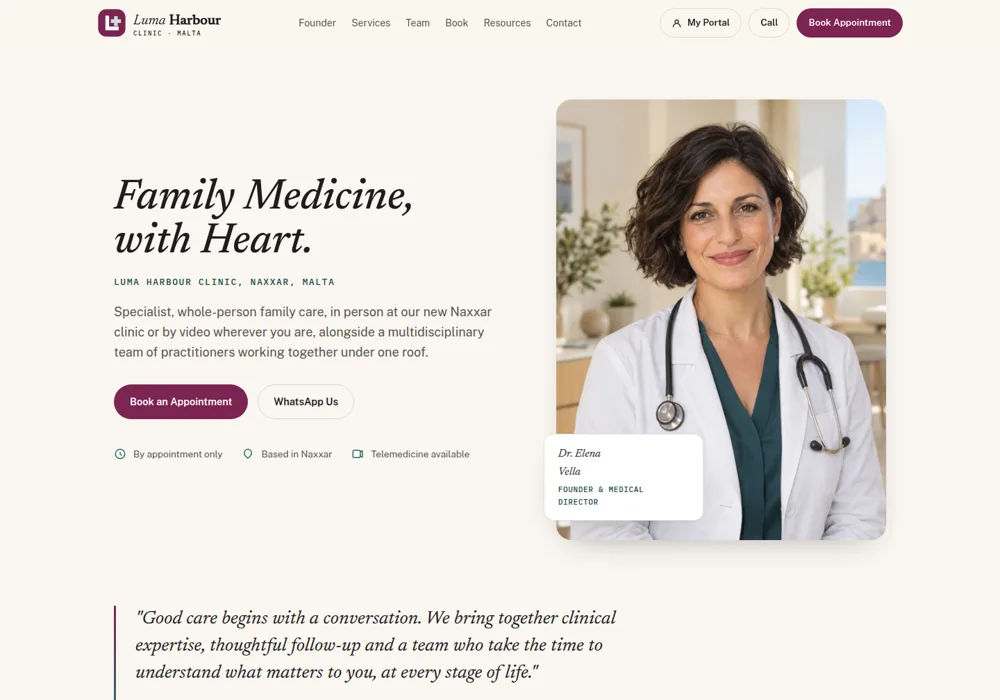
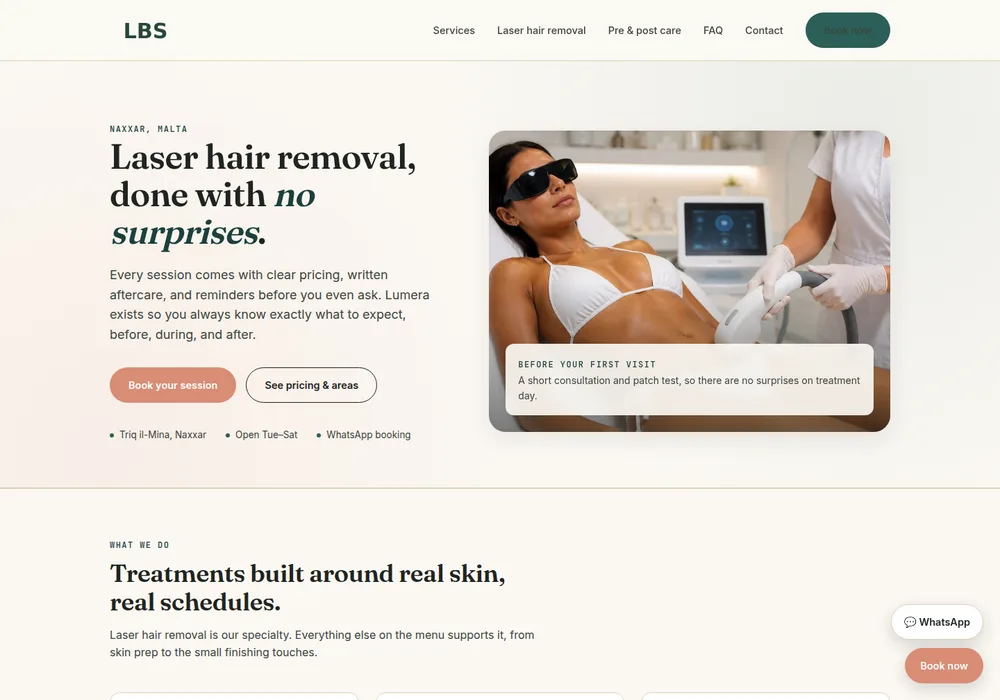
A chatbot works best on a fast, clear website that already answers the main questions, because the same content feeds the chatbot. These demos show the kind of service and booking sites a chatbot sits on.
Want a chatbot that answers your customers’ real questions? Message us on WhatsApp
Tell us on WhatsApp the questions you get most. We’ll tell you honestly whether a chatbot is worth it yet and what it would need.
Ready-made or custom
Ready-made chatbot tools are quick to start: you upload your FAQs or connect your website, choose a style and paste a code snippet onto your site. They suit a business with simple questions and no need to connect to other systems. Check how the monthly price grows with chat volume, the languages, the handover options and where the data is stored.
A custom chatbot makes sense when it needs to do things in your systems, such as check real availability, look up an order, prepare a quote or log the enquiry in your CRM, or when you need tight control over data and wording. It costs more to build but fits how your business actually works.
Whichever you choose, the content matters more than the tool. A chatbot fed with an out-of-date price list will give out-of-date prices, politely and at speed.
| Ready-made chatbot tool | Custom chatbot | |
|---|---|---|
| Best when | Questions are simple and need no other systems | It must check availability, look up orders or log enquiries in your systems |
| Setup | Upload FAQs or connect the website, paste a code snippet | Built around your systems, data and wording |
| Cost pattern | Monthly subscription that grows with chat volume | One-off build plus AI usage |
| What to check | Languages, handover options, where data is stored | Access rights, testing, data processing agreement |
Costs to consider
There are three kinds of cost. The tool or build, either a monthly subscription or a one-off development project. The usage, because AI models are charged by how much text they process, which grows with the number and length of chats. And your time, which is the cost most people forget: writing the content, testing the answers and reviewing the chats every week.
The return comes from enquiries that would otherwise be lost, mostly out of hours, and from the time your team saves on repeat questions. Before you start, count how many chats, emails and calls you get with the same ten questions. That number tells you whether a chatbot is worth it yet.
If you are building a new website anyway, plan the chatbot with it, because the same clear content serves both. Our websites start from €990, excluding VAT; we quote chatbot work separately once we know what it needs to connect to.
How to start
Start with one channel and one job, usually the website chat answering your most common questions and collecting enquiries. Write the content first: the questions you get, the honest answers, the prices or price ranges you are happy to share, and the cases where a person must take over. Test it with twenty real questions from your inbox, including awkward ones.
Then launch it, read every chat for the first two weeks and fix the answers that were wrong or vague. After a month, decide whether to add a second channel such as WhatsApp, or a connection to your booking system or CRM.
How we do it
We start with a short call about the questions you get and where they come from. We write or tidy the content with you, set up the chatbot on your site or channel, connect it to your booking system or CRM where that adds value, and add a clear AI notice, privacy wording and a handover to your team. Then we test it with your real questions before it goes live, and review the conversations with you in the first weeks.
We quote each chatbot after that first call, because the cost depends on what it needs to connect to. You can read more about our wider AI work on our AI automation page.
A few straight answers
A chat assistant on your website or messaging channels that answers customers in plain language using your own information, collects enquiry details and hands over to your team when needed.
Yes. Since 2 August 2026 the EU AI Act requires that people are clearly told they are interacting with an AI system, unless it is obvious. Say it in the greeting.
Yes, if it is not limited to your own information or that information is out of date. Restrict it to your content, test it and review the chats regularly.
Some AI models handle Maltese, but less reliably than English, Italian, German or French. Test it carefully before offering it.
It can be. Mention it in your privacy notice, collect only what you need, set retention periods and use a provider with a data processing agreement.
Ready-made tools suit simple FAQs. A custom chatbot suits businesses that need it to check availability, look up orders or log enquiries in their own systems.
Keep reading
The Business Platform, Meta’s 2026 AI rules, the 24-hour window, costs and Malta examples.

Answering calls, booking appointments and taking messages, with the rules, costs and simpler options.

What an AI agent is, how it differs from a chatbot, practical examples, risks and a safe first job.
A useful first step
We write the content with you, connect it to your systems and add a clear AI notice and handover. Quoted after a short call.