
AI chatbot for business
What a website chatbot should and should not answer, GDPR and the AI Act, costs and how to start.
Systems & automation · AI agents
An AI agent is software that is given a goal and can take steps on its own to reach it: read an email, look something up in your systems, decide what to do next, draft a reply, update your CRM and ask a person to approve. A chatbot answers; an agent acts. For a small business in Malta the useful agents today are narrow ones with one clear job, such as sorting new enquiries or preparing draft quotes, working inside limits you set and with a person approving anything that matters.

The short answer
The word “agent” is used for almost everything in AI marketing at the moment, which makes it hard to know what is real. A simple definition helps. A chatbot answers questions in a conversation. An automation follows fixed rules: when a form arrives, add it to the CRM and send an email. An AI agent combines the two: it understands a messy input, decides which steps to take, uses your tools to take them, and checks the result.
Picture a new enquiry arriving by email at a kitchen company in Mosta. An automation can file it. An AI agent can read it, see that the customer wants a quote for a kitchen of a certain size and finish, check whether photos are attached, ask for them if not, create the lead in the CRM with the right details, draft a reply with the next available survey dates and put the draft in front of the salesperson to approve.
That is useful, and it is also where the risk is: an agent that can act can also act wrongly. Good agents are designed around that.
Agent, chatbot or automation
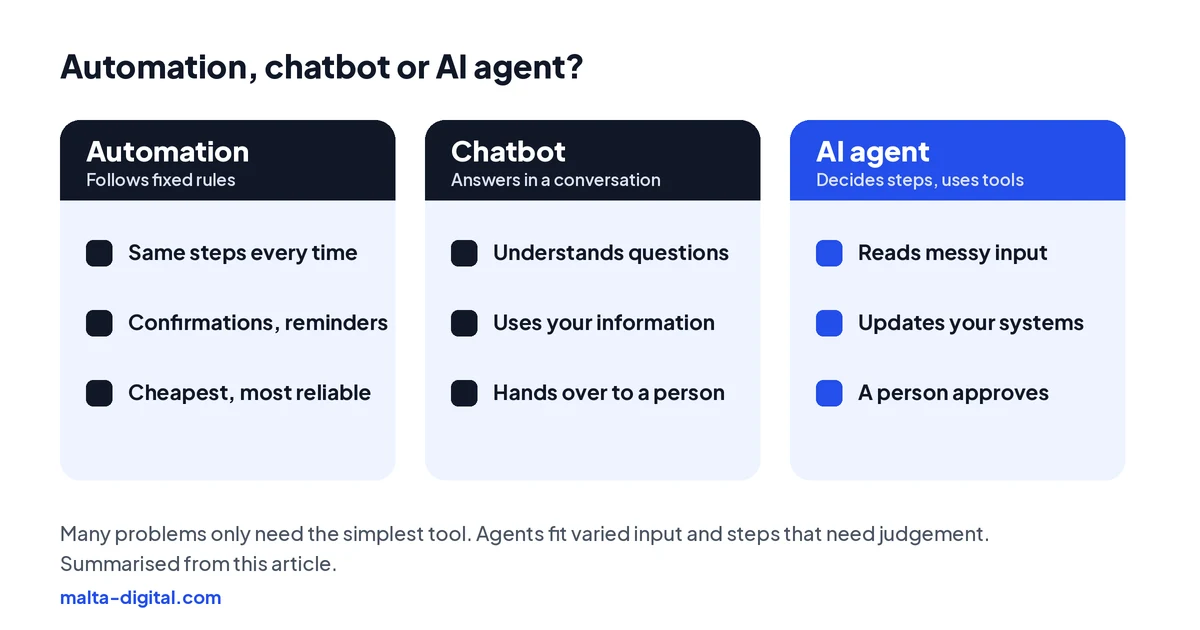
Many problems do not need an agent. If the process is the same every time, such as sending a booking confirmation, a reminder or an invoice, a simple automation is cheaper, faster and more reliable. If customers mainly need answers, a chatbot is enough. Agents earn their place when the input varies, the steps depend on what the input says, and the work currently takes a person a few minutes of judgement each time.
A good test is to describe the job to a new employee. If the instructions fit on one page and the employee would rarely need to ask, an agent can probably do it with supervision. If the job needs experience, negotiation or responsibility for money, it should stay with a person, perhaps with an agent preparing the groundwork.
| Automation | Chatbot | AI agent | |
|---|---|---|---|
| What it does | Follows fixed rules | Answers questions in a conversation | Decides steps and uses your tools to complete a task |
| Best when | The process is the same every time | Customers mainly need answers | The input varies and the steps need judgement |
| Example | Booking confirmation or reminder | Opening hours, prices, delivery areas | Reading an enquiry, filling in the CRM, drafting the reply |
| Person involved | Sets up the rules | Takes over when needed | Approves anything that leaves the business |
Practical examples
Enquiry handling. Read new enquiries from the website, email, WhatsApp and lead ads, sort them by type and urgency, fill in the CRM, ask for missing details and draft the first reply. Quotes. Turn a customer’s description, measurements and photos into a draft quote from your price list, for a person to check and send. Follow-ups. Notice quotes that have had no reply for a few days and draft a polite follow-up.
Admin. Read supplier invoices and delivery notes, match them to orders and flag differences for your accountant. Bookings. Move appointments when a customer asks, fill gaps from a waiting list, and send reminders. Reporting. Pull the week’s leads, bookings and sales from different systems into a short summary every Monday.
In each case the agent does the reading, sorting and drafting, which takes the time, and a person makes the decisions, which takes the judgement.
See it working
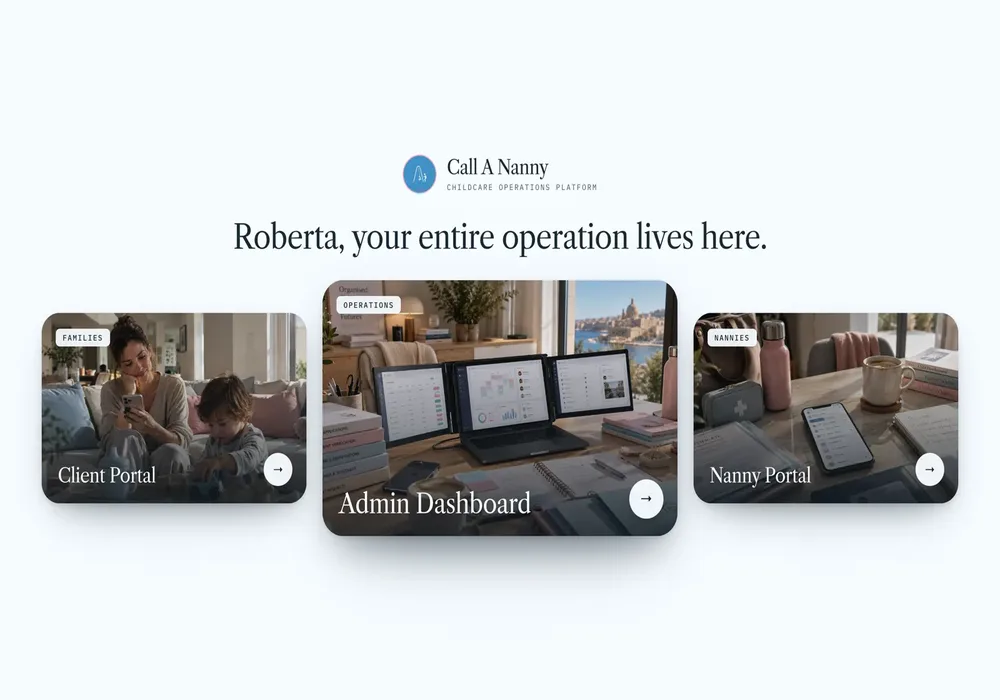
Agents need well-organised systems to work in: a CRM, a booking diary or an admin dashboard with clear records. This demo shows a platform with an admin Command Centre, a Nanny Portal and a Client App.
Which job would you hand to an AI agent first? Message us on WhatsApp
Risks
AI models can misread an email, invent a detail or follow instructions hidden in a message, such as a spam email telling the agent to forward your customer list. An agent with wide access to your email, files and payment systems can do real damage from one mistake. This is not a reason to avoid agents; it is a reason to design them carefully.
The safeguards are well understood. Give the agent the least access it needs: read the enquiries inbox and write to the CRM, but not send money or delete records. Keep a person approving anything that leaves the business, such as quotes, refunds and messages to customers, at least until you trust it. Log everything it does so you can check it. And start with a job where a mistake is cheap to fix.
Tell us the task that eats your team’s time. We’ll say honestly whether it needs an agent, a simple automation or neither.
The rules
Agents process personal data, so GDPR applies just as it does to your staff and systems: a clear purpose, only the data needed, a privacy notice that mentions it, providers with data processing agreements, and care over where the data is stored. If an agent talks directly to customers, the EU AI Act’s transparency rule, which applies from 2 August 2026, means people must be told they are dealing with AI unless it is obvious.
Some uses carry more obligations, such as using AI to screen job applicants or assess creditworthiness, which the AI Act treats as high-risk. For the everyday uses in this article, the practical rules are the ones above: be transparent, minimise data and keep a person accountable.
How to start
Pick one process that takes your team time every day, follows a pattern and has a clear right answer most of the time. Enquiry handling is often the best first choice, because it touches every sale and the time saved is easy to see. Write down how a good employee does it today, including the exceptions, because those instructions become the agent’s rules.
Run the agent alongside your team for a few weeks, with every action approved by a person. Measure the time saved and the mistakes caught. Only then widen what it is allowed to do on its own. Grants may help with the cost of AI projects in Malta; check the current schemes before you start.
How we do it
We start with the process, not the technology: how the work is done today, where time goes and what a mistake would cost. Often the answer is a simple automation or a better CRM, and we say so. When an agent is the right tool, we build it around your existing systems, give it only the access it needs, keep a person approving the important steps, and log everything it does.
We quote each project after a short call, once we understand the process and the systems involved. Our AI automation page covers our wider work, including chatbots, WhatsApp assistants and CRM automation.
A few straight answers
Software given a goal that can decide and take steps on its own using your tools, such as reading enquiries, updating your CRM and drafting replies, with a person approving important actions.
A chatbot answers questions in a conversation. An agent takes actions across your systems to complete a task.
Only for jobs where the input varies and the steps need judgement. For fixed processes, simple automation is cheaper and more reliable.
They can be, with limited access, a person approving anything that leaves the business, full logs and a first job where mistakes are cheap to fix.
If an agent talks directly to people, they must be told it is AI unless that is obvious, from 2 August 2026. High-risk uses such as recruitment screening carry more obligations.
Enquiry handling: sorting new enquiries, filling in the CRM, asking for missing details and drafting the first reply for a person to approve.
Keep reading
What a website chatbot should and should not answer, GDPR and the AI Act, costs and how to start.

The Business Platform, Meta’s 2026 AI rules, the 24-hour window, costs and Malta examples.

Answering calls, booking appointments and taking messages, with the rules, costs and simpler options.
A useful first step
We build narrow, supervised AI agents around your existing systems, with a person approving what matters.