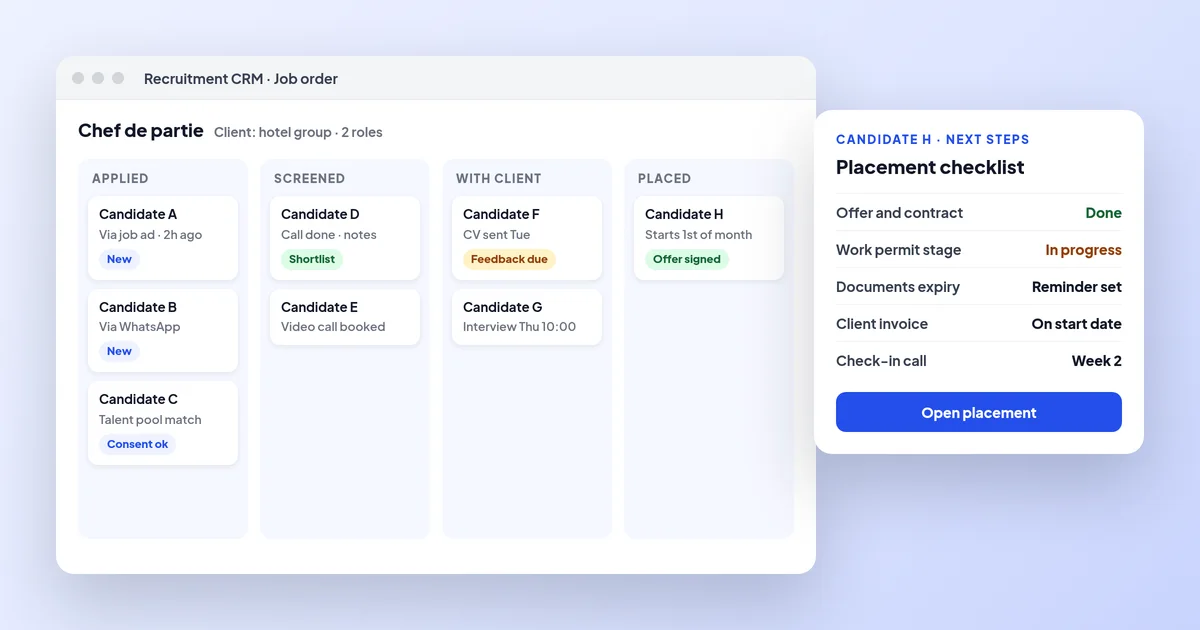
CRM for Recruitment Agencies in Malta: Candidates & Permits
What a recruitment CRM should do for agencies in Malta: candidates, job orders and clients in one system, matching, placements, permits and GDPR for CVs.
Systems & AI · Language schools
Malta Digital builds custom CRM systems in Malta, and English language schools have one of the hardest jobs to track. One booking can involve a student, a parent, an agent, a group leader, a host family and an airport transfer. This guide shows what a school CRM should hold, the ELT rules it can help you keep, a worked example and a free planner.
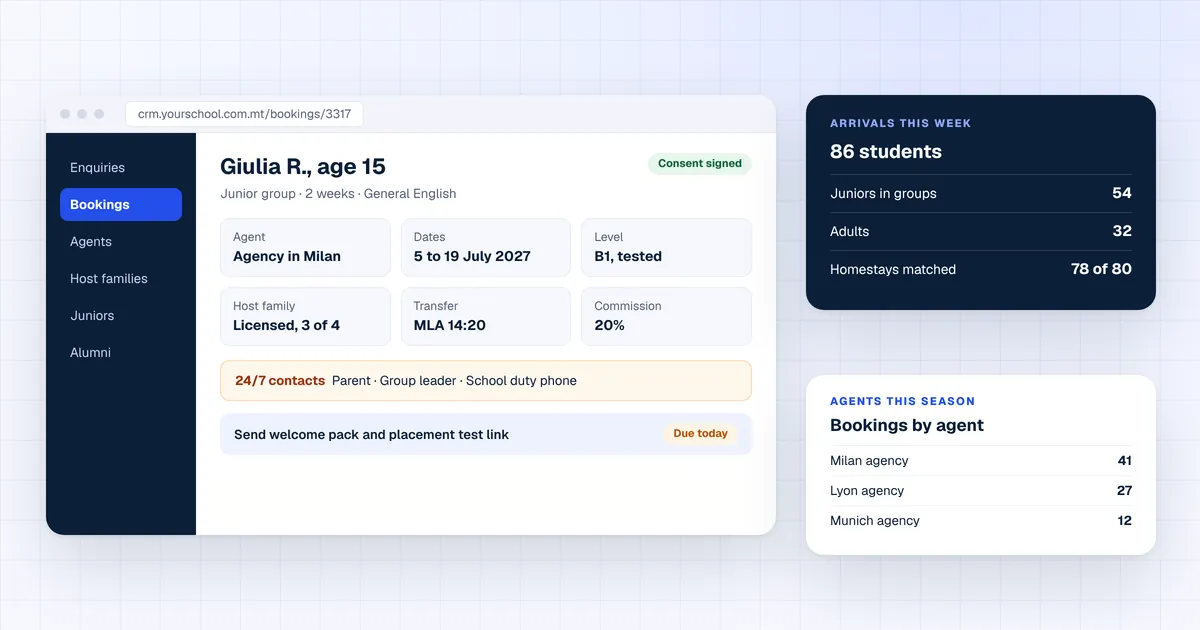
A CRM for a language school keeps every enquiry, agent, booking, host family, group leader and past student on one record. It follows up quotes, works out agent commission, matches students to homestays, keeps the 24/7 contact details for under-18s and invites alumni back. Malta had 76,063 ELT students and 34 licensed schools in 2025 (NSO), and half the students were under 18. Malta Digital builds these CRMs to fit how your school already works, connected to your booking and accounting tools.
The short version
Most schools run on a booking system, a spreadsheet for agents and a lot of email. The CRM is the layer that remembers people: who asked, who sent them, what they were quoted and what happens next.
Website, email, WhatsApp and agent requests land on one list, each with an owner and a reply deadline.
Each agent has a record with its contract, commission, price list and the students it sent.
Course, dates, level and extras are linked to the student, the agent and the invoice.
Host families, residences and rooms, with who stays where and for which weeks.
Parent, group leader and 24/7 emergency contacts on every under-18 booking.
Past students who agreed to hear from you get the right offer before the next season.
It does not replace your class timetable or your accounts. It sits next to them and makes sure no student, agent or family falls between the gaps.
Malta data
The National Statistics Office (NSO) counted 76,063 foreign students at Malta’s 34 licensed ELT schools in 2025. That is 4,883 fewer than in 2024, yet student weeks rose to 262,255, because the average stay grew to 3.4 weeks.

Fewer students staying longer changes the job. Each booking is worth more, so a lost quote or a forgotten agent costs more too. And with half the students under 18, the junior paperwork is not a side task, it is the main one.
Agents
Many students book through agents in Italy, Germany, France and further away. An agent that sent forty juniors last summer and none this spring needs a call, not silence. A CRM shows that at a glance.
| Field | Why it matters |
|---|---|
| Contract and end date | Regulation 13 asks for a written contract when you teach as part of their package |
| Commission and price list | The CRM works out what you owe on every booking, so statements match |
| Students sent this year and last | Shows who is growing and who has gone quiet |
| Main contact and language | The right person gets the right email, in their language |
| Payment terms | Flags bookings where the agent has not paid before arrival |
Group packages need a written contract. Regulation 13 of the ELT Council Regulations says a school that teaches as part of a package sold by someone else must have a written contract with that person, including safeguards for under-18s. Keep the signed contract on the agent’s record, with its end date and a renewal reminder.
Apply now and tell us how many students you host, how many agents send them and what you track today. We reply with what we would build first.
The rules
Malta’s English Language Teaching Council Regulations (L.N. 221 of 2015) and the Host Family Accommodation Regulations (S.L. 409.10) ask schools to keep many things on file. A CRM keeps them for you, on the right record, without anyone having to remember.
| Rule | What it asks | What the CRM does |
|---|---|---|
| L.N. 221/2015, Schedule 1, Part A | Proper academic records, including student attendance | Pulls attendance from your school system onto the student record |
| Schedule 1, Part A, 7.1 | A certificate of attendance with course, level, dates and hours | Builds the certificate from the booking and attendance data |
| Schedule 1, Part B, 1.4(h) | An identification document for each registered student | Prints the student card from the record |
| Schedule 1, Part B, 1.4(k) | For under-18s, a 24/7 emergency service and welfare measures | Keeps parent, leader and emergency contacts on every junior booking |
| Schedule 1, Part B, 1.4(l) and (m) | Approve and monitor lodging, and vet the permits of agents and subcontractors | Stores licence and permit dates for families, residences and transfer firms, with reminders |
| S.L. 409.10, regulations 4 and 6 | Licensed host families only, with no more than four guests at a time, contracted with the school | Blocks a match that would break the guest limit or use an unlicensed family |
Student details are personal data under the GDPR, and data about children needs extra care. Limit who can see passport copies and medical notes, and decide how long you keep them. Our guide to CRM and GDPR covers access and retention.
Free tool
Put in your enquiries, booking rate, course length and price. The planner works out the extra bookings that steady follow-ups could bring, the agent commission on them and what past students could add. Nothing you type leaves this page.
Starting numbers match the worked example below. Replace them with yours.
Your result appears here as you type.
The journey
Here is the path a booking takes through a school CRM. Each step adds to the same record, so anyone in the office can pick it up.
Juniors
In July and August, a school can host hundreds of under-18s in groups. The rules ask for a 24/7 emergency service, supervision suited to the students’ age, and checked board and lodging. The CRM is where all of that is written down.
The emergency line, the group leader and the parent on every junior record, visible to the duty team on a phone.
Only licensed families, with room and bed counts, so no family takes more than four guests at once.
Parent consent for activities and photos, allergies and medical notes, seen only by staff who need them.
Flights, transfers and first-night addresses for every group, sorted by arrival day.
If your summer runs on a big shared spreadsheet today, this is usually where a CRM pays for itself first.
Worked example
Here is an example school, not a client: 300 enquiries a month, about 3.4 weeks a booking and €320 a week for course and accommodation. These are the planner’s starting numbers.
| Item | Today | With a CRM | Difference |
|---|---|---|---|
| Enquiries that book | 20% of 300 a month | 24% with reminders | 12 more bookings a month |
| Value of a booking | 3.4 weeks at €320 | same | about €1,088 |
| Extra bookings a year | 144 | about €156,700 | |
| Alumni asked back | None | 2% of 1,200 who agreed | 24 more bookings a year |
The biggest number comes from quotes that were never followed up. Change the figures in the planner to your own.
Your options
Many ELT platforms include enquiries, agents and invoices.
Best for: Schools whose process matches the software and who need little else.
Good at enquiries, follow-ups and email. It knows nothing about courses, homestays or juniors, so that must be built in.
Best for: Schools with a strong sales team and simple bookings.
Built around your agents, families and junior rules, connected to the systems you keep. You own the code.
Best for: Schools with many agents, summer juniors or their own residences.
Compare costs before you decide with our guide to what a CRM costs, and see how the parts connect in CRM integration.
Proof
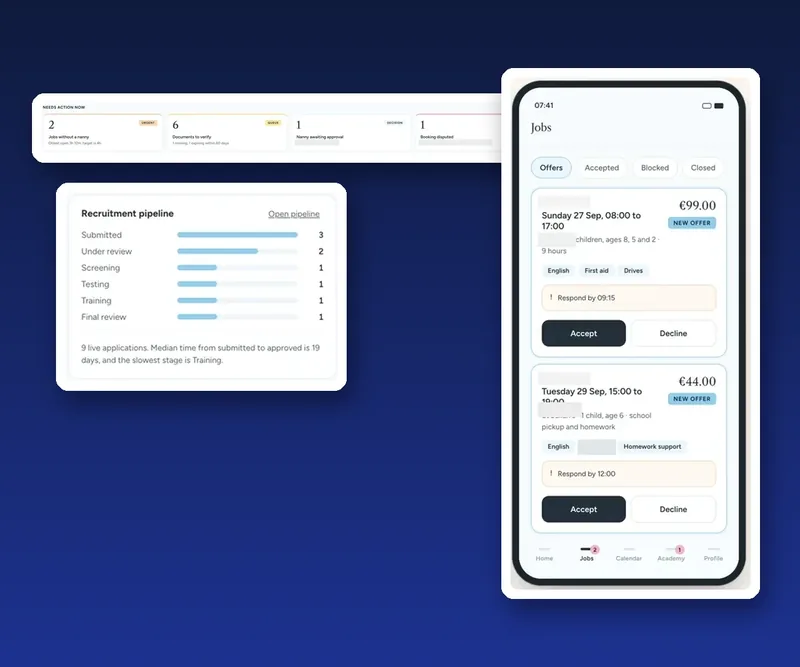
For a childcare agency we built a platform with an office command centre, a portal for the nannies and a booking app for parents. A language school has the same shape: the office, the host families and the students or parents, each with their own screen on one shared record. The case study shows the problem, what we built and how it works.
A few straight answers
Software that keeps every enquiry, student, agent, host family and past student on one record, with follow-ups and reminders. It works next to your timetable and accounts.
Yes. Each agent has a commission rate and price list on its record, so the CRM works out the commission on every booking and builds the statement.
It keeps the parent, group leader and 24/7 emergency contacts, consents and medical notes on each under-18 booking, visible only to staff who need them.
Yes. It holds each family’s licence, rooms and beds and the weeks they are booked, and it can stop a match that would put more than four guests in one home.
The ELT Council Regulations ask for proper academic records including attendance, a certificate of attendance for every student and, for under-18s, a 24/7 emergency service.
Only those who agreed. Under S.L. 586.01 and the GDPR, ask with a box that is not pre-ticked and give an easy way to stop in every message.
Malta Digital builds custom CRM systems from €7,500. The price depends on your agents, users, residences and the systems it connects to, with a written quote first.
Sources
Keep reading
What a recruitment CRM should do for agencies in Malta: candidates, job orders and clients in one system, matching, placements, permits and GDPR for CVs.
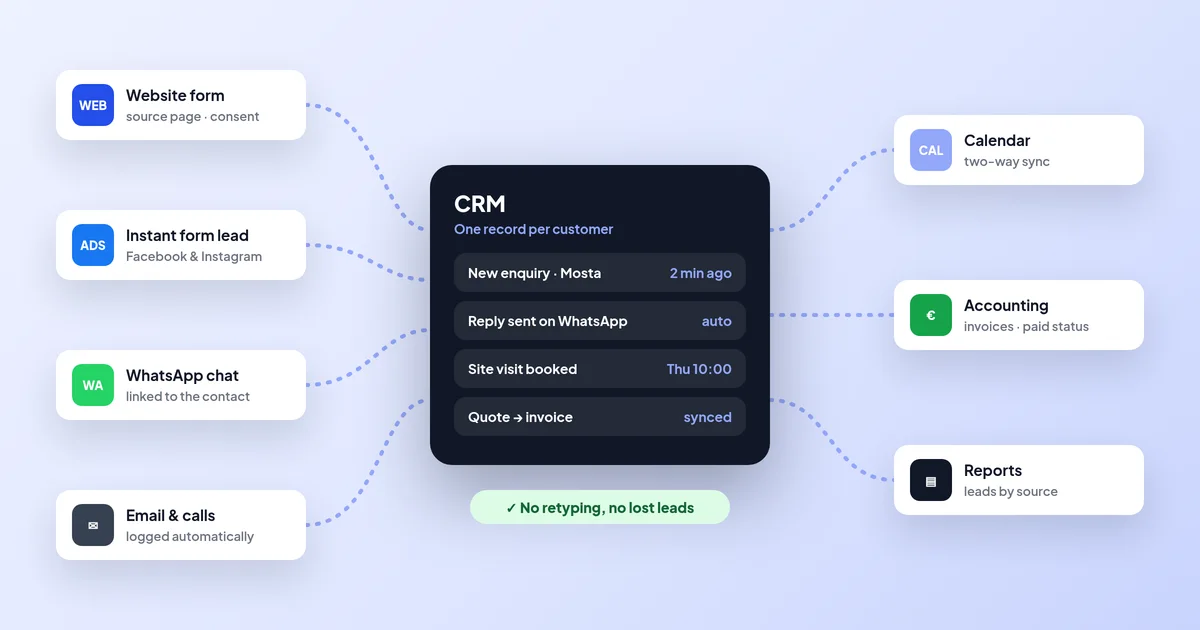
How CRM integration works for Malta businesses: website forms, Facebook lead ads, WhatsApp, calls, calendar and accounting in one record, and what to check.
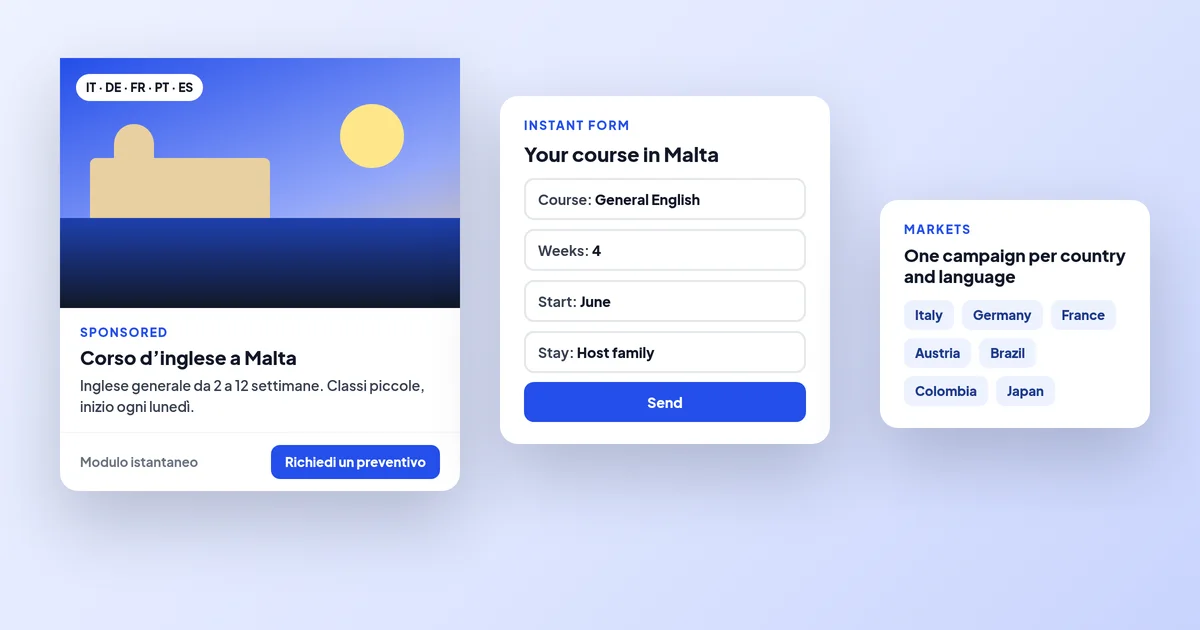
How English language schools in Malta can use Facebook and Instagram ads to find students abroad: markets, languages, junior courses, forms and NSO data.
A useful first step
Tell us how many students you host, how many agents send them and which booking system you use. We reply with what we would build first and what a CRM that fits would cost.
Step 1 of 3
A few quick questions, about a minute. We usually reply within 2–3 hours.