
Facebook job ads
Job ads that get applications: the employment special ad category, pay in the ad, lead forms that screen applicants and replies the same day.
Systems & automation · Recruitment CRM
A CRM for a recruitment agency in Malta links three things that spreadsheets keep apart: candidates, the clients who hire them and the job orders in between. Every application from job ads, your website, WhatsApp and referrals lands in one place, candidates are matched and moved through a pipeline per role, clients get shortlists and feedback is chased, and each placement is followed through to the start date, the invoice and the check-in call. For agencies hiring from outside the EU, it also tracks vacancy adverts, permit stages and document expiry dates. This guide shows what to look for and when custom is worth it.
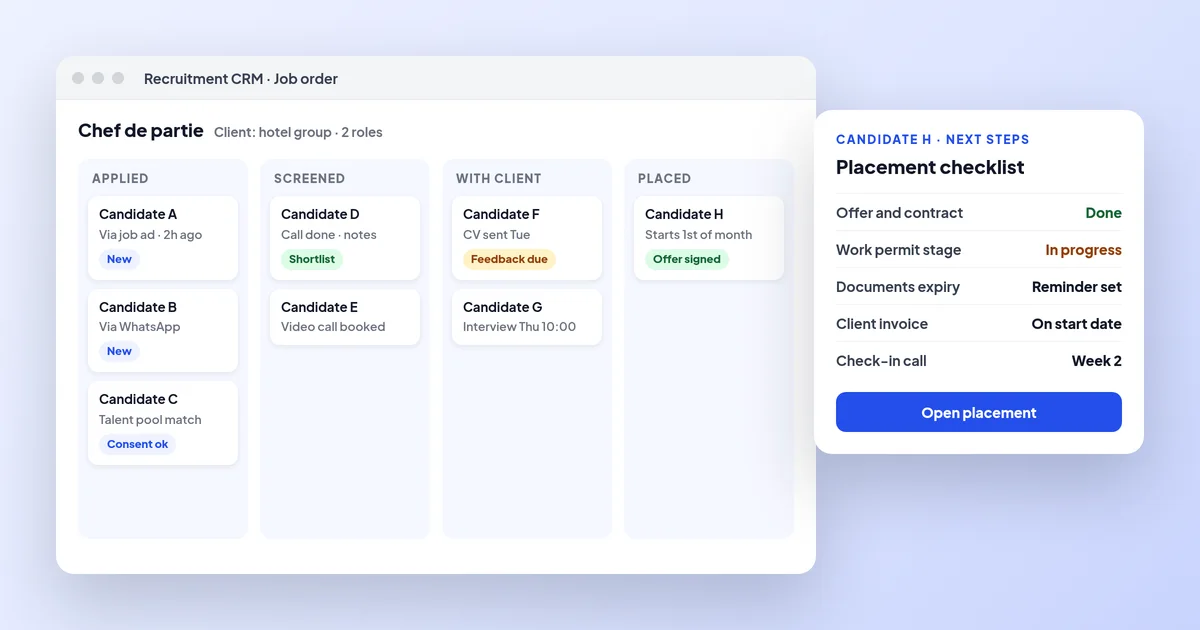
A recruitment CRM links candidates, clients and job orders: every application lands in one place, candidates are matched and moved through a pipeline per role, shortlists and feedback are tracked, and placements are followed through to the start date and invoice. In Malta it should also track Jobsplus adverts, permit stages and document expiry dates. Malta Digital builds custom recruitment CRMs.
The short answer
A sales CRM is built around one customer moving through one pipeline. A recruitment agency has two customers at once. The client company is buying a hire. The candidate is choosing a job. Each job order has its own pipeline of candidates, and each candidate can be in several pipelines for different clients at the same time. A recruitment CRM is built around those links: who is being considered for what, by whom, and what happens next.
Malta makes this harder in specific ways. The labour market is small and fast, so the best candidates are often talking to two or three agencies at once and the one that calls first with the right role wins. Many roles, especially in hospitality, care, construction, cleaning and transport, are filled with workers from outside the EU, which adds adverts, permits and document dates to every placement. And the same candidates come back: someone placed in a hotel kitchen this year may be your best candidate for a head chef role in two years, if you can find their record.
The common mistake is running the agency from an inbox, a shared drive of CVs and a WhatsApp group per consultant. It works until a consultant leaves and takes their network with them.
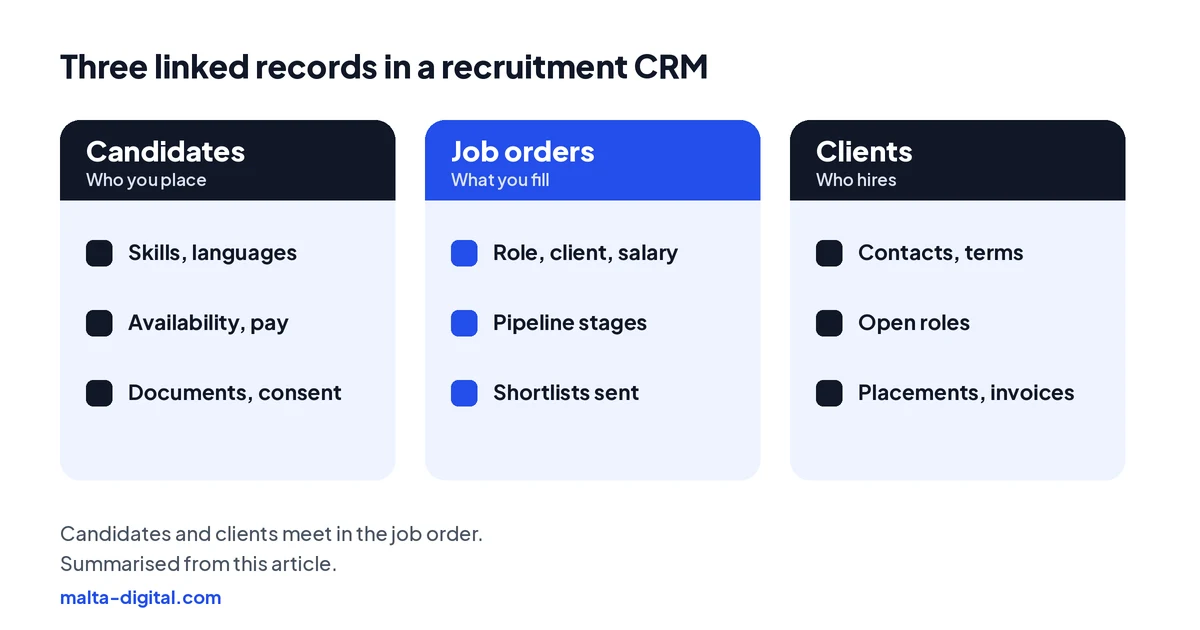
Candidates
Applications reach a Maltese agency from job boards, Facebook and Instagram ads, your own website, LinkedIn, WhatsApp messages with a CV attached, walk-ins and referrals from people you have placed. A CRM should catch all of them in one list, with the CV parsed or attached, the source recorded and a consultant assigned. Duplicates are merged on email and phone so the same person who applied three times is one record with three applications.
What makes the database useful later is structured fields, not just the CV file: job titles and skills, languages (English, Maltese, Italian and others matter for many roles here), years of experience, the type of work wanted, availability and notice period, salary expectations, whether they are already in Malta, and their right-to-work status. With those fields you can search the database in seconds when a new role comes in, instead of advertising again.
Reply to every applicant, even with a short automated message. Candidates talk to each other, and in a market this size an agency known for never replying finds it harder to attract good people. Our guide to Facebook job ads in Malta covers how to bring in applications in the first place.
Job orders
When a client gives you a role, it becomes a job order in the CRM: the client, the role, location, hours, salary range, start date, requirements, your fee terms and the consultant responsible. Each job order has its own pipeline, for example applied, screened, shortlisted, sent to client, interview, offer and placed, and every candidate moves through it with a date and a note at each step.
Matching is where the CRM earns its keep. From the requirements, it can list candidates in your database who fit: the right skills, language, availability and right to work, near the right locality, and not already placed. You still choose who to put forward, but you start from a list rather than memory. When you send a shortlist to the client, the CRM records which CVs went where, so you never send the same candidate to the same client twice, or to two competing clients without knowing.
Then chase feedback. The most common complaint from candidates is silence after an interview, and the most common delay in a placement is a client who has not replied. A reminder after two days, to the consultant and then to the client, keeps both sides moving.
Placements
A placement is not finished when the candidate says yes. The CRM should hold the offer details, the start date and the fee, prompt the invoice to the client at the point your terms say, and remind the consultant to call the candidate and the client in the first weeks. If your terms include a replacement or guarantee period, the CRM can track that date for each placement so nobody has to look it up when a placement does not work out.
For temporary and outsourced staff the work continues for months: assignments, hours, timesheets, payroll and the client invoice each week or month. Malta’s Employment Agencies Regulations (S.L. 452.130) require a separate licence for recruitment and for temping or outsourcing, and temping and outsourcing agencies must keep records under the Transparent and Predictable Working Conditions Regulations. If you do both, the CRM should keep the two clearly apart, in data, reports and access.
Placements are also your best source of future business. Every candidate you placed is a future candidate, and often a future client contact. A reminder to check in at three months and again at a year keeps you in mind when they are next hiring or looking.
Third-country hiring
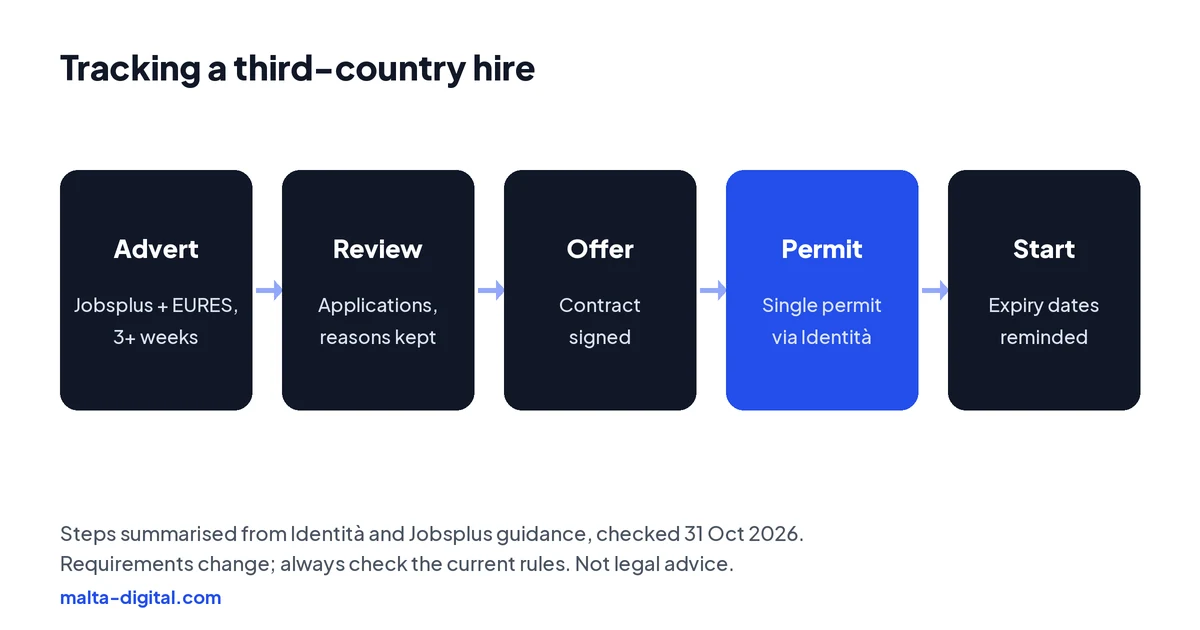
For many Maltese agencies, placements involve workers from outside the EU, and each of these comes with a paper trail and a set of dates. A CRM will not make the decisions for you, but it is the right place to keep the trail and the reminders.
Some of the steps are set by the authorities. Under the Employment Agencies Regulations, which came into force on 1 June 2024, temping, recruitment and outsourcing agencies need an employment agency licence from DIER before they can submit single permit applications to Identità on behalf of third-country workers. For a new single permit, Jobsplus requires the employer to have advertised the vacancy on the Jobsplus and EURES portals for at least three weeks within the two months before applying, and to give reasons if applicants from Malta, the EEA or Switzerland were rejected. Those rules change from time to time, so check the current requirements with Identità and Jobsplus before each application.
In a CRM, each of those becomes a field or a task on the placement: the date the advert went live and the proof, the applications received and the reasons recorded, the permit application date and stage, and the expiry dates of the passport, permit and residence card, with reminders well before each one. That last part matters long after the placement: an expired document is a problem for the worker, the client and you.
Apply now and tell us whether you recruit, temp or both, how many roles you fill and where applications come from. We’ll show you what a recruitment CRM would do for you, or message us on WhatsApp.
Compliance and GDPR
A few legal duties map neatly onto CRM settings. S.L. 452.130 says a licensed agency must include its licence number in its job adverts and publicity, so put it in your advert templates once and it is never forgotten. Recruitment agencies must keep records of applicants (names, addresses, ID document numbers, qualifications and experience) and of the employers they serve, including VAT and income tax numbers, and these can be inspected at any time. A CRM keeps them in one place and makes the inspection a report rather than a search. The same regulations treat charging applicants for employment services as grounds to refuse or revoke a licence, so never build fee steps for candidates into your process.
CVs are personal data, and ID copies and permit documents are sensitive. Tell candidates in your privacy notice how long you keep their details and why, ask before keeping them in your talent pool for future roles, and set the CRM to flag or delete old records when that period ends. Keep ID and permit documents in a restricted area that only the people who need them can open, use personal logins, and choose EU hosting. When a candidate asks what you hold about them or asks to be removed, you should be able to answer within a month. Our guide to CRM and GDPR in Malta covers the settings in detail.
Ready-made or custom
There are three routes. Dedicated recruitment platforms (often called ATS and CRM in one) come with candidates, job orders, CV parsing and pipelines out of the box and suit agencies whose process fits the product. General CRMs such as HubSpot, Zoho or Pipedrive are strong on clients and sales pipelines but need custom objects for candidates and job orders. A custom CRM is built around your agency: your stages, your fee and guarantee rules, permits and document dates, temping and payroll if you need them, and a portal where candidates apply and accept offers.
Custom is worth it when you combine recruitment with temping or outsourcing, place many third-country workers and need every date tracked, want your own candidate portal or app, or have rules the ready-made tools cannot follow. It is not worth it for a one-person agency placing a few people a month. At Malta Digital, custom CRM systems start from €7,500, excluding VAT, and our CRM quiz gives an honest first answer.
| Recruitment platform | General CRM | Custom CRM | |
|---|---|---|---|
| Best for | Agencies whose process fits the product | Small agencies focused on client sales | Recruitment plus temping, many permits, own portal |
| Candidates and job orders | Built in | Needs custom objects | Built around your fields and stages |
| Permits and document dates | Depends on the product | Set up as fields and tasks | Built in, with your reminders |
| Watch out for | Data export and what you can change | Paying per user as the team grows | A rushed scope; skipping mapping and testing |
Proof
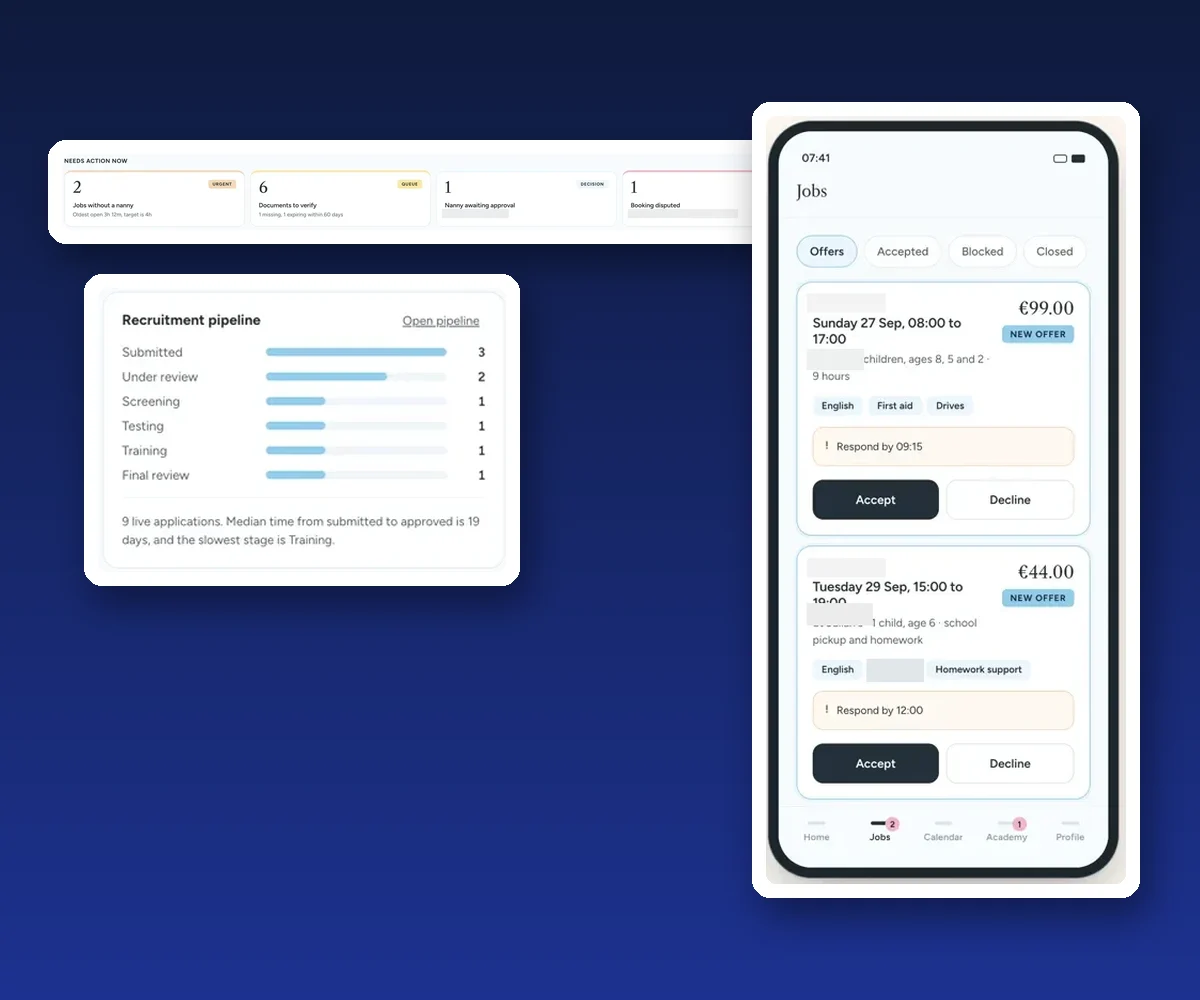
Our closest example is a custom platform we built for a childcare and nanny agency, which recruits nannies on one side and serves parents on the other. Nannies complete a six-step application, follow their progress through a recruitment pipeline, upload documents, take tests and training, and accept or decline matched job offers with a respond-by time in their own portal. The office opens on what needs action now: jobs with nobody assigned, documents to verify or expiring soon, and people waiting for approval.
Swap nannies for candidates and parents for client companies, and that is the shape of a recruitment CRM. It is a new system, so we do not publish results or usage figures for it; the case study shows what we built and how the parts connect.
Want candidates, clients and permit dates in one system? Message us on WhatsApp
How we do it
We start with your consultants and your office, not only the director, and map how a role comes in, how candidates are found and screened, how shortlists and interviews run, and what happens after a placement, including permits and temping if you do them. Then we propose the route that fits: setting up a ready-made tool, or a custom system with your record types, stages, matching rules and reports, with the scope, price and timeline in writing before work starts.
The build follows the map. We move your candidates, clients and open roles from spreadsheets or your old system and check them against the source (our guide to CRM data migration explains how), connect your job adverts, website and WhatsApp, set roles and access for consultants and managers, and train the team on live roles. See the CRM page for what is included.
A few straight answers
The one that fits how your agency works. Many agencies do well with a dedicated recruitment platform. Agencies that combine recruitment with temping, place many third-country workers or want their own candidate portal often need a custom CRM. Take the free CRM quiz for a quick first answer.
An applicant tracking system (ATS) manages candidates through the stages of a role. A recruitment CRM also manages the client side: companies, contacts, job orders, fees and placements. Most agencies need both, and many tools combine them.
Yes. Each placement can hold the advert dates, permit application stage and the expiry dates of the passport, permit and residence card, with reminders before each one. It supports your process; it does not replace checking the current rules.
Only as long as you need them for the reason you told the candidate. Set a retention period in your privacy notice, ask before keeping people in a talent pool for future roles, and have the CRM flag or delete old records.
Under the Employment Agencies Regulations (S.L. 452.130), licensed agencies must include their licence number in adverts and publicity. Adding it to your CRM advert templates makes sure it is never missed.
Yes, with a candidate portal or app. Candidates apply, upload documents, see their progress and accept offers, and everything updates the CRM directly.
Ready-made platforms charge a subscription, usually per user. Malta Digital’s custom CRM systems start from €7,500, excluding VAT, depending on users, workflows and integrations.
Keep reading
Job ads that get applications: the employment special ad category, pay in the ad, lead forms that screen applicants and replies the same day.
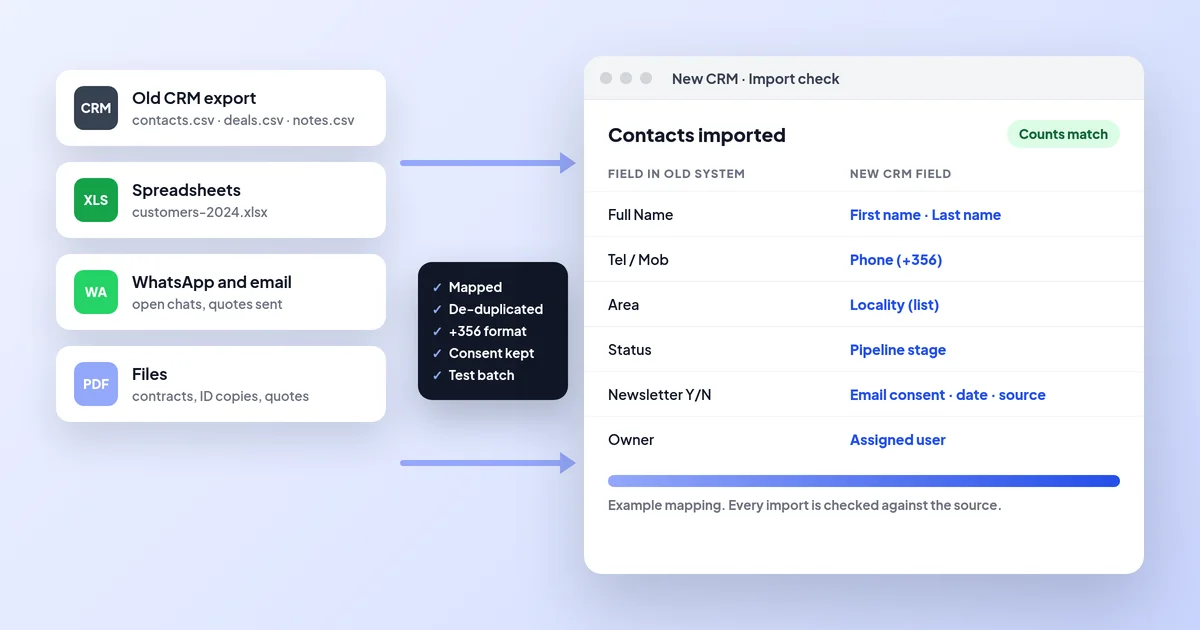
Export, field mapping, clean-up with +356 numbers and Maltese letters, consent records, test imports, cutover with automations off, and checks.
Lawful basis, marketing consent, EU hosting, roles, retention, data requests and breaches, turned into CRM settings and habits.
A useful first step
We build the pipeline, matching, placement follow-up and document reminders around your agency, with CVs and ID documents kept safe. Custom CRM systems from €7,500, excluding VAT.