
Facebook lead ads in Malta
Form setup, follow-up and judging cost per customer, not just cost per lead.
Facebook & Instagram ads · Recruitment
Facebook and Instagram job ads work in Malta when the ad names the role, the area, the hours and the pay range, a short lead form or WhatsApp chat screens applicants with two or three questions, and someone replies the same day to book interviews. Job ads reaching Malta must be declared in Meta’s employment special ad category, which removes age, gender and postcode targeting and lookalikes, so the ad itself does the targeting. Malta Digital runs recruitment campaigns for employers and recruiters and measures interviews and hires, not clicks.

Instant form · job ad
Line cook, St Julian’s
Full nameCan you work weekends? Yes · NoStart date: Now · 2 weeks · 1 monthApply nowFacebook job ads work in Malta when the ad names the role, area, hours and pay, a short lead form screens applicants and someone replies the same day. Job ads reaching Malta must use Meta’s employment special ad category, which removes age, gender and postcode targeting. Malta Digital runs recruitment ads and tracks interviews and hires.
The short answer
Yes, especially for roles where the best candidates are not searching job boards every day: waiters and chefs, care workers, drivers and couriers, shop staff, cleaners, technicians, tradespeople and customer service teams. Those people are on Facebook and Instagram every day. A clear job ad puts the role in front of them while they scroll, and a short form lets them apply from their phone in under a minute.
For specialist or senior roles, Meta ads still help, but as a support to LinkedIn and job boards rather than a replacement. The rule is the same for every role: say exactly what the job is, make applying easy, and answer fast. Employers in Malta compete hard for staff, and the one who calls back first often gets the person.
The problem
The usual hiring post in Malta is a graphic that says “We’re hiring!” with a list of roles and an email address. It reaches the people who already follow the business, gets shared a few times and brings a handful of CVs, many from people who do not fit. Nobody knows the hours, the pay or the location, so good candidates scroll on and others apply for everything.
Boosting that post makes it worse in a new way. If the post is about jobs but the campaign is not declared in the employment category, Meta can reject it or restrict the account. And boosting optimises for likes and shares, not for applications.
The last problem is the inbox. Applications arrive in Messenger, email, comments and WhatsApp, nobody owns the replies, and candidates who applied on Monday hear nothing until Friday. By then many have accepted another job.
The rules
Meta requires employment ads to be declared in the employment special ad category when the audience is in the United States, Canada or certain parts of Europe, and Malta is on that list. It covers ads for full-time and part-time jobs, internships, professional certification programmes, apprenticeships, job fairs, job boards and company perks shown alongside job openings, whether you are the employer or a recruitment agency. You choose the category when you create the campaign.
Once you declare it, some audience options are limited or switched off: age, gender, postcode targeting, exclusion targeting, lookalike audiences and saved audiences, and some interests disappear. City or pin-drop locations get an expanded radius, in practice about 15 km. Meta’s discriminatory practices policy also applies to the ad text, so do not write “young team”, “native Maltese only” or anything that excludes people by age, sex, origin or other protected characteristics. Describe the job and the requirements instead: “Weekend shifts, English required, driving licence needed.”
On a small island these limits matter less than people fear. A 15 km radius around Birkirkara already covers most of the main island, and a separate campaign can cover Gozo. What you cannot do is aim the ad at a narrow group of people. What you can do is write an ad so specific that the right people recognise themselves and the wrong ones scroll past.
Making the ad
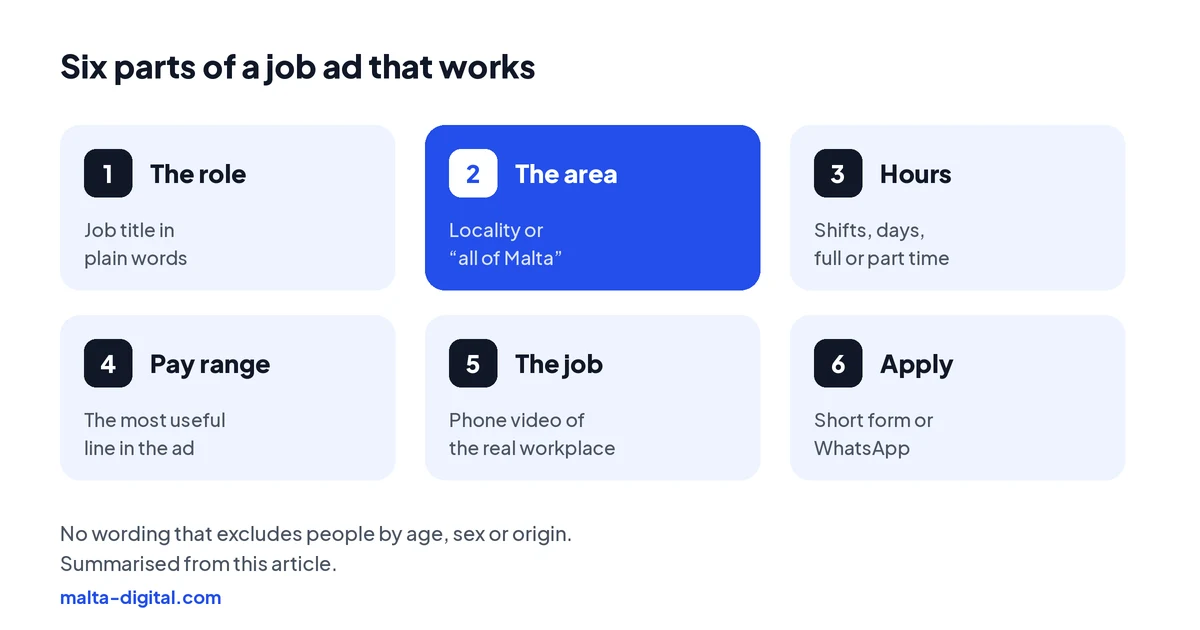
Lead with the role and the area: “Line cook, St Julian’s, full time.” Then the hours and shifts, the pay range and the main benefits, such as meals, transport, training or a bonus. Pay is the single most useful line in a job ad; ads that hide it bring fewer and less suitable applicants, because people cannot tell whether it is worth their time.
Show what the job is like. A short vertical video of the kitchen at service, the warehouse, the van or the shop floor, filmed on a phone, says more than a stock photo of people in suits. A team member explaining a normal day in their own words, with their permission, builds trust quickly. Add captions, and keep a version for Reels and Stories.
Write in the language of the people you want. Many roles in Malta are filled by people who speak English rather than Maltese, so English usually reaches the widest pool. If the job really needs Maltese, say so plainly as a requirement. If a role is open to people who need a work permit, say whether you can support the application; it saves everyone time.
Where applications go
An instant lead form is usually the best start. It opens inside Facebook or Instagram with the name, phone and email already filled in, so applying takes seconds on a phone. Add two or three screening questions that matter for the role, such as whether they can work weekends, whether they have a driving licence and when they can start. Use multiple-choice answers where you can, and choose the “higher intent” form type so people review their answers before they send.
Click-to-WhatsApp suits roles where candidates want to ask a question first, and it matches how many people in Malta prefer to communicate. It needs someone who replies within hours, with a ready message that asks the screening questions. A careers page with an application form suits roles that need a CV or a portfolio; it needs a fast mobile page and the Meta Pixel and Conversions API, so Meta can learn who applies.
Whichever you choose, send every application to one place where someone owns it: a shared inbox, a spreadsheet or a simple CRM. Judge the campaign on interviews booked and people hired, not on the number of applications, because fifty applicants who never pick up the phone cost more than five who start on Monday.
| Instant lead form | Click-to-WhatsApp | Careers page | |
|---|---|---|---|
| Where people apply | A form inside Facebook or Instagram | A WhatsApp chat with you | An application form on your website |
| Best for | Most roles, the most applications | Candidates who want to ask first | Roles that need a CV or portfolio |
| What it needs | Two or three screening questions, higher intent form | Replies within hours, ready screening questions | A fast mobile page, Pixel and Conversions API |
| Judge it on | Interviews and hires | Interviews and hires | Interviews and hires |
Apply now and tell us the roles, the area and how many people you need. We’ll reply with the ads, form questions and follow-up we’d set up, or message us on WhatsApp.
Proof
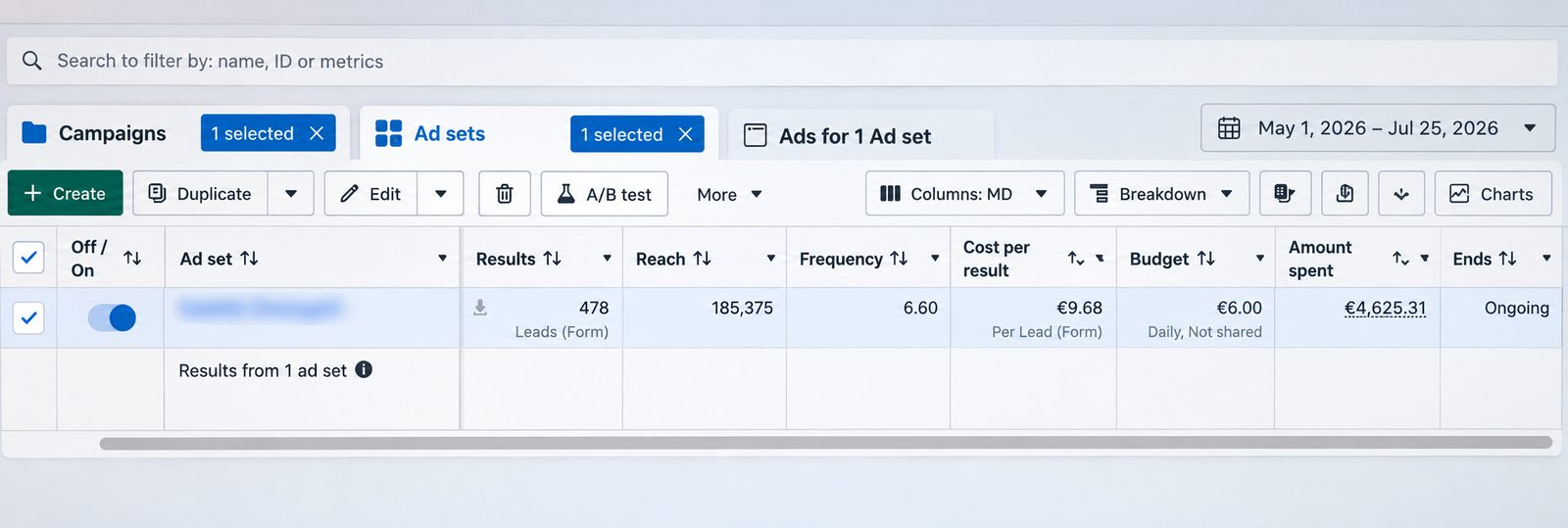
This is a lead generation campaign we ran on Facebook and Instagram from 1 May to 25 July 2026. It brought 478 form leads from €4,625.31 of ad spend, which is €9.68 per lead, on a €6.00 daily ad set budget. The screenshot is straight from Meta Ads Manager, with the ad set name blurred.
Want a steady flow of applicants for your open roles? Message us on WhatsApp
Follow-up
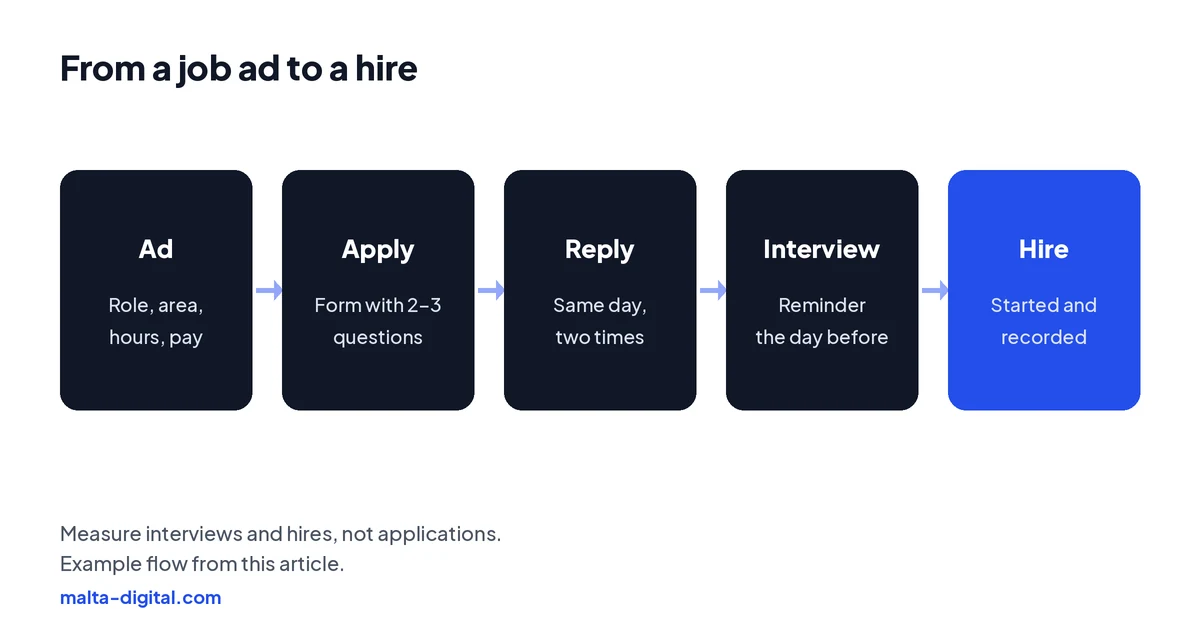
Reply the same day, by WhatsApp or phone, and offer two interview times: “Can you come on Wednesday at 10:00 or Thursday at 15:00?” A choice gets far more yeses than “when are you free?”. Send the address and what to bring, and a reminder the day before. Candidates who are already working often have little time, so a short call or video interview as the first step helps.
Keep a simple record for every applicant: contacted, interview booked, attended, offered, started. After two weeks you can see which ads bring people who actually start, and move the budget to them. If many people apply but few attend interviews, the problem is usually the ad promising one thing and the call revealing another, often pay or hours.
Be kind to the people you do not hire. A short, polite reply costs nothing, and on an island this size the same people will see your next job ad, and talk to their friends about how you treated them.
Targeting and budget
With the employment category, targeting is mostly location plus the ad itself. Choose Malta, or a radius around your workplace that covers a realistic commute, and keep the audience broad. Let Meta’s delivery find people likely to apply, and let the ad do the filtering by naming the role, the area, the hours and the requirements.
Run each role, or each group of similar roles, as its own ad set or campaign, so you can see which role is filling and stop spending on one that is full. Refresh the creative every few weeks for roles you hire all year round, because on a small island the same people see your ads quickly.
For budget, start with an amount that brings enough applications to judge within two weeks, rather than a tiny daily spend spread over many roles. Our Meta ads management starts from €1,249 a month plus ad spend, excluding VAT, and we agree the ad budget with you based on how many people you need to hire and how quickly.
How we do it
We start with the roles: what the job really involves, the pay range, the hours, the requirements and how many people you need. Then we set up the campaign in the employment category, write the ads within Meta’s rules, film or brief the videos, build the lead form with the right screening questions and connect it to the phone or inbox of the person who will call.
Every week we look at applications, interviews and hires with you and move the budget to the roles and ads that bring people who start. Our case studies show the kind of tracked results we report, straight from Ads Manager.
A few straight answers
Yes, especially for hospitality, care, retail, driving and trade roles, when the ad shows the role, area, hours and pay and someone replies the same day.
Yes. Job ads reaching people in Malta must be declared as employment ads, whether you are the employer or a recruitment agency.
Age, gender and postcode targeting, exclusions, lookalike and saved audiences and some interests. City locations use an expanded radius of about 15 km.
Yes. A clear pay range brings more and better applicants, because people can tell whether the job is worth their time.
A lead form with two or three screening questions brings the most applications; WhatsApp suits people who want to ask first. Judge both by interviews and hires.
Malta Digital’s Meta ads management starts from €1,249 a month plus ad spend, excluding VAT.
Keep reading
Form setup, follow-up and judging cost per customer, not just cost per lead.

Setup, the first message, cost and the free 7-day window, examples and measuring chats that become sales.

Location, age, interests, custom and lookalike audiences, and why broad usually beats narrow on a small island.
A useful first step
We set up job ads in the employment category, write them within Meta’s rules, build lead forms that screen applicants and track interviews and hires. Meta ads management from €1,249 a month plus ad spend, excluding VAT.