
Meta Business Manager, set up properly
Create a business portfolio, add your assets, give agencies partner access, stay secure and verify your business.
Facebook & Instagram ads · Targeting
Facebook ads targeting in 2026 works in two layers. A few settings are hard limits that Meta must respect, such as the location (Malta, Gozo or a radius around a locality), the minimum age and any audiences you exclude. Everything else, including interests, age ranges, custom and lookalike audiences, is mostly treated as a suggestion that Meta’s Advantage+ audience can go beyond. On a market as small as Malta, the best strategy is usually to set the limits carefully, keep the rest broad, and let your ad, your offer and your tracking tell Meta who to show it to.

The short answer
A few years ago, targeting was the main skill in Facebook advertising. You picked interests such as “home improvement” or “yoga”, stacked them, excluded a few others and hoped you had found your customers. Today most of that work has moved inside Meta’s delivery system. When you create an ad set, Advantage+ audience is switched on by default for most objectives, and the age ranges, interests and audiences you add are read as hints about who to start with, not walls Meta has to stay inside.
What you still control firmly are the audience controls: the locations, the minimum age, the audiences you want excluded and, if you choose, the languages. Meta will not show the ad outside those. Inside them, it looks for the people most likely to do what you optimise for, whether that is a lead, a WhatsApp chat or a purchase, using its own data and the signals your Pixel and Conversions API send back.
That changes what “good targeting” means for a Malta business. It is less about finding a clever interest and more about three things: setting the controls correctly for where you actually sell, giving Meta good data about who became a customer, and writing ads that make the right people stop and the wrong people scroll past.
Where your customers are
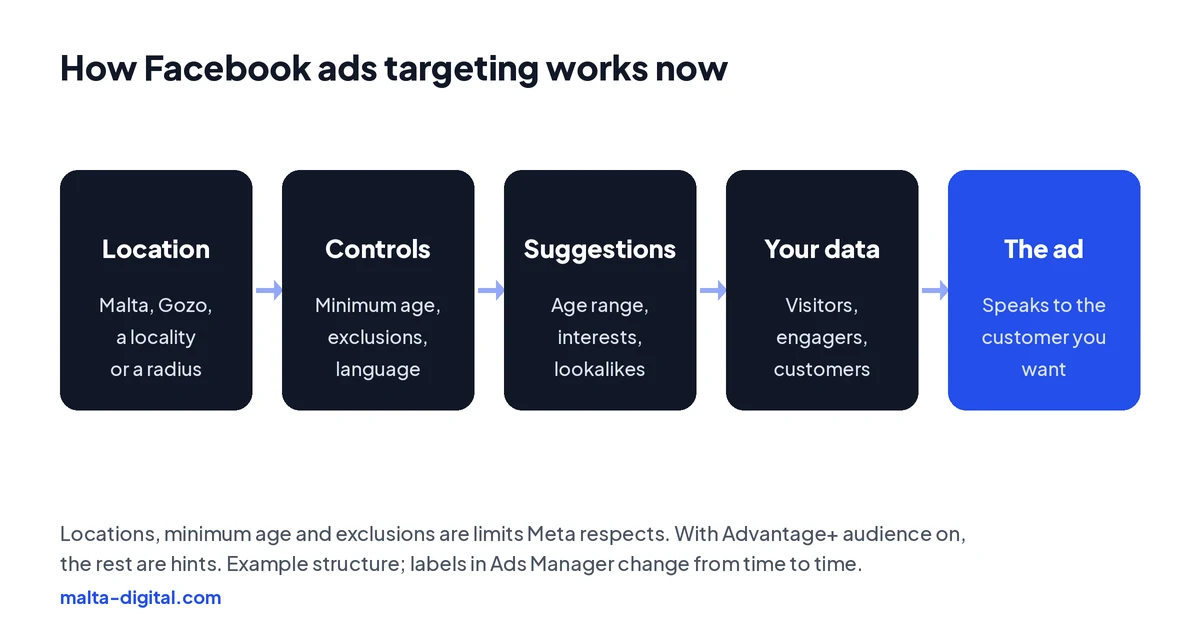
Location is the setting that matters most, and the one most businesses in Malta get slightly wrong. You can target the whole country, a town or locality, or a radius around a pin, and you can exclude places. A pastry shop in Rabat that only delivers locally does not need to pay for people in Marsaskala; a clinic in Victoria may want Gozo plus a small part of the north of Malta for patients who take the ferry; an online shop that delivers everywhere should simply target Malta.
The thing to know is that Meta no longer lets you choose only residents or only tourists. Location targeting now reaches people who live in an area or have recently been there, and Meta says it cannot guarantee complete accuracy. In practice that means a summer campaign in St Julian’s will reach visitors as well as residents. If you sell a gym membership or a kitchen renovation, write the ad so that it is obviously for residents (“for homes in Malta and Gozo”, a Maltese phone number, a monthly plan). If you want tourists, say so in the ad and the image instead of relying on a setting that no longer exists.
Ads in the housing, employment, and financial products and services categories are different. In Malta and the rest of the EU they must be declared as a special ad category, and location then works with a minimum radius of about 15 km around a point, with no age, gender or postcode targeting. On an island this size, 15 km around Birkirkara already covers most of Malta, so the restriction matters less than people fear.
Who sees the ad
Set a minimum age when there is a real reason: alcohol, cosmetic treatments and some financial products need 18 or more, and a few of Meta’s own policies require it. Beyond that, an age range you type in is treated as a suggestion when Advantage+ audience is on. That is usually fine. Many Malta businesses assume their customer is “women aged 30 to 45”, then find that a good share of their buyers are older, younger or men buying gifts.
Gender targeting is rarely worth it outside products that are clearly for one group, and it is not available at all in the special ad categories. Leave it open and let the creative do the work: an ad showing a men’s barber cut will mostly be clicked by the people it is meant for.
Language targeting matches the language people use Facebook and Instagram in. Meta’s own advice is to leave it empty unless your ad is in a language that is not common in the location. For Malta that is useful in a narrow way: an ad written in Italian, Serbian or Filipino for one community, for example. For an English or Maltese ad aimed at everyone, leave it blank, or you may quietly cut out customers who use the app in another language.
Interests and behaviours
Detailed targeting is the list of interests, behaviours and demographics, such as “interested in interior design” or “recently moved”. Meta has cut it back several times. Health and other sensitive interests went in 2022. In 2025 Meta removed detailed targeting exclusions, so you can no longer say “not interested in X”, and it consolidated many narrow interests into broader groups. For many optimisation goals, including conversations, landing page views and website conversions, Advantage+ detailed targeting is applied automatically, so Meta may reach people outside the interests you picked when it expects better results.
On a market of Malta’s size this is not a loss. Stack three narrow interests on top of “Malta, 25 to 55” and the audience becomes so small that costs rise and the same few thousand people see your ad again and again. Interests are useful as a starting hint for a brand-new account with no data, for example “weddings” for a wedding photographer, but they are rarely the reason a campaign works.
The common mistake is to change interests every few days when results are poor. If the ad is weak or the offer is unclear, a new interest will not fix it. Change the ad first; touch the targeting last.
Your own audiences
Custom audiences are built from your own data, and they are still the most valuable targeting you have. You can create them from people who visited your website (up to 180 days back), people who engaged with your Facebook Page or Instagram account (up to 365 days), people who watched your videos, people who opened or sent your lead form, and customer lists you upload.
Use them in two ways. First, for retargeting: showing a reminder or an offer to people who visited a product page or asked about a price but did not book. Second, for exclusions: keeping existing customers out of an ad for new customers, so you do not pay to show a “first visit” discount to people who already come every month. Exclusions of custom audiences are still hard controls, even though interest exclusions are gone.
Customer lists need care under GDPR. Upload only people you have a lawful basis to use this way, tell them in your privacy notice that you use their details for advertising on social media, and let Meta hash the data during upload. A list of 200 customers from a shop in Paola is small, but as an exclusion or as a lookalike source it is genuinely useful.
Proof
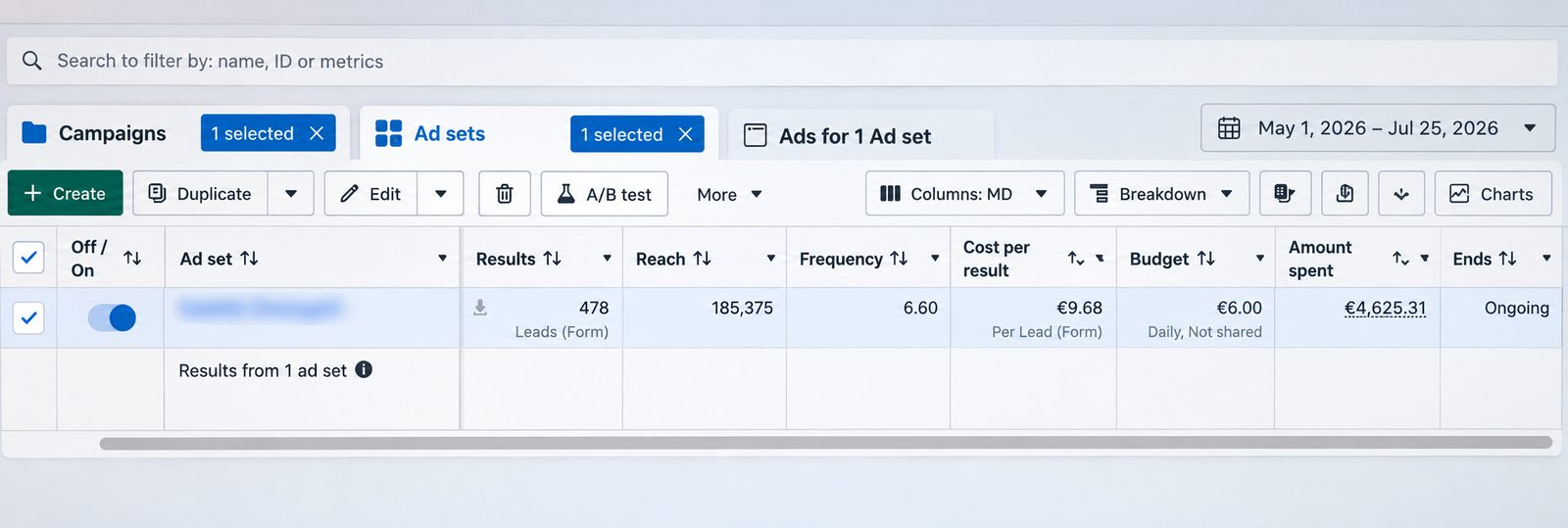
This is a lead generation campaign we ran on Facebook and Instagram from 1 May to 25 July 2026. It brought 478 form leads from €4,625.31 of ad spend, which is €9.68 per lead, on a €6.00 daily ad set budget. The screenshot is straight from Meta Ads Manager, with the ad set name blurred.
Want enquiries like this from the right people in Malta? Message us on WhatsApp
Send us your ad account or Facebook page on WhatsApp. We’ll check your locations, audiences and exclusions and tell you what we’d change. Free, no obligation.
Finding more like them
A lookalike audience asks Meta to find people who resemble a source audience, such as your customers or your best leads. The source needs at least 100 people from one country, and Meta suggests 1,000 to 5,000 for better results. You choose a size from 1% to 10% of the people in the target country: 1% is the closest match, 10% is broader.
Malta changes the maths. Because the country is small, a 1% lookalike is a small group of people, and the gap between 1% and 10% is less dramatic than in a large country. For most local businesses, a lookalike of past customers is worth testing against a broad Malta audience, but it is often not the winner it would be in Germany or the UK. With Advantage+ audience switched on, Meta also treats a lookalike as a suggestion rather than a limit.
Lookalikes are not available for the housing, employment and financial products and services categories. A good source matters more than the percentage: a list of 300 people who actually bought is a better seed than 5,000 people who once liked a post.
Broad or narrow?
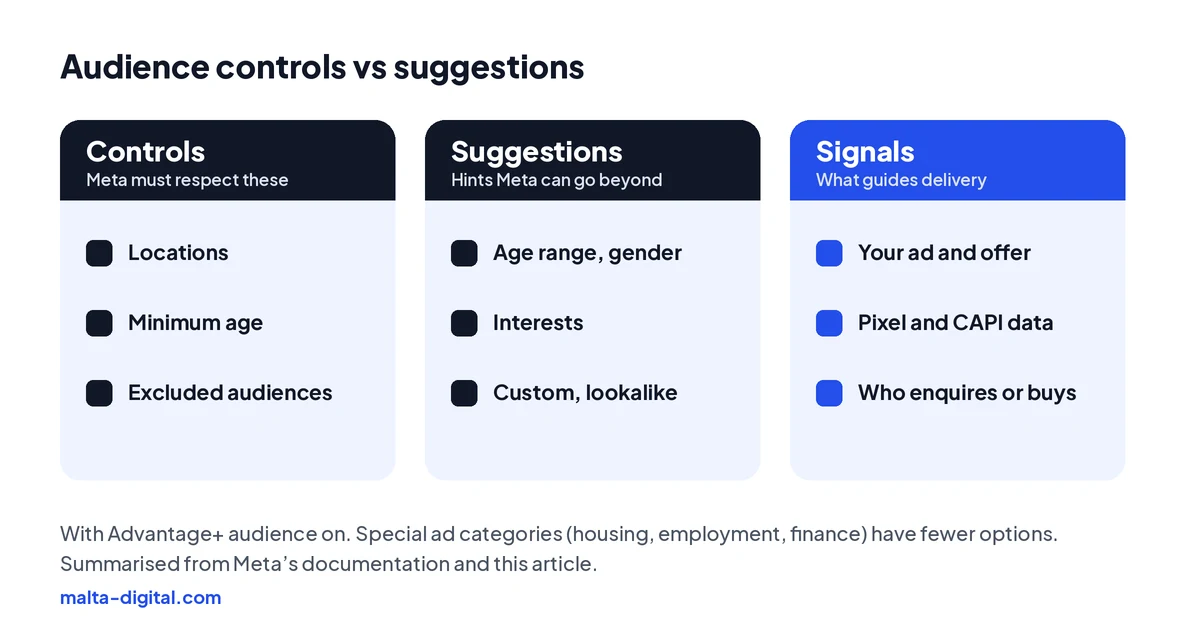
For most businesses we work with, the starting point is simple. One campaign for new customers, targeting Malta (or the area you actually serve) with Advantage+ audience on, the right minimum age, and existing customers excluded. A second, smaller campaign for warm audiences: website visitors, Instagram engagers and people who opened your form. Then a handful of strong ads in each, so Meta has something to learn from.
The real targeting happens in the ad. An ad that names the locality, the problem and the price range (“Bathroom renovations in the north of Malta, from design to tiling”) attracts the people it describes and puts others off, which is exactly what you want. Meta reads who stops, clicks and enquires, and finds more of them.
Give it time and data. On a small budget, Meta needs a couple of weeks and enough results to settle. Splitting €20 a day across six ad sets with six different interest groups gives none of them enough to learn, which is why broad, simple structures usually beat clever ones on the Maltese market.
| Broad (Advantage+ audience) | Detailed targeting (interests) | Custom and lookalike audiences | |
|---|---|---|---|
| What it is | Location, minimum age and exclusions; Meta finds the people | Interests, behaviours and demographics as a starting hint | Your own data: visitors, engagers, customer lists, and people like them |
| Hard limit or hint | Controls are limits; the rest is open | Usually a suggestion Meta can go beyond | Exclusions are limits; inclusions are suggestions with Advantage+ audience on |
| Best for | New customers across Malta or your area | A brand-new account with no data yet | Retargeting, excluding customers, finding more like your best customers |
| Watch out for | Weak ads attract the wrong people | Narrow stacks shrink a small market fast | GDPR basis for customer lists; no lookalikes in special ad categories |
How we do it
We start with the business, not the settings: where you deliver or serve, who your best customers are, what they buy first, and how they like to get in touch. From that we set the controls (locations, minimum age, exclusions), build the custom audiences from your website, Instagram and customer list, and write ads that speak to the customer you want. Tracking comes first, so Meta learns from real enquiries and sales, not clicks.
After launch we read the results by age, placement and location, and adjust the ads and the offer before touching the targeting. Our Meta ads management starts from €1,249 a month plus ad spend, excluding VAT, and the ad account and audiences stay in your name.
Common mistakes
Stacking narrow interests until the audience is a few thousand people and every ad costs more. Targeting a 1 km radius around the shop when customers drive from all over the island. Assuming the residents-only setting still exists and wondering why tourists are messaging. Forgetting to exclude existing customers from new-customer offers. Setting a language that cuts out half the audience. And, the most common one, changing the targeting when the real problem is the ad, the offer or how fast someone replies.
A few straight answers
Locations, minimum age and exclusions are hard controls. Interests, age ranges, custom and lookalike audiences are mostly suggestions that Advantage+ audience can go beyond to find people likely to act.
No. Meta removed the “people living in this location” option. Location targeting reaches people who live in or were recently in the area, so use your ad to make clear who it is for.
Usually a broad audience: Malta or the area you serve, the right minimum age, existing customers excluded and Advantage+ audience on, plus a smaller campaign for website visitors and Instagram engagers.
No. Meta removed detailed targeting exclusions in 2025. You can still exclude custom audiences, such as existing customers.
At least 100 people from one country. Meta suggests 1,000 to 5,000 for better results.
Yes. Housing, employment and financial products and services ads in the EU cannot use age, gender or postcode targeting or lookalikes, and need a radius of about 15 km.
Ours starts from €1,249 a month plus ad spend, excluding VAT.
Keep reading
Create a business portfolio, add your assets, give agencies partner access, stay secure and verify your business.

How to search competitors’ ads, what EU ads reveal about targeting and reach, and what the Library cannot show.

Find the reason in Account Quality, fix policy, payment or security issues, and request a review that works.
A useful first step
We set the controls, build your audiences from your own data and write ads that find the right people, from €1,249 a month plus ad spend, excluding VAT.