How much to spend on Facebook ads
A free budget planner using Meta’s own caps and the learning phase.
Facebook & Instagram ads · Guide
To run Facebook ads for a business in Malta, set up a Meta business portfolio and ad account in your own name, install tracking, choose one objective in Ads Manager (usually Leads or Sales), start with a broad Malta audience, and test a few strong ads for long enough to learn. This guide walks through each step, with the Malta details most guides miss.

Set up a Meta business portfolio and ad account in your name, add tracking, pick one goal (usually Leads or Sales), target Malta broadly and test 2 or 3 strong ads for at least a week. Malta Digital does all of this for you in Meta ads management in Malta, from €1,249 a month plus ad spend.
Before you start
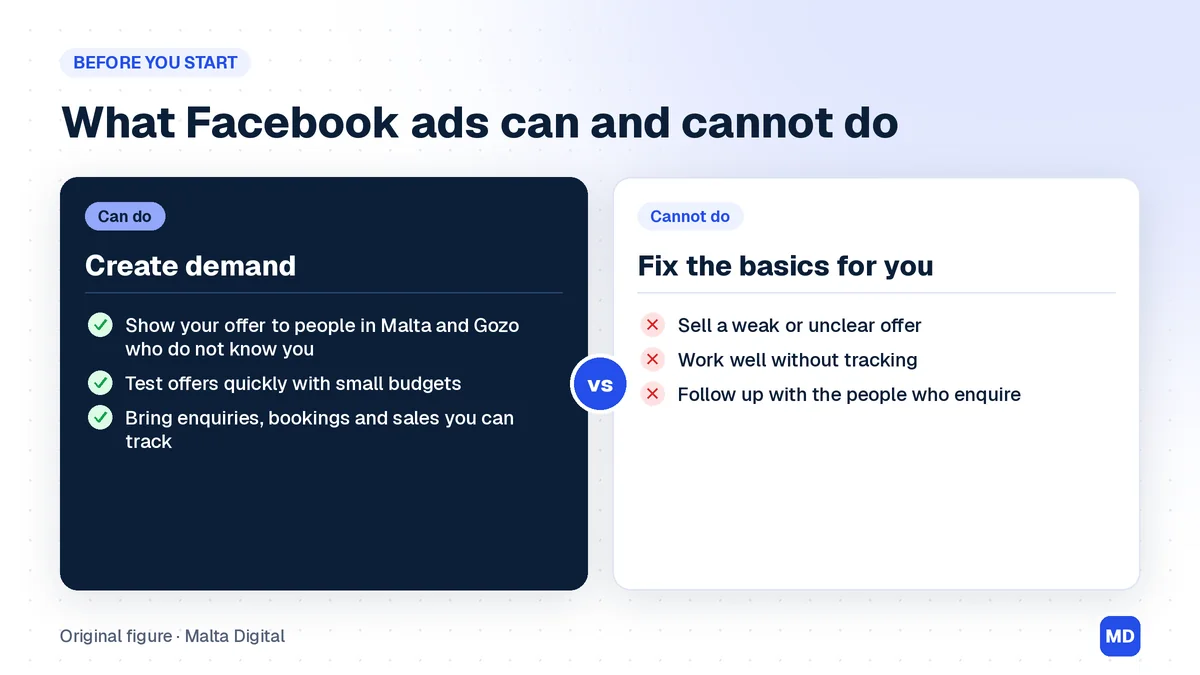
Facebook ads put your business in front of people in Malta and Gozo who have never heard of you, on Facebook, Instagram, Messenger and WhatsApp, from one tool called Ads Manager. They are excellent at creating demand: showing a new restaurant, a clinic offer or a product to the right people at the right moment.
Example sceneA Birkirkara gym boosts a post for €50 on a Friday. It gets 300 likes and no new members. The next month it runs a Leads campaign with a “free first class” form, and the owner calls each lead within the hour. Same island, same budget, a different goal.
They are not a switch you flip for instant sales. Meta needs data to learn who responds, your offer has to be clear, and someone has to follow up. Businesses that treat the first three months as a test usually do well; those that judge it after a week usually quit too early.
Step 1
Create a Meta business portfolio (formerly Business Manager) and an ad account inside it, both in your business’s name. Connect your Facebook Page and Instagram account, and add your payment method. If an agency or freelancer runs your ads, give them access as a partner; never let the ad account sit in their personal profile, because if you part ways you lose your history and data.
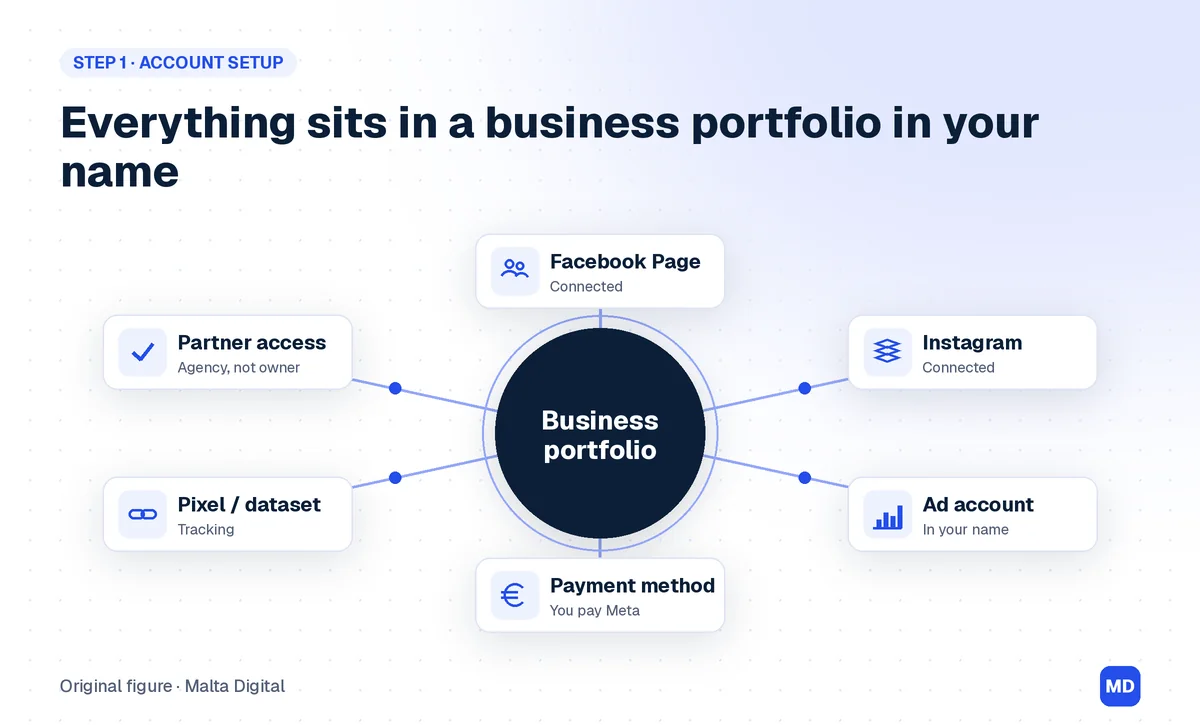
A clinic’s ad account sits inside a former freelancer’s personal profile. When they part ways, the clinic loses its ad history, its audiences and its pixel data. Setting it up in the clinic’s own business portfolio takes ten minutes and avoids all of that.
Step 2
The Meta Pixel on your website, ideally with the Conversions API alongside it, tells Meta who enquired or bought after seeing an ad. Without it, Meta can only optimise for clicks, and clicks are not customers. If you sell through forms or WhatsApp rather than a website, you can still track leads and conversations inside Meta.
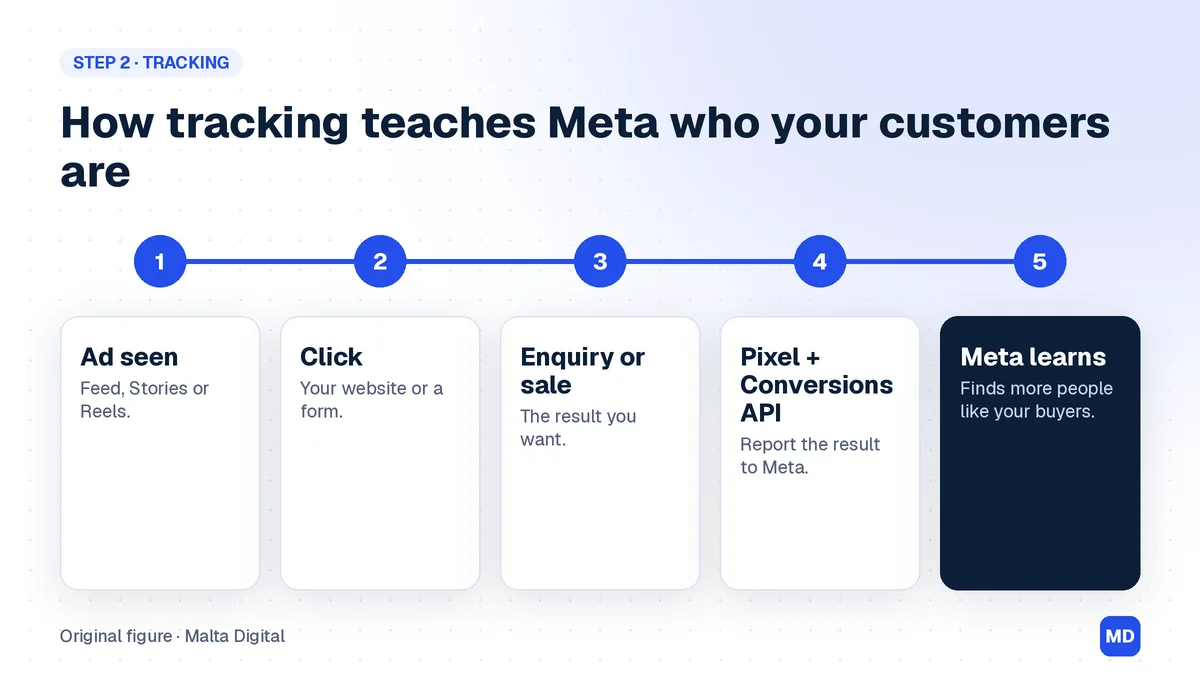
The Pixel is a small piece of code on your website that reports visits, enquiries and purchases. The Conversions API sends the same events from your server, so fewer get lost to ad blockers and browser privacy settings. Both feed the same result into Ads Manager.
Step 3
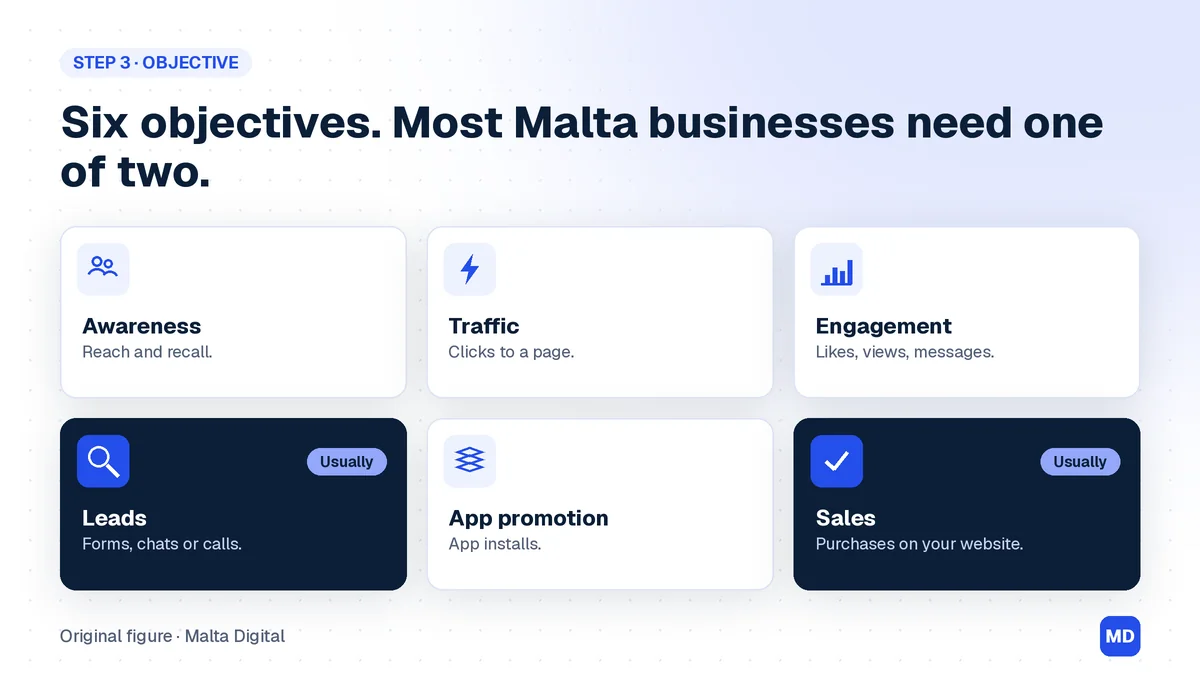
Ads Manager offers six objectives: Awareness, Traffic, Engagement, Leads, App promotion and Sales. For most Malta businesses the honest choice is Leads (forms, WhatsApp chats or calls) or Sales (purchases on your website). Engagement and Awareness get you likes and views, which feel good but rarely pay the bills on their own. Our guide to Facebook ads objectives explains each one in detail.
Step 4
You pay Meta directly for ad spend, and you set the amount. Pick a daily budget you can keep running for around 90 days without needing the money back in the first month. Spread too thinly across many campaigns, Meta never gets enough results to learn. One or two campaigns with a sensible budget beat ten tiny ones.
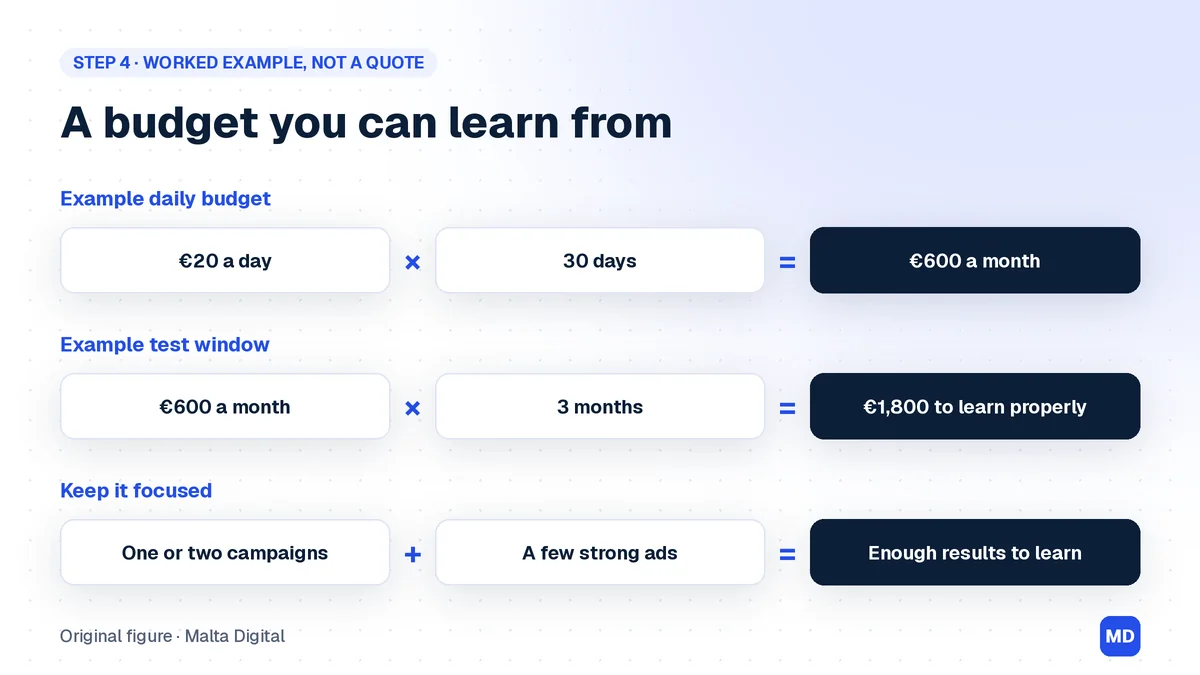
€20 a day is about €600 of ad spend a month. Over a three-month test that is about €1,800. That buys Meta enough results to learn, if it all goes into one or two campaigns. The same €1,800 split across eight campaigns teaches Meta almost nothing.
Step 5
Malta is small, so stacking narrow interests usually makes ads more expensive, not more precise. Start broad: Malta (or the localities you serve), the right age range, and let good creative do the targeting. Meta no longer lets you pick only residents or only visitors: location targeting reaches people who live in or were recently in the area. So a Sliema restaurant chasing visitors and a Gozo clinic serving residents both make the difference clear in the ad itself, not in a setting.
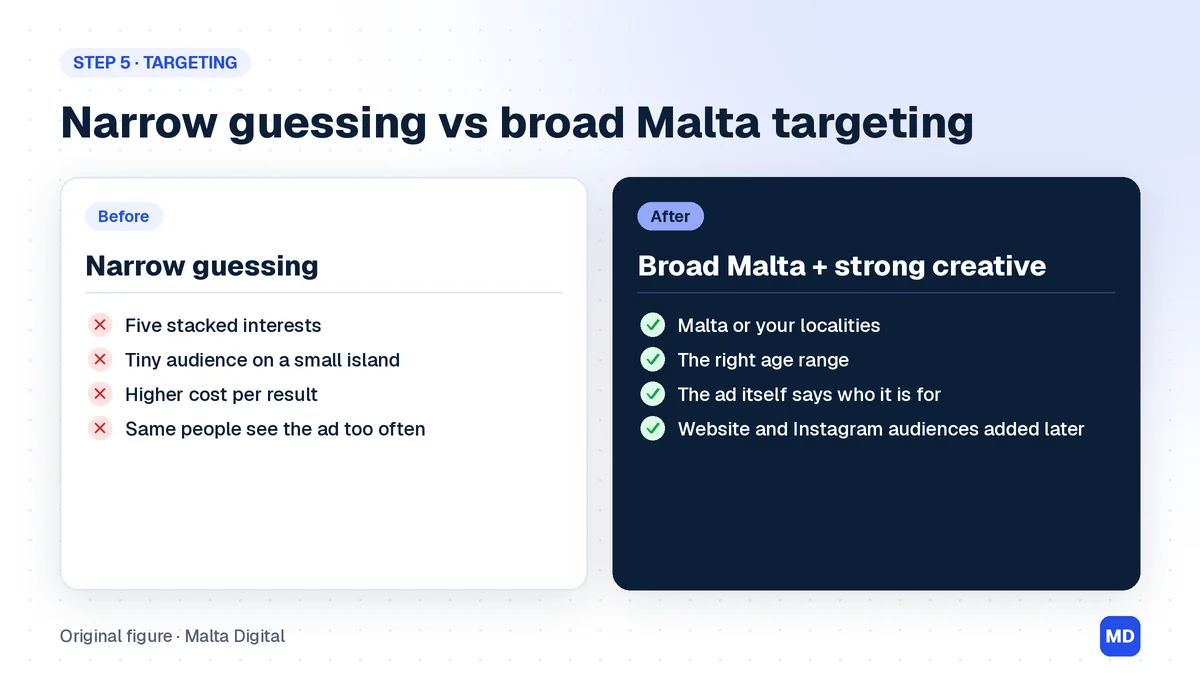
Later, add audiences that work well everywhere: people who visited your website, engaged with your Instagram, or are already customers (for exclusion or for repeat offers).
Malta facts
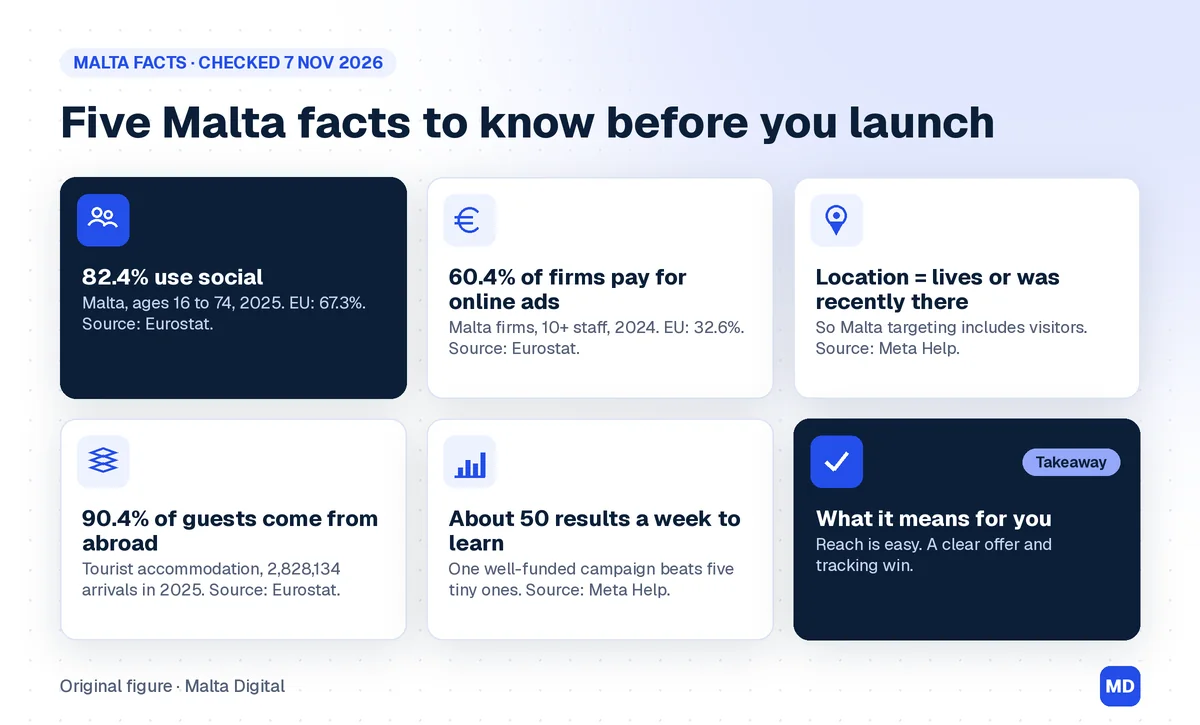
Your audience is already online. In 2025, 82.4% of people aged 16 to 74 in Malta used social networks. The EU figure was 67.3% (Eurostat isoc_ci_ac_i). Reach is rarely the problem. A clear offer is.
The auction is busy. In 2024, 60.4% of Malta firms with 10 or more staff paid to advertise online, against 32.6% across the EU (Eurostat isoc_cismt). Expect local competitors in the same feeds.
Location means “lives or was recently here”. Meta shows ads to people who live in your chosen area or were there recently (Meta Business Help: Choose locations for your ad). In Malta that includes visitors. If you pick a city, Meta may also tick a box that adds people interested in travelling there. Untick it if you only want locals.
Most hotel guests come from abroad. Malta’s tourist accommodation had 2,828,134 guest arrivals in 2025, and 90.4% came from other countries (Eurostat tour_occ_arnraw). Tourism businesses should read Facebook ads for tourism businesses in Malta.
Meta needs about 50 results a week to learn. An ad set usually leaves the learning phase after about 50 results in the week after its last big edit (Meta Business Help: About the learning phase). That is why one well-funded campaign beats five tiny ones.
Apply now and send us your Facebook page or ad account. We’ll tell you honestly what we’d do first. Free, no obligation.
Step 6
Real photos and short vertical videos of your product, your place and your work almost always beat stock images. Put the offer in the first second and the first line, say what it costs or what happens next, and make a 9:16 version for Reels and Stories. Most Malta audiences are happy with English; Maltese can stand out for local, warm audiences and is worth testing.
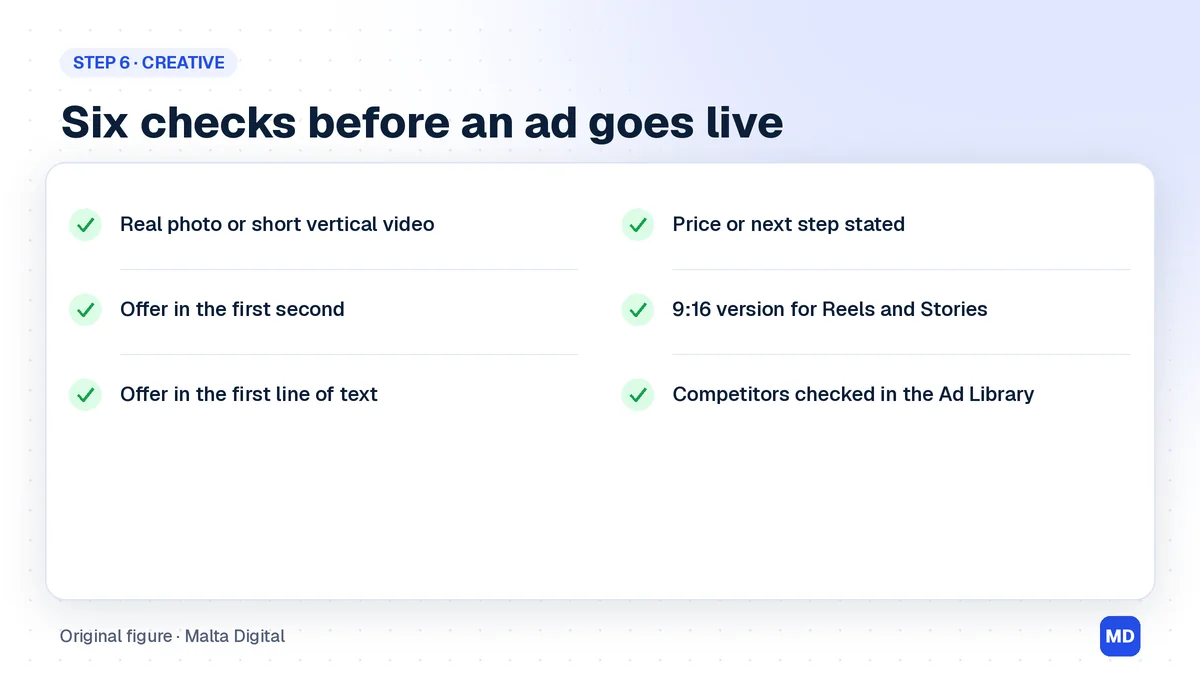
Before you start, open the free Meta Ad Library and search your competitors. You will see every ad they are running right now, which is the fastest way to learn what your market already responds to.
Proof
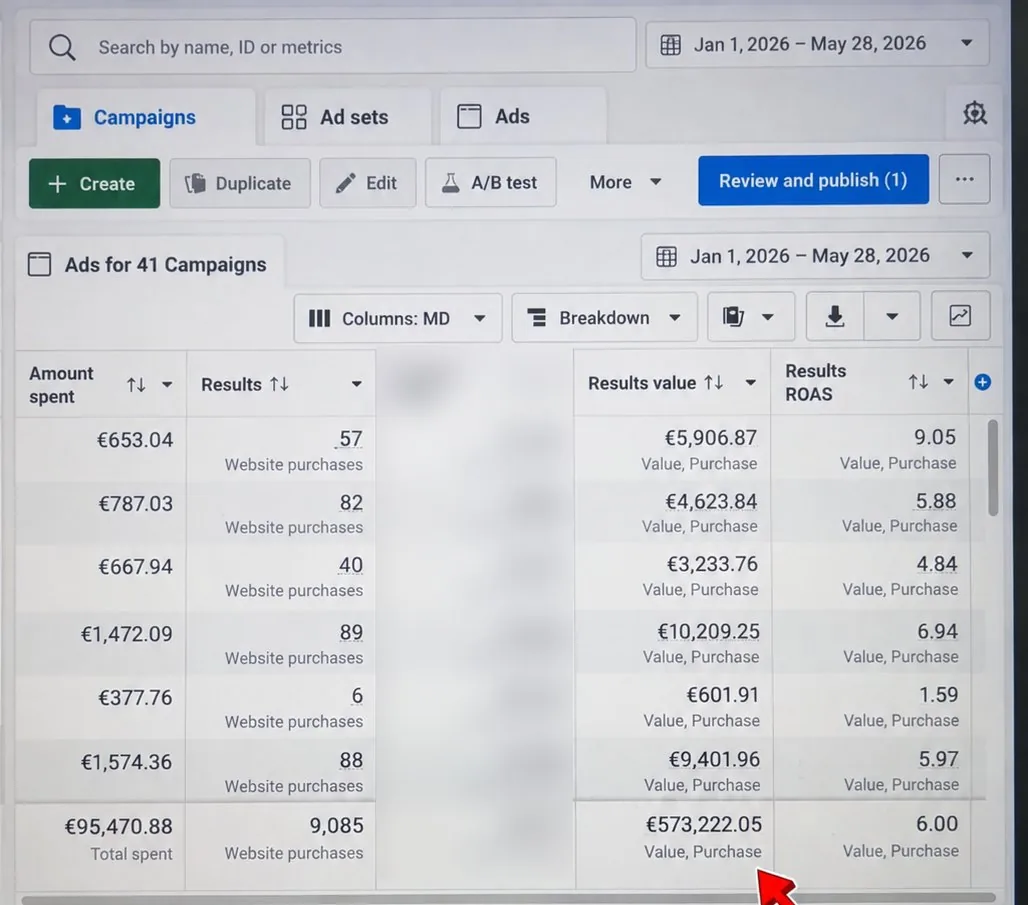
From 1 January to 28 May 2026, an online store we ran ads for spent €95,470.88 on Facebook and Instagram. Meta Ads Manager tracked 9,085 website purchases worth €573,222.05, an average ROAS of 6.00.
Want results like this from your ads? Apply now for Meta ads
Worked example
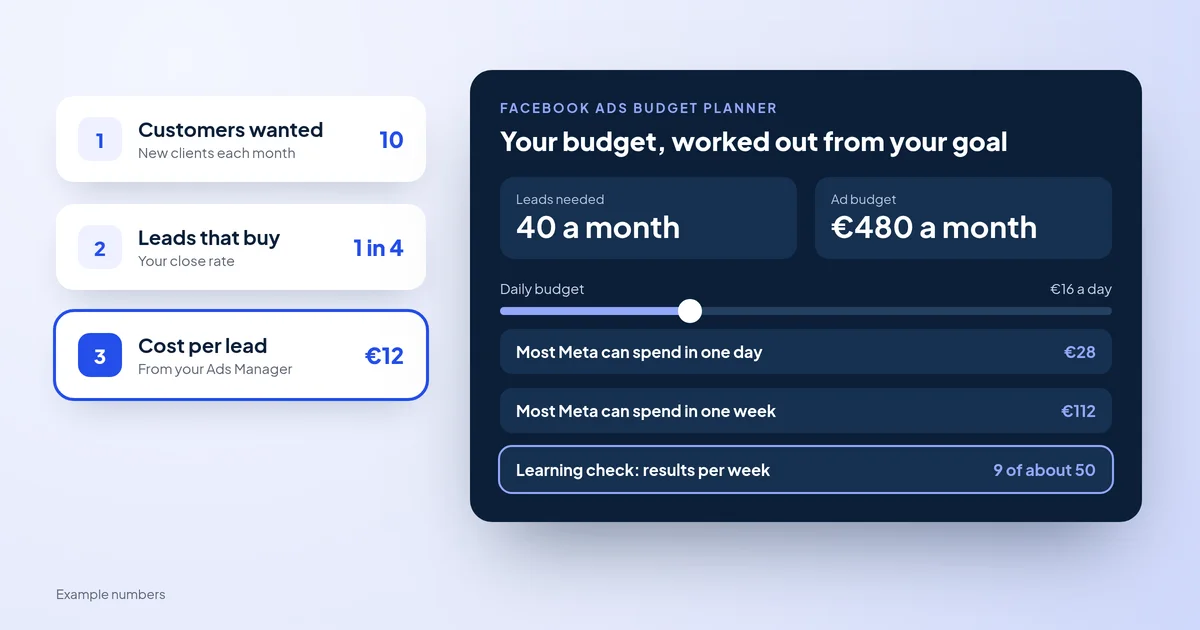
In one lead campaign we ran, each form lead cost €9.68. If a new ad set got leads at that price, reaching 50 leads in one week would take about €484 of ad spend that week (50 × €9.68).
Split the same money across five ad sets and each gets about €97 a week. At that price, none of them reaches 50 results, so none leaves learning. Your own cost per lead will differ. Our budget planner works it out from your numbers.
| Step | What “done” looks like | Typical time |
|---|---|---|
| Accounts | Portfolio, ad account, Page and Instagram in your business’s name | 1 hour |
| Tracking | Pixel fires on your thank-you or booking page | 1 to 3 hours |
| Goal | One campaign on Leads or Sales | 15 minutes |
| Creative | 2 to 3 ads, with a 9:16 version for Stories and Reels | Half a day |
| Budget | A daily amount you can keep for 90 days | 15 minutes |
| Review | Cost per result read after a full week, not daily | Weekly |
Times are our own estimates for a simple setup, not Meta figures. For video, see Facebook video ads: lengths and shapes.
Free tool
Use the planner to try your own numbers. Type the results you want each month and what one result costs you. The planner stays on your device. The same formulas are written out on our Facebook ads budget guide.
Type the results you want and what one result costs you. The planner works out the budget, then checks it against Meta's own learning guidance. Everything stays on your device.
This planner needs JavaScript. You can do the same maths on the budget guide linked above.
Step 7
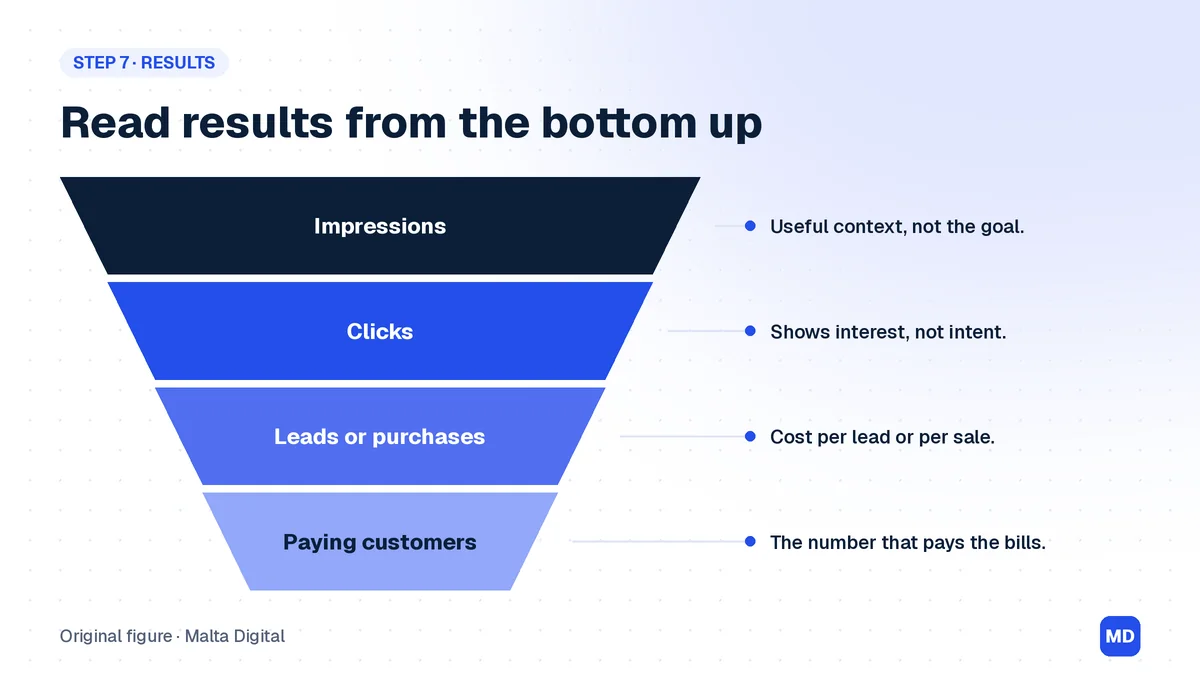
Give a new campaign at least a week before judging it, and avoid editing it every day, which resets Meta’s learning. Then look at the numbers that matter: cost per lead or per purchase, and, more importantly, how many became paying customers. Switch off the weakest ads, keep the winners, and add fresh creative every few weeks, because on a small island the same people see your ads quickly.
DIY or help
If your budget is small and you enjoy learning, running ads yourself is a good way to start. Once ads are a real part of your sales, an experienced specialist usually pays for the fee through better tracking, testing and creative. Ask any agency for real Ads Manager screenshots, ask who actually runs your account, and make sure the ad account stays in your name. We compare the three routes in Meta ads agency vs freelancer vs DIY. Malta Digital has 18 Google reviews, and management starts from €1,249, €2,449 or €3,449 a month plus the ad spend you pay Meta.
| Do it yourself | Specialist or agency | |
|---|---|---|
| Suits | Small budget and time to learn | Ads are a real part of your sales |
| Tracking, testing, creative | You learn and do it | Done by someone experienced |
| Cost | Your time plus ad spend | Ours: from €1,249 a month plus ad spend |
| Ad account | In your name | Should stay in your name |
A few straight answers
Set up a business portfolio and ad account in your name, install tracking, pick one objective in Ads Manager, start with a broad Malta audience and test a few strong ads for several weeks.
You set the ad spend and pay Meta directly. Our management starts from €1,249 a month plus ad spend.
No. Posting is free, but ads and boosted posts are paid.
A free public tool from Meta that shows the ads any Page is currently running. It is useful for checking competitors.
Some campaigns bring enquiries in the first weeks, but plan for about 90 days to test and improve.
Enough to run one campaign steadily for several weeks. Meta needs about 50 results in 7 days for a campaign to leave the learning phase, so a budget spread across too many campaigns rarely works. Our management starts from €1,249 a month plus ad spend.
You choose one of six objectives (Awareness, Traffic, Engagement, Leads, App promotion or Sales), set a budget and audience, add your ads, and Meta shows them to the people most likely to take that action.
Yes. Meta’s location setting reaches people who live in or were recently in your area, which includes visitors. Speak to visitors in the ad itself, because there is no tourists-only switch.
Usually one or two. Meta needs about 50 results a week per ad set to leave the learning phase, so splitting a small budget across many campaigns slows learning.
English reaches most people in Malta. Maltese can stand out with local, warm audiences. Test both with the same offer and keep the one with the lower cost per result.
No. Lead ads open a form inside Facebook and Instagram, and message ads open a chat. A website with the Meta Pixel is still best if you sell online, because Meta can then see each purchase.
Keep reading
A free budget planner using Meta’s own caps and the learning phase.
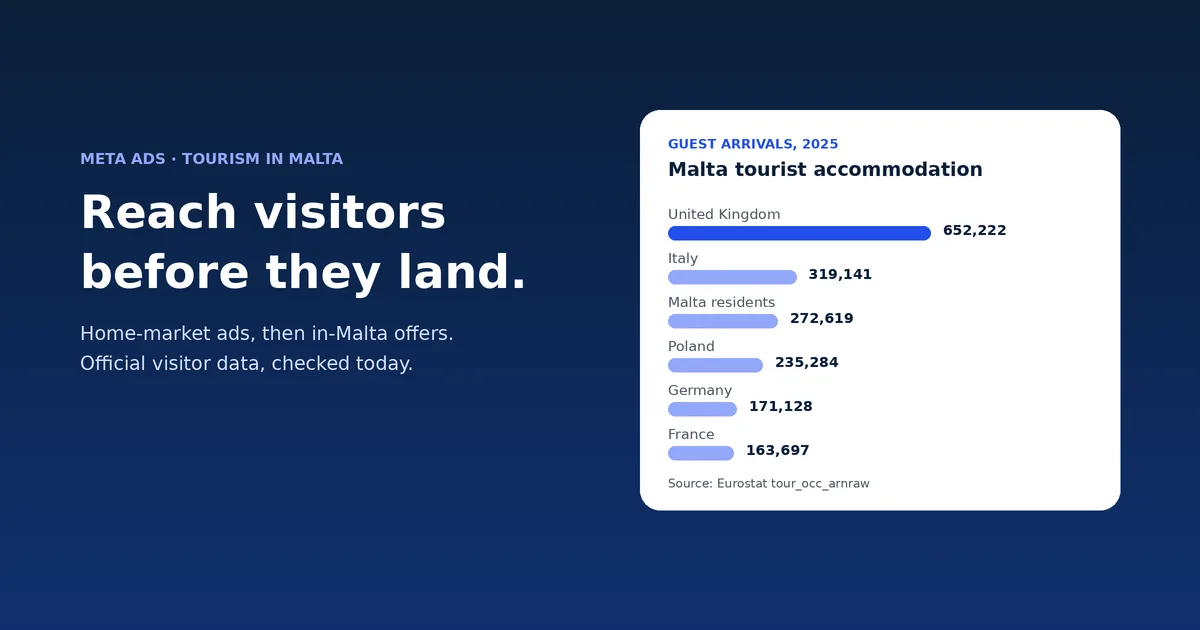
Reach guests at home, then on the island, with official arrival data.
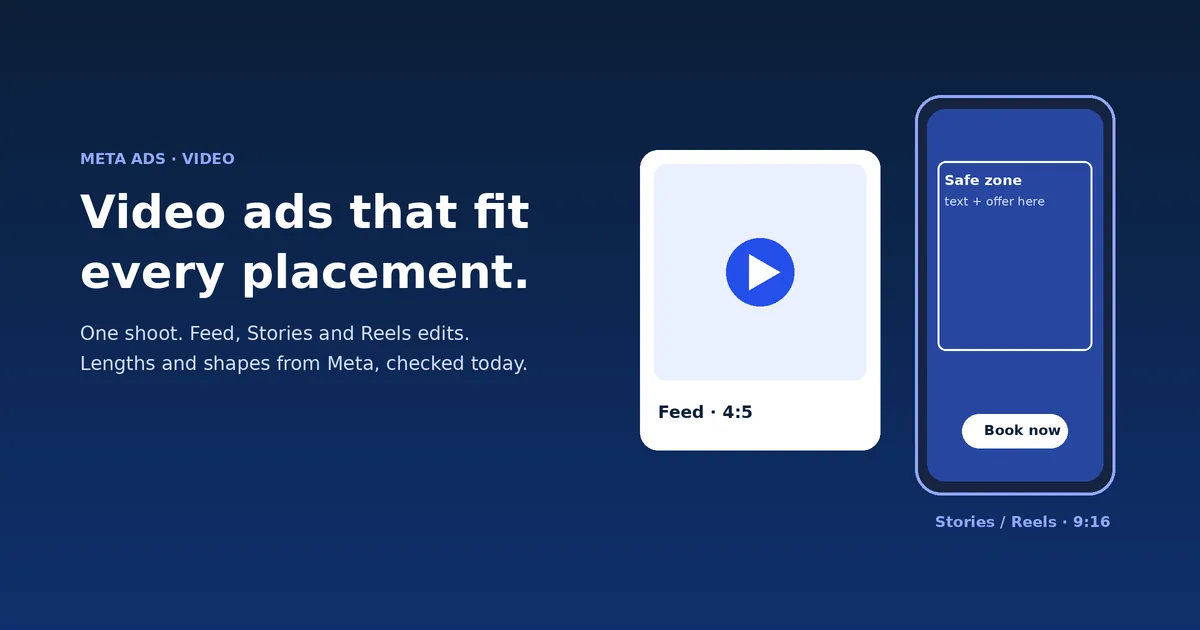
Lengths and shapes for each placement, plus a free video planner.
A useful first step
We run Facebook and Instagram ads for businesses in Malta and Gozo, from €1,249 a month plus ad spend.
Step 1 of 2
A few quick questions, about a minute. We usually reply within 2–3 hours.