
Facebook ads in Malta: a practical guide
Costs, setup, campaign types, creative and mistakes to avoid, with real Ads Manager results.
Facebook & Instagram ads · Campaign setup
Meta has six ad objectives: Awareness, Traffic, Engagement, Leads, App promotion and Sales. Choose the one that matches the result you want, because Meta shows your ads to the people most likely to take that action. For most businesses in Malta that means Leads for enquiries and bookings, Sales for online shops, and Engagement with a messaging app for WhatsApp chats. Traffic brings clicks, not customers. Malta Digital chooses the objective, conversion location and performance goal for every campaign we manage.
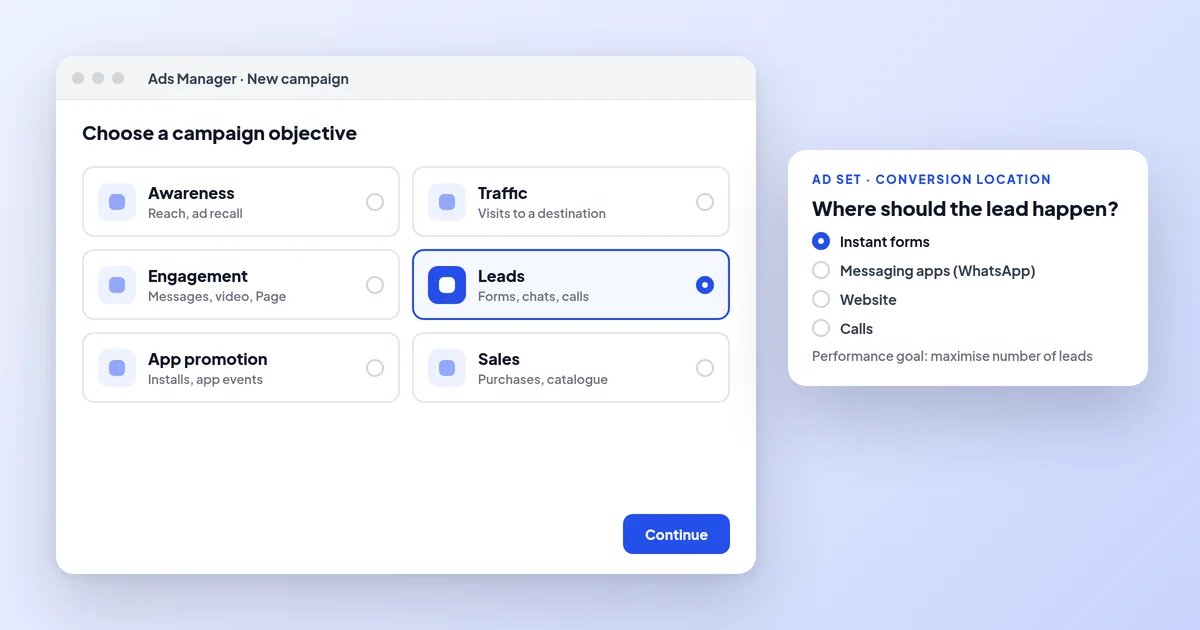
Meta has six ad objectives: Awareness, Traffic, Engagement, Leads, App promotion and Sales. Choose the one that matches the result you want, because Meta finds the people most likely to take that action. Most Malta service businesses should use Leads, online shops Sales, and WhatsApp campaigns Engagement or Leads with messaging apps. Malta Digital sets the objective for every campaign it runs.
The short answer
The objective is the first thing you choose in Ads Manager, and it is the most important. It tells Meta what result you want, and Meta then shows your ad to the people in your audience who are most likely to give you that result. Choose Traffic and Meta finds people who click. Choose Leads and it finds people who fill in forms or start enquiries. Same budget, same audience, very different people.
That is why so many businesses in Malta are disappointed by their first campaign. They choose Traffic or Engagement because the results look good, get lots of cheap clicks and likes, and wonder why the phone does not ring. The ads did exactly what they were asked to do. They were simply asked for the wrong thing.
In 2022 Meta replaced its old list of eleven objectives with six simpler ones. If you learnt Facebook ads a few years ago, things like Conversions, Messages, Reach, Video views and Catalogue sales still exist, but they now sit inside the six objectives as options you choose a step later.
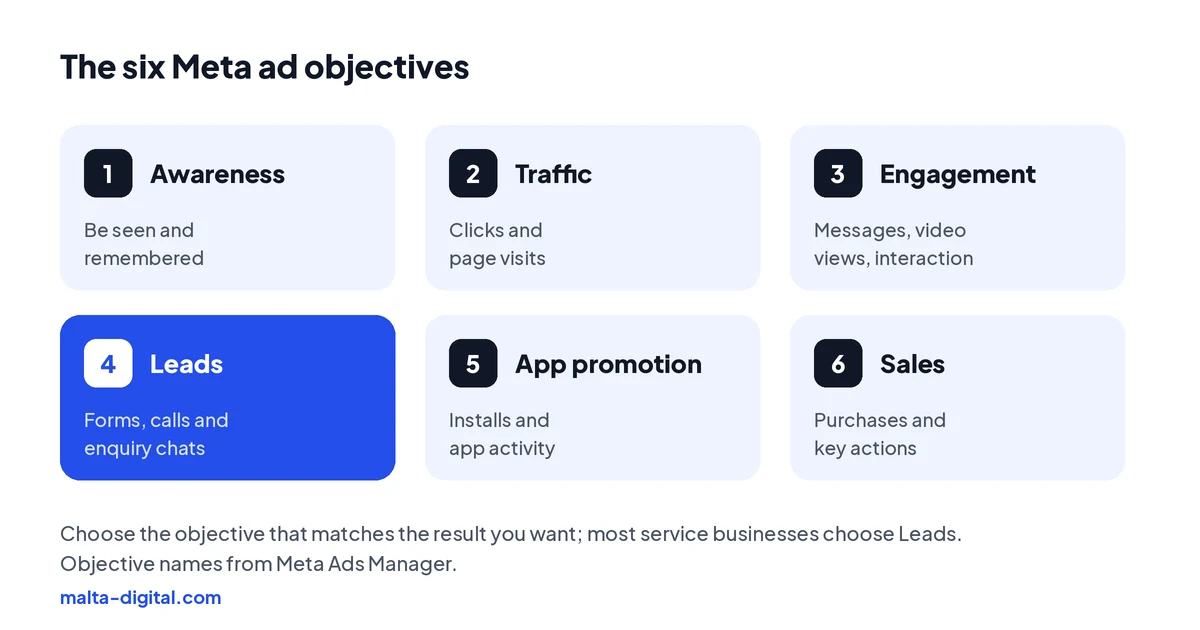
The six objectives
Awareness shows your ad to as many relevant people as possible, and to people likely to remember it. Reach, brand awareness, video views and store traffic for physical locations sit here. It suits a new opening, an event or a brand that needs to be known before people need it, but it will not bring many direct enquiries.
Traffic sends people to a website, an app or a chat. Meta optimises for link clicks or landing page views, so you pay for visitors, not for customers. We use it for content, such as a guide, and almost never for sales. Engagement finds people likely to interact: messages, video views, post engagement, or calls. This is where most click-to-WhatsApp and Messenger campaigns live.
Leads is for enquiries. People can fill in an instant form inside Facebook or Instagram, send a message, call you, or complete a form on your website. It suits clinics, contractors, real estate, schools and most service businesses. App promotion is only for businesses with their own app. Sales finds people likely to buy or complete a key action on your website, app, in chat or by phone, and it is where online shops and catalogue ads belong.
| Objective | What Meta looks for | Good for | Example in Malta |
|---|---|---|---|
| Awareness | People likely to see and remember the ad | Being known before people need you | A new restaurant in Valletta showing its opening |
| Traffic | People likely to click or load the page | Sending people to content, rarely for sales | Promoting a guide or a blog post |
| Engagement | People likely to message, watch, like or comment | WhatsApp and Messenger chats, video views | A contractor running click-to-WhatsApp ads |
| Leads | People likely to fill in a form, call or message to enquire | Enquiries and bookings | A clinic collecting consultation requests |
| App promotion | People likely to install or use an app | Businesses with their own app | An app getting new installs |
| Sales | People likely to buy or complete a key action | Online shops and website bookings | An online shop selling to Malta and Gozo |
Conversion location
After the objective comes the conversion location, chosen in the ad set. For Leads, you choose between instant forms, messaging apps, calls, your website, or a combination such as website and instant forms. For Sales, it is website, app, messaging apps, calls or a combination. This is often the choice that makes the most difference for small businesses in Malta.
Take a dentist in Birkirkara who wants new patients. Leads with instant forms usually brings the most enquiries at the lowest cost, because people never leave Instagram. Leads with a website form brings fewer but often more serious people, because they had to read the page first. Leads with messaging apps opens a WhatsApp chat, which suits people who would rather ask a quick question. All three are the Leads objective; the conversion location changes who comes in.
For website conversions you need the Meta Pixel, ideally with the Conversions API, set up to report the result you care about, such as a form submission or a purchase. Without it, Meta cannot see the result and cannot find more people like the ones who converted. Our guide to the Meta Pixel and Conversions API explains the setup.
Performance goal
Inside the ad set, the performance goal tells Meta exactly what to optimise for. With Leads and an instant form you can choose to maximise the number of leads, or to maximise conversion leads, which uses information from your CRM about which leads became customers. With Sales on a website, you can maximise the number of conversions or the value of conversions if you report sale values.
The goal should match what you can actually measure. If you only track form submissions, optimise for those. If your CRM can tell Meta which leads became bookings, conversion leads may bring better people. For video, ThruPlay counts plays of at least 15 seconds, or the whole video if it is shorter, and suits awareness and retargeting audiences rather than direct sales.
Do not change the goal often. Each major change can send the ad set back into the learning phase, and results jump around while Meta learns again. Choose carefully, give it time, and judge it on a few weeks of results rather than one day.
Proof
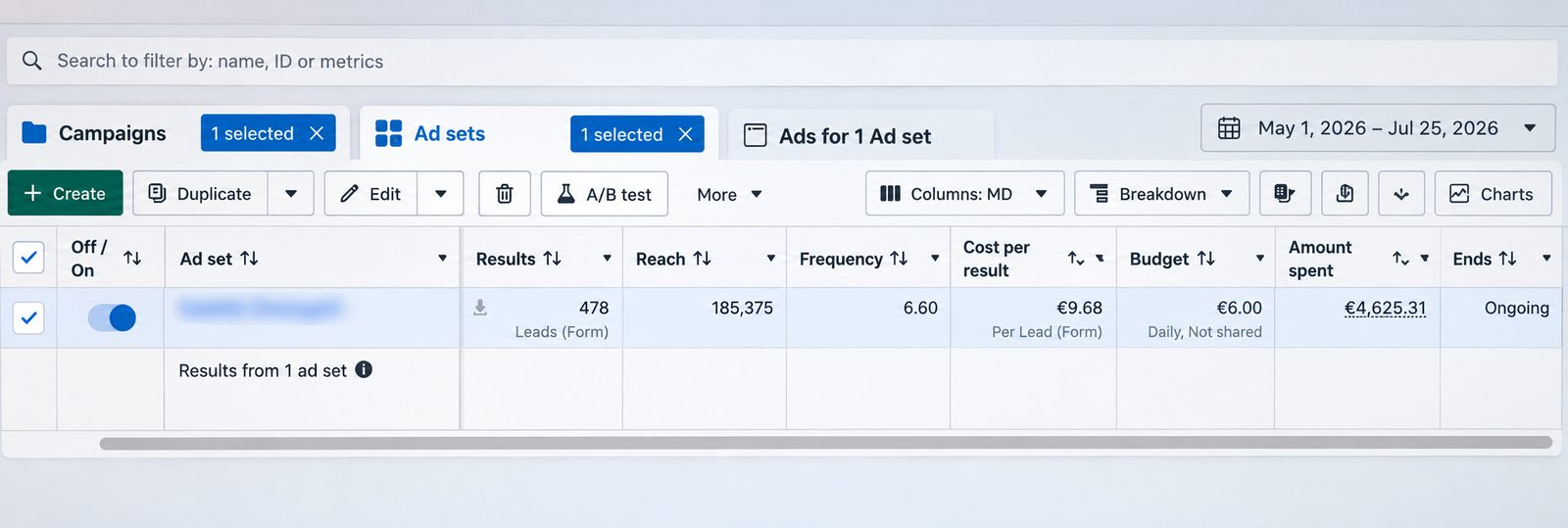
This is a lead generation campaign we ran on Facebook and Instagram from 1 May to 25 July 2026. It brought 478 form leads from €4,625.31 of ad spend, which is €9.68 per lead, on a €6.00 daily ad set budget. The screenshot is straight from Meta Ads Manager, with the ad set name blurred.
Want enquiries like this from the right objective? Message us on WhatsApp
Apply now and tell us what you want from your ads: enquiries, bookings, sales or chats. We’ll reply with the objective, conversion location and goal we’d use, or message us on WhatsApp.
Which to choose
Service businesses such as clinics, salons, contractors, cleaners, tutors and real estate agents: Leads, with instant forms, messaging apps or website forms. Online shops: Sales, with the website as the conversion location and purchases tracked by the Pixel. Restaurants and venues: Leads or Sales if you take bookings online, Engagement with messaging if people book by WhatsApp, and Awareness to build a local following.
Events: Sales if tickets are sold online, Leads to collect registrations. Recruitment: Leads with an instant form; our guide to Facebook job ads covers the extra rules for job ads. New brands: a small Awareness or Engagement campaign alongside a Leads or Sales campaign, so you build an audience to retarget later.
When in doubt, choose the objective closest to money. It is better to pay more per result and get customers than to pay less and get likes. Our guides to Facebook lead ads, click-to-WhatsApp ads and Advantage+ campaigns go deeper into each route.
Common mistakes
Choosing Traffic for an online shop, then wondering why there are hundreds of visits and no sales. Choosing Engagement because likes are cheap, when the business needs bookings. Boosting posts, which uses simpler options and gives you less control; we compare the two in Facebook ads vs boosted posts. Choosing Sales without a working Pixel, so Meta has nothing to learn from.
Others: changing objective every few days, splitting a small budget across five campaigns with five objectives so none of them gets enough results to learn, and comparing the cost per result of different objectives as if they measured the same thing. A €2 click and a €10 lead are not comparable; one of them might become a customer. To see what results are realistic for your budget, try our Facebook ads calculator.
How we choose
We start from what the business needs in the next month, not from Ads Manager. A business that needs bookings gets a Leads or Sales campaign, set up to track the action that matters. We decide the conversion location from how the business works: if the team answers WhatsApp fast, messaging can work well; if they prefer to call people back, an instant form with good questions is often better.
Then we keep the structure simple, so each campaign gets enough results to learn, and we judge it on cost per real enquiry or sale, not on clicks. If an Awareness or retargeting campaign makes sense alongside it, we add it once the main campaign is working. Every month, the report shows what each campaign produced and what we will change next.
A few straight answers
There are six: Awareness, Traffic, Engagement, Leads, App promotion and Sales. They replaced the older list of eleven objectives in 2022.
The one that matches the result you want. For most service businesses that is Leads, for online shops Sales, and for WhatsApp enquiries Engagement or Leads with messaging apps as the conversion location.
Use Leads if you want enquiries. Traffic asks Meta for people who click, not people who enquire, so it usually brings cheaper visits and fewer customers.
Messaging is a conversion location inside Engagement, Leads or Sales. Choose one of those objectives, then choose messaging apps such as WhatsApp, Messenger or Instagram.
Website conversions are chosen inside Engagement, Leads or Sales, with the website as the conversion location. For sales, use the Sales objective.
Changing the objective of a running campaign is limited and restarts learning, so it is usually cleaner to create a new campaign with the right objective and reuse the same ads.
For website sales, yes. Meta needs the Pixel, ideally with the Conversions API, to see purchases and find more buyers.
Yes. We choose the objective, conversion location and goal for every campaign we manage. Meta ads management starts from €1,249 a month plus ad spend, excluding VAT.
Keep reading
Costs, setup, campaign types, creative and mistakes to avoid, with real Ads Manager results.

Form setup, follow-up and judging cost per customer, not just cost per lead.

Advantage+ audience, placements and campaign budget, sales and leads campaigns, and when to take control.
A useful first step
We choose the objective, conversion location and goal for how your business makes money, then run and improve the ads. Meta ads management from €1,249 a month plus ad spend, excluding VAT.