
Facebook ads calculator
Free tool: enter your budget, cost per lead or sale, close rate, sale value and margin to see customers, ROAS and your break-even point. Your numbers only.
Facebook & Instagram ads · Budget
There is no fixed amount to spend on Facebook ads. Start from your goal: the results you want each month, times what one result costs. Then check that the budget gives Meta about 50 results a week to learn from. Malta Digital plans budgets this way for every client. The free planner below does the maths with your numbers.
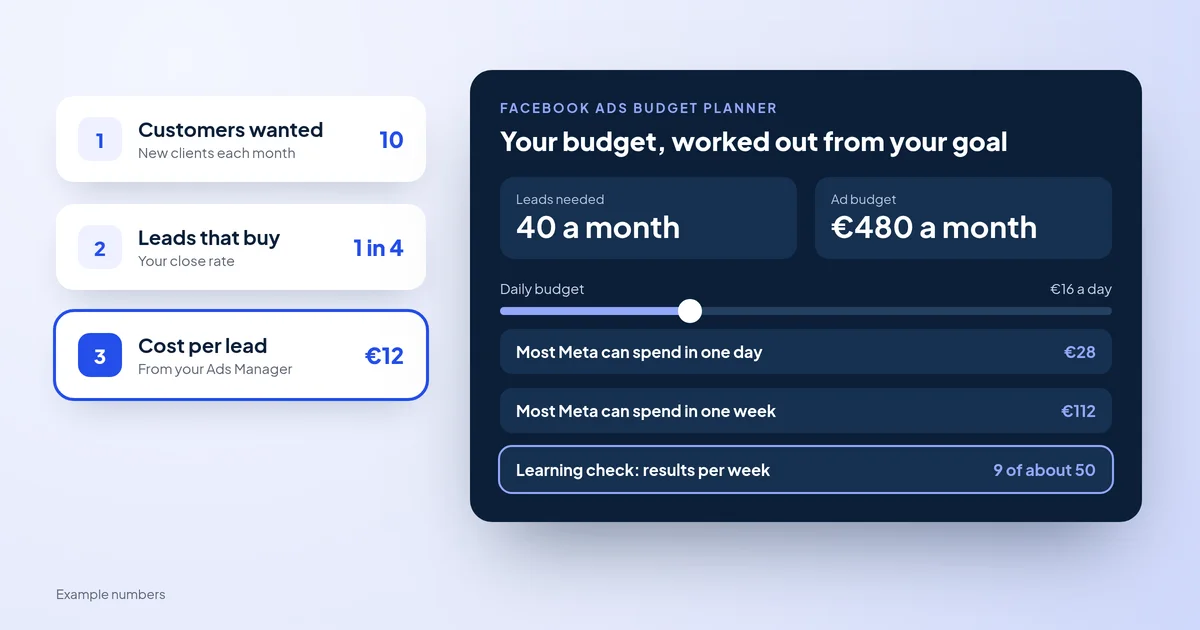
Set your Facebook ads budget from your goal: results you want each month × cost per result. Then check it gives Meta about 50 results a week to finish learning. A daily budget can spend up to 175% on one day, never over 7× in a week. Malta Digital plans budgets this way in our Meta ads management.
The short answer
Most people pick a number that feels safe, such as €5 a day, and hope for the best. A better way is to work backwards. Decide what you want each month, such as 20 bookings. Find out what one booking costs you. Multiply the two, and you have a budget with a reason behind it.
The budget is only one bill. If someone runs the ads for you, there is also a management fee. Our page on Facebook ads management in Malta explains how we run budgets for clients, and Facebook ads cost in Malta covers both bills together.
Below you will find the planner, the three checks we use, a table by goal and the mistakes that waste the most money in Malta.
Budget planner
Enter the results you want each month and your cost per result. If you have run ads before, take the real cost from Ads Manager. If not, use your best guess and update it after two or three weeks. Then move the slider to see what a different daily budget would give you.
Type the results you want and what one result costs you. The planner works out the budget, then checks it against Meta’s own rules. Everything stays on your device.
This planner needs JavaScript. The formulas are written out below, so you can do the same maths by hand.
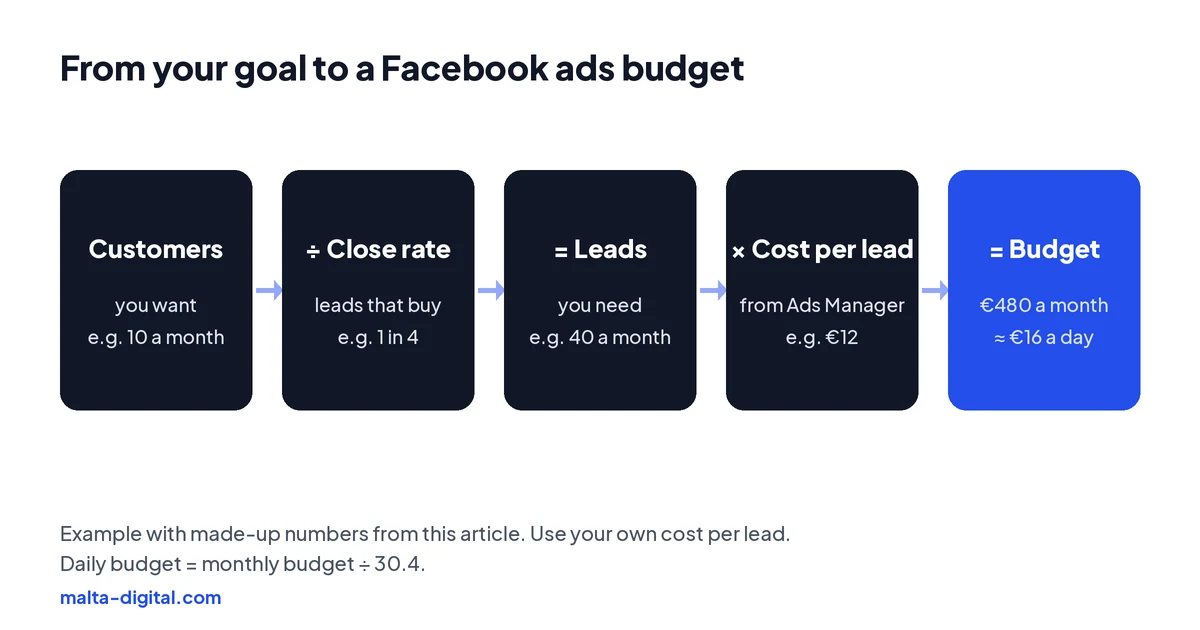
Here are the formulas, so you can check them by hand. Monthly budget = results you want × cost per result. Daily budget = monthly budget ÷ 30.4. Results per week = daily budget × 7 ÷ cost per result. If that weekly number is under 50, Meta will probably show “Learning limited”.
Step 1
Before you choose any budget, work out what you can afford to pay for one result. Take what a new customer is worth to you. Then take the share of leads that turn into customers. Multiply them, and you have the most you can pay for one lead without losing money.
Here is an example with made-up numbers. A clinic in Sliema wants 10 new patients a month. About one in four enquiries books, so it needs 40 enquiries. If one enquiry costs €12, the budget is 40 × €12 = €480 a month. That is about €16 a day. If a new patient is worth €200, paying €48 to win one is fine.
The common mistake is to set the budget first and the goal later. Then nobody knows if €300 a month is too much or far too little. Start with the goal, and the budget follows.
Step 2
When you start a new ad set, Meta’s delivery system is still learning who to show it to. Meta says an ad set usually leaves this learning phase after about 50 results in the week after its last significant edit. Until then, costs jump around and are often higher.
So check your weekly results. In the clinic example, 40 enquiries a month is about 9 a week. That is far below 50. It does not mean the ads will fail. It means delivery stays less stable for longer, and you should not judge the ads after a few days.
You have three ways to help. You can raise the budget, if the numbers still work. You can run one ad set instead of three, so all the results land in one place. Or you can optimise for an earlier step that happens more often. Meta also says to use realistic budgets and avoid frequent budget changes, because big edits can restart learning.
Step 3
A daily budget is not a hard daily limit. Meta treats it as a target over the week, from Sunday to Saturday. On a good day it may spend up to 75% more than your daily budget. It will never spend more than 175% of the daily budget in one day, or more than 7 times the daily budget in one week.
So a €20 daily budget can spend up to €35 on a busy Friday, but never more than €140 in that week. Plan your cash flow on the weekly number, not the daily one. If you turn on ad set budget sharing, Meta can also move up to 20% of the budget between ad sets.
If you set a cost per result goal, Meta recommends a daily budget of at least five times that goal. A goal of €8 per lead means at least €40 a day. Meta also sets a minimum budget, which changes by country and objective, and warns you in Ads Manager if you go below it.
By goal
Different goals need different budgets, because some results are harder to get. A sale costs more than a click. A booking costs more than a message. Pick the goal that matches what you really want, then use its own cost in the planner.
| Your goal | What Meta optimises for | How to set the budget | First thing to check |
|---|---|---|---|
| Enquiries (leads) | Leads from a form or a website | Leads you need × cost per lead | Are the leads real, and do you reply fast? |
| Bookings | Bookings or a booking-page step | Bookings you need × cost per booking | Can people book in two or three taps? |
| Online sales | Purchases on your website | Sales you need × cost per sale, checked against your margin | Does the Pixel count every sale? |
| Messages | Conversations started in WhatsApp or Messenger | Chats you can handle × cost per chat | Who answers, and how quickly? |
| Getting known | Reach or views | A fixed monthly amount you are happy to spend | Do people remember you later? |
If you are not sure which goal to pick, read Facebook ad objectives explained. For leads, our guide to Facebook lead ads in Malta shows how to keep lead quality high.
Apply now and tell us your goal, your offer and any past results. We’ll suggest a starting budget and tell you honestly if the numbers work.
Malta
Malta is a small market. A narrow audience, such as one town or one profession, runs out quickly. The same people then see your ads again and again, and results wear out faster. Keep an eye on frequency, and refresh your images and videos more often than a big-country guide would suggest. Our guide to ad frequency shows what to watch.
Seasons matter too. Tourism businesses get a different crowd in summer than in winter. Many shops compete hard before Black Friday and Christmas, so costs often rise in November and December. Plan those months early, and put aside more budget if they are your busy season. See Black Friday Facebook ads for timing.
We also checked what Malta ad providers advise in public on 3 November 2026. The starting budgets they publish range from €200 to €450 a month for most small businesses, €650 or more for busy niches and online shops, and at least €750 a month on another site. Treat these as rough guides, not rules. Your own goal and cost per result matter more.
Proof
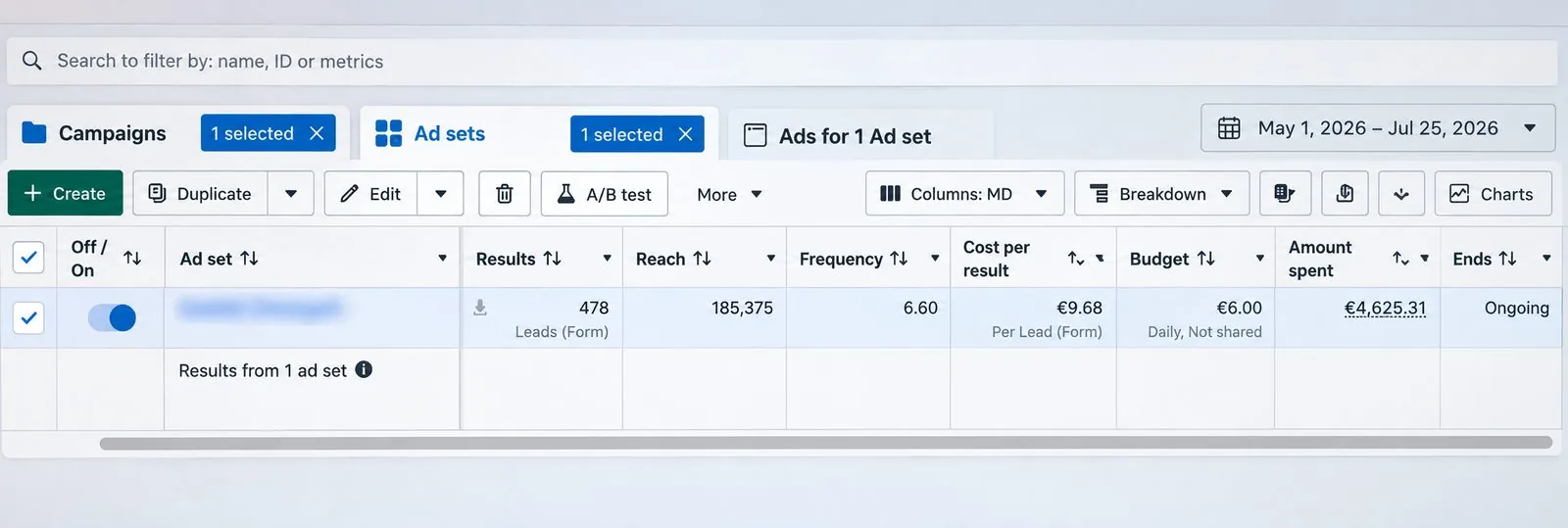
Here is a real campaign we ran for lead generation. From 1 May to 25 July 2026, it spent €4,625.31 on Facebook and Instagram and brought 478 form leads. That is €9.68 per lead. The campaign ran for 86 days, long enough to judge it fairly.
Now let us use that number in the formula, as an example only. At €9.68 per lead, 100 leads a month would need about €968 of ad spend. Your cost per lead will be different, because it depends on your offer, your audience and your ads. That is why the planner asks for your own number.
Want a budget plan built from your own numbers? Apply now for Meta ads management
Mistakes
Spreading a small budget too thin. Five ad sets at €4 a day each learn very slowly. One ad set at €20 a day learns faster.
Changing the budget every day. Big edits can send an ad set back into learning. Make changes once a week, in steps, and give them time to settle.
Judging the ads too early. Two weeks is rarely enough in a small market. Plan for about 90 days before you decide what works.
Mixing up ad spend and fees. Your ad budget goes to Meta. A management fee is separate. Keep them apart, so you know what the ads really cost.
Paying for clicks you cannot answer. If enquiries wait a day for a reply, the budget is wasted. Make sure someone can answer quickly, or use an automatic follow-up.
Our help
When you apply, we look at your offer, your margins and any past results. Then we suggest a starting budget and the goal to optimise for. We tell you plainly if the numbers do not work yet, before you spend anything.
Our Meta ads management starts from €1,249 a month plus ad spend. You pay the ad spend to Meta directly, so it does not pass through us, and the ad account stays in your name. Want to compare ways of paying for help first? Read Facebook ads management pricing models.
A few straight answers
Multiply the results you want each month by what one result costs you. Then check that it gives Meta about 50 results a week to learn from. The planner on this page does both.
Divide your monthly budget by 30.4. Remember that Meta can spend up to 75% more on a busy day, but never more than 7 times the daily budget in a week.
Meta sets a minimum that changes by country and objective, and Ads Manager warns you if you go below it. A budget that is too small rarely gives enough results to learn from.
It can test an idea, but it rarely gives Meta enough results to finish learning. Use the planner with your own cost per result to see how far it goes.
A daily budget is a weekly target. Meta may spend up to 175% of it on one day, but no more than 7 times the daily budget from Sunday to Saturday.
No. Big changes can restart the learning phase. Change the budget once a week, in steps, and give it time to settle.
No. Ad spend is paid to Meta. A management fee is a separate bill. Malta Digital’s Meta ads management starts from €1,249 a month plus ad spend.
Keep reading
Free tool: enter your budget, cost per lead or sale, close rate, sale value and margin to see customers, ROAS and your break-even point. Your numbers only.
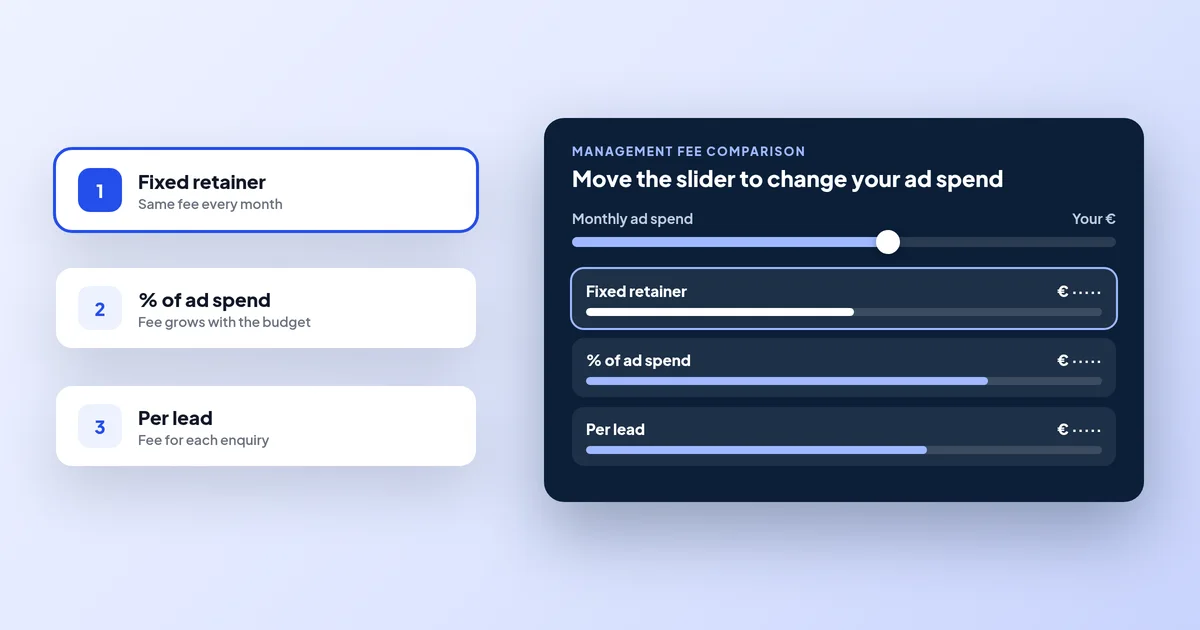
Retainer, percentage of ad spend or pay per lead, with a free slider to compare the quotes you have.
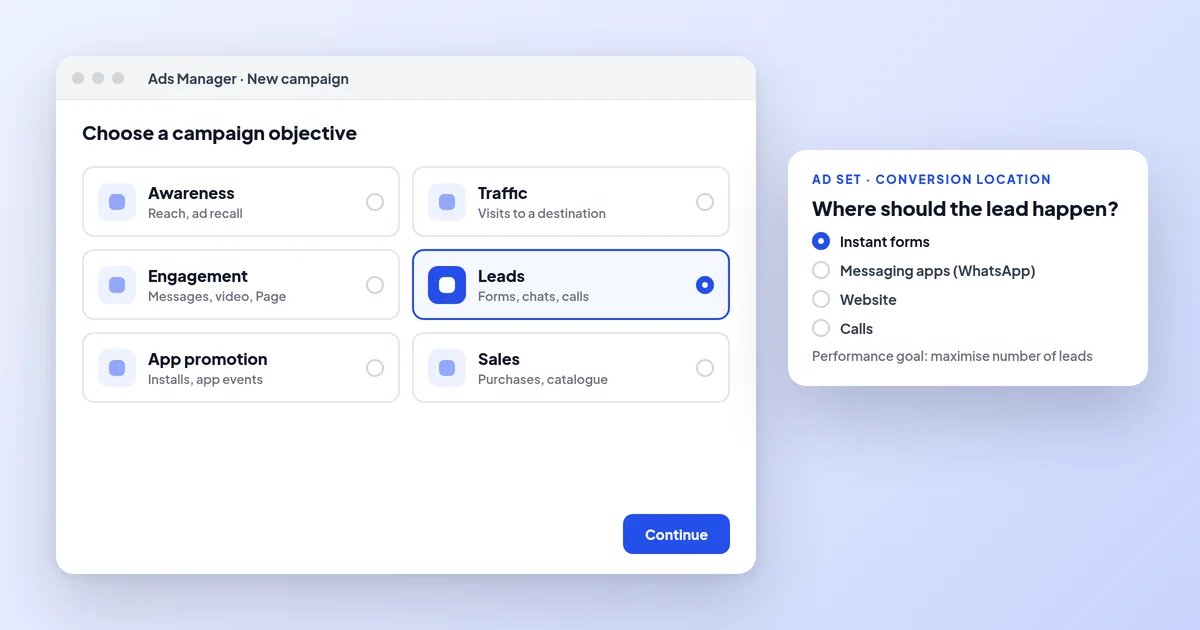
The six Meta ad objectives, conversion locations and performance goals, which one to choose for your business in Malta, and the objective mistakes that waste budget.
A useful first step
We plan your budget from your goal, run your Facebook and Instagram ads and report on leads or sales every month. Meta ads management from €1,249 a month plus ad spend.
Step 1 of 2
A few quick questions, about a minute. We usually reply within 2–3 hours.