
Ad creative in Malta
Sizes and safe zones, hooks, formats, examples, testing and creative fatigue.
Facebook & Instagram ads · Frequency and ad fatigue
Facebook ad frequency is the average number of times each person saw your ad: impressions divided by reach. There is no single good number, and Meta does not publish one. Frequency becomes a problem when it keeps rising while your cost per lead or sale climbs and fewer people click, which is ad fatigue. In Malta it happens sooner than in big markets, because the audience is a little over half a million people and many businesses only target part of the island. Malta Digital watches frequency together with cost per result every week and fixes fatigue with new creative and broader audiences before it eats the budget.

Facebook ad frequency is impressions ÷ reach, the average number of times each person saw your ad. There is no universal safe number: it is too high when it keeps rising while cost per result climbs and CTR falls. In Malta’s small market it rises sooner, so Malta Digital checks it weekly and fixes fatigue with new creative and broader audiences.
The short answer
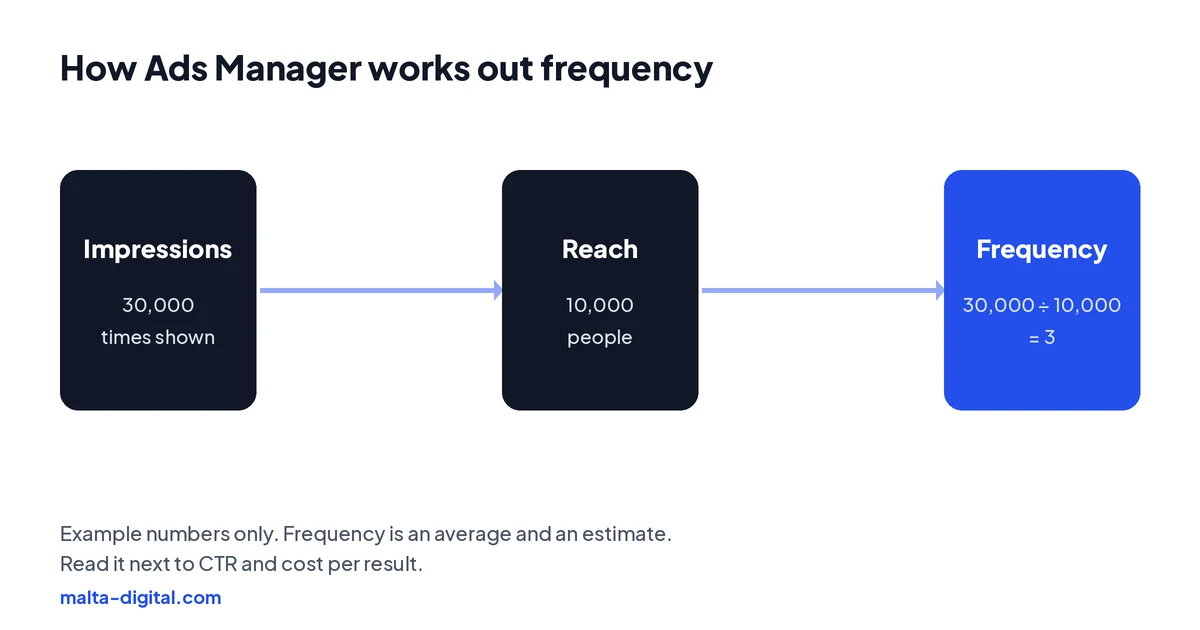
Ads Manager calculates frequency as impressions ÷ reach over the dates you choose. If an ad was shown 30,000 times to 10,000 people, the frequency is 3. It is an average and an estimate: a frequency of 3 can mean everyone saw the ad three times, or that some people saw it once and others ten times.
Nobody can give you a safe number that works for every business, because the right frequency depends on the goal. Seeing a retargeting ad several times in a week is normal; seeing the same cold ad every day for a month is not. The useful question is not “is my frequency above 2 or 3?” but “is my frequency rising while my results get worse?”
When the answer is yes, you have ad fatigue. People have seen the ad, decided, and started scrolling past it, so Meta has to pay more to get each click, lead or sale. The fix is almost never to just raise the budget.
Why Malta is different
Malta has a little over half a million residents, and Gozo far fewer. A business that only serves the north of the main island, or only Gozo, has a much smaller pool still. A budget that would take months to wear out in a large city can show the same ad to most of a Maltese audience within a few weeks. The result is that frequency rises faster here than in many other markets, and creative wears out sooner.
The audience also moves with the seasons. In summer, location targeting that includes people recently in Malta brings in many visitors, which can keep frequency down for consumer businesses; in winter the pool shrinks back to residents. Many businesses notice ads that worked well in August getting more expensive in November without anything changing in the account.
Small audiences make other habits expensive too. Several ad sets aimed at similar people compete with each other and push frequency up across the account. Long lists of interests and exclusions shrink the audience even further. In Malta, a simpler structure with broader targeting and more creative variety usually holds up better than a complicated one.
Reading it
Look at frequency over a fixed window, such as the last 7 days, and compare it with the 7 days before, rather than over the lifetime of the campaign, which always grows. Add the columns Frequency, Reach, Cost per result and CTR (link click-through rate) side by side, and look at them at ad set and ad level.
The pattern to look for is all of them moving together over two weeks or more: frequency up, CTR down, cost per result up. That is fatigue. If frequency is up but cost per result is flat, the ad is still working and there is no need to change anything yet. If cost per result is up but frequency is flat, the problem is somewhere else, such as the offer, the landing page or more competition at that time of year.
Meta can also flag creative fatigue for eligible ad sets and suggest fixes in its opportunity score recommendations, based on how often people have seen the same creative, including across your other campaigns. Treat those flags as a prompt to check the numbers above, not as an automatic instruction.
Fixing fatigue
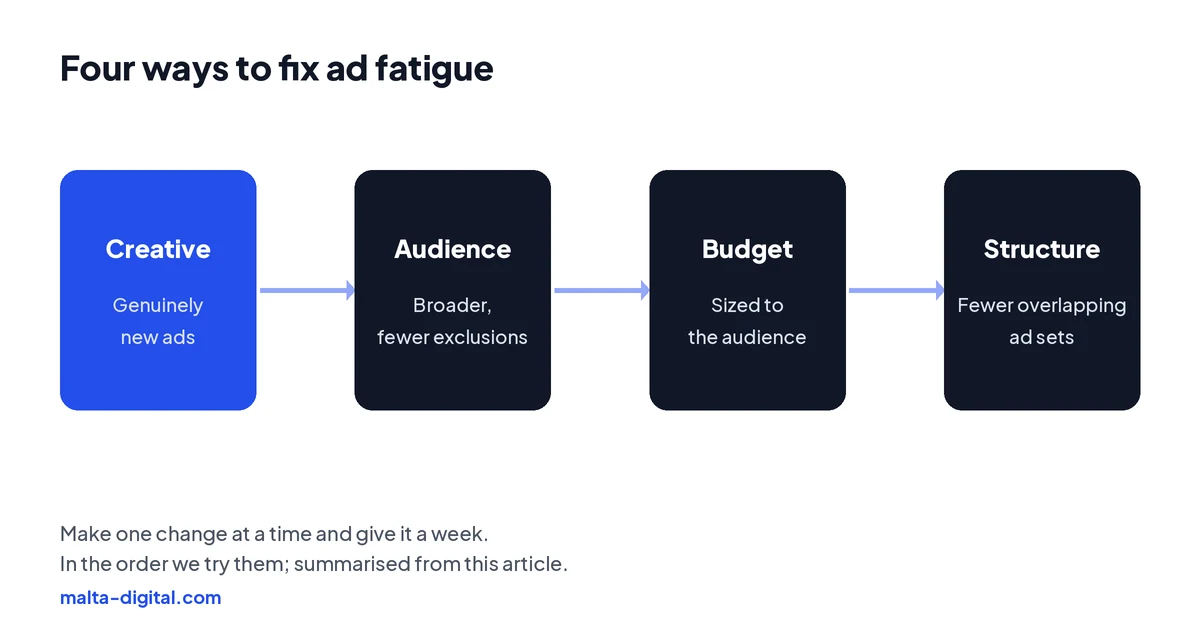
New creative first. Add ads that are genuinely different, not the same photo in a new colour: a new angle, a new format, a new first line. A short phone video, a customer question answered, a before-and-after or a carousel of real work all count as different. Keep the old ad running while the new ones get going, rather than switching everything off at once.
Broaden the audience. Remove narrow interests and unnecessary exclusions, widen the area to all of Malta if you can serve it, and let Meta’s broad targeting find new people. In a small market, the audience you can reach is often the real limit, not the ad.
Match budget to audience. If a retargeting audience or a small local audience is getting too much money, frequency goes up fast. Lower the budget, or move it to a broader ad set. Combine ad sets that target similar people so they stop bidding against each other. Each of these is a significant change, so make one at a time and give it a week.
Proof
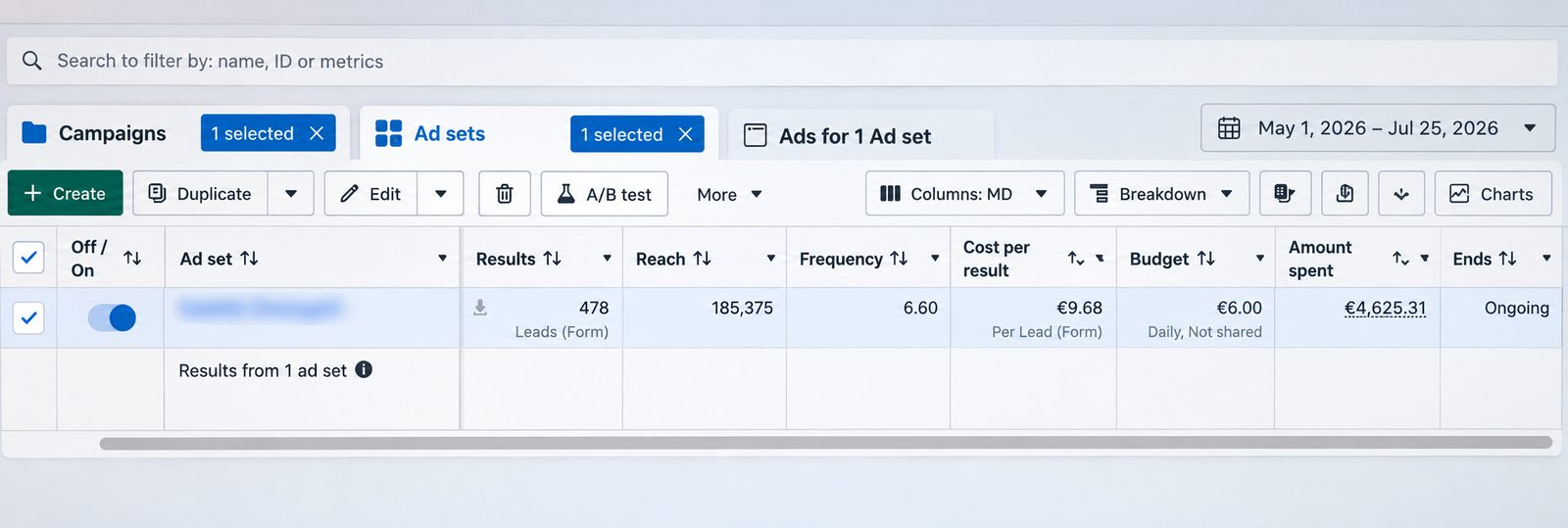
This is a lead generation campaign we ran on Facebook and Instagram from 1 May to 25 July 2026. It brought 478 form leads from €4,625.31 of ad spend, which is €9.68 per lead, on a €6.00 daily ad set budget. The screenshot is straight from Meta Ads Manager, with the ad set name blurred.
Want leads at a cost that stays steady month after month? Message us on WhatsApp
Apply now, or send us your ad account on WhatsApp. We’ll check frequency, creative and audiences and tell you what we’d change first. Free, no obligation.
By campaign type
For lead and sales campaigns aimed at new people, a rising frequency is an early warning. Watch it weekly and refresh creative before results fall too far. These campaigns cannot be given a frequency cap; Meta decides how often to show the ad based on the goal.
For retargeting, a higher frequency is expected, because the audience is small and the people in it already know you. Keep it in check by sizing the budget to the audience, changing the message for each step and excluding people who have already bought or enquired. For events, frequency naturally climbs in the final week; plan a fresh ad for each stage so people see something new.
For awareness, frequency is something you can set. With the Awareness objective and the Reach performance goal, or the ThruPlay goal for video, you can cap how many times a person sees your ads in a number of days. The cap is a ceiling, and a tight cap on a small Maltese audience can slow delivery once most people have been reached.
| Campaign | Higher frequency is… | Watch for | Main fix |
|---|---|---|---|
| Leads or sales to new people | A warning sign | Cost per result rising week after week | New creative, broader audience |
| Retargeting | Expected, within reason | Complaints, hidden ads, falling results | Budget sized to the audience |
| Awareness or reach | Something you set | Delivery slowing with a tight cap | Frequency cap on the Reach goal |
| Events and deadlines | Normal in the final days | The same ad shown all campaign long | New ads for each stage |
Planning ahead
The cheapest way to handle frequency is to expect it. Start each campaign with three to five different ads, not one, and plan the next batch before the first one wears out. Businesses in Malta that produce new photos and short videos every month, from real jobs, real products and real customers who agreed to it, rarely have a frequency problem for long.
Keep a simple record of when each ad started, when its cost per result began to rise and what replaced it. After a few months you will know roughly how long ads last in your market, which is a far better guide than any number from a blog. Use the calculator to see what a rising cost per result does to your profit, so you know when a refresh is urgent.
How we do it
Every week we check frequency, reach, CTR and cost per result for each ad set and ad, side by side, and compare them with the week before. When the pattern points to fatigue, we add new creative first, then look at the audience and the budget, one change at a time.
We plan creative a month ahead, so there is always a new batch ready, and we keep the account structure simple enough for a small market. Every month you get a report of spend, results and cost per result straight from Ads Manager. Our case studies show the kind of tracked results we report.
A few straight answers
The average number of times each person saw your ad over the dates you choose: impressions divided by reach. It is an estimate.
There is no single number. Frequency is too high when it keeps rising while your cost per result climbs and CTR falls for two weeks or more.
Usually a small audience, a budget too big for it, too few ads, or several ad sets targeting the same people. In Malta small audiences make it happen sooner.
Only for some goals: the Reach and ThruPlay performance goals and reservation buying. Lead, sales and traffic campaigns cannot be capped.
Add genuinely different creative first, then broaden the audience, size the budget to the audience and combine overlapping ad sets, one change at a time.
Not by itself. Retargeting audiences are small, so frequency is higher. Watch results and complaints, and change the message for each step.
When frequency rises and cost per result has climbed for a couple of weeks. Plan new creative every month so a fresh batch is always ready.
Malta Digital’s Meta ads management starts from €1,249 a month plus ad spend, excluding VAT.
Keep reading
Sizes and safe zones, hooks, formats, examples, testing and creative fatigue.

Warm audiences, retargeting windows, ads for each step, budget and cookie consent.
A practical checklist for ads that are not running, or running without results.
A useful first step
We plan new creative every month, keep the account simple for a small market and watch frequency and cost per result every week. Meta ads management from €1,249 a month plus ad spend, excluding VAT.