Facebook ads for restaurants
Goals, targeting, ad ideas and how to track bookings and walk-ins for restaurants in Malta.
Facebook & Instagram ads · Events
To sell tickets for an event in Malta with Facebook and Instagram ads, run a Sales campaign that sends people to your ticket page and tracks each purchase with the Meta Pixel and Conversions API, and use a cheaper event-response campaign only to build early interest. Start four to six weeks out, show real footage of the night, make the date, venue and price clear in the first seconds, and save budget for the final week, when most people decide. Malta Digital plans and runs event campaigns and reports tickets sold, not “Interested” clicks.

Sponsored · Valletta
Saturday night, live
Early bird ends FridayDoors 21:00Get ticketsTo sell tickets for an event in Malta, run a Facebook and Instagram Sales campaign to your ticket page with the Meta Pixel tracking every purchase, start four to six weeks out and keep budget for the final week, when most people decide. Event-response ads are cheap but bring “Interested”, not tickets. Malta Digital runs event campaigns and reports tickets sold.
The short answer
Yes. Facebook and Instagram are where most people in Malta hear about what is on: concerts in Valletta, club nights in Paceville, food festivals, conferences, weddings fairs, sports events and summer parties in Gozo. Your event page, your Instagram and your posts in local groups already reach the people who follow you. Ads reach everyone else who would come, on a schedule you control.
What works is more specific than “boost the event”. Ads that sell tickets have one job per stage: announce the date, push the early-bird price, remind people as the night gets close and sell the last tickets in the final week. Each stage uses a different message and, often, a different campaign. When the ads are built around tickets sold, not likes, events become far more predictable to fill.
The problem
The most common event ad in Malta is a boosted Facebook event. It is easy, it is cheap per response, and it fills the event page with hundreds of people marked “Interested”. Then the night comes and far fewer turn up or buy. Meta did exactly what was asked: it found people likely to tap “Interested”, which is not the same group as people likely to pay.
The second problem is timing. Many organisers spend the whole budget in the first week, when the event is still far away and nobody is planning their weekend yet, and have nothing left for the last ten days, when friends are actually deciding where to go. The third is a weak creative: a flyer full of small text, sponsor logos and line-up names that is unreadable on a phone. People scroll past it in under a second.
The fix is simple to describe: track ticket sales, pace the spend to the way people buy, and make ads that show what the night feels like. The rest of this guide shows how.
The campaign
Meta offers three ways to promote an event. An Engagement campaign with event responses shows your Facebook event with an Interested button and optimises for responses. It is cheap and builds social proof, and it works for free events, but responses are not tickets. A Traffic campaign sends people to your ticket page with a Get tickets button, which is better, but Meta still optimises for clicks rather than buyers.
A Sales campaign optimises for purchases on your ticket page. It needs the Meta Pixel and Conversions API on that page, or a ticketing platform that lets you add your Pixel, so Meta can see who actually buys. For any paid event this is the campaign that should get most of the budget, because Meta learns from real buyers and finds more people like them.
A common setup for a paid event in Malta is a small event-response campaign in the first weeks to build interest and an audience to retarget, then a Sales campaign that carries the main push to the end. For a free event, such as a shop opening or a free festival, event responses or traffic are fine; judge them by how many people came.
| Event responses | Traffic | Sales | |
|---|---|---|---|
| What Meta optimises for | People tapping Interested or Going | Clicks to your ticket page | Tracked ticket purchases |
| Button on the ad | Interested | Get tickets | Get tickets |
| What it needs | A Facebook event on your Page | A ticket page | The Meta Pixel and Conversions API on the ticket page |
| Best for | Free events and early interest | Paid events without purchase tracking | Most of the budget for any paid event |
The timeline
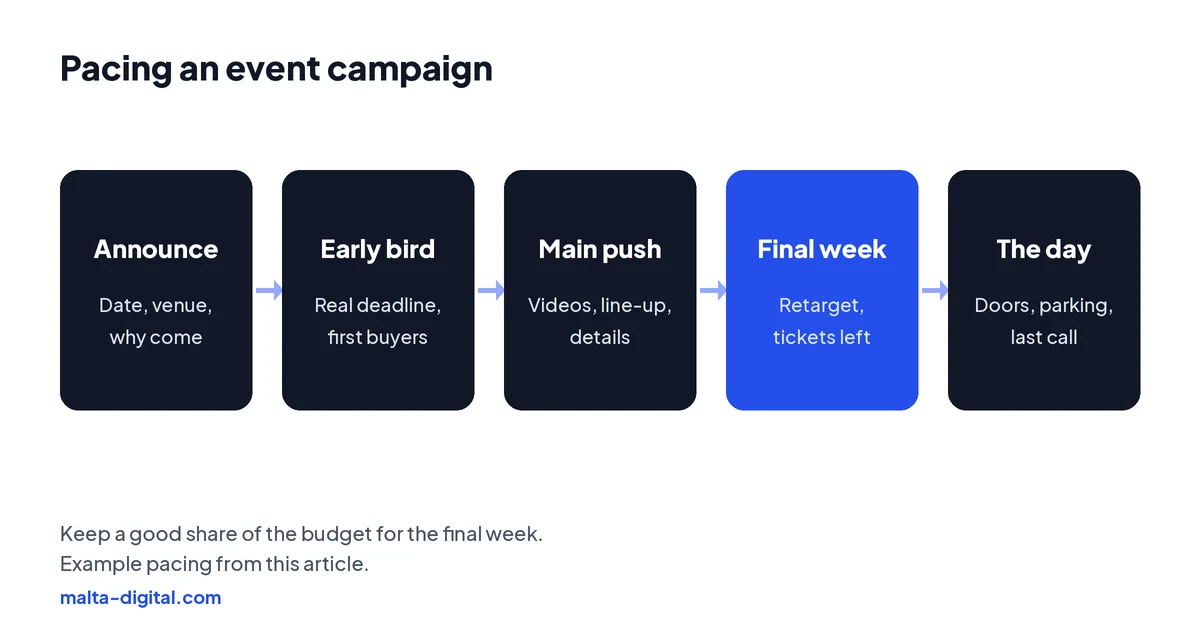
For most local events, start ads four to six weeks before the date. Announce with the date, venue and the main reason to come, then run an early-bird price with a real deadline, because a genuine reason to act now moves people who would otherwise wait. The main push runs from about three weeks out, with videos, line-up or speaker clips and reminders of what is included.
Keep a good share of the budget for the final week. That is when people in Malta make weekend plans, check with friends on WhatsApp and buy. Retarget everyone who watched your videos, visited the ticket page or responded to the event, with a clear message: date, price, how many tickets are left if that is true, and one tap to buy. A last-day ad on the morning of the event can work for venues where people decide late.
Big events with visitors, such as summer festivals, need longer. People flying in from abroad plan weeks or months ahead, so their campaign starts earlier and runs in their own country, separately from the local campaign.
Making the ads
Show the night, not the flyer. A 10–20 second vertical video from the last edition, the venue or the artist does more than any poster: the crowd, the lights, the food, the stage. Put the date, place and price on screen in the first two seconds, with captions, because most people watch with the sound off. Make separate versions for Reels and Stories, where the screen is full height, and for the feed.
Make the message different at each stage. Early on, sell the idea: what it is and why it is worth a Saturday night. In the middle, sell the details: the line-up, the menu, the speakers, the dress code, the transport. At the end, sell urgency and certainty: tickets left, doors open time, where to park in Valletta or how to get the ferry back from Gozo.
Use only music you have the rights to. Meta can mute or reject ads that use copyrighted tracks, so use the artist’s own permission or Meta’s Sound Collection. If the event has sponsors, keep their logos small at the end of the video; nobody buys a ticket because of a sponsor’s logo in the first second.
Proof
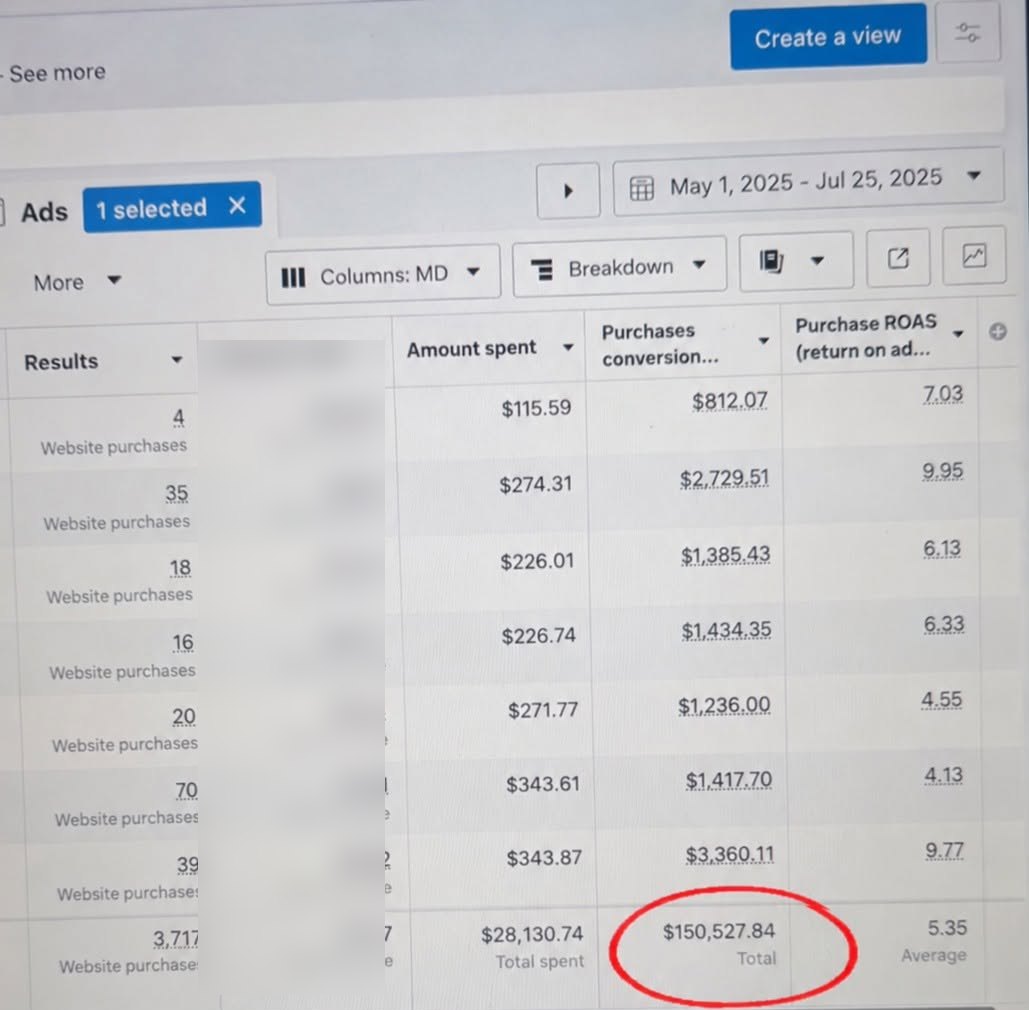
This is an online store we ran Facebook and Instagram ads for, not an event, but the method is the same one that sells tickets: a Sales campaign optimised for tracked purchases, with the Pixel and Conversions API recording every sale.
Meta Ads Manager tracked 3,717 website purchases worth $150,527.84 from $28,130.74 of ad spend between 1 May and 25 July 2025, an average purchase ROAS of 5.35. The screenshot is straight from Ads Manager. Ad names are cropped and cost per purchase is blurred. Tracked purchase value is not profit, and past results are no guarantee of future ones.
Want ticket sales tracked like this for your next event? Free Meta Ads audit on WhatsApp
Apply now and tell us the date, venue, capacity and where tickets are sold. We’ll reply with the stages, budget and ads we’d run, or send your event page on WhatsApp for a free check.
Audiences
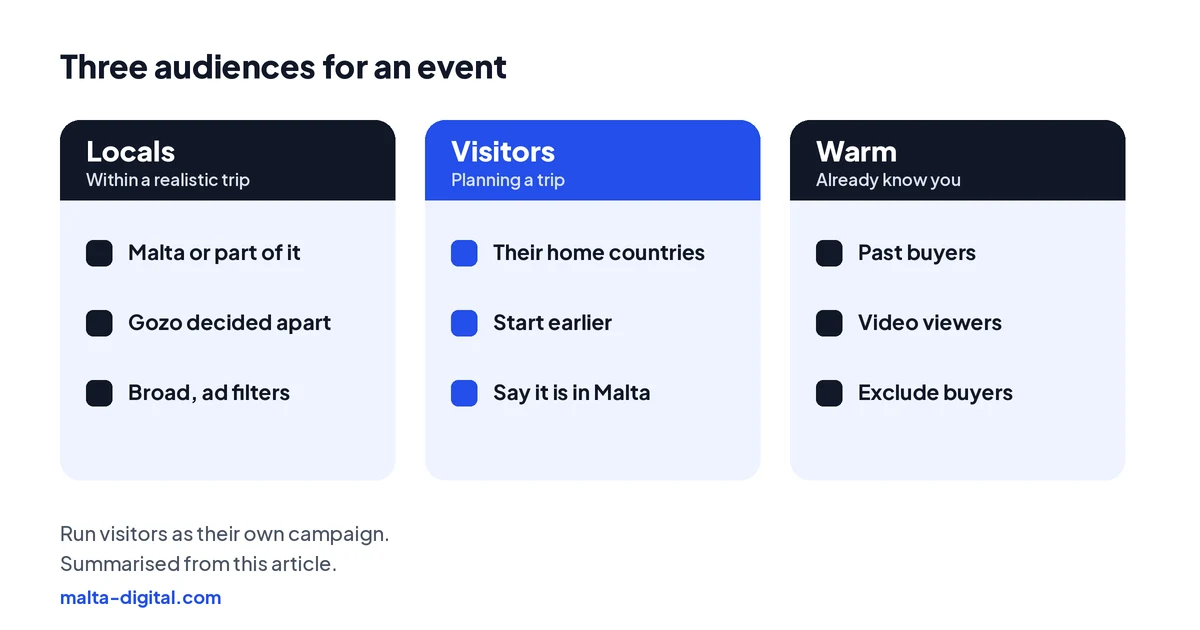
For local events, target Malta, or the part of Malta that will realistically travel to you, and keep the rest broad. Meta’s Advantage+ audience usually finds buyers better than a long list of interests, as long as the ad says clearly what the event is. Gozo is the exception to “all of Malta”: for a Gozo event, decide whether you want Gozitans, Maltese who will take the ferry or both, and say so in the ad.
Visitors need a separate campaign. Location targeting reaches people who live in or were recently in an area, so tourists already in Malta will see local ads, but people planning a trip are at home in their own countries. Target the countries where your visitors come from, start earlier, and say in the ad that it is in Malta, with the date and how to get there.
Your best audience is people who already know you: past ticket buyers, people who watched your videos, visitors to your ticket page and your followers. Upload past buyer lists as a custom audience where your privacy notice and consent allow it, and run them as a retargeting campaign close to the date. Exclude people who have already bought, so you do not pay to sell them a ticket they have.
Tracking
Before spending, check where tickets are sold. If you sell from your own website, install the Meta Pixel and Conversions API and send a Purchase event with the ticket value on the thank-you page. If you use a ticketing platform, check whether it lets you add your own Pixel; some do, some do not. Without it, Meta cannot see who buys and the Sales campaign has nothing to learn from.
When the platform does not support your Pixel, there are still ways to measure. Use a separate tracked link for each campaign, give each campaign its own promo code, and compare sales on the platform with what the ads spent each day. It is less precise, but it is far better than judging by event responses.
After the event, write down three numbers: tickets sold from ads, total ad spend, and what an average ticket brought in. That tells you what you can afford to spend next time, and the buyer list becomes the first audience for your next event.
The rules
Many events in Malta involve alcohol. Meta allows ads that promote alcohol, including venues and events where the business depends on alcohol sales, as long as they follow the rules for the audience’s location and are never targeted at people under 18. Set the age in the ad set, keep the drinks out of the centre of the ad if the event is about the music, and never suggest that drinking makes the night or the people better.
Ads must also be accurate. If you write “last tickets”, it should be true; if the line-up is not confirmed, do not show it as confirmed. Meta reviews ads automatically and can reject ones that mislead, and on a small island people remember an event that promised more than it gave.
Ads about social issues, elections or politics cannot run in the EU any more, so a campaign event, a political fundraiser or an advocacy evening will not be able to use paid ads. Most concerts, parties, conferences and festivals are not affected.
How we do it
We start with your date, capacity, ticket prices and where tickets are sold. Then we plan the stages and the budget for each, check or set up the Pixel and Conversions API on the ticket page, make or brief the videos, write the ads for each stage and build the audiences, including visitors abroad when the event needs them.
During the campaign we watch tickets sold every day and move the budget to what sells. After the event we report tickets from ads, spend and what we would change for the next one. Our case studies show the kind of tracked results we report, straight from Ads Manager.
A few straight answers
Create the Facebook event, then run a Sales campaign to your ticket page with the Meta Pixel installed, plus a small event-response campaign early on to build interest.
Four to six weeks before for local events, earlier for visitors from abroad. Keep a good share of the budget for the final week, when most people decide.
For free events, yes. For paid events, responses are cheap but are not tickets, so put most of the budget into a Sales campaign that tracks purchases.
Yes, if the platform lets you add your Meta Pixel. If not, use tracked links and a promo code per campaign and compare sales with daily spend.
Yes, if they follow Meta’s alcohol policy: never target people under 18 and follow the rules for the audience’s location.
Malta Digital’s Meta ads management starts from €1,249 a month plus ad spend, excluding VAT.
Keep reading
Goals, targeting, ad ideas and how to track bookings and walk-ins for restaurants in Malta.

Warm audiences, retargeting windows, ads for each step, budget and cookie consent.

What the Pixel and the Conversions API do, why the Pixel alone misses sales, and how to check your setup.
A useful first step
We plan the stages and budget, set up ticket tracking, make the ads and retarget in the final week, then report tickets sold. Meta ads management from €1,249 a month plus ad spend, excluding VAT.