
Facebook ads for events
How to sell tickets with Facebook and Instagram ads: event responses or ticket sales, when to start, locals and visitors, tracking and alcohol rules.
Facebook & Instagram ads · Research
The Facebook Ad Library (now the Meta Ad Library) is a free public search of ads running on Facebook, Instagram, Messenger and Threads. Anyone can open it, set the country to Malta, and see what a business is running today. For ads delivered in the EU it also shows age, gender and location targeting, plus reach bands. It never shows sales or cost per lead, so treat it as research, not a scoreboard. We use it before every Meta ads in Malta campaign plan.
Short answer
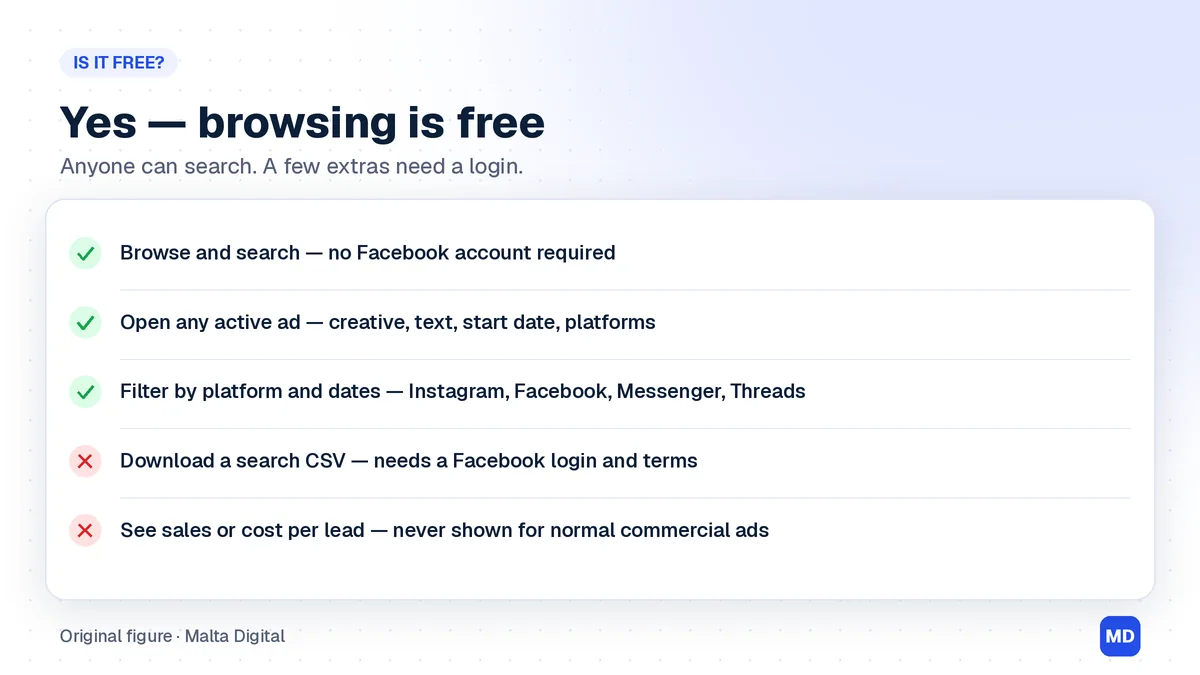
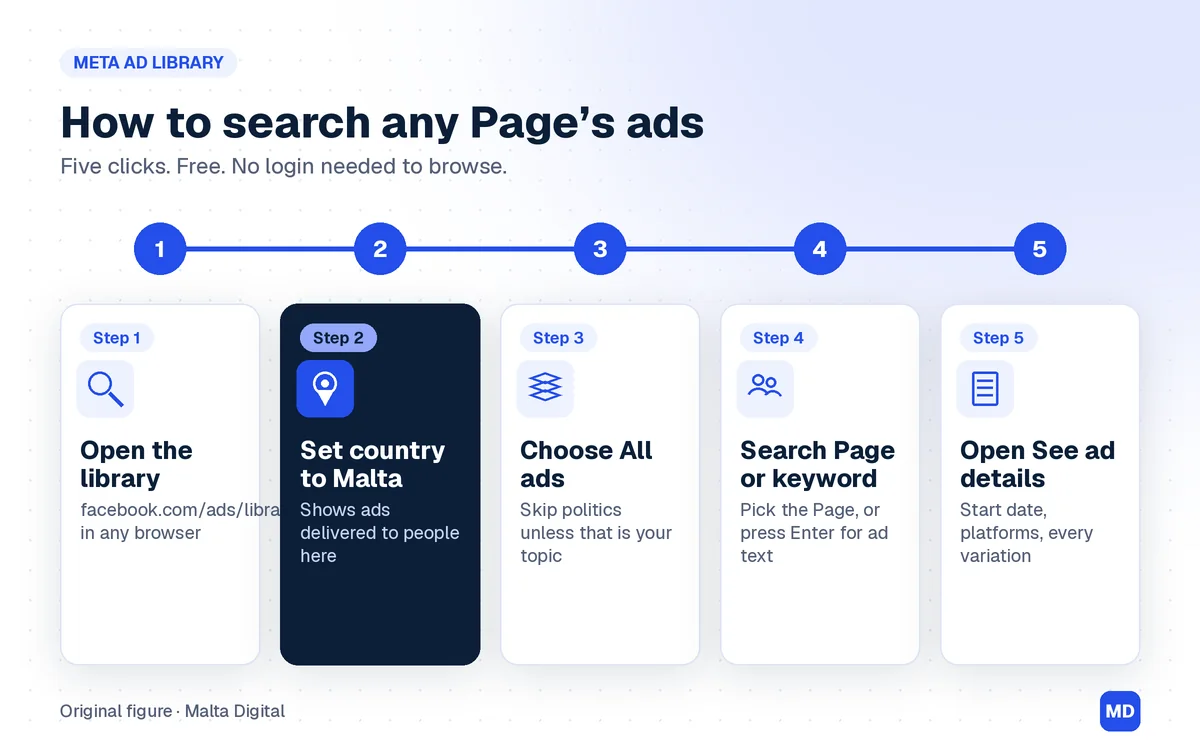
Yes, the Facebook Ad Library (Meta Ad Library) is free. Open facebook.com/ads/library, set the country to Malta, choose All ads, then search a Page name or a keyword. You see active creatives, start dates and platforms. You do not see sales or cost per lead. For ads delivered in the EU you also see targeting and reach bands. Malta Digital uses it before every Meta ads in Malta plan.

The short answer
Meta’s own help pages describe the same tool: the Facebook Help Center article What is the Meta Ad Library and how do I search it? and the Business Help Center guide About the Meta Ad Library. The public library is at facebook.com/ads/library.
Meta built the Ad Library as a transparency tool. It lists the ads that are currently active from every Facebook Page and Instagram account, with the image or video, the text, the button and the date the ad started running. You do not need an ad account or even a Facebook login to search it. Open facebook.com/ads/library, choose a country, choose “All ads” and type a business name or a keyword.
For anyone advertising in Malta it is the quickest way to see what the market looks like. In a few minutes you can see whether the three biggest kitchen showrooms are advertising at all, which offers the local gyms are pushing this month, or how a hotel in St Julian’s talks to tourists compared with residents.
It is also the place to check your own ads. Searching your own Page shows exactly what the public sees, which is a useful test when someone else, such as an agency or a former employee, has been running your account.
How to search it
Example sceneA Sliema clinic owner opens the Ad Library on a Tuesday morning, sets the country to Malta, and searches “dental”. Three clinics appear with active ads. One has run the same “same-week appointment” offer for 11 weeks. She does not copy the ad. She notes the angle (speed) and tests her own version with a clearer next step in Ads Manager.
Start with the country. Setting it to Malta shows ads that were shown to people in Malta, which is what you want for local competitors. Leave the category on “All ads” unless you are looking for something specific; the political and issue category is mostly empty in the EU, because Meta stopped allowing social issue, electoral and political ads in the EU in October 2025.
Then search. Typing a business name suggests matching Pages; pick one to see all its ads. Typing a keyword such as “bathroom renovation”, “nail salon” or “Gozo apartment” searches the text of ads instead, which is how you find competitors you did not know about. Filters let you narrow by platform, language, media type, active or inactive status and date.
Official note from Meta: for most ads you only see what is active now. Ads about social issues, elections or politics also keep inactive ads for about seven years, with who paid, a spend range and reach by demographics.
Open an ad to see its details: when it started, which platforms it runs on and whether several versions of the same ad exist. Many advertisers test a few versions of one idea, and the Library groups them so you can see every variation of the headline or image.
What EU ads reveal
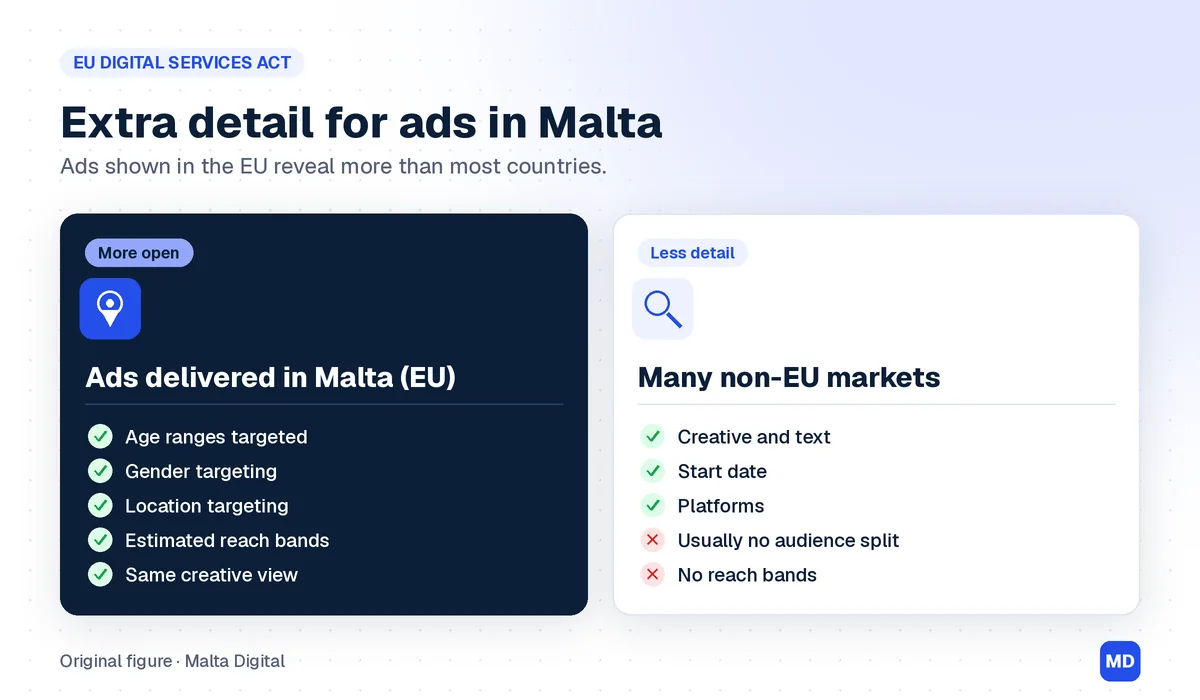
Under the EU Digital Services Act, ads shown in the EU come with extra transparency that ads in most other countries do not have. Open an ad that ran in Malta and the details panel can show the age range and gender it was aimed at, the locations it targeted, an estimate of how many people in the EU it reached, with a breakdown by country, age and gender, and who paid for it and who benefits from it.
Malta context (Eurostat dataset isoc_ci_ac_i): most households here are online, so competitor ads in the Library are not a curiosity: they are what your customers already see. Keep the country selector on Malta when you research local rivals, and run a second search in English and Maltese keywords.
That is genuinely useful. You can see that a competitor’s ad for a dental check-up was aimed at people aged 30 to 65 across Malta, or that a restaurant is only targeting a few localities around Sliema and St Julian’s. EU ads also stay searchable for a year after they stop running, so you can look back at last summer’s campaigns, not just today’s.
Read the figures for what they are. Reach is the number of people who saw the ad at least once, not the number who clicked or bought. A big reach can mean a big budget or simply a long run on a small one.
What it does not show
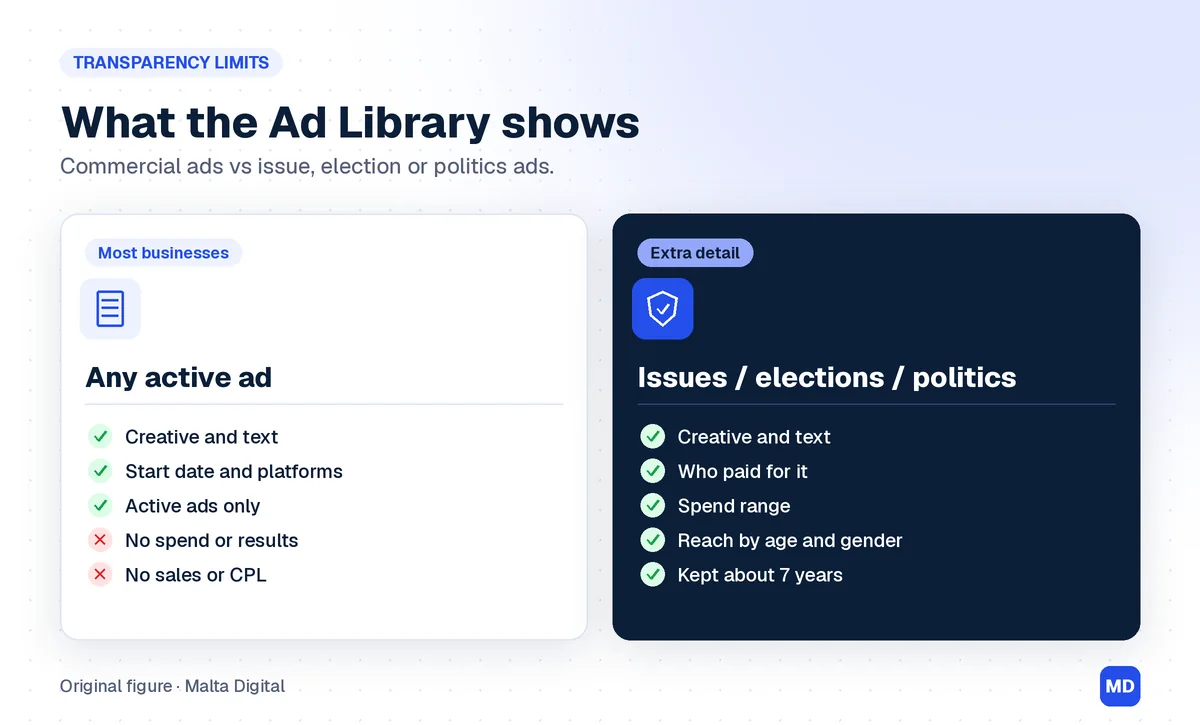
The Ad Library does not show results. There is no click-through rate, no cost per lead, no sales and, for ordinary commercial ads, no budget. You cannot tell from the Library whether an ad made money. That is the most common misunderstanding: people see a competitor running lots of ads and assume they are all working.
One signal is worth more than the rest: how long an ad has been running. Businesses that watch their numbers usually switch off ads that lose money within days or weeks. An ad that has been running for three months is more likely to be paying for itself than one launched yesterday. It is still a hint, not proof, because some advertisers simply forget to switch ads off.
The Library also says nothing about what happens after the click. Two businesses can run almost the same ad and get completely different results, because one answers WhatsApp within minutes and the other replies the next day.
Proof
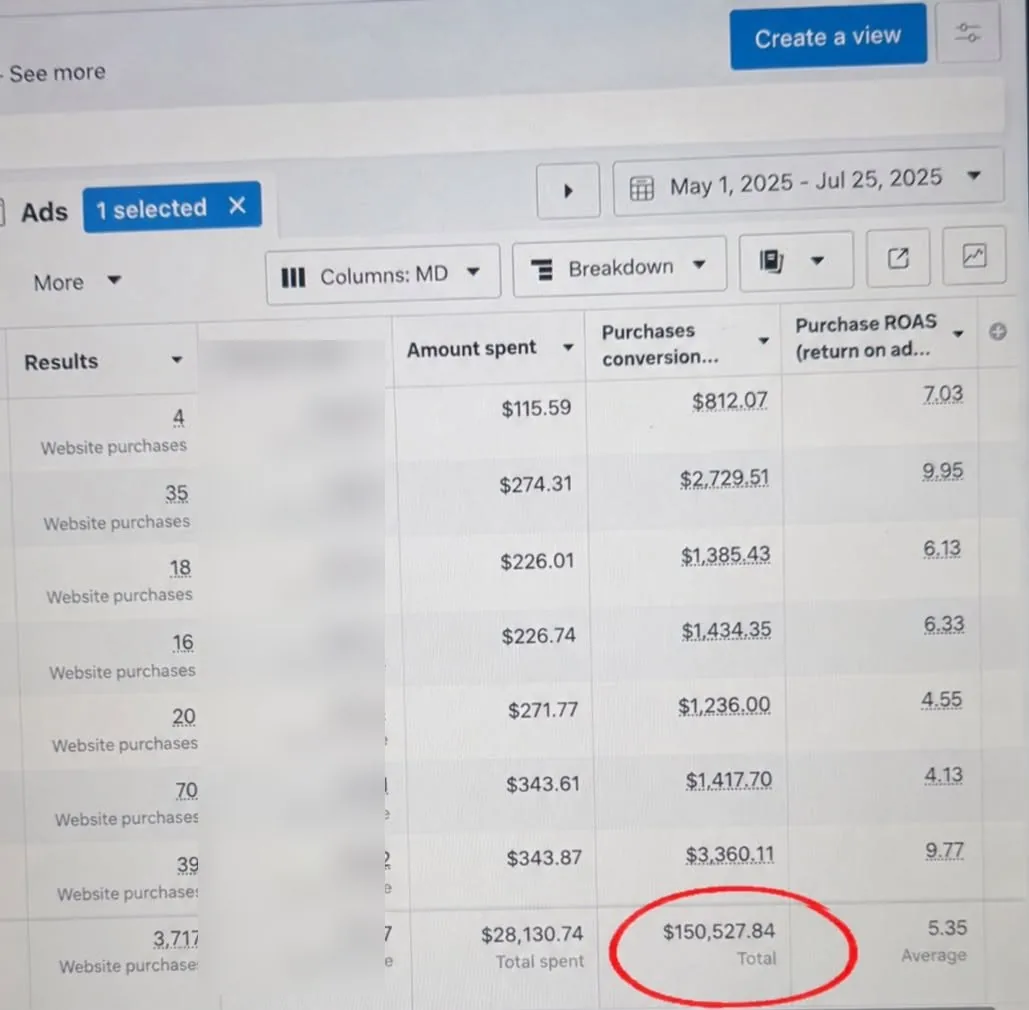
From 1 May to 25 July 2025, an online store we ran ads for spent $28,130.74 on Facebook and Instagram. Meta Ads Manager tracked 3,717 website purchases worth $150,527.84, an average purchase ROAS of 5.35. Tracked purchase value is not profit, and results vary by offer, audience and follow-up.
The Ad Library would have shown that store’s creatives and how long they ran. It would not have shown the $150k. That is why we read the Library for angles and endurance, then judge results only inside Ads Manager, the same place we report from on every Meta ads in Malta retainer.
Want tracked sales like this for your store? Apply now for Meta ads.
Apply now and send us your Facebook page. We’ll look at your competitors in the Ad Library and tell you the angle we’d test first. Free, no obligation.
Using it well
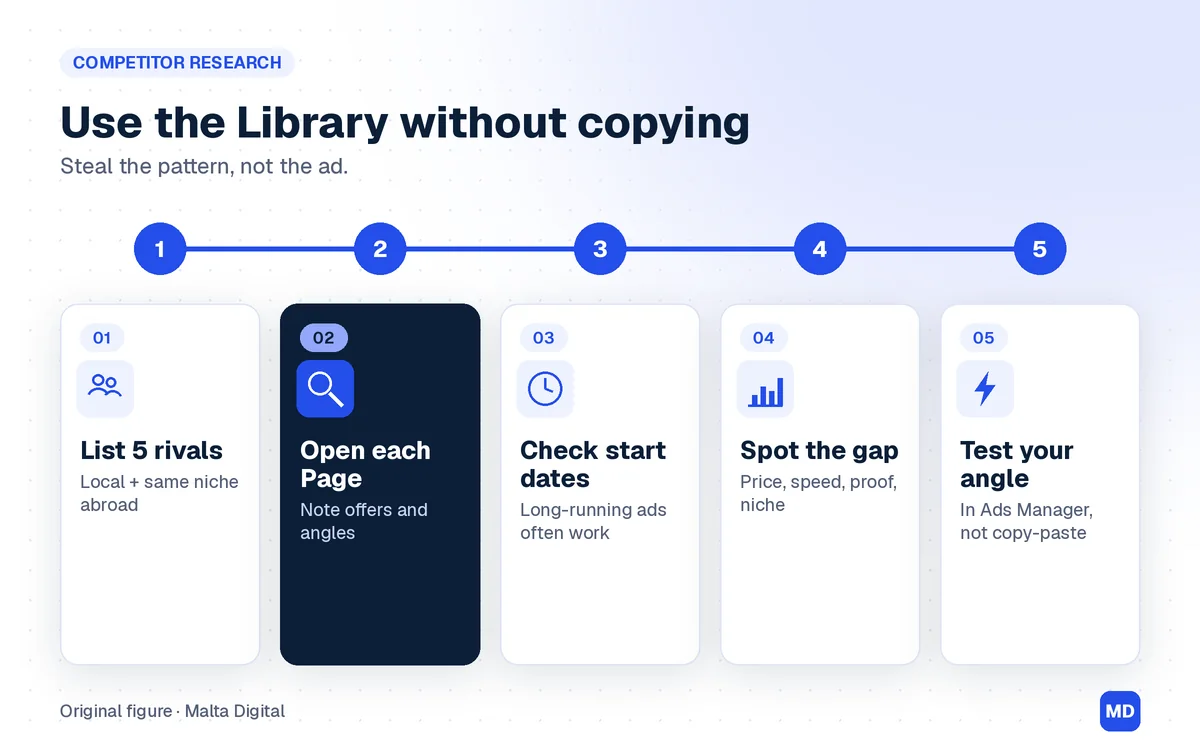
Look for patterns, not individual ads. Spend twenty minutes on the five or six businesses you lose customers to and note what they lead with: price, speed, quality, a guarantee, a free consultation, delivery to Gozo. Note the formats too. If every competitor uses polished photos, a short phone video of your own team at work may stand out more than another polished photo.
Then look for the gap. If every furniture shop in Malta advertises discounts, the one that shows delivery and assembly within two days has something different to say. If every clinic shows the same smiling stock model, real photos of your own rooms and staff are already a difference. The best use of the Library is to find what nobody else is saying.
Do not copy wording, images or video. It is unfair, can breach copyright, and in a market as small as Malta customers notice. It also rarely works, because the ad is only one part of what makes a competitor’s campaign succeed.
Checking your own ads
Search your own Page once a month. Check that only the ads you expect are running, that old offers and wrong prices have been switched off, and that the Page name and the “paid for by” details are correct. If you work with an agency, this is a simple way to see that ads are live without logging into Ads Manager.
The Page transparency section also shows when your Page was created, any name changes and the countries where the people who manage it are located. If you see managers or ads you do not recognise, treat it as a security issue: check who has access in your Meta business settings and remove anyone who should not be there.
How we do it
Before we plan a new campaign, we review the Ad Library for the client’s main competitors in Malta and abroad, note the offers, angles and formats that have been running for a long time, and look for what nobody is saying yet. That review shapes the first round of creative we test, alongside what the client’s own customers tell them.
After launch, the decisions come from the client’s own Ads Manager data: leads, bookings and tracked sales. Our Meta ads management starts from €1,249 a month plus ad spend, and the ad account stays in your name.
Common mistakes
Assuming every competitor ad is working. Copying a competitor’s ad instead of finding your own angle. Looking only at Malta, when good ideas often come from the same type of business in other countries. Forgetting to set the country, so the results are full of ads that never ran here. Treating reach as a result.
And the quiet one: researching for hours and never testing. Twenty minutes in the Library is enough to come up with three ideas. The ads you run, and the numbers they bring, will tell you more than any amount of watching.
A few straight answers
Yes. Anyone can open and search the Meta Ad Library at facebook.com/ads/library without paying. You do not need a Facebook account to browse. You do need to be logged in to download search results. The library never shows sales or cost per lead for ordinary commercial ads.
A free public search of the ads running on Facebook, Instagram, Messenger and Threads, run by Meta. It is now called the Meta Ad Library.
Yes. Open facebook.com/ads/library, set the country to Malta, choose All ads and search the business name or a keyword.
For ads shown in the EU, including Malta, yes: the age range, gender and locations targeted, plus estimated reach and who paid for the ad.
Not for ordinary business ads. Spend ranges are only shown for political and social issue ads.
No. The Library shows no clicks, leads or sales. An ad that has run for months is more likely to be profitable, but that is only a hint.
No. You can search the Ad Library without logging in.
Ours starts from €1,249 a month plus ad spend.
Keep reading
How to sell tickets with Facebook and Instagram ads: event responses or ticket sales, when to start, locals and visitors, tracking and alcohol rules.

Job ads that get applications: the employment special ad category, pay in the ad, lead forms that screen applicants and replies the same day.

Quote requests from Meta ads: real job photos, seasonal offers, lead forms that ask the locality and job, the housing category for repairs and fast call-backs.
A useful first step
We research your market, find the angle nobody is using and run the ads, from €1,249 a month plus ad spend.
Step 1 of 2
A few quick questions, about a minute. We usually reply within 2–3 hours.