CRM and GDPR in Malta
Lawful basis, marketing consent, EU hosting, access roles, retention and data requests, in plain steps.
Systems & automation · Clinic CRM
A clinic CRM tracks every patient enquiry until it is booked, then runs recalls and treatment-plan follow-up. Clinical notes stay in your clinical system. This guide is part of our custom CRM in Malta hub.
Recall due · reception
Check-up and hygiene
Reminder sent · not bookedCall back todayBook appointmentA clinic CRM handles the journey around care: enquiries, bookings, recalls, treatment-plan follow-up, reviews and referrals. It should never hold clinical notes, and because almost everything in it can reveal health data, it needs roles, EU hosting and discreet messages.
What it is
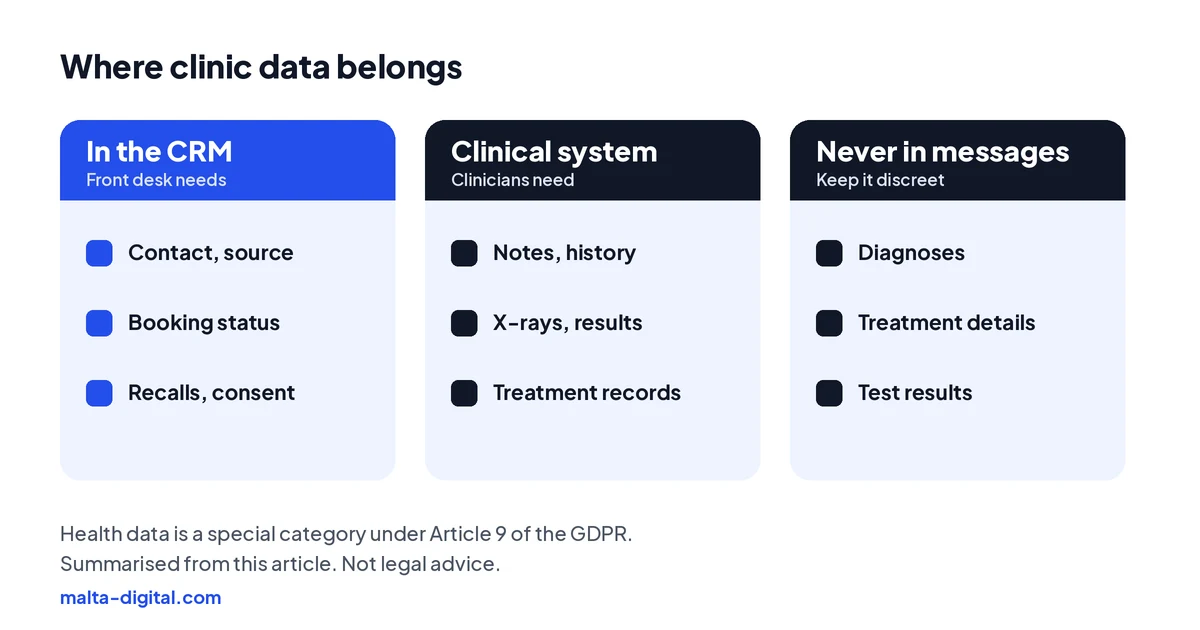
Most clinics already have practice software for the clinical side. It holds patient files, notes, treatment records and X-rays. That system should stay the home of anything clinical.
A CRM does a different job. CRM stands for customer relationship management. In a clinic, it handles people who are not patients yet, and the follow-up around care. Think of the enquiry that came in at nine at night. The implant plan someone took home to think about. The six-month check-up nobody booked.
The mistake to avoid is copying clinical notes into the CRM. You end up with health data in two places and twice the risk. The CRM holds what reception and the practice manager need. It links to the clinical record when more is needed.
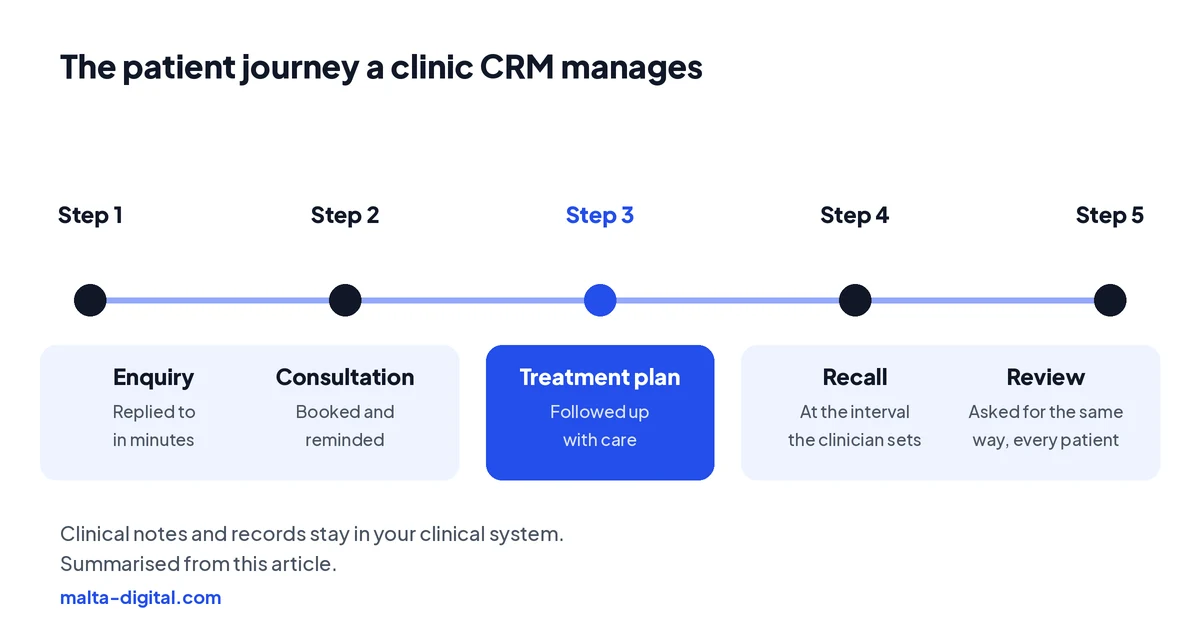
Enquiries
Reception answers the phone, checks people in and takes payments, often at once. Meanwhile, enquiries land on WhatsApp, Messenger, the website form, Google and ad forms. In Malta many arrive in the evening, when the clinic is closed.
A CRM puts all of them in one list. Each enquiry gets a source, an owner and a status. An instant reply says thank you and offers a booking link or a call back. If nobody books within a day, the CRM creates a task for reception.
At the end of the month you see how many enquiries came from each channel, and how many became booked consultations. That one number tells you if your ads and your Google profile are working. If enquiries come from ads, our guide to Facebook ads for clinics covers the ad side.
Recalls
A recall is a planned return visit: a dental check-up, a physio review, an annual health check or a vet booster. The clinician sets the interval. The CRM holds the due date, sends the reminder by the channel the patient chose, and puts anyone who does not book on a call list.
Here is a worked example for a small dental clinic.
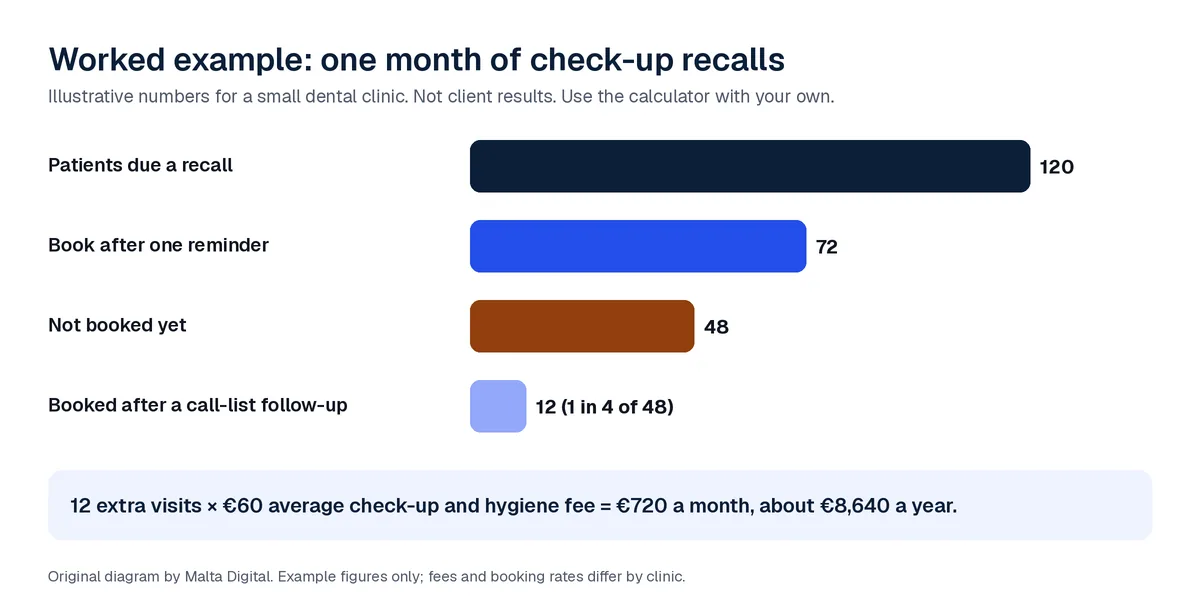
Twelve extra visits a month does not sound like much. Over a year it is close to €8,640 in visit fees, before any treatment those visits lead to. Now try it with your own numbers.
Use last month’s numbers. Everything stays on your device.
This calculator needs JavaScript. The maths: unbooked recalls = due × (1 − booked %). Value at stake = unbooked × visit fee.
Appointment reminders are the other half. A reminder a day or two before, with an easy way to confirm or move the slot, fills gaps that would stay empty. Our guide to appointment reminders covers timing and wording.
Treatment plans
Many treatments need a decision. Implants, aligners, a course of physio, an aesthetic treatment or surgery for a pet. The patient leaves with a plan and a price, then goes home to think. Most clinics have no system for what happens next.
A CRM gives each plan a status: sent, questions, accepted or declined. It also sets a follow-up date agreed with the patient. The follow-up is a service, not a sales push. A short message asks if they have questions and offers a call with the clinician.
Keep the tone right. Patients must decide freely about their own care. One or two kind follow-ups and an easy way to say no is the right rhythm. Pressure loses trust, and trust is what fills a clinic.
Health data
Health data is a special category under Article 9 of the GDPR, so it gets more protection than an ordinary customer list (European Data Protection Board SME guide). In a clinic CRM almost anything can reveal health: even “asked about implants” says something about a person. Treat the whole CRM as sensitive.
In practice that means personal logins with two-factor sign-in, roles, EU hosting with a processor contract, an audit log and no clinical notes. A processor contract is the agreement that makes the software company protect your data. Malta’s regulator, the IDPC, publishes guidance for organisations (IDPC: For organisations).
| Role | Sees | Does not see |
|---|---|---|
| Reception | Contact details, enquiry source, bookings, recall dates | Clinical notes, plan prices if not needed |
| Practice manager | Everything above, plan status, reports by channel | Clinical notes |
| Clinician | Their own patients’ bookings and plan status | Other clinicians’ pipelines, marketing lists |
| Marketing | Counts and consent status only | Names linked to treatments |
Marketing is separate from care. A reminder about a patient’s own visit is a service message. Offers and newsletters are marketing. Under Malta’s S.L. 586.01, email and SMS marketing needs prior consent. The one exception is the soft opt-in: you may email past patients about your own similar services, with a free opt-out at collection and in every message (IDPC: Direct marketing; S.L. 586.01, regulation 9).
Our guide to CRM and GDPR in Malta goes through each setting step by step.
Clinic types
Every clinic needs enquiries, bookings and recalls. What changes is where the money leaks. The table shows the main job of the CRM for each type.
| Clinic type | Main CRM job | Typical recall | Watch out for |
|---|---|---|---|
| Dental | Recalls and big treatment plans | Check-up and hygiene | Plan follow-up that feels pushy |
| Medical / GP | Enquiries and bookings across several doctors | Annual checks, follow-up visits | Referrals in and out going untracked |
| Physio | Courses of sessions and people who stop half-way | Review after a course | No-shows mid-course |
| Aesthetics | Fast replies to ad enquiries and consultation follow-up | Top-up treatments | Marketing consent |
| Vet | Owner reminders | Vaccines, boosters, parasite care | The owner’s details are still personal data |
Multi-disciplinary clinics gain the most from one shared CRM. The same patient can be referred across the team without anyone retyping details.
Reviews and referrals
Reviews matter to clinics, and Google’s rules are clear. Ask every patient the same way, after the visit. Never offer a discount or gift for a review. Never ask only the happy patients. Google’s policy bans both incentives and selective asking (Google Maps content policy).
A CRM makes asking fair and consistent. The request goes out after every completed visit, to everyone who agreed to messages. When you reply to reviews, never confirm that someone is a patient or mention a treatment.
Referrals deserve the same care. Record who referred each new patient, whether a GP, another clinic or a past patient. Then you can thank them and see which relationships matter most.
Real build
We have not built a clinic CRM we can show yet, so here is the closest real build. It is a custom CRM platform we built for a childcare agency. The office, the staff and the clients each see the same record from their own side.

Why it matters for a clinic: the home screen opens with what needs action now. In that build it is jobs to fill and documents about to expire. In a clinic, the same idea becomes unbooked recalls, plans waiting for an answer and enquiries with no reply. Reception stops searching and starts with the list.
For the patient-facing side, our clinic website design guide shows booking demos.
Want reception to start every day with one clear list? Apply now for a clinic CRM
Apply now and tell us what kind of clinic you run, which booking software you use and where enquiries come from.
Ready-made or custom
Start with what you have. If your practice software already handles booking and reminders well, the gap may only be enquiries and follow-up. A ready-made CRM, set up properly and connected to your booking, can close it.
If you have several practitioners, sell plans and courses, and take enquiries from many channels, a custom CRM is often cleaner. It connects booking, WhatsApp, website forms and lead ads, with roles that fit your team.
| Practice software features | Ready-made CRM, set up | Custom clinic CRM | |
|---|---|---|---|
| Best for | Booking and reminders only | Small clinics that need enquiry tracking | Several practitioners, plans, many channels |
| Enquiries from many channels | Often limited | Yes, with connections | Built in, with your rules |
| Treatment-plan follow-up | Rarely | Set up as a pipeline | Built around your plans |
| Health data | Usually designed for it | Check hosting, roles and contract | Designed in from day one |
| Cost | Your current subscription | A monthly fee per user | From €7,500 |
At Malta Digital, custom CRM systems start from €7,500. Larger digitalisation projects may qualify for co-funding under Digitalise your SME, subject to eligibility and approval. See how much a CRM costs for the full picture.
How we do it
We start with reception and the practice manager, because they know where enquiries get lost. Together we map every channel, the steps from enquiry to booking, and how plans and recalls work today. Then we set up a ready-made CRM or build a custom one around that map.
We import your contacts carefully, keep clinical data out, test every message for wording and privacy, and train your team. See what our CRM in Malta service includes, or use the lost leads calculator to price the enquiries you miss today.
Sources
This guide is general information, not legal advice.
A few straight answers
The one that fits your clinic and protects health data. If your practice software already handles booking and reminders, a ready-made CRM for enquiries and follow-up may be enough. Clinics with several practitioners, plans and many channels often need a custom CRM.
No. Practice software holds clinical notes and records. A CRM manages enquiries, bookings, treatment-plan follow-up, recalls, reviews and referrals, and should not hold clinical notes.
Yes, for the patient’s own care, on a business account the patient agreed to be contacted on. Keep messages free of treatment details and use EU-hosted tools with a processor contract.
Only with prior consent, or under the soft opt-in for past patients about your own similar services, with a free opt-out in every message. That is the rule in Malta’s S.L. 586.01, as the IDPC explains.
Multiply the patients due a recall who do not book by your average visit fee. In our worked example, 48 unbooked recalls at €60 is €2,880 of visits a month. Use the calculator on this page with your own numbers.
EU hosting is strongly advisable for health-related data. Data stored outside the EEA needs a legal safeguard, and you need a processor contract with every tool.
No. Google’s policy bans incentives for reviews and asking only happy patients. Ask every patient the same way, after the visit.
Ready-made CRMs charge a monthly fee, usually per user. Malta Digital’s custom CRM systems start from €7,500, depending on users, workflows and integrations.
Keep reading
Lawful basis, marketing consent, EU hosting, access roles, retention and data requests, in plain steps.
WhatsApp, SMS or email, when to send, message templates and reschedule links.

Online booking, doctor profiles within Medical Council rules, health-data-safe forms and Google Maps.
A useful first step
We connect your booking system, WhatsApp, website and ads, follow up plans and recalls automatically and keep clinical data out of the CRM. Custom CRM systems from €7,500.
Step 1 of 3
A few quick questions, about a minute. We usually reply within 2–3 hours.