Which CRM fits my business? (quiz)
Answer a few questions and see whether a ready-made CRM, setup help, or a custom CRM fits.
Systems & automation · CRM
A slow first reply can turn a warm enquiry into a missed sale. Malta Digital built this checker so you can type your own leads, reply time, close rate and sale value, then see an estimated yearly gap. Use it with a CRM in Malta that gives every enquiry an owner and a clock.
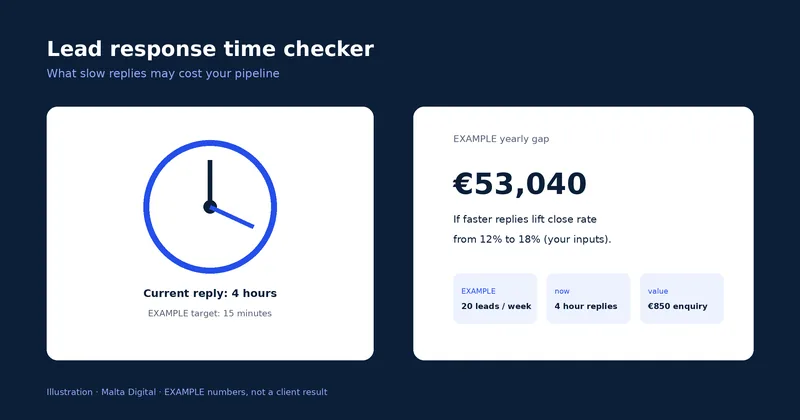
Malta Digital’s lead response time checker estimates what delayed replies may cost you, using numbers you type yourself. Enter leads per week, how long you take to reply, your close rate and an average sale value. Then compare that with a faster-reply close rate you choose. Pair it with a CRM system in Malta so every lead has a person, a deadline and a report. Custom CRM projects start from €7,500 after scoping.
The felt problem
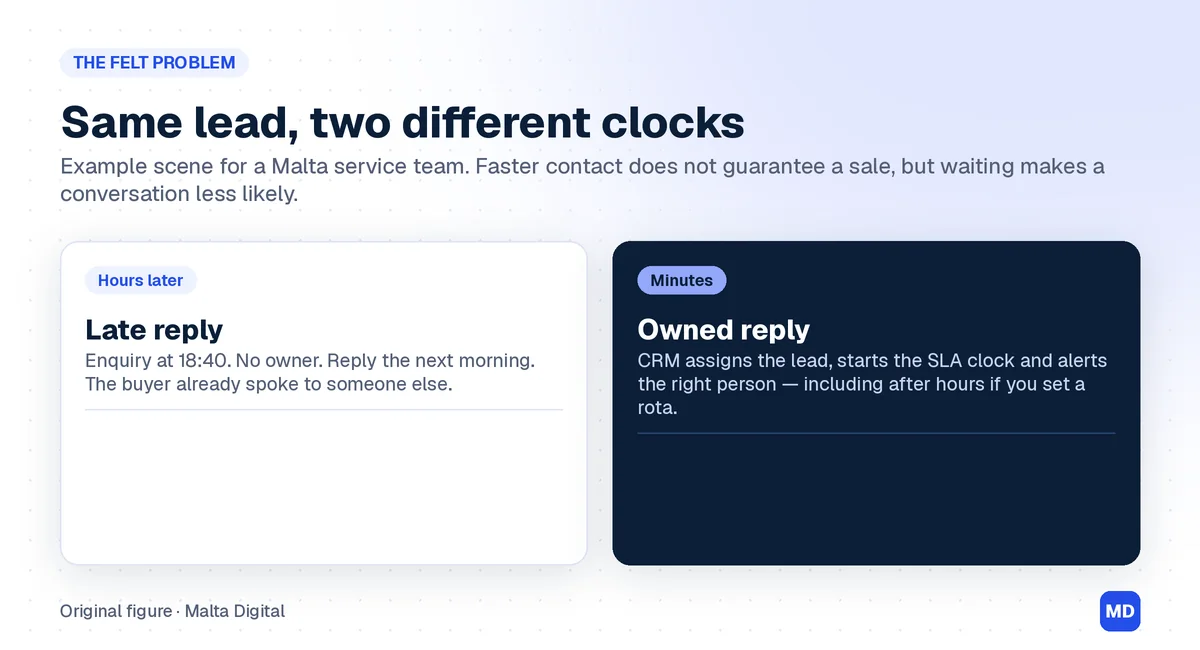
A clinic in Sliema, a contractor in Mosta and a multi-site retailer all share the same leak. Someone fills in a form at 18:40. The message sits in a shared inbox, a personal email or a Facebook page. By morning the buyer has already spoken to the team that wrote back first.
Example sceneA three-branch service firm runs Facebook lead ads and a website form. Night enquiries land on one person’s phone. That person is off on Tuesday. The lead waits 14 hours. Nobody can see the delay unless they go hunting.
Speed is not a slogan. In 2013, XANT (then InsideSales.com) tested web-form replies at 14,061 companies. Of the 9,538 that received the test lead, 4,472 (47%) never responded. Among companies that did call back, the median first call took 3 hours and 8 minutes, and the average was 61 hours and 1 minute (2014 Lead Response Report, opened 8 November 2026).
A separate Leads360 paper, drawn from several million internet-generated leads, found that contacting someone within 1 minute was linked to a 391% improvement in conversion versus slower contact. Calling within 30 minutes was linked to a 62% improvement, and within 1 hour to 36% (Beyond Qualification, Leads360, opened 8 November 2026). Those figures are from that study, not a promise for your market. They are why a CRM in Malta should measure minutes, not good intentions.
The checker
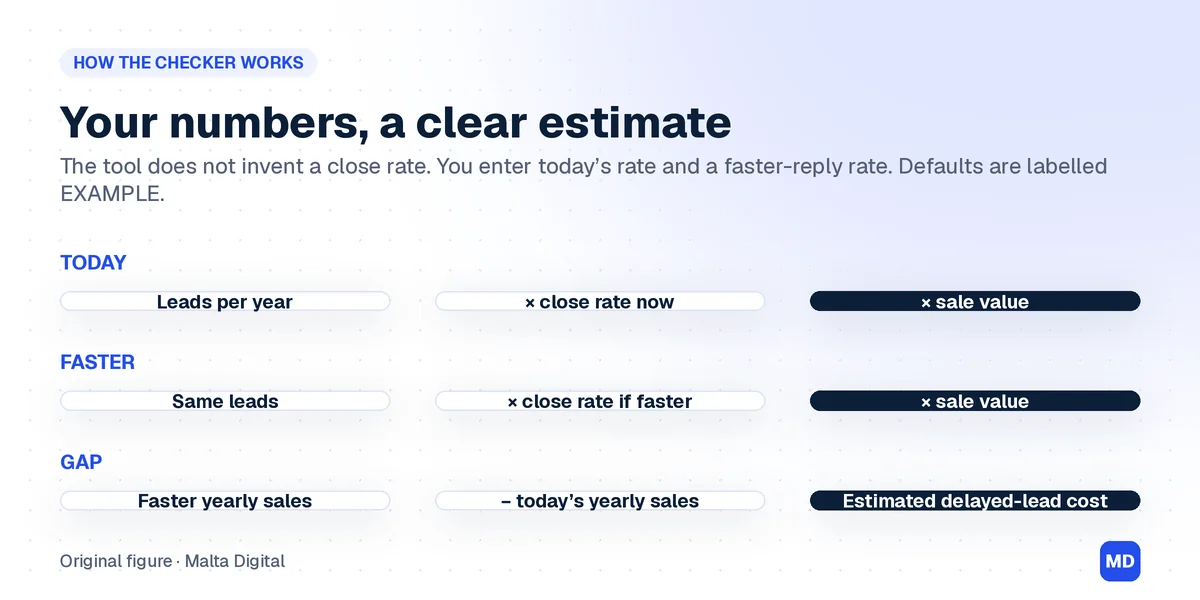
The checker stays honest. It does not claim that a faster reply will multiply your sales by a fixed number. You enter today’s close rate, and the close rate you believe you could reach if replies were faster. The tool then shows the yearly euro difference at your average sale or enquiry value.
Load the labelled EXAMPLE if you want a starting point: 20 leads a week, a 4-hour reply, a 15-minute target, a 12% close rate now and an 18% close rate if you were faster, at €850 per won enquiry. Change every field. Nothing you type is sent anywhere.
Use your own numbers. The starting values you can load are a labelled EXAMPLE, not a forecast. Nothing you type leaves this page.
Without JavaScript: yearly leads = leads per week × 52. Today = yearly × (close rate ÷ 100) × value. Faster = yearly × (faster close rate ÷ 100) × value. Gap = faster − today.
Reply time is there so you can see your own clock next to the target. The euro gap itself comes only from the two close rates and the sale value. That keeps the maths something you can check on paper.
Worked EXAMPLE
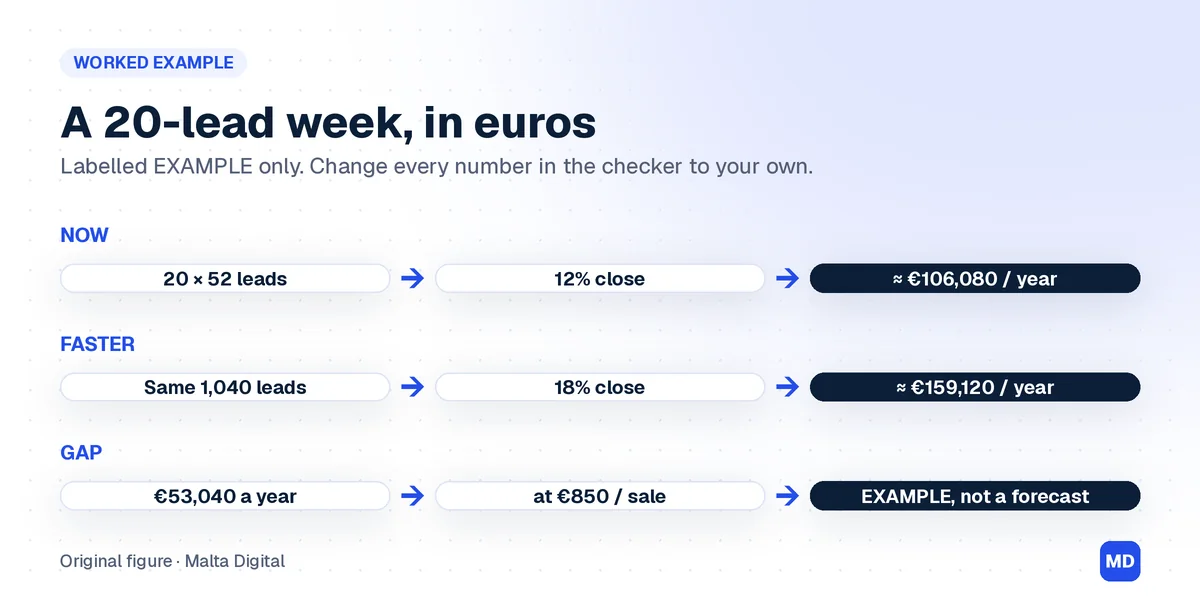
Here is the EXAMPLE in full. 20 leads a week × 52 weeks = 1,040 leads a year. At a 12% close rate you win about 125 sales. At €850 each, that is about €106,080. If faster replies lift the close rate to 18%, you win about 187 sales, or about €159,120. The gap is about €53,040 a year.
That lift is an assumption you typed, not a result we measured for this business. If your close rate would barely move, the gap shrinks. If each sale is worth €3,000 instead of €850, the same percentage gap becomes much larger. Use the checker with figures from your last quarter, not a guess you like the look of.
Want this estimate turned into a reply process your team can keep? Apply now for a CRM / business system
Tell us how enquiries arrive and who answers them. We will map routing, an SLA and after-hours cover.
How a CRM helps
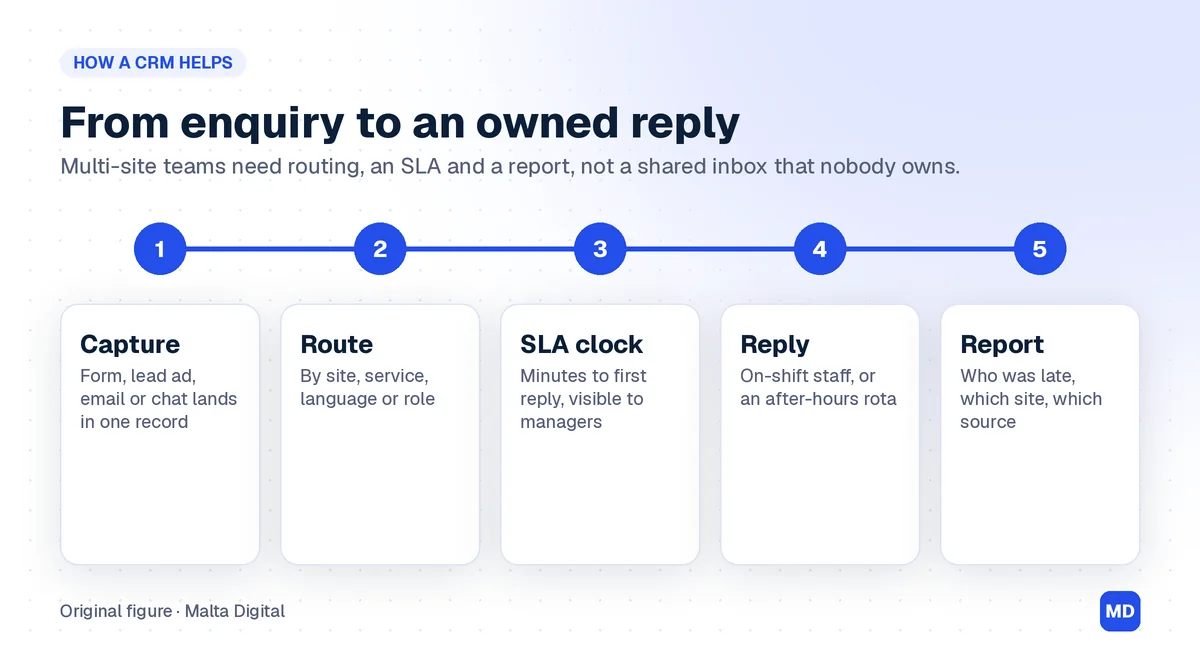
A CRM is a shared record of each enquiry and customer. In plain terms, it stops leads living in someone’s head. For response time, five steps matter. Capture the enquiry from the website, a lead ad, email or chat. Route it to the right site, service or role. Start an SLA clock. Get a reply out. Report who was late.
Smaller teams may only need one pipeline and a reminder. Larger operators need more. Multi-site groups should route by branch so a Birkirkara lead is not waiting on a Gozo colleague. Role routing keeps reception, sales and after-sales out of each other’s way. Managers need a simple report: median minutes to first reply, by site and by source.
After-hours is where many Malta teams leak. You can set a rota, a next-open queue, or a short holding reply that still assigns an owner for the morning. The holding reply is not a close. It is a promise that someone named will follow through.
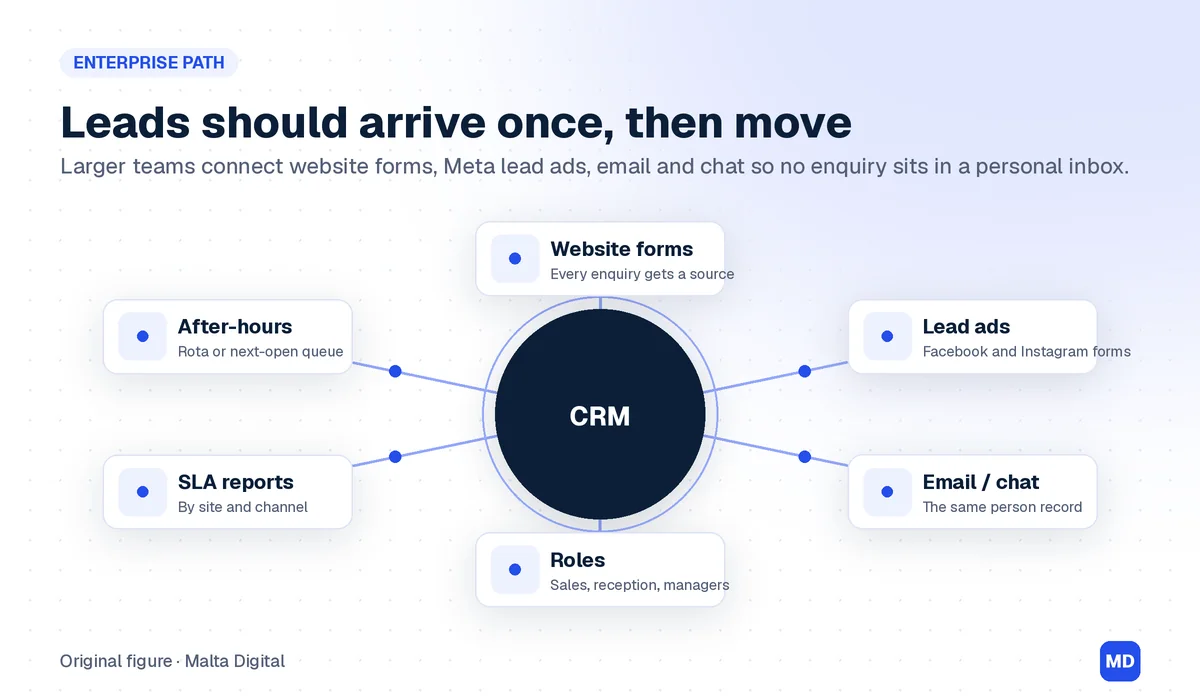
Facebook and Instagram lead ads, website forms and email should create the same kind of record, with the source attached. Otherwise you will measure website speed and ignore the ads that actually fill the evening inbox. If you also run paid campaigns, pair this page with how those leads are generated, then let the CRM own the minutes after they arrive.
Enquiry records hold personal data. Treat them as such. The IDPC oversees data protection in Malta. Limit access by role, keep messages only as long as you need them, and say so in your privacy notice.
Proof
A CRM will not invent demand. It protects the demand you already paid for. Malta Digital also runs lead campaigns, so we see both sides: the cost to generate an enquiry, and the waste when nobody answers it.
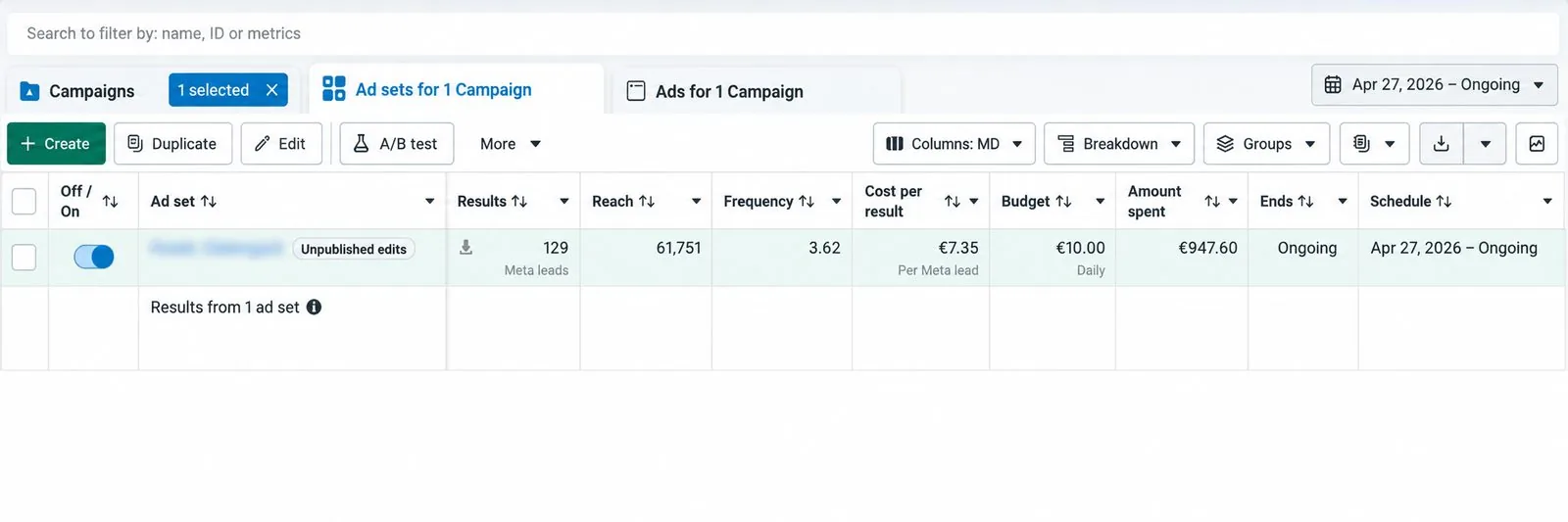
Those 129 leads arrived at €7.35 each. If half of a list like that waits overnight, you have paid for conversations you may never have. A CRM with routing and an SLA is how a larger team stops that leak without adding another spreadsheet.
Want your next leads assigned and timed, not left in a shared inbox? Apply now for a CRM / business system
A few straight answers
There is no single official target that fits every trade. A Leads360 study of several million internet leads found that calling within one minute was linked to a much higher conversion rate than slower contact, and that speed still helped inside the first hour. Use a target your team can keep, then measure it.
A CRM does not have to send the first message. Its job is to catch the enquiry, give it an owner, start a timer and show who is late. Some teams add templates or automation for the first note. A person should still handle judgement calls.
It multiplies yearly leads by the close rate and sale value you enter, once for today and once for a faster-reply close rate you also enter. The difference is the estimated gap. It does not invent a close-rate lift for you.
Yes. Larger teams route by site, service, language or role, and report SLA by location. After-hours work can go to a rota or a next-open queue so a Valletta lead is not waiting on a Gozo shift.
Yes. Names, numbers and messages are personal data. The Information and Data Protection Commissioner (IDPC) is Malta’s authority. Keep only what you need, limit who can see it, and say how long you store it.
Malta Digital custom CRM and business-system projects start from €7,500, per project after scoping. Ready-made software has its own subscription. We quote after we map how leads arrive and who should own them.
Keep reading
Answer a few questions and see whether a ready-made CRM, setup help, or a custom CRM fits.
Estimate what missed enquiries and manual admin cost you each month, using only your numbers.

A practical checklist for fields, owners, migration and the first weeks after launch.
A useful first step
Share how leads reach you and how long replies take. We will tell you honestly whether a ready-made CRM or a custom system fits, then quote after scoping.
Step 1 of 3
A few quick questions, about a minute. We usually reply within 2–3 hours.