
CRM for contractors
Quotes, site visits and follow-ups for builders and trades.
Systems & automation · Logistics
Quotes in email, bookings in WhatsApp, the day’s runs on a whiteboard. A logistics CRM puts customers, quotes, jobs, vehicles and invoices on one record. Malta Digital builds custom CRMs for hauliers, couriers, skip hire and waste firms as part of our CRM in Malta work, from €7,500.
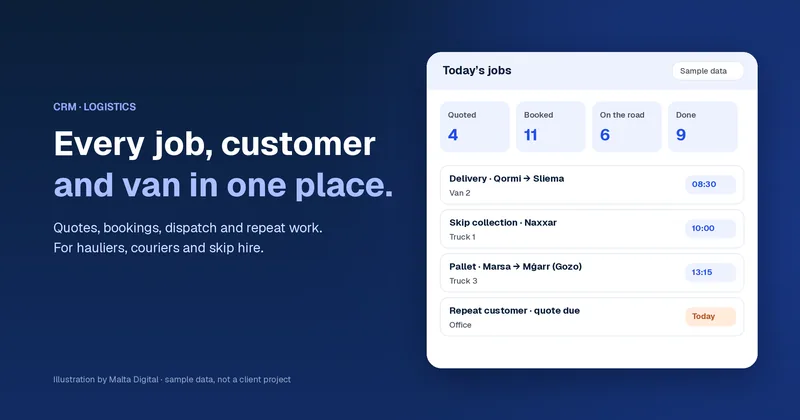
A logistics CRM keeps every customer, quote, job, vehicle and invoice on one record, from the first call to the repeat order. Malta Digital builds custom logistics CRMs for transport, courier and skip hire firms in Malta and Gozo as part of our CRM in Malta service, from €7,500.
The problem
Most small transport firms run on memory and messages. A customer calls for a quote. Someone writes it in an email. The booking arrives on WhatsApp. The run sheet is a whiteboard or a group chat. The invoice is typed up on Friday from whatever people remember.
It works until it does not. A quote is never chased. Two jobs land on the same truck. A driver cannot find the access notes. A regular customer stops ordering and nobody notices for two months.
Example sceneA haulier with five trucks gets 30 quote requests a week. Eight never get a follow-up because the person who priced them is on the road. Nobody can say which ones. This is a made-up example, not a client story.
None of that is a people problem. It is a record problem. Every job has a customer, a quote, a date, a vehicle, a driver, a proof and an invoice. When those live in six places, the office spends the day asking. For the wider CRM picture, start with CRM in Malta.
The idea
CRM stands for customer relationship management. In plain words, it is one list of customers and everything you did for them. A logistics CRM adds the parts a moving business needs: jobs, addresses, vehicles, drivers and proof of delivery.
| Part | What you see | What you stop doing |
|---|---|---|
| Customers | Every account, contact and past job | Searching old chats for a phone number |
| Quotes | Price, date, vehicle and status | Losing quotes nobody chased |
| Jobs | Address, access notes, permit status | Ringing the customer for details again |
| Dispatch | Vehicle, driver and slot per job | Double-booking a truck |
| Proof | Photo, time and signature on the job | Arguing about whether it was delivered |
| Invoices | Linked to the job that earned them | Typing invoices from memory on Friday |
You do not need all of it on day one. Most firms start with customers, quotes and jobs, then add dispatch and proof once the team trusts the record.
Malta data
Malta’s transport firms are already ahead of the EU, which raises the bar for everyone else. Eurostat data for 2025 shows that 38.6% of Malta transport and storage businesses with 10 or more staff use CRM software, against 18.6% across the EU. In waste management, the Malta figure is 36.7%, against 23.8%.
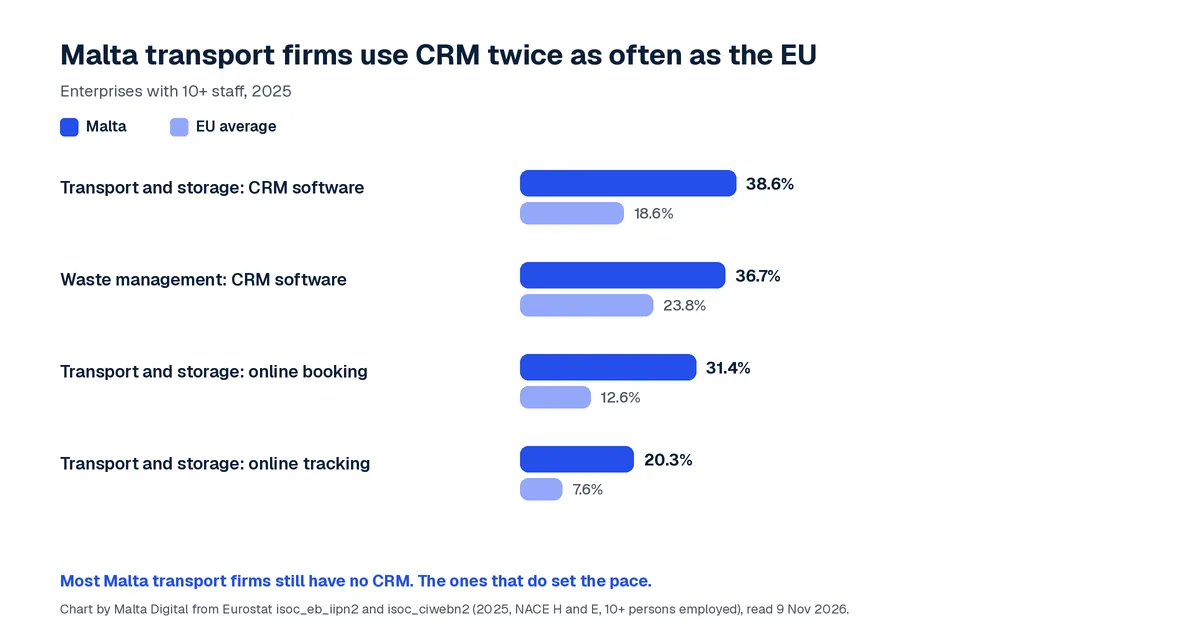
Customers notice. 31.5% of these Malta transport firms let customers book or order on their website, and 20.3% offer online tracking. In the EU those figures are 12.6% and 7.6%. Once a customer has booked a pallet online, a phone-only competitor feels slow.
The flip side matters too. About six in ten Malta transport firms of that size still have no CRM. That is a real chance to be the easy one to work with.
How it flows
The best logistics systems follow the job, not the department. One record starts with the enquiry and ends with the next order from the same customer. Everyone adds to it. Nobody retypes it.
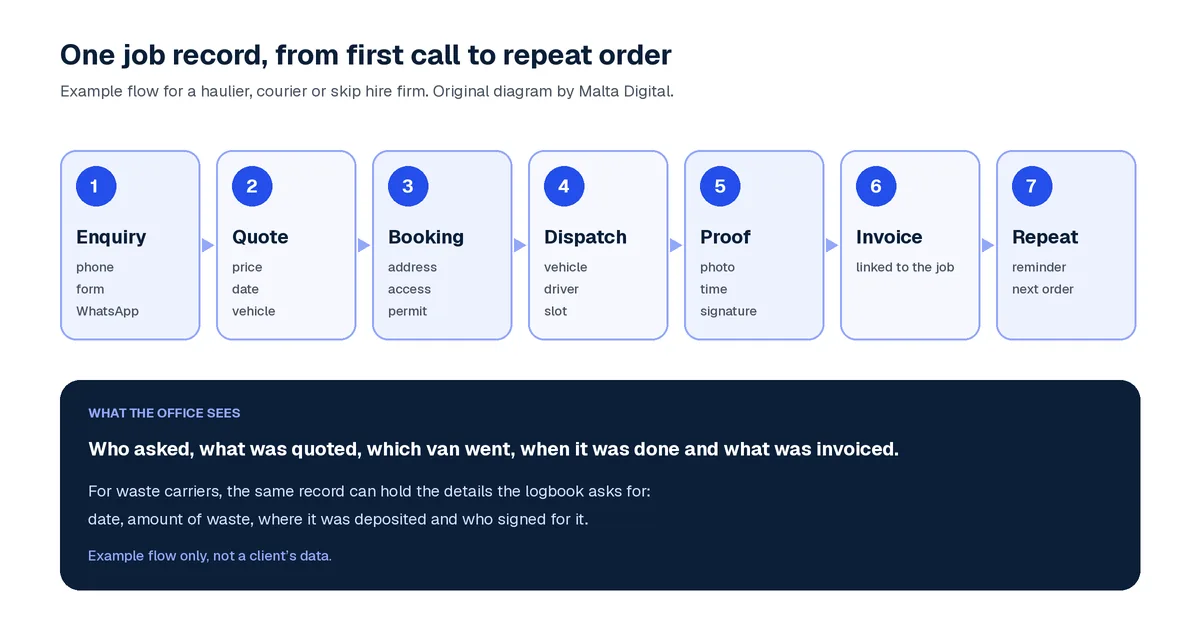
Here is what that means on a normal morning. The office opens “today” and sees every job, its vehicle and its slot. A driver marks a delivery done with a photo. The invoice is ready before the truck is back. A reminder tells the office that a regular customer usually orders around now.
If quotes and invoices still live in separate files, our quote and invoice automation guide shows how they join the same record.
Apply now and tell us how jobs reach you today. We will show you the first screens that would replace the whiteboard.
Malta rules
Waste carriers have extra paperwork, and a CRM can carry it. Malta’s Waste Management (Activity Registration) Regulations, S.L. 549.45 (legislation.mt) lists the conditions for registered waste carriers. Skip loaders used for non-hazardous and inert waste fall under Class A. Registration is renewable each year.
Each vehicle must keep a logbook showing the date of delivery, the amount of waste, where it was deposited and the signature of the person in charge of the receiving facility, where one is present. Skips must be marked with the carrier’s name and phone number. Open skips must be covered in transit, and a consignment note is needed for the waste streams that require one.
A job record can hold all of that next to the customer and the invoice. The driver adds the deposit site and signature on the phone. The office can print or export the log when asked. That is far easier than rebuilding it from paper at the end of the month.
We are not lawyers or environmental advisers. Check your own registration conditions with the authority. The system stores what you are asked to keep. It does not decide what that is.
Want your jobs and your logbook in the same place? Apply now for a CRM
Worked example
This is a made-up example to show the maths, not a benchmark. A courier firm sends 40 quotes a month. On average, a won job is worth €180. Today, 10 quotes a month get no follow-up because nobody owns them.
Suppose a CRM reminder means those 10 get a follow-up call, and 2 of them turn into jobs. That is 2 × €180 = €360 a month, or €4,320 a year, from quotes you already priced. Change the numbers to yours. If only 1 converts, it is €2,160 a year.
| Line | Example figure | Your figure |
|---|---|---|
| Quotes sent a month | 40 | Count last month’s |
| Quotes with no follow-up | 10 | Check your sent folder |
| Extra jobs won after a follow-up | 2 | Your estimate |
| Average value of a job | €180 | Your average |
| Extra revenue a month | €360 | Jobs × value |
Repeat orders work the same way. If a regular customer stops ordering, a CRM can flag it while there is still time to call. To put your own numbers on lost leads and admin time, try the CRM ROI calculator. Not sure if you need custom at all? Take the which CRM is right for me quiz.
Your options
Ready-made transport and freight software is a good fit when your work matches its model: standard shipments, standard documents, standard rates. It struggles when you mix services. Think skip hire plus grab trucks, local deliveries plus Gozo runs, or pallets plus removals.
A custom CRM is worth it when the workarounds multiply. If you keep a spreadsheet “just for Gozo” or a WhatsApp group “just for drivers”, the software is not doing its job.
| Common route | How Malta Digital does it | |
|---|---|---|
| Data | Quotes, jobs and invoices kept apart | Customer, quote, job and invoice on one record |
| Fit | Your process bends to the software | Screens follow your vehicles, services and words |
| Drivers | A separate app or a group chat | A simple phone view of today’s jobs |
| First working version | After long specs | In 2–4 weeks for a focused system |
| Start | Weeks of paperwork first | We start as soon as the first payment is made |
| Ownership | A licence you rent each month | You own every line of code we build for you |
Custom CRM projects start from €7,500. Qualifying software may get help from the Digitalise your SME grant. If part of the project uses AI, look at the AI grant in Malta too. We prepare the technical specification and quote. The funding body decides.
Proof
Our closest example is a booking and dispatch system for a skip hire and waste business. Requests used to arrive by phone, Messenger, a Facebook button and a contact form. The office had no single view of skips, vans, drivers and daily capacity.
The system gives the office a week view of delivery and collection slots left each day. Each job is assigned to a vehicle, a driver and a date. If a day is full or a vehicle is double-booked, the system warns. Drivers see their jobs in order and mark each one delivered or not done, with a reason. It is now being rolled out, and the screens use sample data.

That is the logistics CRM idea in one sentence: everyone looks at the same job. The customer details, the slot, the driver and the outcome live together.
Want the same control over your vehicles and jobs? Apply now for a CRM
How we work
We start as soon as the first payment is made. A focused system has its first working version in 2–4 weeks. Bigger systems are live within 2–3 months at most. You own every line of code we build for you. Hosting stays where you want it.
We start with how a job really moves through your business, on paper. Then we build customers, quotes and jobs first, add dispatch and the driver view, and connect invoices last. Your team tests each part with real jobs before the next one starts.
Driver locations, photos and customer details are personal data. Collect only what you need, tell drivers what you record and why, and limit who can see it. Malta’s Information and Data Protection Commissioner (IDPC), Malta is the local authority. Our CRM and GDPR guide covers the basics, and the CRM setup checklist shows what to tidy before you switch.
Apply below and tell us what you move and how jobs reach you. We will tell you honestly whether ready-made software is enough, or whether a custom CRM will pay for itself.
A few straight answers
It is a customer system built for moving things. Next to contacts and quotes, it holds jobs, addresses, dates, vehicles, drivers, proof of delivery and invoices, so the office, drivers and accounts see the same record.
Not exactly. A transport management system (TMS) focuses on planning loads and routes. A CRM focuses on customers, quotes and repeat work. A custom system can do the parts of both that you actually use.
Yes. The record can hold the skip, the site, the permit status, the delivery and the collection. It can also store the details a waste carrier’s logbook asks for under S.L. 549.45, such as date, amount, deposit location and signature.
Yes. Drivers see their jobs in order, add a photo or note and mark each job done or not done with a reason. The office sees it straight away.
It can. Driver locations, photos and customer details are personal data. Use only what you need, tell staff what you collect and why, and set who can see it. Malta’s IDPC is the local authority.
Custom CRM projects start from €7,500. You get a fixed quotation after we map your jobs, vehicles and invoices. We start as soon as the first payment is made. A focused system has its first working version in 2–4 weeks. Bigger systems are live within 2–3 months at most.
Sources
Keep reading
Quotes, site visits and follow-ups for builders and trades.
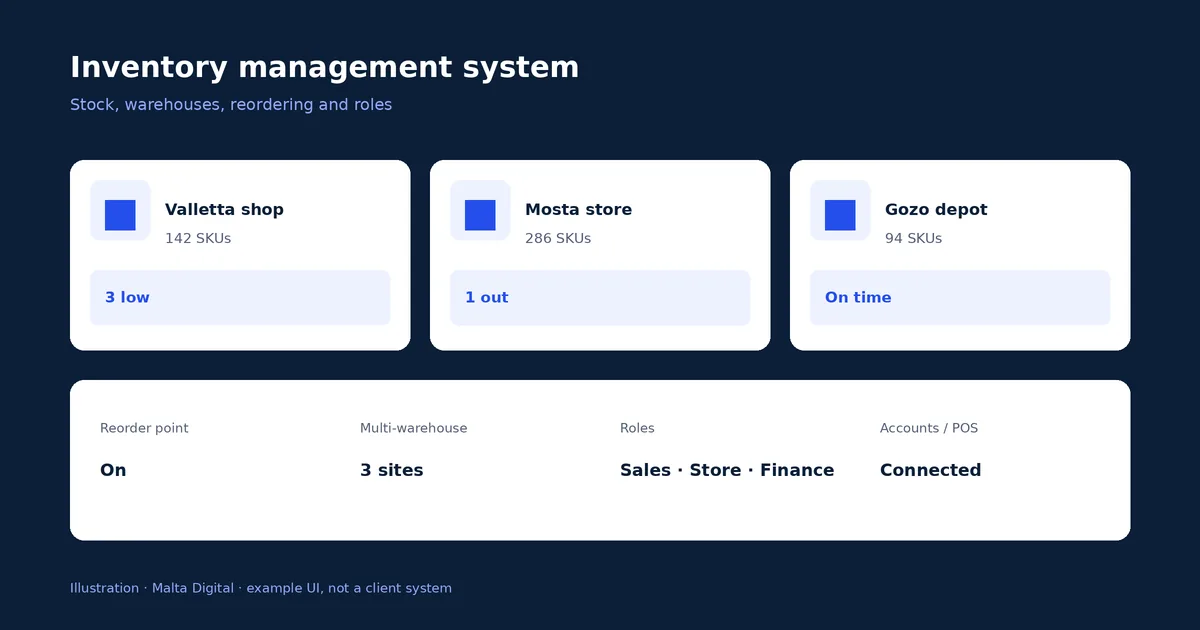
Stock in every place, reorders and invoices on one record.
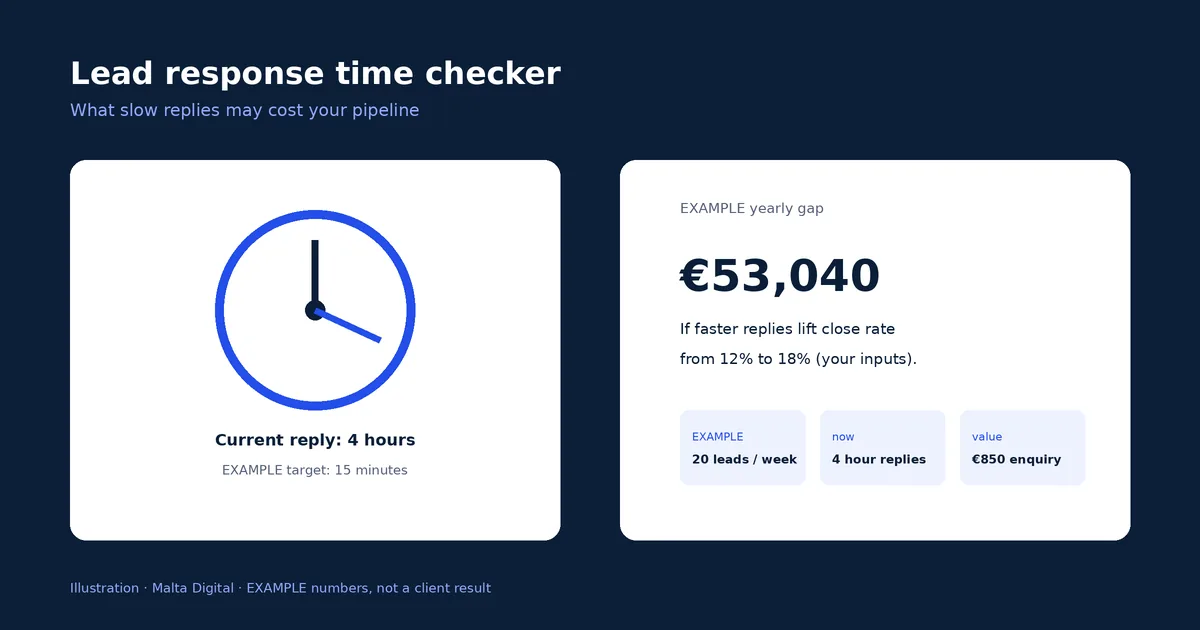
See how long your enquiries wait, from your own numbers.
A useful first step
Tell us what you move, how many vehicles you run and where jobs come from. We reply with a clear first version and what it would cost.
Step 1 of 3
A few quick questions, about a minute. We usually reply within 2–3 hours.