
CRM Implementation Checklist for Malta Businesses (Free PDF)
A free, printable CRM setup checklist for Malta and Gozo businesses: 38 steps from choosing a CRM to data, GDPR, lead ads, launch and funding. Get the PDF.
Systems & automation · CRM
Malta Digital builds custom CRM systems in Malta, and accounting practices have a problem most CRMs ignore: the hard part is not winning clients, it is chasing them for documents before each deadline. This guide shows what a CRM does for an accounting firm here, from the first enquiry and due diligence to provisional tax dates and year-end packs, and gives you a free planner for your own client list.
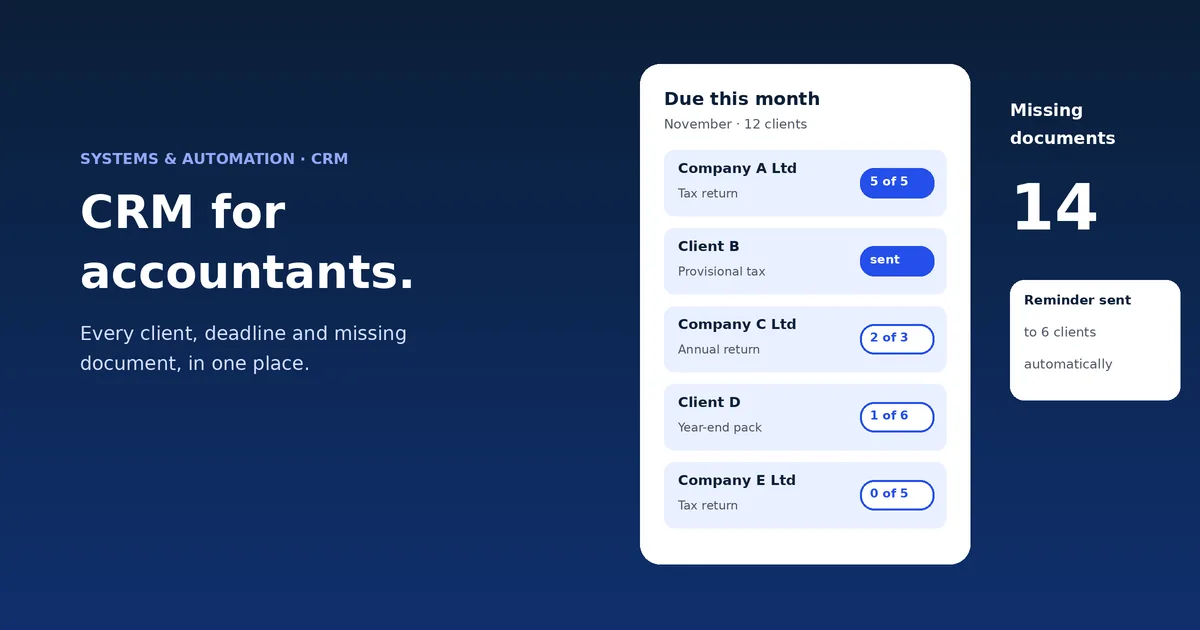
A CRM for an accounting firm keeps one record per client with their contacts, services, due diligence, documents and deadlines. It captures new enquiries, sends fee proposals and engagement letters, runs the onboarding checklist, shows every deadline coming up and chases missing documents by itself. The books and tax returns stay in your accounting and tax software. Malta Digital builds custom CRMs for practices in Malta from €7,500.
The short version
A CRM (customer relationship management system) is one shared list of every client and everything about them. In a practice that means who the client is, which services they pay for, who owns the relationship, what is due and what is still missing.
It does not replace your accounting or tax software. The books, payroll and returns stay where they are. The CRM sits around them and runs the client side: enquiries, proposals, onboarding, requests, reminders and the calendar.
For most firms the biggest win is not sales. It is knowing, on any morning, which clients still owe you documents for a deadline in the next 30 days, and having the reminders go out without anyone writing them.
Malta data
Eurostat, the EU statistics office, groups legal, accounting, architecture and engineering firms together. In 2025, 48.2% of these Maltese firms with 10 or more staff used CRM software, well above the EU’s 33.8%.
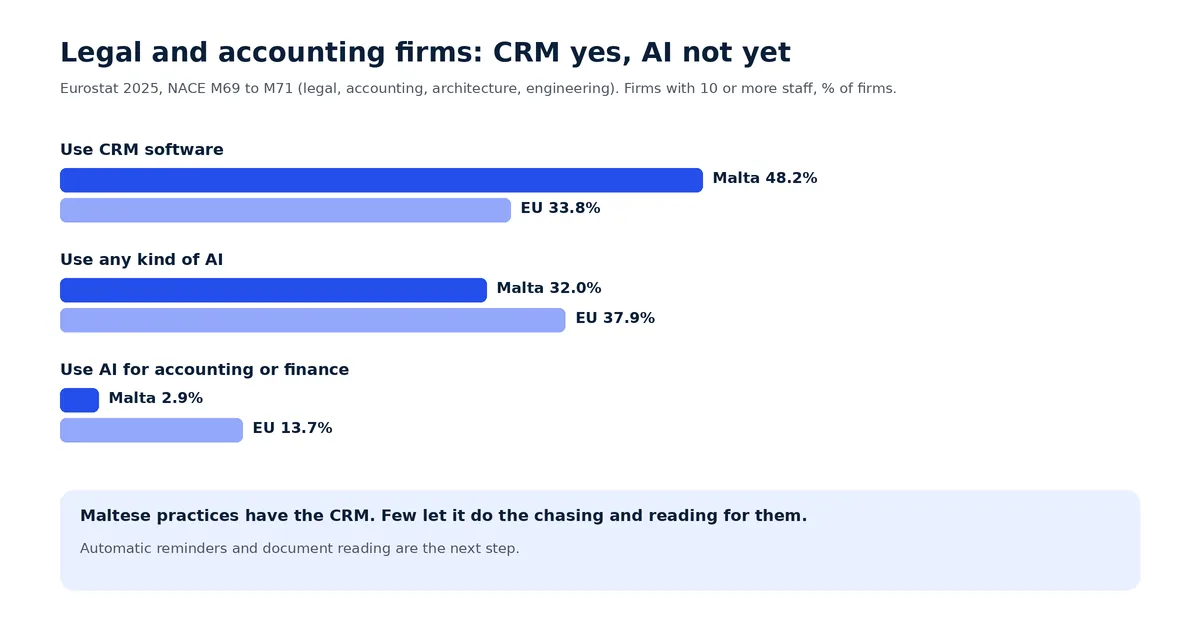
Automation is the gap. Only 2.9% of the same Maltese firms used AI for accounting, controlling or finance, against 13.7% across the EU, and 32.0% used any AI at all (EU 37.9%). Many practices own a CRM that still waits for someone to type.
Onboarding
Accountants who give tax advice or external accounting services are subject persons under Malta’s anti-money laundering rules, the PMLFTR. Before taking on a client, the FIAU expects you to identify and verify the client and any beneficial owner, understand the purpose of the relationship, and keep monitoring it.
A CRM turns that into a checklist on each client record, so nothing starts before every step is ticked.
| Stage | What happens | What the CRM does |
|---|---|---|
| Enquiry | A prospect asks about bookkeeping, tax or a company set-up | Creates the record from the website form, ad or email and assigns an owner |
| Fee proposal | You confirm the services and send a fee | Builds the proposal from your service list and reminds you if there is no reply |
| Due diligence | Identity and beneficial owners verified, purpose and risk recorded | Runs the checklist, stores the documents and blocks the next stage until it is complete |
| Engagement letter | Scope, fees and responsibilities agreed and signed | Sends the letter for signature and files the signed copy |
| Set-up | Access to records, year-end, filing calendar and contact person | Adds the client’s deadlines to the calendar and starts the first document requests |
| Ongoing monitoring | Changes in ownership, activity or risk reviewed | Sets a review date and reminds the owner |
The FIAU says these records must be kept for five years from the end of the business relationship, and sometimes longer. A CRM should store the end date and keep the file until then, instead of someone remembering.
Apply now and tell us how many clients you have and how you track deadlines today. We reply with what we would automate first.
Free tool
Put in your clients by type and how you chase documents today. The planner counts the main Malta deadlines you handle in a year, shows your three busiest months, and works out the hours spent chasing documents by hand and how many a CRM with automatic reminders could give back. Nothing you enter leaves this page.
Starting numbers are an example practice. Replace them with yours.
Your result appears here as you type.
The calendar
These dates drive most of the chasing in a practice. A CRM gives each client the dates that apply to them and works backwards: the document request goes out weeks before, then polite reminders until everything arrives.
| Deadline | When | What the CRM does |
|---|---|---|
| Provisional tax | 30 April, 31 August and 21 December | Reminds each client in time, with the amount your team sets |
| Company tax return | Within 9 months of the year-end (31 December 2025 year-end: 30 September 2026; online filing extended to 27 November 2026) | Requests the year-end pack months ahead and tracks every document |
| Annual return to the MBR | Within 42 days of each company’s registration anniversary | Holds each company’s anniversary and reminds before it |
| Individual and self-employed tax return | 30 June each year (for 2025 income, extended to 31 July 2026) | Sends the document request in spring and chases until complete |
| Due diligence review | On the review date your risk assessment sets | Flags clients due for review and stores the result |
Check MTCA notices every year. Online filing extensions change, and as MTCA notes, extensions apply to filing, not to paying the tax.
Chasing documents
Every message, upload and call is logged on the client record, so anyone in the firm can pick it up.
The rules
Client files are sensitive. ID copies, salaries and bank statements are personal data under the GDPR. Give each person access only to the clients they work on, log who views and changes what, and store data with a supplier that signs a data processing contract.
Retention has two clocks. Anti-money laundering records must be kept for at least five years after the relationship ends. Other personal data should not be kept longer than needed. A CRM can hold the end date and remind you when files are due for review. Our guide to CRM and GDPR covers the rest.
Your warrant stays with you. Under the Accountancy Profession Act (Chapter 281), the professional judgement belongs to warranted accountants. The CRM organises the work and reminds people; it does not sign anything.
Your options
Practice management software. Built for accounting firms, often with Malta deadlines included. A good choice if its workflow matches yours and it connects to the accounting software you use.
A general CRM. Tools like those in our HubSpot vs Zoho vs Pipedrive comparison handle enquiries and proposals well, but deadlines, due diligence and document requests need building on top.
A custom CRM. Fits firms with their own service mix, several teams, a client portal or links to in-house tools. It is built around your onboarding checklist, your calendar and your document requests, and you own it. Read how to plan a CRM data migration and what a client portal adds.
Step by step
Proof
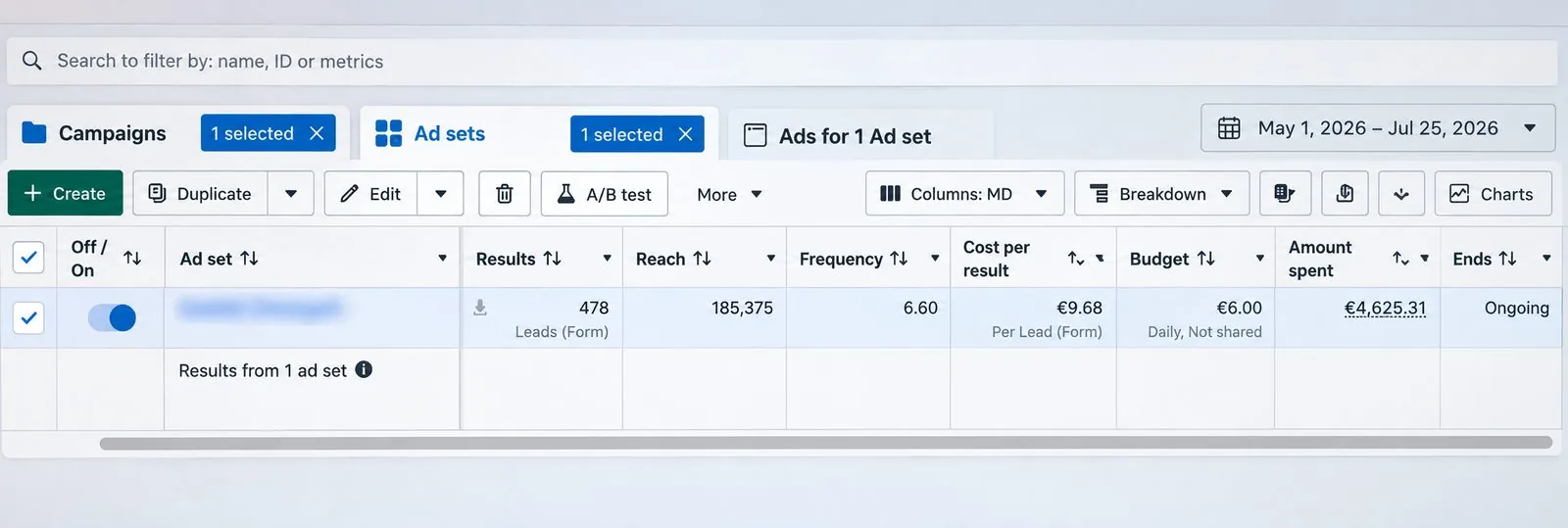
A Facebook lead campaign we ran brought 478 form enquiries between May and July 2026, at €9.68 each. Getting enquiries was not the hard part. Answering each one quickly, asking the right questions and moving the right ones to a proposal was. A practice that advertises its services, or simply gets busy in tax season, needs the same thing: every enquiry captured in the CRM with an owner and a next step, so none waits a week for a reply.
Want every new client enquiry answered and tracked? Apply now
A few straight answers
Most practices with more than a few dozen clients benefit. It keeps every client’s services, deadlines, documents and due diligence in one place, and sends reminders so staff stop chasing by hand.
Practice software is built for accounting firms and often includes jobs and deadlines. A general CRM is stronger on enquiries and sales. A custom CRM combines what your firm needs in one system.
Yes. It can run your onboarding checklist, store identity and beneficial owner documents, record the risk assessment and remind you of review dates. The judgement stays with your team.
The FIAU says at least five years from the end of the business relationship, and sometimes longer if requested. A CRM can hold the end date and remind you when files are due for review.
Yes, through the official WhatsApp Business Platform with approved message templates, to clients who agreed to receive them. Email suits formal requests.
Usually yes, through a built-in connection or a custom link. Decide which system owns each piece of data, so client details are not kept in two places.
Malta Digital builds custom CRM systems from €7,500. The price depends on users, workflows, client portal and connections, with a written quote first.
Sources
Keep reading
A free, printable CRM setup checklist for Malta and Gozo businesses: 38 steps from choosing a CRM to data, GDPR, lead ads, launch and funding. Get the PDF.
How to run a GDPR-compliant CRM in Malta: lawful basis, marketing consent, EU hosting, access roles, retention, data requests and breaches, in plain steps.
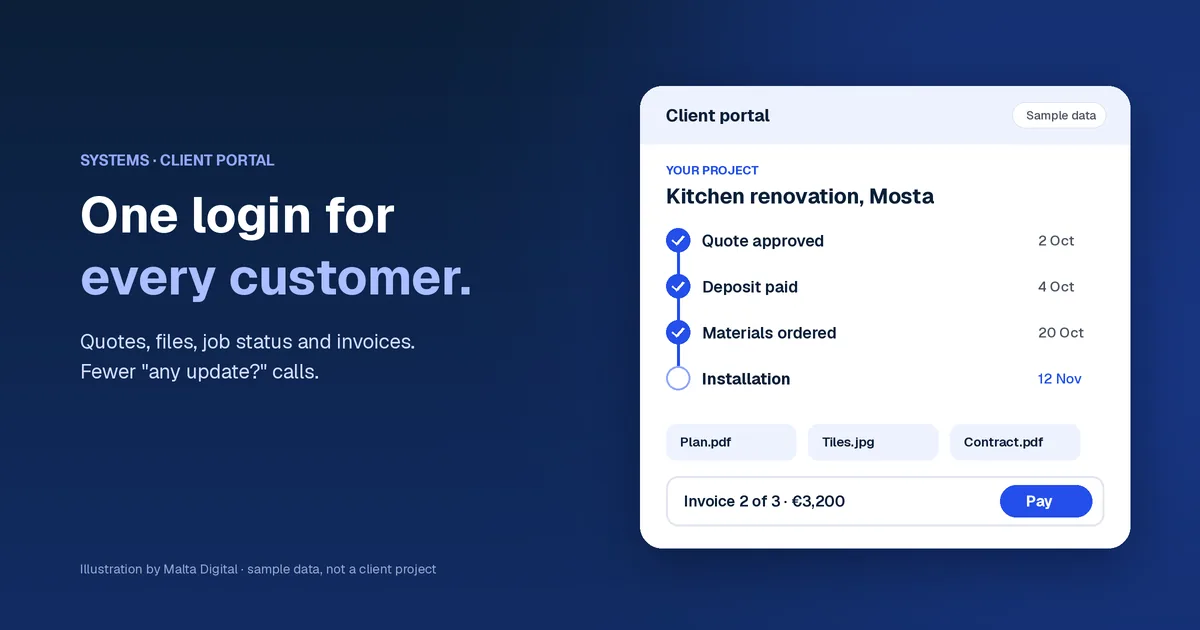
What a client portal does for a service business: quotes, files, job status and invoices in one login, Malta data, a free time-cost calculator and costs.
A useful first step
Tell us how many clients you look after, which software you use and where deadlines or documents slip. We reply with what we would automate first and what a CRM that fits would cost.
Step 1 of 3
A few quick questions, about a minute. We usually reply within 2–3 hours.