Staff rota software in Malta
Plan shifts inside the working time rules.
Systems · Staff and HR
Leave in Malta is counted in hours and changes every year with the calendar. This guide sets out the 2027 annual leave, every other type of leave the law sets, the 2025 and 2026 changes many contracts still miss, and a free calculator for any employee.
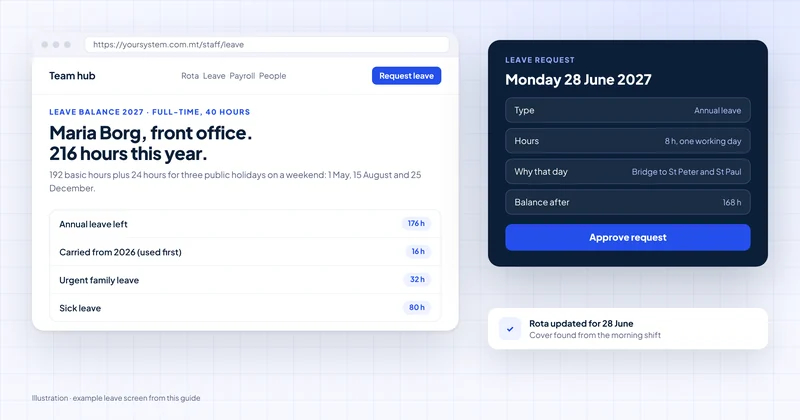
A full-time employee in Malta on a 40-hour week gets 216 hours of paid annual leave in 2027 (27 days): 192 basic hours plus 24 hours for three public holidays on a weekend. Part-timers get it pro rata, urgent family leave is now at least 32 hours, and sick leave is two working weeks where no sector order applies. We build leave tracking into business systems in Malta.
The short version
A full-time employee in Malta on a 40-hour week gets 216 hours of paid annual leave in 2027, which is 27 working days of 8 hours. That is the basic 192 hours plus 24 hours, because three public holidays fall on a weekend in 2027: Workers’ Day (Saturday 1 May), the Assumption (Sunday 15 August) and Christmas Day (Saturday 25 December).
Part-timers get the same pro rata, and someone who joins or leaves during the year gets leave in proportion to the time employed. This guide covers every other type of leave Malta law sets, the 2025 and 2026 changes many contracts still miss, and a free calculator for any employee.
Keeping these balances right for every person is part of our business systems in Malta work, where leave, rotas and payroll live in one place.
Annual leave
Regulation 8 of S.L. 452.87 sets the base: four weeks and 32 hours, so 192 hours on a 40-hour week. Since 1 January 2021, each national or public holiday that falls on a Saturday, Sunday or the employee’s weekly day of rest adds one more day of leave in the same year (article 6 of the National Holidays and Other Public Holidays Act, Cap. 252).
So the total moves with the calendar: 240 hours in 2024, when six holidays fell on a weekend, 224 hours in 2025 and 216 hours in both 2026 and 2027. A payroll or leave system that hard-codes "24 days" gets every one of these years wrong.
2027 calendar
| Date | Holiday | Day | Effect on leave |
|---|---|---|---|
| 1 January | New Year’s Day | Friday | Long weekend |
| 10 February | St Paul’s Shipwreck | Wednesday | Day off |
| 19 March | St Joseph | Friday | Long weekend |
| 26 March | Good Friday | Friday | Long weekend |
| 31 March | Freedom Day | Wednesday | Day off |
| 1 May | Workers’ Day | Saturday | +1 day of leave |
| 7 June | Sette Giugno | Monday | Long weekend |
| 29 June | St Peter and St Paul | Tuesday | Bridge on Monday 28 June |
| 15 August | Assumption | Sunday | +1 day of leave |
| 8 September | Victory Day | Wednesday | Day off |
| 21 September | Independence Day | Tuesday | Bridge on Monday 20 September |
| 8 December | Immaculate Conception | Wednesday | Day off |
| 13 December | Republic Day | Monday | Long weekend |
| 25 December | Christmas Day | Saturday | +1 day of leave |
Five holidays land on a Friday or Monday, and two on a Tuesday. Expect leave requests for 28 June and 20 September early, and decide how you share them out before the first person asks.
Want leave requests and balances to sort themselves out? Apply now for a business system
Free tool
Enter the year, the normal weekly hours and the dates the person is employed this year. The calculator applies the 192-hour base, the weekend public holidays in that period and the pro rata rules.
Use your own figures. Nothing you type is sent anywhere.
Your result appears here as you type.
The same logic can run inside your own system: each person’s hours, start date and holidays set their balance, and the balance updates the moment a request is approved.
Other leave
| Leave | How much | Paid? | Law |
|---|---|---|---|
| Sick leave | 2 working weeks a year (80 hours on 40 a week), where no sector order applies | Full pay less sickness benefit; first 3 days of each claim in full | S.L. 452.101 reg 3 |
| Urgent family leave | At least 32 hours a year | 16 hours from annual leave, 16 from sick leave | S.L. 452.88 reg 6 |
| Maternity leave | 18 weeks | 14 weeks full wages, the rest by maternity benefit | S.L. 452.91 |
| Paternity leave | 10 working days after the birth or adoption | Full wages | S.L. 452.125 reg 4 |
| Parental leave | 4 months per parent, per child, until age 8 | 2 months paid at the sickness benefit rate | S.L. 452.125 regs 5 and 6 |
| Carers’ leave | 5 working days a year | Unpaid | S.L. 452.125 reg 9 |
| Bereavement leave | 3 working days | Full wages | S.L. 452.101 reg 4 |
| Special parental bereavement | Up to 7 working days in total on the death of a child under 18 | Full wages; employer can claim a refund for the extra days | S.L. 452.101 reg 4 |
| Marriage leave | 3 working days | Full wages | S.L. 452.101 reg 4 |
| Injury leave | Up to 1 year | Full wages less injury benefit | S.L. 452.101 reg 4 |
One catch: the sick, bereavement, marriage and injury minimums in S.L. 452.101 apply where no sector Wage Regulation Order covers the employee. Hotels, retail, construction and other sectors have their own orders, so check yours before you set the balances.
Changes
Urgent family leave is the change most employers miss. Older contract templates, including sample contracts still published online, say 15 hours. The current text gives at least 32 hours with pay a year for sickness or accidents in the immediate family, with the first 16 hours taken from annual leave and the next 16 from sick leave.
In 2026 the work-life balance rules also added 18 weeks of leave for workers recognised as parents of a child born outside Malta, where neither parent gave birth. Update your handbook and your system together, or the two will drift apart.
Rules
Fewer than one in ten workers in Malta are part-time, against almost one in five across the EU. That makes each part-timer the exception your spreadsheet formula forgets, which is exactly where balances go wrong.
Compared
| Spreadsheet | Generic leave app | Leave in your own system | |
|---|---|---|---|
| Weekend holidays each year | Typed in by hand | Often set for another country | Built in from Malta’s calendar |
| Part-timers and new joiners | A formula per person | Sometimes | Worked out from hours and start date |
| Urgent family leave split | Rarely tracked | Rarely | 16 hours from annual, 16 from sick |
| Rota and payroll | Separate files | Separate tool | Same people, same data |
| Records on request | Search the drive | Export | Statement for any person in one click |
If you already plan shifts, read our guide to staff rota software; leave and rotas share the same people and the same rules. For moving off spreadsheets in general, see CRM vs Excel.
Ready to stop counting leave in a spreadsheet? Apply now for a business system
Mistakes
Most of these come from the same root: balances kept by hand, away from the rota and payroll. Our guide to business process automation shows how to take those steps off someone’s desk.
How we help
We build business systems where staff request leave on their phone, managers approve it in one tap, and each balance follows Malta’s rules: the weekend holidays for the year, pro rata for part-timers and new joiners, urgent family leave split between annual and sick leave, and carry-over limits. The rota and payroll see the same data.
We have 18 Google reviews from Malta businesses. See what else a system can run on our business systems in Malta page.
Ready for leave balances that are always right? Apply now for a business system
A few straight answers
216 hours for a full-time employee on a 40-hour week, which is 27 working days of 8 hours. That is the basic 192 hours plus 24 hours because Workers’ Day, the Assumption and Christmas Day fall on a weekend in 2027.
Pro rata to their normal weekly hours. Someone on 20 hours a week gets half of the full-time entitlement, including half of the extra hours for public holidays that fall on a weekend (S.L. 452.79 and S.L. 452.87).
Yes. Since 2021, each national or public holiday that falls on a Saturday, Sunday or the employee’s weekly day of rest adds one day of leave in that same year, under article 6 of Cap. 252.
At least 32 hours with pay a year since L.N. 28 of 2025. The first 16 hours come out of annual leave and the next 16 out of sick leave. Part-timers get it pro rata.
Yes, up to 50% of the year’s entitlement, once, if employer and employee agree. Carried leave is used first and cannot be carried forward again.
Where no sector Wage Regulation Order applies, at least two working weeks a year in hours, on full pay less sickness benefit, with the first three days of each claim paid in full by the employer (S.L. 452.101).
Yes. We build leave requests, approvals and balances that follow Malta’s rules into business systems, together with rotas and payroll. Systems start from €7,500, with a first working version in 2 to 4 weeks.
Keep reading
Plan shifts inside the working time rules.

When a spreadsheet stops being enough.
Take repeat admin off your desk.
A useful first step
Custom business systems from €7,500, with a first working version in 2 to 4 weeks. Tell us how you track leave, rotas and payroll today and we reply with what we would build.
Step 1 of 2
A few quick questions, about a minute. We usually reply within 2–3 hours.