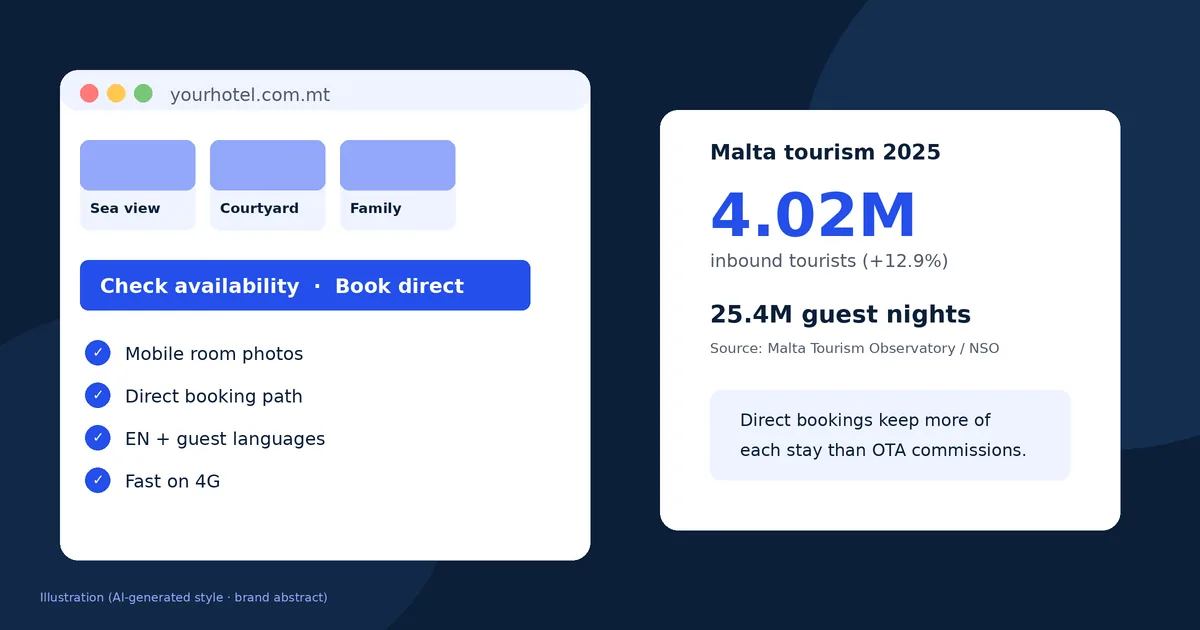
Hotel website in Malta: features that book
What a hotel site needs to take direct bookings.
Websites · Languages
English reaches most of Malta, but not everyone who buys from you. This guide uses Eurostat and NSO figures, and Google’s own rules, to show which languages are worth adding and how to add them so they can be found.
Most Malta businesses should build in English first and add a second language only where real customers need it: Maltese for local trust, or Italian, Polish, German or French for visitors and foreign buyers. Eurostat’s 2025 survey shows only 14.3% of Malta firms with 10 or more staff have a website in two or more languages, against 29.5% across the EU, so doing it properly still sets you apart. Malta Digital builds multilingual sites as part of web design in Malta, on packages from €990.
Why it matters
Malta is bilingual by law. Article 5 of the Constitution makes Maltese the national language, and Maltese and English the official languages. Most local customers read English well, so an English site already reaches most residents.
But your customers are not only Maltese. NSO’s Census 2021 counted 115,449 non-Maltese residents on Census Day, more than one in five people living here. NSO also found that Maltese is still the main language of Maltese nationals in every age group, while many younger Maltese grew up with English first. And every year millions of visitors arrive from countries where English is not the first language.
So the real question is not “should my website be multilingual?”. It is “which customers am I losing because they cannot read my site comfortably, and is it worth the upkeep to win them?”. This guide answers that with official numbers, Google’s own rules and a free planner. If you are still choosing who builds the site, start with web design in Malta and come back here for the language plan.
The data
Eurostat publishes arrivals at Malta’s tourist accommodation by the guest’s country of residence. In 2025 there were 2,828,134 arrivals, of which 2,555,515 came from abroad. The chart shows the ten largest markets as a share of those foreign arrivals.
Three things stand out. First, residents of the UK, Ireland and the US made up 30.4% of foreign arrivals, so English stays your main language. Second, the next biggest markets do not speak English at home: Italy (12.5%), Poland (9.2%), Germany (6.7%) and France (6.4%). Third, the mix moves. Compared with 2024, arrivals from Poland rose 41.6% and from the UK 22.1%, while arrivals from Italy fell 6.1% and from France 10.5%.
| Country of residence | 2024 | 2025 | Change |
|---|---|---|---|
| United Kingdom | 534,142 | 652,222 | +22.1% |
| Italy | 339,746 | 319,141 | −6.1% |
| Poland | 166,197 | 235,284 | +41.6% |
| Germany | 163,479 | 171,128 | +4.7% |
| France | 182,819 | 163,697 | −10.5% |
These figures count stays in hotels, guesthouses, holiday homes and other registered accommodation. They do not tell you who walks into your shop or books your service. Use them as a starting point, then check your own bookings, enquiries and analytics before you pay for a translation.
Want a site in the languages your guests actually speak? Apply now for a multilingual website
Malta vs the EU
Here is the gap you can use. Eurostat’s 2025 survey of enterprises with 10 or more people employed found that 81.6% of Malta firms have a website, slightly above the EU average of 79.0%. But only 14.3% of Malta firms have a website with content in at least two languages, against 29.5% across the EU.
The gap is there even in tourism. In accommodation, 51.9% of Malta businesses have a website in two or more languages, against 72.3% across the EU. In real estate it is 11.9% against 26.1%. For a hotel, a tour operator or an agency selling to foreign buyers, a second language done properly is still a way to stand out from most local competitors.
One caution. The survey covers firms with 10 or more staff. Smaller businesses are not in these figures, so do not read them as a rule for a two-person business. Read them as proof that most Malta sites stop at one language.
By business
There is no single right answer. This table is where we start the conversation with clients. Your own customer data always wins.
| Business | Start with | Add when |
|---|---|---|
| Local service or shop | English | Maltese pages if customers call or write to you in Maltese |
| Restaurant, café or bar | English menu, hours and booking | Italian first in many areas, then the language your floor staff hear most |
| Hotel, guesthouse or holiday let | English | The top two non-English markets in your own booking data |
| Tours, diving or activities | English | The languages of the groups you already guide, with the booking steps translated too |
| Real estate | English | The languages of your foreign buyers or tenants, with listing forms translated |
| Online shop selling abroad | English | One language per market you deliver to, with delivery and returns text translated |
| Professional or B2B services | English | Rarely needed, unless a clear client group needs it |
Gozo deserves a mention. According to NSO’s release for 2025 (NR 020/2026), 2,305,968 tourists visited Gozo and Comino, including same-day visitors, or 57.3% of all inbound tourists. A Gozo restaurant or dive centre is serving the same international mix as Sliema, often on a day trip with little time to read.
For ads, language works differently. If you run Facebook or Instagram ads, read our guide on Facebook ads in Maltese or English before you decide the language of the website your ads point to.
Google’s rules
A translation that Google cannot find will not bring you anyone from search. Google’s guide to multilingual sites, read on 10 November 2026, is clear on what works.
| Option | Example | What it means for a Malta business |
|---|---|---|
| Subfolders | yourbusiness.com/it/ | Easy to set up, one host, low maintenance. Our usual choice for small and mid-sized sites |
| Subdomains | it.yourbusiness.com | Easy to separate, but visitors may not know if “it” means a language or a country |
| Country domains | yourbusiness.it | Strong country signal, but more domains to buy and run, and some have strict rules |
| URL parameters | ?lang=it | Google does not recommend this |
One more rule matters if you plan to translate a lot of pages quickly. Google’s spam policies list mass-producing pages through automated changes, translation included, that add little value as scaled content abuse. A short set of well-written pages beats hundreds of machine-translated ones.
Scope
A half-translated site often does more harm than an English-only one. An Italian visitor who lands on an Italian page, then hits an English form and an English confirmation email, may leave. Translate whole journeys, not single pages.
Keep a short glossary: your service names, room types and place names written the same way in every language. Malta’s place names are easy to get wrong in translation, so decide once whether you write Marsaxlokk, St Julian’s or Xlendi in Maltese spelling on every version.
Then set one date a month to check every language. When a price, an opening time or a menu changes in English, it has to change everywhere on the same day.
Want us to plan the pages and the journey in every language? Apply now for a multilingual website
We plan the languages, build each version on its own address and hand you a site you own.
Free tool
Pick your type of business, say how many customers come from abroad and tick the languages they actually use with you. The planner suggests an order, counts what has to exist in each language and gives you an address plan.
Uses Eurostat 2025 arrivals at Malta tourist accommodation by country of residence. Nothing you type is sent anywhere.
Languages your customers actually use with you
This planner needs JavaScript. The same steps are in the article, so you can do it by hand.
The shares come from Eurostat’s 2025 accommodation arrivals, as charted above. They describe where guests live, not what they speak, and they are not a forecast for your business.
Proof
We already build in other languages. BSG Ausbau, in our work, is a German-language renovation website with service pages, a project gallery and a guided enquiry journey. The same structure works for an Italian, French or Polish version of a Malta business site.
Every site we build is set up so a language can be added later as its own set of pages, without rebuilding the rest. You own the code, the domain and the accounts.
Want a second language added the right way? Apply now for a multilingual website
Our way
| Step | How it is often done | How we do it |
|---|---|---|
| Choosing languages | Every language the plugin offers | Only the languages your customers use, checked against your data |
| Translation | A widget that rewrites the page in the browser | Real pages on their own address, which Google can find |
| Forms and emails | Left in English | Translated, so the whole journey works |
| Search signals | Missing or one-way hreflang | Matching hreflang on every version, plus a language switch to the same page |
| Start and first version | A wait for a free slot | Work starts as soon as the first payment is made; first version in 2–4 weeks once your content is ready |
You supply or approve the translations, or tell us who your translator is. We build the pages, connect them and check each version on a phone before launch.
Prices
Multilingual sites are built on our main website packages. The quote depends on how many pages and how many languages you need.
| Package | Price | Fits |
|---|---|---|
| Professional Website | From €990 | Up to 5 core pages, mobile design, contact form, analytics and hosting set-up |
| Business Website | From €2,490 | More services, more content and a fuller page plan |
| Growth Website | From €4,900 | A site built to support ads, with an enquiry journey and a CRM connection where needed |
| Custom system | From €7,500 | Portals, booking or internal systems with user roles, quoted after a call |
Our 24-Hour Premium Website (€2,990, up to 15 pages) is English-only by design: multi-language work needs translations and checks that do not fit a 24-hour clock. See web design in Malta for every package, or the website cost guide for what to ask in any quote.
Want a price for your languages and pages? Apply now for a multilingual website
A few straight answers
Not for most businesses. Maltese and English are both official languages of Malta, and most local customers read English, so an English site reaches most residents. Add Maltese pages if your customers call or write to you in Maltese, and write them properly rather than translating word for word.
English first. In Eurostat’s 2025 figures, residents of the UK, Ireland and the US made up 30.4% of foreign arrivals at Malta tourist accommodation. The next largest markets were Italy (12.5%), Poland (9.2%), Germany (6.7%) and France (6.4%). Check your own bookings before choosing.
Eurostat’s 2025 survey found that 14.3% of Malta enterprises with 10 or more people employed have a website with content in at least two languages, against 29.5% across the EU. In accommodation it is 51.9% against 72.3%.
Not if you want to be found in that language. Google recommends a separate URL for each language version and says it may not find versions that change dynamically. Real pages, linked with hreflang, are what Google can show.
No. Google advises against automatic redirects based on what you think a visitor’s language is. Add a language switch that links to the same page in each language instead.
At Malta Digital, multilingual sites are built on our main website packages: Professional Website from €990, Business Website from €2,490 and Growth Website from €4,900. The quote depends on how many pages and languages you need.
Yes, if the site is built for it. We set each language up as its own set of pages, so adding one later means adding pages and their links, not rebuilding the site.
Sources
Keep reading
What a hotel site needs to take direct bookings.
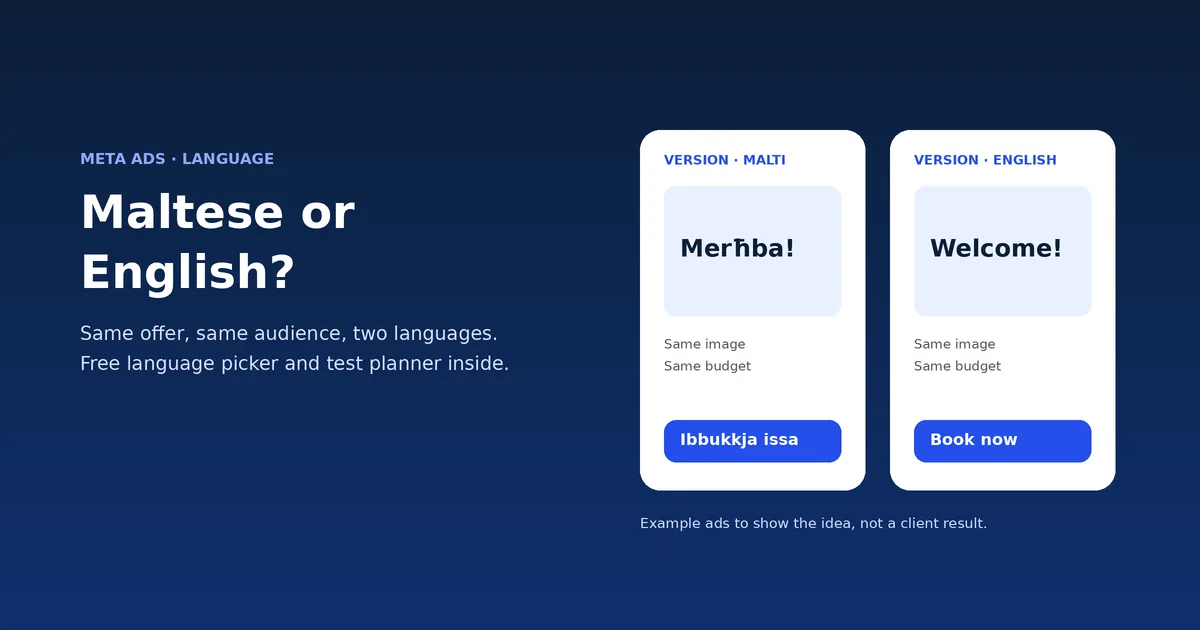
Which language to use in your ads, with census data.
A 12-point check before you sign.
A useful first step
Professional Website from €990, Business Website from €2,490 and Growth Website from €4,900. Tell us your languages and pages, and we reply with what we would build.
Step 1 of 2
A few quick questions, about a minute. We usually reply within 2–3 hours.