Website copywriting tips
Write pages in your clients’ words.
Websites · Personal brand
People hear your name, then search for it. This guide shows what a personal website for a consultant, coach, trainer or freelancer in Malta needs to turn that search into a call, with Malta data and a free planner.
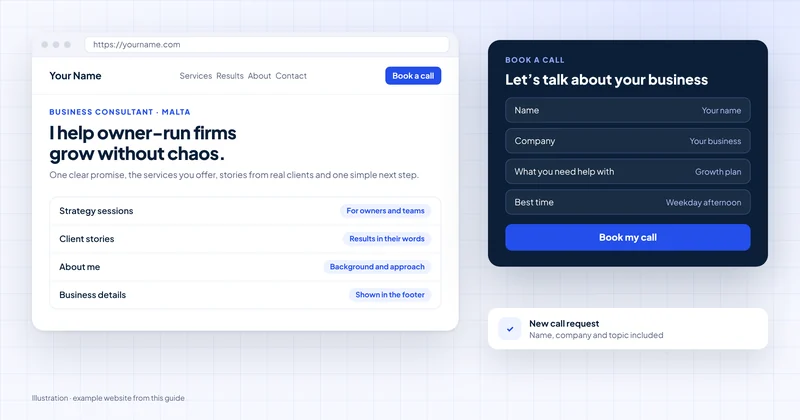
A personal brand website needs five pages: home (who you help and the result), about (your face and story), services, proof from real clients and a short contact page with one clear next step. Use your own name as the domain and show the business details Malta’s rules ask for. We build these in our web design in Malta packages, from €990.
The short version
A personal brand website needs five pages: a home page that says who you help and with what, an about page with your face and story, a page for each main service, proof from real clients, and a contact page with one clear next step. Everything else is optional until you have real content to put on it.
Most people who hire a consultant, coach or freelancer in Malta hear the name first, from a referral, a talk or a post, and then search for it. Your website is what they find. If it is missing, out of date or vague, they move to the next name. This guide shows the pages, the proof and the words that turn that search into a call, with Malta data and a free planner.
It supports our web design in Malta service, where we build personal websites for consultants, coaches, trainers and freelancers in Malta and Gozo.
Why it matters
Self-employment is growing in Malta. Eurostat counts 44,400 self-employed people aged 15 to 74 in Malta in 2025, up from 40,700 in 2021. Most work alone: 32,600 had no employees in 2025, up from 29,200.
Consulting is one of the busiest corners. Eurostat counts 2,989 business and management consultancy firms in Malta in 2024, up from 2,220 in 2021. That is a lot of people offering advice, and the buyer’s first filter is usually a quick look online.
People in Malta look. Eurostat reports that 82.4% of people in Malta used social networks in 2025, against 67.3% across the EU, and 81.0% searched online for information about goods and services, against 71.8%. A profile on a social network is a start, but it is rented space: you do not control the layout, the rules or who sees it. Your website is the one place that is fully yours.
Your pages
Start with five pages and make each one excellent. A big site with empty sections looks worse than a small site that answers every question.
| Page | Its job | Common mistake |
|---|---|---|
| Home | Say who you help, the result you bring and the one next step, in the first screen | A slogan with no client or problem in it |
| About | Earn trust: your face, your story, why you do this work | A full CV in date order |
| Services | One page per main service: who it is for, how it works, a starting price | Ten services in one bullet list |
| Proof | Client stories: the situation, what you did, what changed | Logos or quotes with no story behind them |
| Contact | A short form and what happens after someone sends it | An email address and nothing else |
Add more pages only when you have the material: a talks page if you speak, a writing page if you publish, a programmes page if you run courses. Our guide to website copywriting shows how to write each page in your clients’ words, not yours.
Positioning
The hardest sentence on a personal website is the first one. It must name the client, the problem and the result. “I help family businesses in Malta plan the handover to the next generation” works. “Helping organisations unlock their potential” does not, because nobody can tell if it is for them.
| Who you are | Weak | Strong |
|---|---|---|
| HR consultant | Your partner in people | I help Malta employers with 10 to 50 staff fix hiring and staff turnover |
| Business coach | Unlock your potential | I coach owners of small Malta businesses to step out of the daily work |
| Fitness trainer | Transform your life | Strength training for busy professionals in Sliema and St Julian’s, before work |
| Freelance designer | Creative solutions | Brand identities for new restaurants and cafés in Malta and Gozo |
Being specific feels risky, as if you are turning work away. In practice the right clients feel understood and get in touch, and the wrong ones were never going to hire you. You can still list other work further down the page.
Want a home page that says exactly who you help? Apply now for a personal brand website
Proof
People hire people they trust, and trust comes from proof that looks like their own situation. Put it next to the button, not on a page nobody opens.
Google points the same way. Its guidance on helpful, people-first content asks whether it is clear who created a page, whether pages carry a byline where one is expected, and whether content shows first-hand expertise. A personal website that names you, shows your work and links to your profiles answers those questions directly.
The basics
Three practical points make a personal website yours and keep it on the right side of the rules.
| Point | What to do | Why |
|---|---|---|
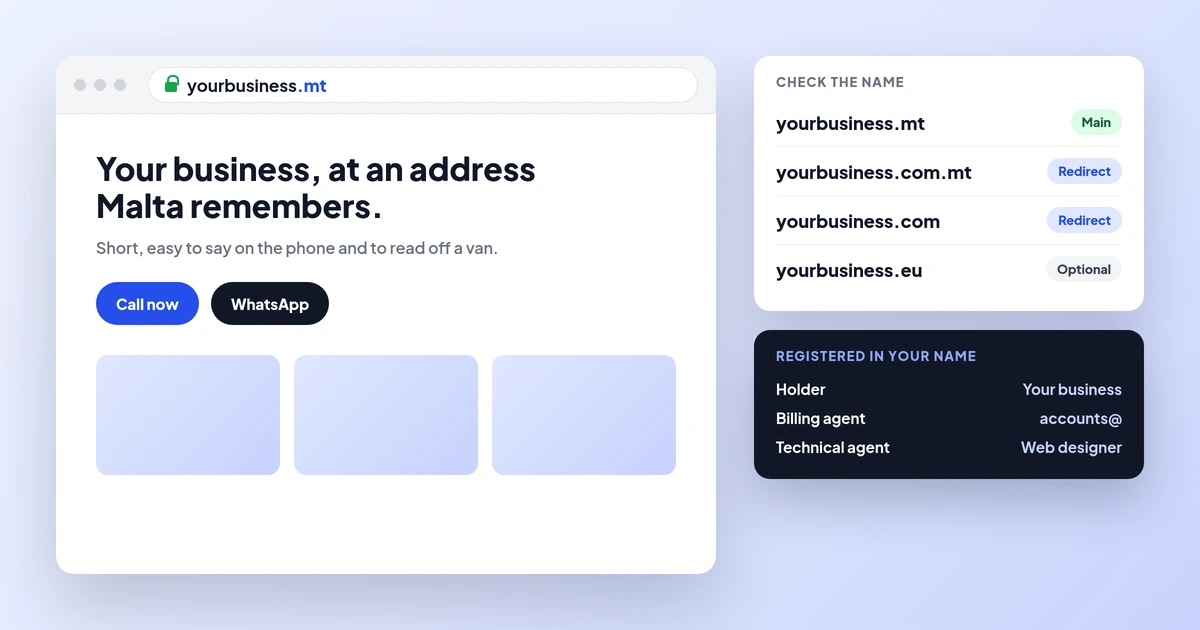
| Your own domain | Register your name, for example yourname.com.mt or yourname.mt, and use it for email too | Your site and inbox move with you, whatever platform you use |
| Business details | Show your name, address, email and the registration numbers that apply to you | The Electronic Commerce Act (Cap. 426) asks business websites to make these easy to find |
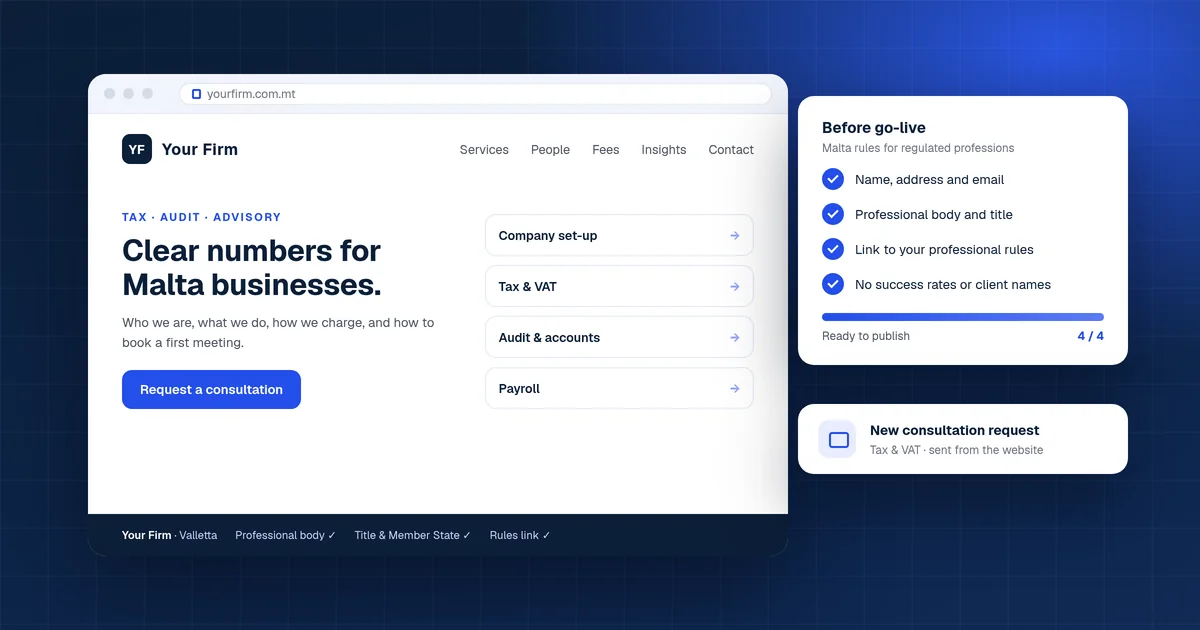
| Regulated work | If your profession is regulated, name the professional body, your title and where its rules are | Malta’s rules on information for service providers expect this for regulated professions |
| Contact form and privacy | Ask only what you need to reply, and link a short privacy notice | The GDPR asks you to tell people how you use their data and to collect only what you need |
| Google profile | If you see clients in person, set up a Google Business Profile in your own name or business name | Google’s guidelines allow individual practitioners to have a profile |
Our guide to .mt and .com.mt domains explains the options, and our guide to website legal requirements in Malta lists everything a business website must show.
Free tool
Tell the planner what you do, how many new clients you want and what proof you already have. It suggests the pages to start with, how many enquiries and visitors you need each month, and what to fix first.
Use your own figures. Nothing you type is sent anywhere.
Your result appears here as you type.
The two numbers that move most are how many visitors get in touch and how many enquiries become clients. A clear first line and real proof raise both.
Worked examples
Example 1: an HR consultant in Birkirkara. Say the goal is 3 new clients a month and about 3 in 10 enquiries become clients. That takes 10 enquiries a month. If 40% come through the website and 2% of visitors get in touch, the site needs 200 visitors a month, which is realistic from referrals, LinkedIn and searches for her name and services. Her five-page site leads with “I help Malta employers with 10 to 50 staff fix hiring and staff turnover”, shows two client stories and offers a 20-minute call.
Example 2: a personal trainer in Sliema. Say he wants 6 new clients a month and half of the people who ask go on to book. That takes 12 enquiries. With a site that shows morning slots, a price per session, three short reviews and a two-minute video from the gym, a quarter of those enquiries come through the website: 3 a month, from about 150 visitors at 2%. His Instagram brings the rest, and the website is where those followers check him before booking.
These are examples. Use the planner above with your own figures.
How we help
We build personal brand websites for consultants, coaches, trainers, freelancers and speakers in Malta and Gozo: a clear first line, service pages, client stories, your photo, a short contact form and the legal lines in place. You own the site, the domain and every enquiry, which comes straight to you.
| Package | Price | Ready in |
|---|---|---|
| Professional Website | From €990 | Complete in 24 to 48 hours |
| Business Website | From €2,490 | 2 to 4 days |
| Growth Website | From €4,900 | 7 days |
| 24-Hour Premium Website | €2,990, up to 15 pages | 24 hours |
If you want more people to see your name, our Facebook and Instagram ads start at €1,249 a month plus ad spend. We have 18 Google reviews from real clients. If you run a firm rather than work alone, our guide to websites for lawyers and accountants covers the extra rules.
Ready for a website that turns your name into clients? Apply now for a personal brand website
A few straight answers
Five pages: a home page that says who you help and the result, an about page with your photo and story, one page per main service, client stories and reviews, and a contact page with a short form and one clear next step.
Yes, if clients search for your name before they hire you. Social profiles are useful, but you do not control their layout, rules or reach. Your website is the one place that is fully yours and shows your services, proof and contact form together.
Usually yes. A domain such as yourname.com.mt is what people type after hearing your name, and it gives you an email address that moves with you whatever platform you use.
Eurostat counts 44,400 self-employed people aged 15 to 74 in Malta in 2025, up from 40,700 in 2021. Of those, 32,600 had no employees.
Showing a starting price or a typical range helps. It filters out poor fits before they call and makes the people who do get in touch more likely to hire you.
Your name, address, email and the registration numbers that apply to you, a privacy notice for the contact form, and, for regulated professions, your professional body, title and where its rules can be read.
Our Professional Website starts from €990 and is complete in 24 to 48 hours. The Business Website starts from €2,490 in 2 to 4 days, the Growth Website from €4,900 in 7 days, and the 24-Hour Premium Website is €2,990 for up to 15 pages.
Sources
Keep reading
Write pages in your clients’ words.
Pick and register your domain.
Extra rules for firms.
A useful first step
Professional Website from €990, Business Website from €2,490 and Growth Website from €4,900. Tell us who you help, and we reply with what we would build.
Step 1 of 2
A few quick questions, about a minute. We usually reply within 2–3 hours.