
Ecommerce website design in Malta
Shopify, WooCommerce or custom, payments, delivery to Malta and Gozo, VAT and EU rules, and how to get the first sales.
Websites · Legal checklist
It is easy for a business website to miss something the law asks for. Usually it is small: no company number in the footer, a cookie banner with no reject button, a privacy policy copied from another site, or an old link to an EU complaints platform that no longer exists. None of it is hard to fix once you know what is required. This checklist explains, in plain words, what a Malta business website has to show and do under the Electronic Commerce Act, the Companies Act, GDPR and Malta’s cookie rules, with links to the official texts, as they stood on 30 October 2026. It is a practical guide, not legal advice: if your business is regulated or handles sensitive data, have your lawyer confirm the wording.

A Malta business website must show your name, geographic address, email, registration and VAT numbers where they apply, and prices that say whether VAT is included. It needs a privacy notice if it collects personal data, cookie consent before analytics or ad pixels load with a clear way to refuse, and terms if you sell online. Malta Digital builds these into every website it makes.
Who this applies to
Malta’s Electronic Commerce Act covers businesses that offer services online, and that includes an ordinary business website that promotes what you sell. It does not matter whether you are a sole trader in Gozo or a limited company in Sliema, or whether your site takes payments. If you collect names through a contact form, use analytics or run Facebook pixels, GDPR and the cookie rules apply as well.
The good news is that most of it is a one-off job. Done once, properly, during the build, it stays done until your business details change.

Business details
Under Article 8C of the Electronic Commerce Act, your website must make these details easy to find, directly and all the time. A footer on every page plus a contact page does that well.
Your name and geographic address, the place you are established, not just a PO box.
Contact details, including an email address, so people can reach you quickly and directly.
Your company registration number, if you are registered in a trade register such as the Malta Business Registry.
Your VAT number, if your activity is subject to VAT.
The supervisory authority, if your activity needs a licence or authorisation, such as a financial services licence, and what the authorisation covers.
For regulated professions, such as doctors, dentists, lawyers, architects and accountants: the professional body you are registered with, your professional title and the Member State that granted it, and a reference to your profession’s rules and where to read them.
How to opt out of marketing messages, if you send them.
Limited companies have one more rule. The Companies Act says a company’s website must show its name, the kind of company it is, its registered office and its registration number, and if you mention share capital, both the issued and the paid-up amount.
Prices and offers
If your website shows prices, the Electronic Commerce Act says they must be clear and must say whether they include tax and delivery costs. “From €990 excluding VAT” is fine. A price with no word about VAT is not.
Promotions need the same care. Discounts, gifts and competitions must be clearly marked as promotions, and their conditions must be easy to find and clearly explained. A banner that says “20% off” needs a link to the terms: what is included, until when and for whom.
Privacy notice
If your website collects personal data, through a contact form, a booking, a newsletter, a chat or a shop, GDPR says you must tell people certain things at the moment you collect it. That is your privacy notice, and Article 13 of GDPR lists what it must cover.
Who you are and how to contact you, and your data protection officer if you have one. Why you use the data and the legal basis for each purpose, such as answering an enquiry or sending marketing with consent. Who receives it, such as your email provider, booking system or courier, and whether it leaves the EU. How long you keep it. People’s rights to access, correct and delete their data, to withdraw consent, and to complain to the Information and Data Protection Commissioner (IDPC).
A privacy notice copied from another business is a common mistake. It lists tools you do not use and misses the ones you do. Write it from your real setup, link it from the footer and next to every form.
Cookies
Malta’s cookie rule is in Subsidiary Legislation 586.01: you need a person’s consent before storing or reading anything on their device, unless it is strictly necessary for the service they asked for. Analytics, Meta and Google ad pixels, chat widgets that track and embedded videos that set cookies all need consent. Cookies that keep a basket working or remember a cookie choice usually do not.
The IDPC’s guidance on cookie consent is clear on what does not count as consent: cookie walls that block the site until people accept, pre-ticked boxes, and treating scrolling or browsing as a yes. As good practice it shows banners that offer “Accept all” and “Reject all” on the same first layer, and it says non-essential cookies must not be in use until people have agreed. Withdrawing consent must be as easy as giving it, so keep a “Cookie settings” link in the footer.

The part banners often get wrong is the technical one: the banner shows, but the tracking scripts have already loaded. A proper setup blocks every non-essential script until consent is given, and records the choice. That also keeps your Meta and Google ads measurement honest, because it only counts people who agreed.
Forms and marketing
A contact form should ask for what you need to reply, link to the privacy notice and nothing more. If you also want to add people to a newsletter, use a separate, unticked box. Answering an enquiry and sending marketing are different purposes.
For marketing emails and messages, each one needs a simple way to opt out, and your website should say how. We cover consent, soft opt-in and opt-out in detail in our guide to CRM and GDPR.
Apply now and send us your website link. We’ll tell you which details, notices and consent settings are missing, and what a rebuild or fix would involve, or message us on WhatsApp.
Selling online
If people can order or pay on your website, you need terms of sale, and before an order is placed the Electronic Commerce Act asks you to explain, clearly: the technical steps to complete the order, whether you file the contract and whether the customer can access it, how to spot and correct typing mistakes before ordering, the languages you offer the contract in, and any codes of conduct you follow. The terms must be available in a way customers can save and print, and each order should be acknowledged by email without undue delay.
Consumer rules on delivery, returns and the right to withdraw also apply. Our ecommerce guide covers those for Malta and Gozo.
One link to remove: some online shops still have a link to the EU Online Dispute Resolution platform in their footer. The platform was closed on 20 July 2025 under Regulation (EU) 2024/3228, so the link and the wording around it should come out.
Accessibility
Since 28 June 2025 the European Accessibility Act has applied to e-commerce and some other services sold to consumers in the EU, including in Malta. Microenterprises, with fewer than 10 staff and turnover or a balance sheet of €2 million or less, are exempt from the service rules. Even if you are exempt, readable text, good contrast, labelled form fields and buttons that work with a keyboard help every visitor, and they are part of how we build anyway.
The checklist
Use this to check your own website. If you tick everything, you are in good shape. If not, most items take minutes to fix on a well-built site.
| Item | Who needs it, and where | Source |
|---|---|---|
| Business name, geographic address, email and other contact details | Every business website. Footer and contact page | Cap. 426 Art. 8C |
| Company or trade register number | Registered businesses. Footer | Cap. 426 Art. 8C; Cap. 386 Art. 6 for companies |
| Company type, registered office; issued and paid-up capital if capital is mentioned | Limited companies. Footer or About page | Cap. 386 Art. 6 |
| VAT number | If your activity is subject to VAT. Footer | Cap. 426 Art. 8C |
| Licensing authority and what the licence covers | Licensed or authorised activities. Footer or About page | Cap. 426 Art. 8C |
| Professional body, title, country, link to professional rules | Regulated professions. Footer or team pages | Cap. 426 Art. 8C |
| Prices that say whether VAT and delivery are included | Anyone showing prices. Every price | Cap. 426 Art. 8C(2) |
| Promotions clearly marked, with easy-to-find conditions | Anyone running offers. Banner and terms | Cap. 426 Art. 8D |
| Privacy notice from your real setup | Anyone collecting personal data. Footer and next to every form | GDPR Art. 13 |
| Cookie consent before non-essential cookies load, with a reject option and a settings link | Sites using analytics, pixels or similar. Banner and footer | S.L. 586.01 reg. 5; IDPC guidance |
| Order steps, error correction, languages, filing, codes of conduct; terms you can save | Online shops and paid bookings. Checkout and terms page | Cap. 426 Arts 10, 11 and First Schedule |
| Remove the old EU ODR platform link | Shops that had one. Footer and terms | Regulation (EU) 2024/3228 |
| Accessibility requirements | E-commerce services, unless a microenterprise. The whole shop | European Accessibility Act |
Proof
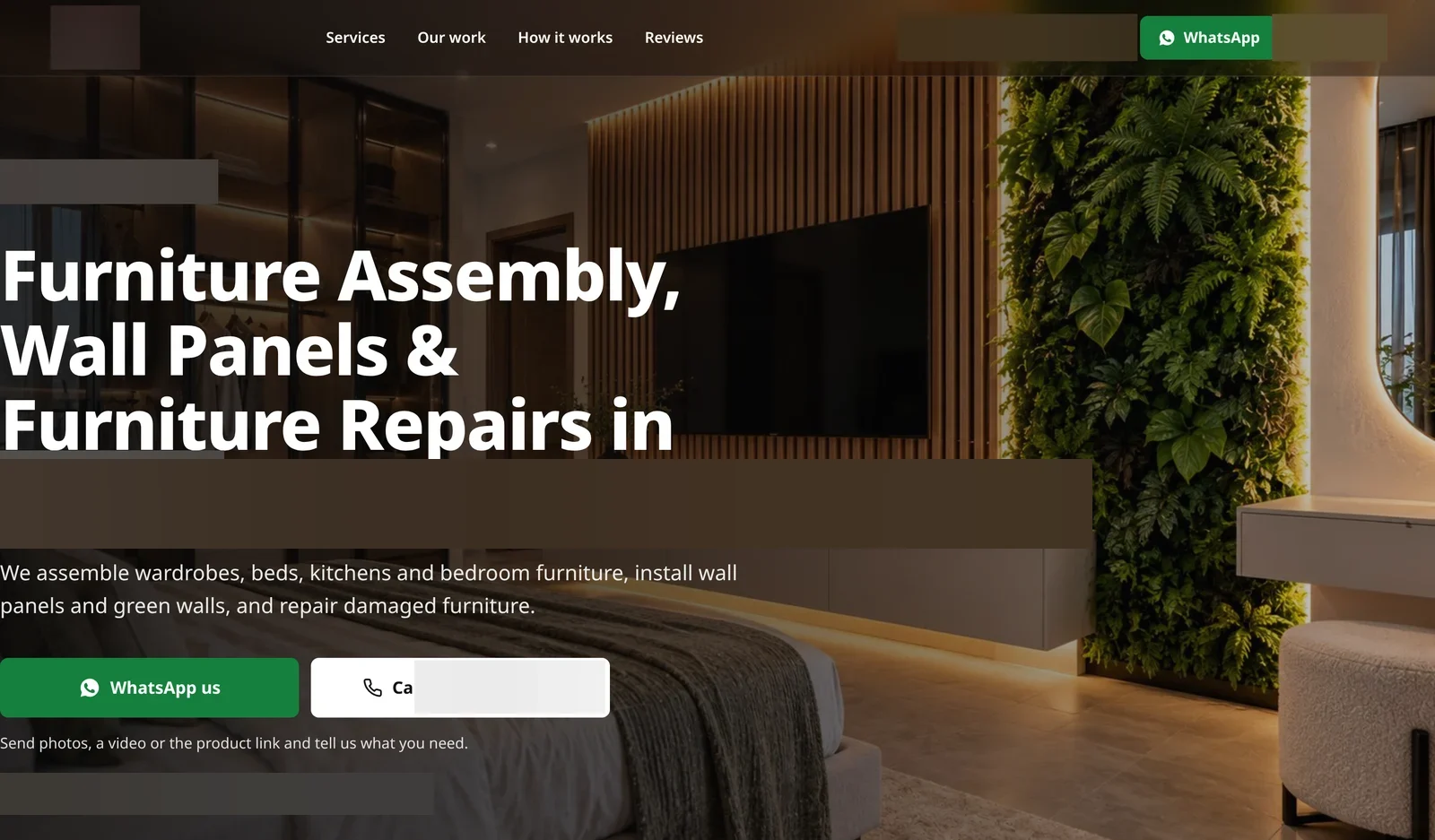
A furniture assembly and installation business came to us with no website, a Facebook page with an empty intro and 858 views in the previous 28 days. We built a mobile website made for quotes on WhatsApp, rebuilt their Facebook and Instagram, and ran Meta ads that open a WhatsApp chat or a phone call.
In the first 28 days, Facebook views went to 154.1K, and €346.75 of ad spend brought 395 WhatsApp taps, 10 phone calls and 1,158 page visits. The website was the place every one of those people landed, so it had to load fast on a phone and make the next step obvious.
Want a website that gets the details right from day one? Message us on WhatsApp
How we do it
Every website we build includes the footer details, a privacy notice link next to each form, cookie consent that really blocks tracking until people agree, a “Cookie settings” link and, for shops, the order steps and terms pages. We ask for your registration and VAT numbers at the start, set up the pages from your real tools and processes, and you or your lawyer approve the final wording. We do not give legal advice, and we will tell you when something needs one.
Websites start from €990 for a Professional Website, €2,490 for a Business Website and €4,900 for a Growth Website, excluding VAT. If you already have a site and just want to know what is missing, apply and send us the link.
A few straight answers
Yes, if it collects any personal data, for example through a contact form, booking, newsletter or analytics. GDPR says people must be told who you are, why you use their data, who gets it, how long you keep it and their rights.
Yes, if your site uses cookies or similar tools that are not strictly necessary, such as analytics or ad pixels. Under S.L. 586.01 you need consent before they load, and refusing should be offered alongside accepting. Under GDPR, withdrawing consent must be as easy as giving it.
Yes, if your activity is subject to VAT. The Electronic Commerce Act lists the VAT number among the details a business website must make easy to find, along with your name, address, email and registration number.
Only if you are registered in a trade register. A sole trader still needs to show their name, geographic address, email and VAT number if their activity is subject to VAT.
No. The EU Online Dispute Resolution platform closed on 20 July 2025, so the link and the wording that pointed to it should be removed.
It is a bad idea. A copied notice lists someone else’s tools and purposes. Your privacy notice must describe what your business really does with personal data.
No. It is a practical checklist based on the official texts, checked on 30 October 2026. If your business is regulated or handles sensitive data, ask your lawyer to confirm the wording.
Keep reading
Shopify, WooCommerce or custom, payments, delivery to Malta and Gozo, VAT and EU rules, and how to get the first sales.

Lawful basis, marketing consent, EU hosting, roles, retention, data requests and breaches, turned into CRM settings and habits.

What a small business website in Malta should include, what it costs and how to get one live fast.
A useful first step
Footer details, privacy notice, cookie consent that really blocks tracking, and terms for shops, built in from day one. Websites from €990, excluding VAT.