
Website legal requirements in Malta
GDPR, cookies, Article 8C details and a full checklist for any business site.
Websites · Professional services
Clients check your firm online before they call. This guide shows what Malta’s rules say your website must show, what lawyers and accountants must avoid, and gives you a free checker that builds your fix list.
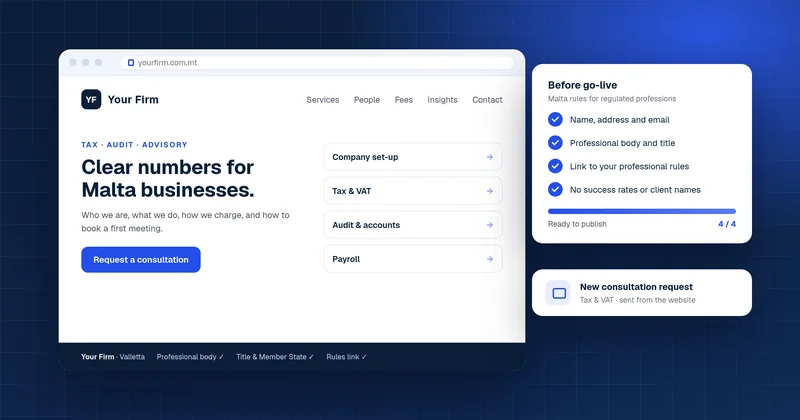
A website for lawyers and accountants in Malta must show who is responsible for it, a physical address, an email, your professional body, title and rules, and it must avoid success rates and client names used without consent. Malta Digital builds these firm websites from €990, with the checks and a consultation form built in: see our web design in Malta service.
The problem
Most new clients reach a lawyer or an accountant through a referral. A friend gives them your name. Then they search for it. In those few minutes, your website either confirms the referral or plants a doubt.
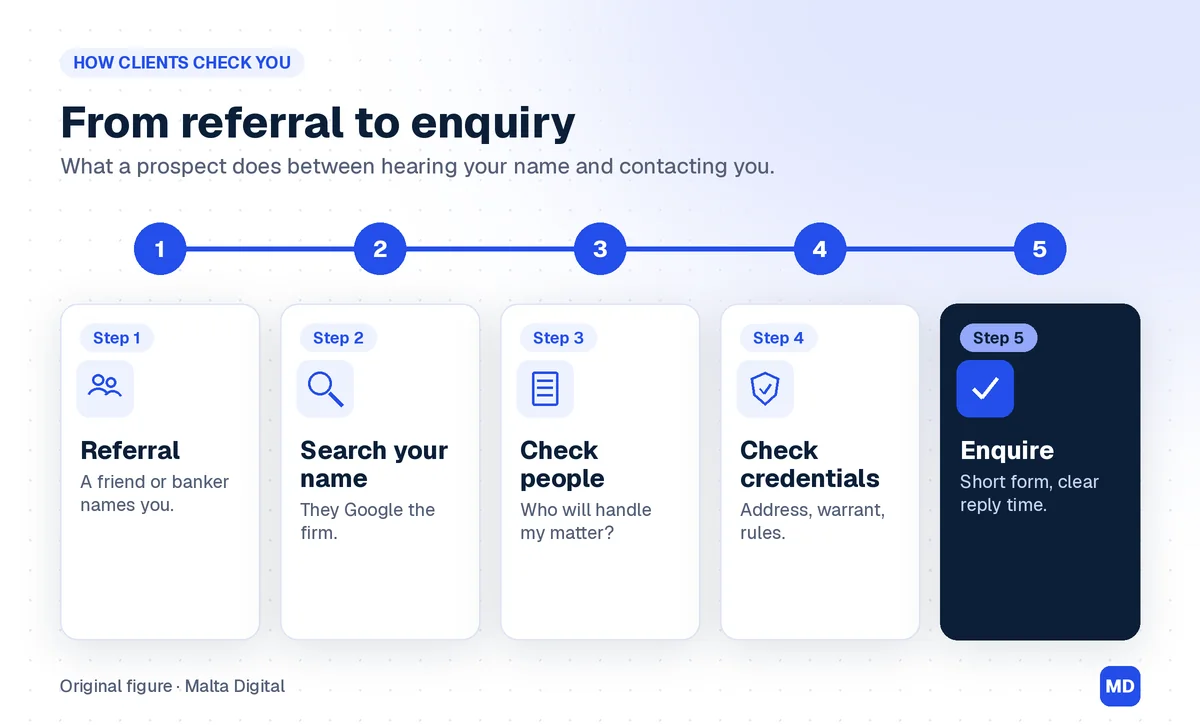
People also search without a referral, for things like “VAT accountant Malta” or “property lawyer Gozo”. Here your website is the whole first meeting. It has to show who you are, what you handle, how you charge and how to book a first conversation.
Firms also carry rules most businesses do not. Malta’s Electronic Commerce Act asks regulated professions for extra details on their websites. Advocates follow publicity rules from the Chamber of Advocates. Accountants follow the Accountancy Board’s code of ethics. A site that looks good but breaks these rules is a risk, not an asset.
This guide covers both sides: what wins the client, and what keeps you within the rules. Use the free checker to see where your own site stands.
Malta data, 2025
Eurostat publishes how firms use their websites, by industry. We read the 2025 figures on 7 November 2026 for Malta’s legal, accounting, consultancy, architecture and engineering firms with 10 or more staff (NACE M69–M71). Here is what stands out.
| Website feature | Malta | EU 27 |
|---|---|---|
| Have a website | 90.8% | 88.9% |
| Show services or price lists | 82.2% | 71.2% |
| Advertise jobs or take applications | 57.8% | 48.8% |
| Content in two or more languages | 18.1% | 30.9% |
| Online booking or ordering | 13.7% | 7.4% |
| Chat for customer support | 10.0% | 5.4% |
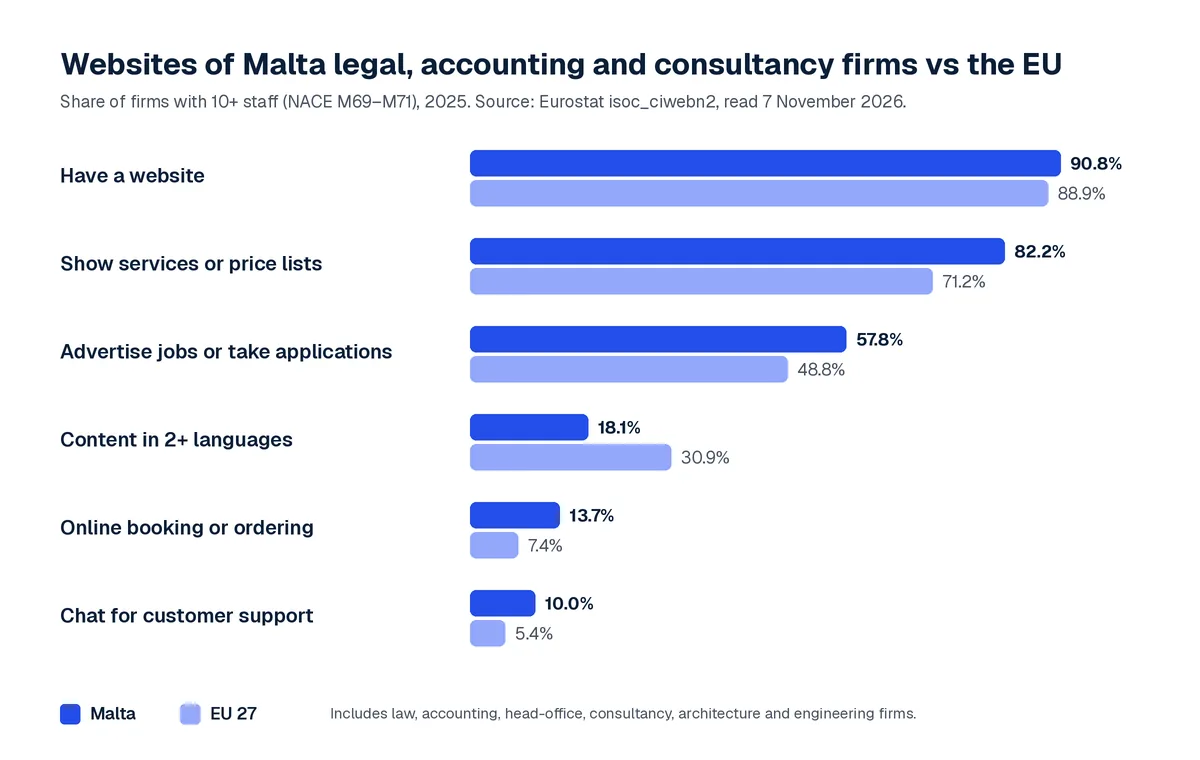
Almost every firm has a website. So having one no longer sets you apart. What sets you apart is what it does. Only 13.7% let people book or request a meeting online. Fewer than one in five offer a second language, well below the EU, even though many Malta clients are foreign companies and residents.
That gap is your chance. A clear site with practice-area pages, a fee explanation, a simple consultation request and the languages your clients use already puts you ahead of most firms.
The law
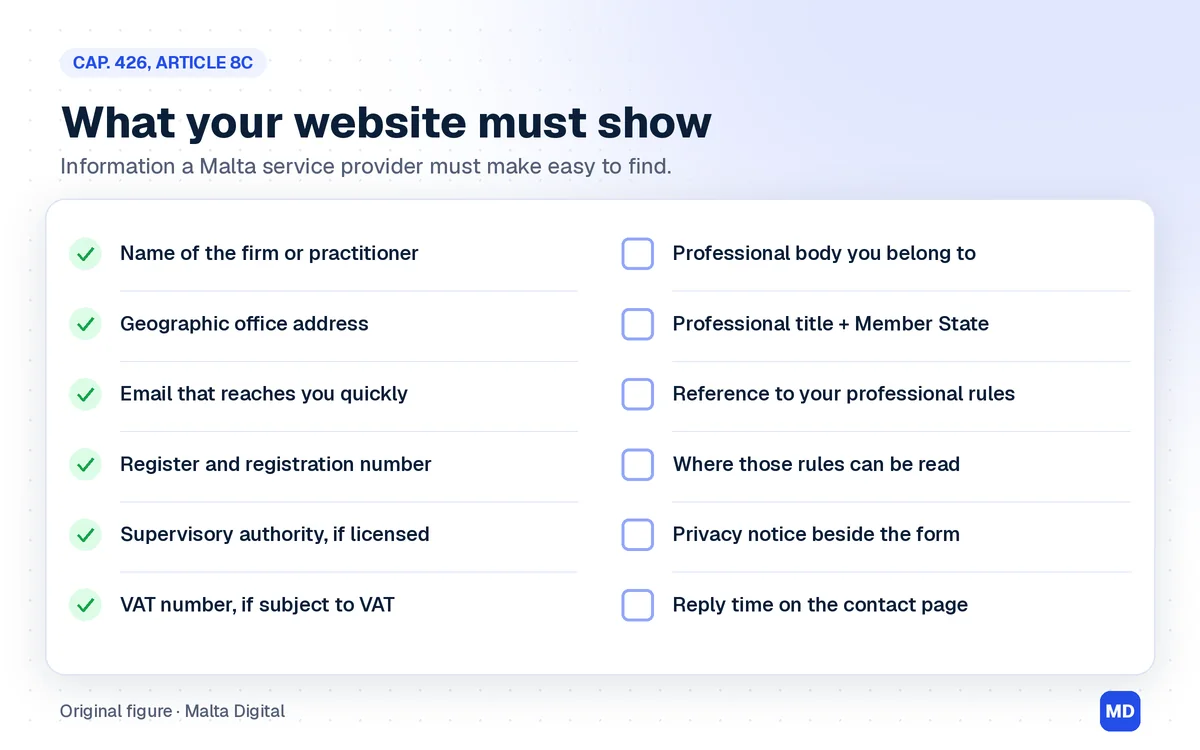
Article 8C of the Electronic Commerce Act (Cap. 426) lists the details every service provider must make “easily, directly and permanently accessible”. We opened the act on legislation.mt on 7 November 2026. For a firm, it looks like this.
| Required detail | Where it usually sits | Example (made up) |
|---|---|---|
| Name of the firm (a) | Footer and contact page | Your Firm Advocates |
| Geographic address (b) | Footer and contact page | A street in Valletta |
| Email and direct contact (c) | Footer, contact page, form | hello@yourfirm.com.mt |
| Register and number, if registered (d) | Footer or legal page | Company register number |
| Supervisory authority, if authorised (e) | Legal page | Only if your activity needs a licence |
| Professional body, title and Member State (f)(i)–(ii) | Footer and people pages | Chamber of Advocates · Advocate · Malta |
| Link to your professional rules (f)(iii) | Footer or legal page | Link to the code of ethics |
| VAT number, if your activity is subject to VAT (g) | Footer or legal page | Your VAT number |
The details in (f) are the ones most firm sites miss. They only apply to regulated professions, such as advocates, notaries, accountants, auditors, architects and doctors. Place them once in the footer, so they sit on every page.
Privacy notices, cookie consent and form consent apply too, as on any business site. Our guide to website legal requirements in Malta covers those in full.
Advocates
The Chamber of Advocates published new advertising rules and guidelines, effective January 2026. They cover advocates, chambers and law firms. We read them on 7 November 2026. They allow far more than the old rules, but they still draw clear lines.
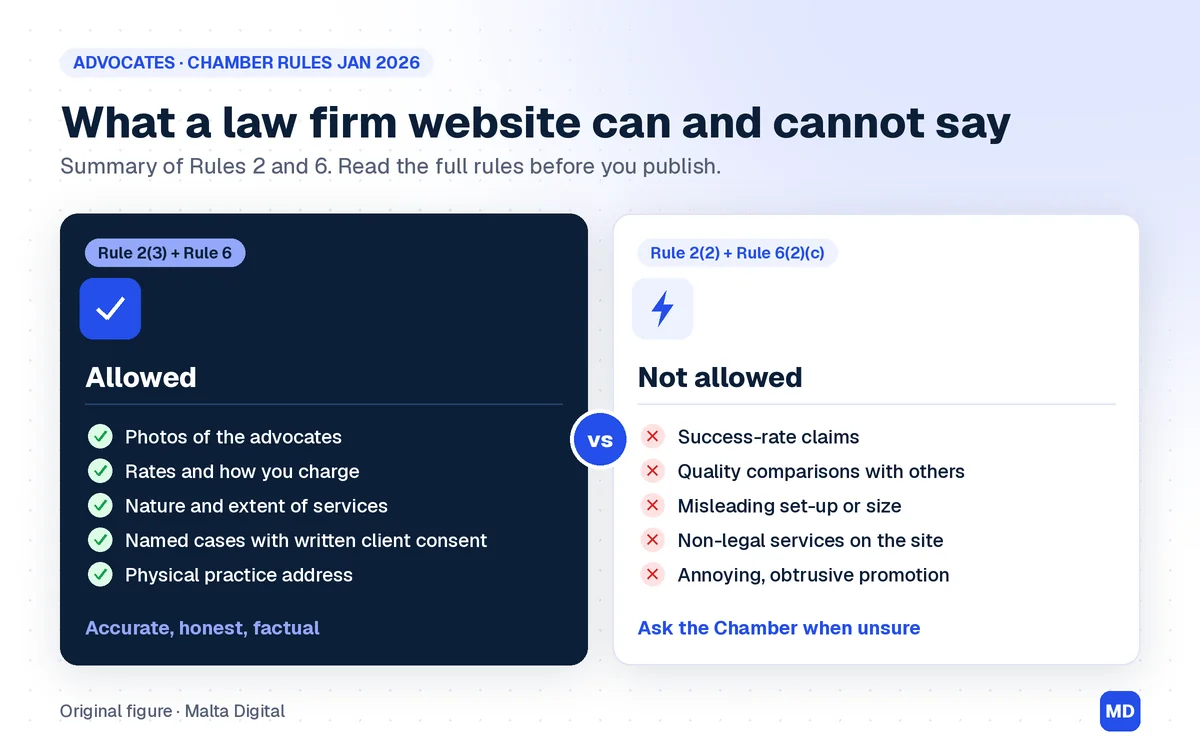
| Topic | What the rules say | What it means for your site |
|---|---|---|
| Websites (rule 6) | Allowed. Must name the people responsible for the content and at least one physical address. | Add a “Responsible for this site” line and your office address to the footer. |
| Non-legal services (rule 6(2)(c)) | No mention of services that are not legal services, even through another company you own. | Keep accounting or property services on a separate site, and link to it. |
| Success rates (rule 2(2)(d)) | Not allowed. | No “we win 9 out of 10 cases” lines or counters. |
| Comparisons (rule 2(2)(c)) | No quality comparisons with, or criticism of, identifiable people. | Say what you do well. Do not say who does it worse. |
| Client names (rule 2(3)(d)) | Only with the client’s express prior written consent. | Keep signed consent on file before naming a client or a transaction. |
| Fees and photos (rule 2(3)) | Rates, methods of charging and photographs of the advocate are allowed. | A clear “How we charge” page and real team photos are fine. |
| Social media (rule 4(1)(g)) | Allowed for professional posts and to promote your legal services. | Share your articles and news from the site. |
| Campaigns (rule 3(2)) | Advertising campaigns on any medium, billboards and broadcast adverts are a breach. | Ask the Chamber before running any paid campaign. |
The safest approach is plain and factual. Describe your practice areas, your people and your fees, and let your articles show your knowledge. When you are unsure, the rules themselves say to ask the Chamber first.
Accountants
Accountants who practise in Malta need a warrant from the Accountancy Board. The Board’s Code of Ethics for Warrant Holders, issued as Directive 2 in 2016, is based on the 2009 international code. Its marketing section says an accountant must be honest and truthful, and must not make exaggerated claims or disparaging, unsupported comparisons with other firms.
Unlike advocates, accountants have no ban on advertising campaigns. Your website can do more selling. It can show fixed fees, a filing calendar or a short tax checklist. Keep every claim provable. “Fast VAT returns” needs a promise you can keep. “The best auditors in Malta” is the kind of claim the code warns against.
Show your warrant clearly. The Accountancy Board keeps public registers of warrant holders and firms, so a visitor can confirm what you say. Put the professional title, the Board as your professional body and a link to the code in your footer. That covers article 8C(1)(f) of Cap. 426 too.
We plan your pages, write the disclosures with you and build the consultation form. You approve every word before it goes live.
Free tool
Pick your profession and tick what your site shows today. The checker lists the legal details you are missing, the publicity risks to fix, and the trust pages that win more enquiries. It also suggests a starting package from our published prices.
Pick your profession, tick what your site shows today and what you plan to add. You get a fix list and a starting package. Nothing you tick is sent anywhere.
1. Your profession
2. What your website shows today
3. Anything on the site, or planned?
4. What the new site needs
This checker needs JavaScript. The full list is in the tables above, so you can check by hand.
The checker is a list, not legal advice. It uses Cap. 426 article 8C, the Chamber’s January 2026 rules and the Accountancy Board code as we read them on 7 November 2026.
What wins clients
A firm website does not need many tricks. It needs a few pages that answer the questions a careful client asks before they get in touch.
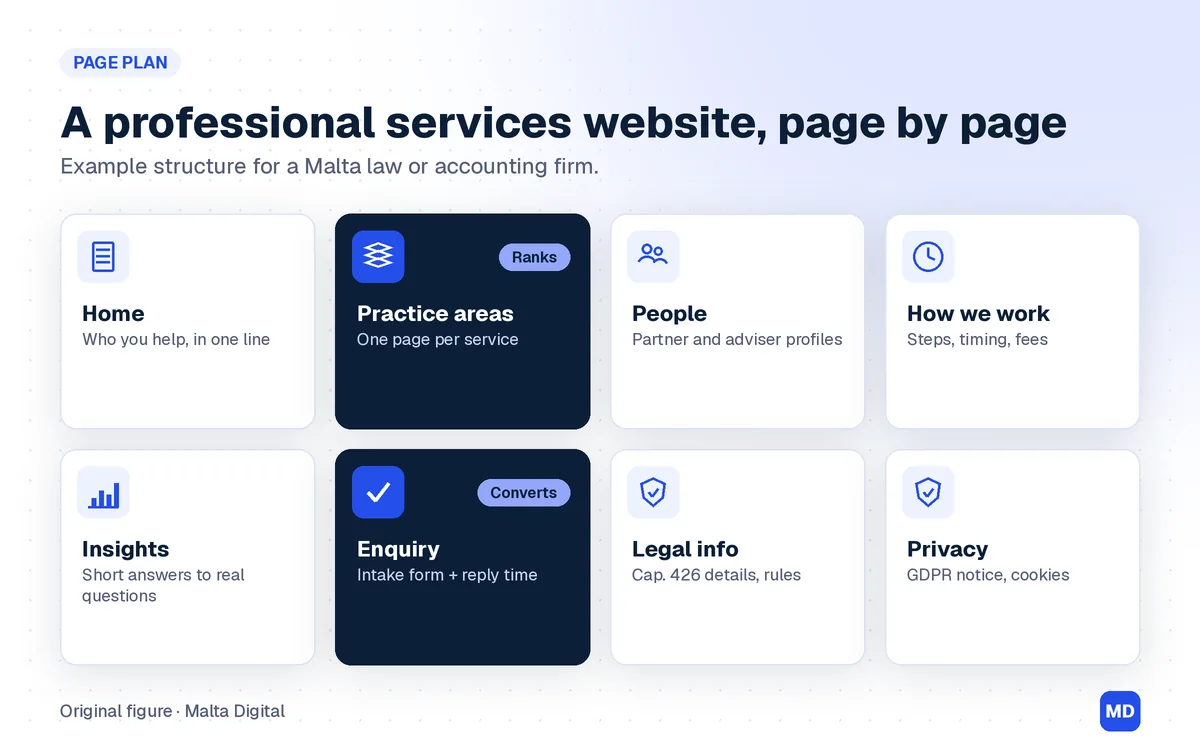
Then make sure people can find you. A Google Business Profile with the same name, address and hours as your site helps people who search for an accountant or a lawyer near them. A matching .mt domain registered in your firm’s name keeps the address yours.
Want these pages planned and written with you? Apply now for a website
Confidentiality
People write sensitive things into contact forms. A divorce, a tax problem, a dispute with a partner. Your form should stop that before it happens.
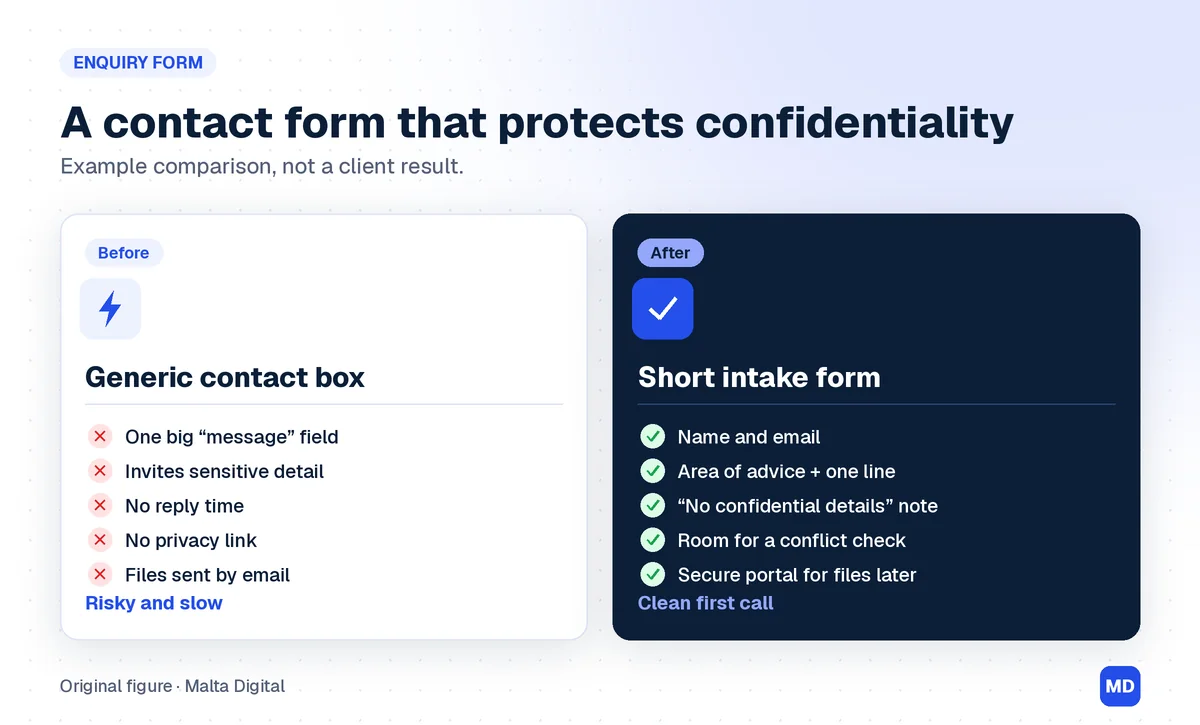
Ask only for what you need to reply: name, email, the area of advice and a one-line summary. Add a note under the message box: “Please do not send confidential details here. We will ask for them once we can act for you.” For advocates, this also gives you room to run a conflict check before you learn too much.
Documents need a safer route than email attachments. Once you take a client on, a secure portal lets them upload files and see where their matter stands. Our guide to client portals explains how this works for service businesses. A focused system like this gets a first working version in 2–4 weeks.
Proof
Consultancy and advisory firms sell through enquiries, not online checkout. So the questions on your form matter as much as the design. Here is a real result from a business that also sells through enquiries.
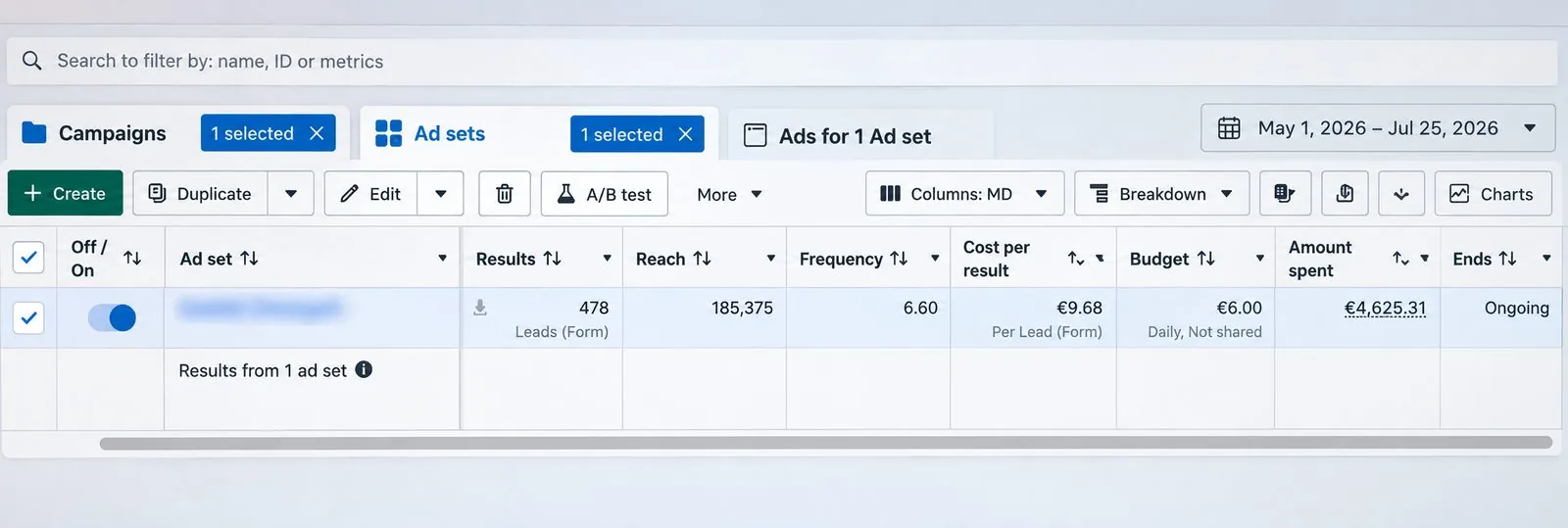
From 1 May to 25 July 2026, a lead generation campaign brought this business 478 form leads at €9.68 each, from €4,625.31 of ad spend. The form asked clear questions that collect what the team needs to follow up. A firm website works the same way: a short form that asks the right three questions gives you enquiries you can act on.
If you are an advocate, remember the Chamber’s rule on advertising campaigns. Your website, your articles and your social media posts can still bring enquiries without one.
Want a consultation form that sorts enquiries for you? Apply now for a website
Our way
| Step | How it is often done | How we do it |
|---|---|---|
| Start date | Often a wait for a free slot in the schedule | Work starts as soon as the first payment is made |
| First version | Published timelines of about 2 to 6 weeks to go live | Professional Website: first version targeted within 24–48 hours once your content is ready |
| Disclosures | Left to the firm to remember | Article 8C details and your professional rules link planned into the footer |
| Publicity rules | Template claims and counters | No success rates, no unconsented client names, no comparisons |
| Ownership | Domain or code sometimes held by the supplier | Domain in your firm’s name; you own the code |
| Next steps | Ads and systems from other suppliers | Social media, Meta ads and client portals from the same team, where your rules allow |
You talk directly to the people who build your site. We draft the pages with you, check the disclosures together and you approve every word. You run your firm; we handle the website.
Prices
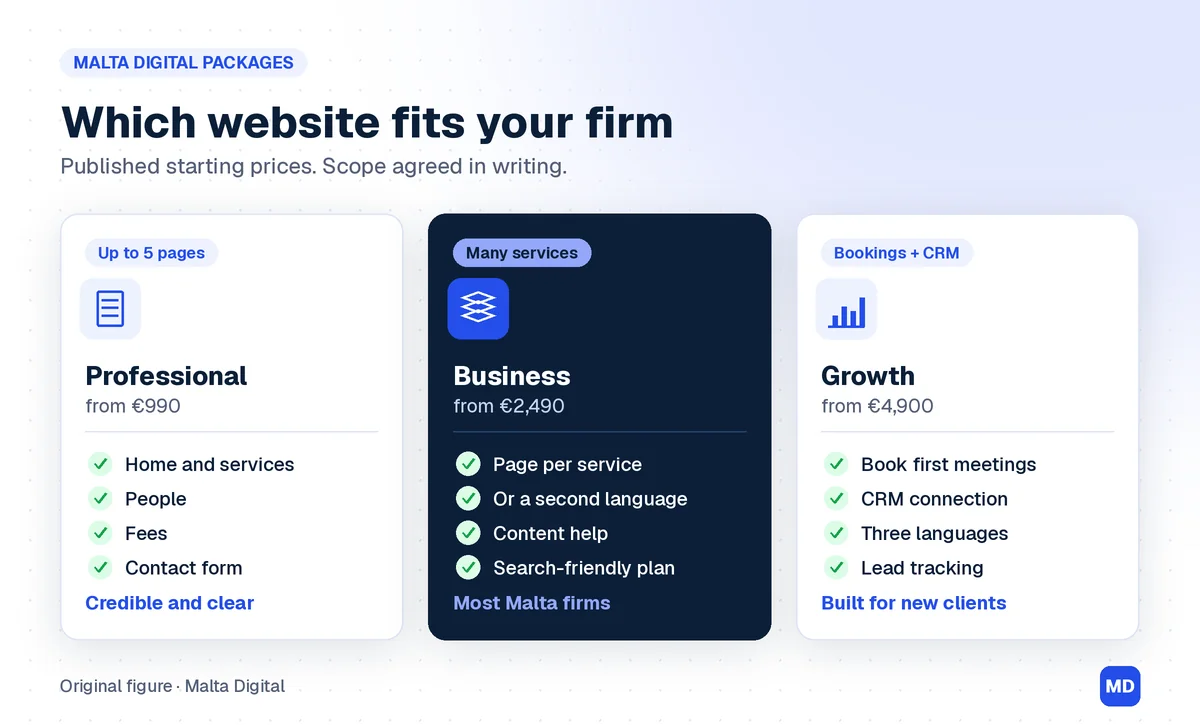
Our three website packages have published starting prices. Most firms fit one of them.
| Package | Price | Fits a firm that needs |
|---|---|---|
| Professional Website | From €990 | Up to 5 core pages: home, services, people, fees and contact |
| Business Website | From €2,490 | A page plan built around many services, or a second language |
| Growth Website | From €4,900 | Online booking of first meetings, a CRM connection or three languages |
| Client portal | Custom systems from €7,500 | A secure login for documents and progress, quoted after a call |
Worked example (made up): a small accountancy firm wants a home page, one page for tax and VAT, one for audit and accounts, a people page and a contact page with a consultation form. That is five core pages in English, with no booking system. It fits the Professional Website, from €990. If the same firm later adds a page for each of ten industries and an Italian version, it moves up to the Business Website, from €2,490.
The domain and any paid tools are written into your scope before we start, so there are no surprises. For the full picture, read our website cost guide for Malta, or see our case studies.
Want a firm website that is clear, fast and within the rules? Apply now for a website
A few straight answers
Under article 8C of the Electronic Commerce Act it must show your name, a geographic address, an email, any register number and VAT number, and, for a regulated profession, your professional body, your title and the Member State that granted it, plus a link to your professional rules. Malta Digital adds these to the footer and contact page of every firm site we build.
Yes. The Chamber of Advocates’ rules, effective January 2026, allow websites and social media posts. The website must name the people responsible for its content and at least one physical address, and must not promote non-legal services. Advertising campaigns, billboards and broadcast adverts are treated as a breach, so ask the Chamber before any paid campaign.
Advocates may name a client only with that client’s express prior written consent, and may not publish success rates. Accountants must not make exaggerated claims or unsupported comparisons. For any firm, get written permission before you name a client or show their logo.
At Malta Digital, a Professional Website with up to five core pages starts from €990. A Business Website with a full page plan starts from €2,490, and a Growth Website with online booking starts from €4,900. A client login for documents is a custom system, from €7,500.
For a Professional Website we target a first version within 24–48 hours once your words, photos and details are ready. Larger sites follow the timeline in your proposal. Work starts as soon as the first payment is made, with no waiting list.
Use the languages your clients actually use. Eurostat’s 2025 data shows 18.1% of Malta legal, accounting and consultancy firms with 10 or more staff offer two or more languages, against 30.9% across the EU. Every language needs wording you have approved.
Not through the contact form. Ask for a short description only, then share documents through a secure route once you take the client on. Malta Digital can build a client portal for this, and you own every line of its code.
Sources
Keep reading
GDPR, cookies, Article 8C details and a full checklist for any business site.
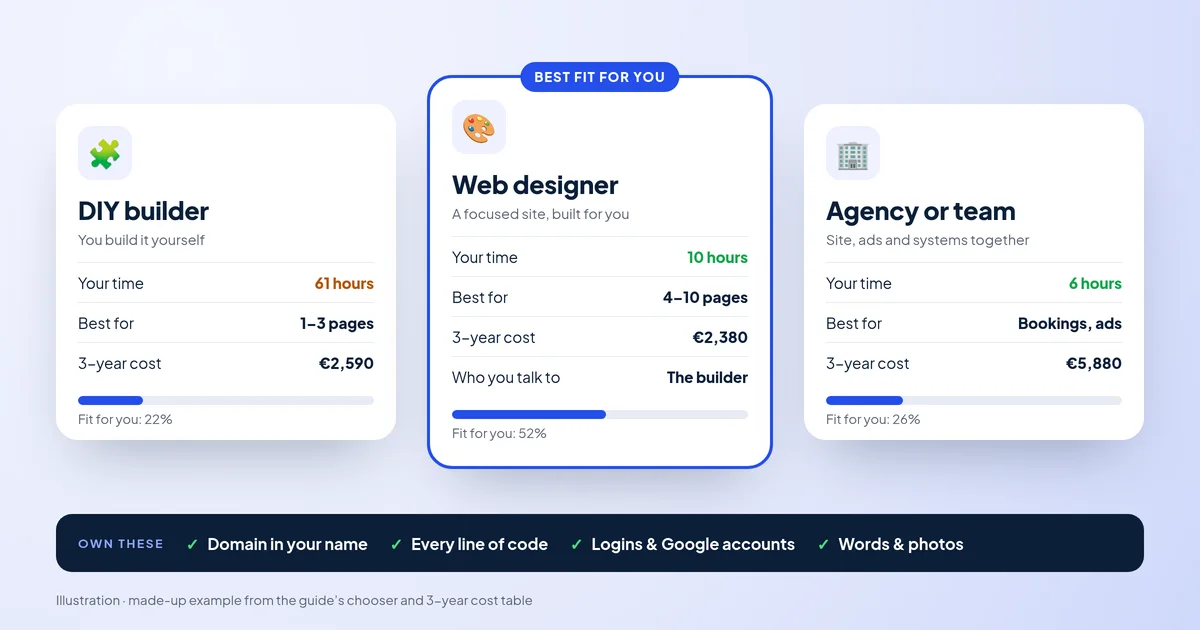
Who should build your site, with a chooser and a true-cost calculator.
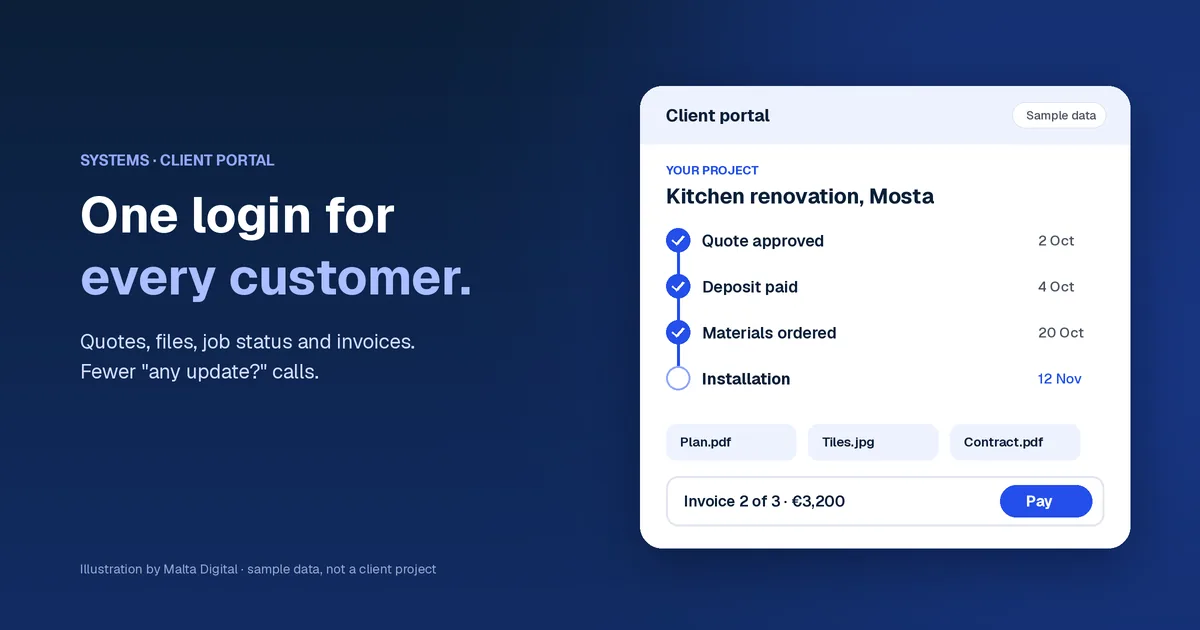
Quotes, files and status in one client login, with Malta data and a calculator.
A useful first step
Professional Website from €990, Business Website from €2,490 and Growth Website from €4,900. We check the Malta disclosure rules with you, and the domain and code are yours.
Step 1 of 2
A few quick questions, about a minute. We usually reply within 2–3 hours.