Web design in Malta: a guide
What a good business website in Malta needs, what it costs and how to choose a web designer.
Websites · Choosing
There are three ways to get a website in Malta. You can build it yourself on a website builder, hire a web designer, or hire an agency. Each one is the right answer for some businesses and the wrong one for others. This guide shows what each really costs over three years, including your own time. It shows who should own what, and the warning signs in a quote. A free chooser then picks the right route for you in about a minute.
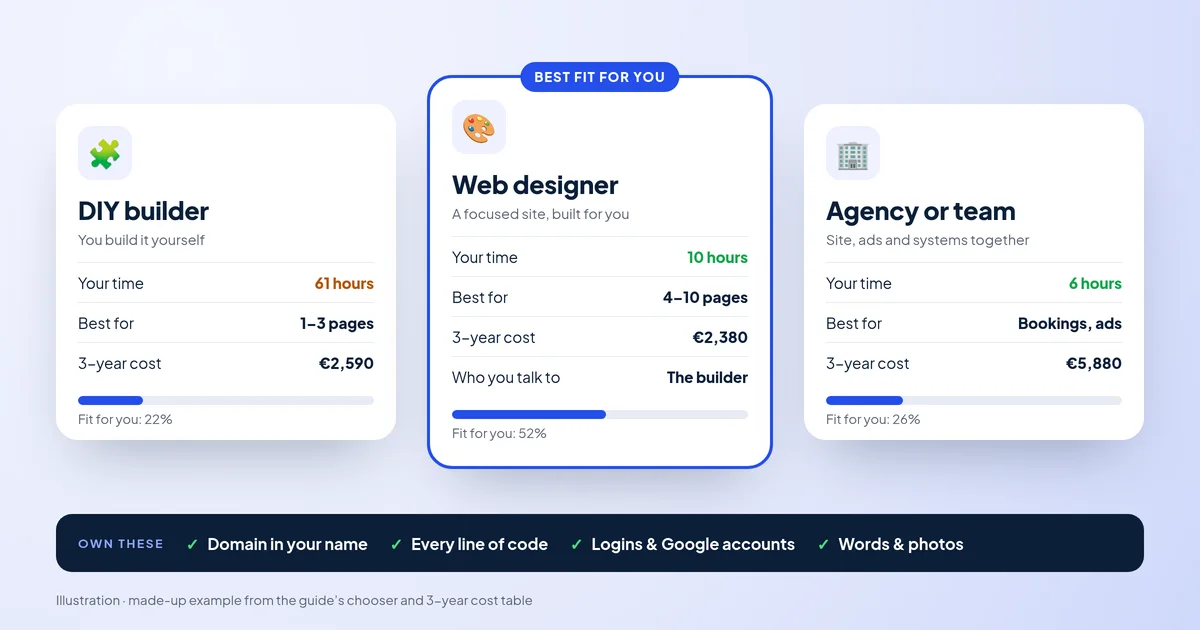
Pick a DIY builder for a simple site you have time to run. Pick a web designer for a focused site when your words and photos are ready. Pick an agency or team when the site must win enquiries, take bookings or connect to other systems. Malta Digital offers web design in Malta from €990, and you own the domain and code.
The short answer
Think about what your website has to do, not just the price. A site that only shows your services and phone number is a small job. A site that must bring in enquiries, take bookings or link to your other systems is a bigger one. The bigger the job, the more help you need.
Here are the three routes side by side. A website builder is an online tool, such as a drag-and-drop editor, where you make the site yourself for a monthly fee. A web designer is one person or a small studio who builds it for you. An agency is a larger team with different people for planning, writing, design and ads.
| DIY website builder | Web designer (freelance or small studio) | Agency or larger team | |
|---|---|---|---|
| Best for | A simple site you have time to build and keep up to date | A focused site when your words and photos are ready | A site with several jobs: enquiries, bookings, ads, connected systems |
| What you pay | A monthly or yearly plan, plus paid add-ons | A one-off build price, then hosting and changes | A higher build price, often with a monthly plan |
| Your time | High: you plan, write, design and build | Low to medium: answer questions, check drafts | Low, but more meetings and sign-offs |
| Who does the work | You | The person you talk to, or someone they hire | A team; ask who exactly works on your site |
| Main risk | The site goes stale, and it stays on that platform | If one person is busy or leaves, work stops | Paying for more than your site needs |
There is no shame in any of them. Google itself says a small local business can probably do much of the search work itself. The question is whether you have the time, and whether your site needs more than you can give it. Our web design in Malta sits between the last two: a small team, so you talk to the people who build your site, with the planning and ads of an agency.
Malta in numbers
We checked the latest Eurostat figures on 3 November 2026. They cover 2025 and businesses with 10 to 49 staff, outside finance. Malta is ahead of the EU average on almost every website job.
| What the website does (2025) | Malta | EU average |
|---|---|---|
| Has a website | 79.2% | 76.7% |
| Shows products or services and prices | 75.2% | 64.4% |
| Takes orders, bookings or reservations | 35.8% | 21.6% |
| Offers a chat service for customers | 15.5% | 8.3% |
| Has content in two or more languages | 12.0% | 25.4% |
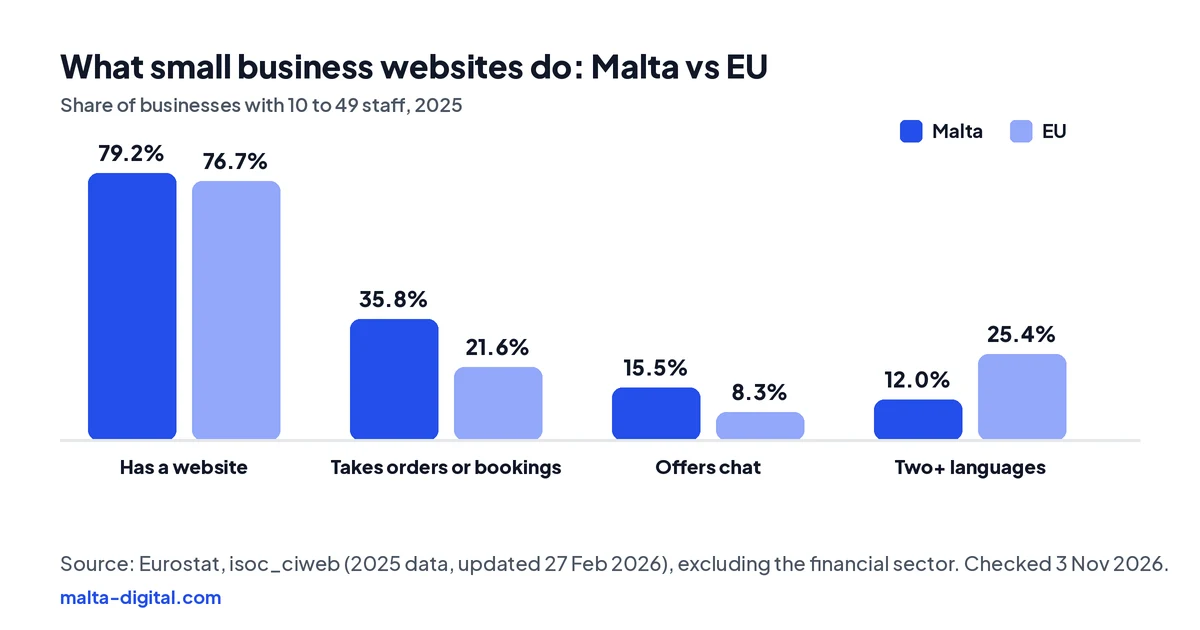
What does that mean for you? More than one in three of these Malta businesses take orders or bookings on their website. That is a job for a planned, tested website, not a quick template. On the other hand, only 12% offer a second language, half the EU rate. If many of your customers are tourists or foreign residents, a second language could set you apart.
Chooser
Answer six questions. The chooser scores each route against your answers and tells you which fits best and what to watch out for. It is honest: if a builder is enough, it says so.
Six quick questions. You get the route that fits your business, and why. Everything is worked out on your device. Nothing is sent anywhere.
Question 1 of 6
This chooser needs JavaScript. The questions are simple: what the site must do, how many pages, who writes the words, your time, what happens after launch and your budget. The section below explains each route.
True cost
The build price is only part of the bill. You also pay to run the site, to change it and, if you do it yourself, with your own hours. Here is a made-up example to show the maths, not real quotes. A physiotherapist needs a five-page website and values an hour of their time at €30.
| Made-up example, 3 years | DIY builder | Web designer | Agency |
|---|---|---|---|
| Build price | €0 | €1,200 | €3,500 |
| Plan, hosting or care plan | €20 a month = €720 | €15 a month = €540 | €60 a month = €2,160 |
| Changes after launch | You do them | €300 | Included in the plan |
| .mt domain (NIC fees) | €40 | €40 | €40 |
| Your time at €30 an hour | 61 hours = €1,830 | 10 hours = €300 | 6 hours = €180 |
| Total over 3 years | €2,590 | €2,380 | €5,880 |
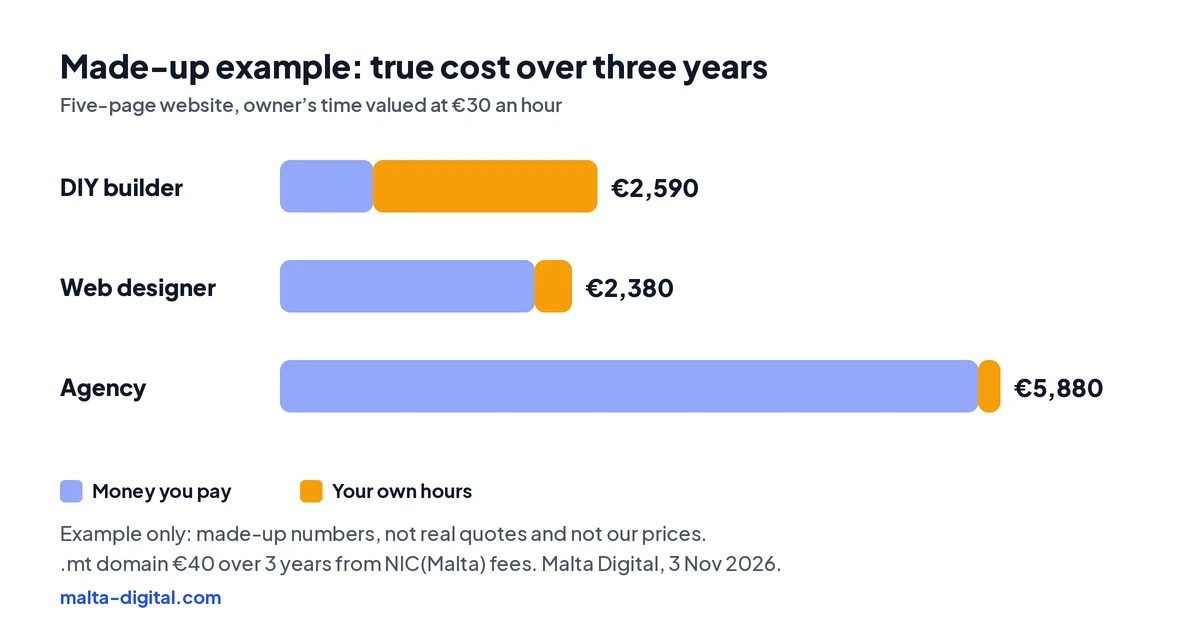
The DIY route looks free at the start. But 25 hours to build it and an hour a month to keep it current add up to 61 hours over three years. At €30 an hour, that is €1,830 of your time. The agency costs most, but it also does more: it writes, plans and changes the site for you. That is only worth paying for if your site has those jobs to do.
Now try it with your own numbers. Put in your builder plan, your hours and what your time is worth. Add a designer’s quote if you have one.
A builder looks cheap until you count your hours. Type your own numbers. Add a designer’s quote to compare.
This tool needs JavaScript. The formula is below, so you can do it by hand.
The formula, if you prefer a pen: DIY true cost = plan × months + (hours to build + hours a month × months) × your hourly value. For a quote: build price + monthly fees × months. Use the same number of years for both.
DIY builder
A builder is a sensible choice, not a second-best one, in a few cases. You are just starting and not sure what the business will look like in a year. You need one to three pages: what you do, where and how to reach you. And you enjoy doing it, with a few evenings free.
The catches are real, though. Your hours are the biggest cost. Many builder sites go stale when the owner gets busy. The site usually lives on that platform, so moving later often means building the design again. You keep your domain and your words, but not the layout. Paid add-ons for bookings, extra pages or a shop can push the monthly fee up.
Our guide to WordPress vs Wix vs a custom website compares the platforms themselves in more detail.
Web designer
A web designer, or a small studio, suits most local businesses that want a proper site without a big bill. It works best when you know what you need: the pages, the services, the areas you cover. If your words and photos are ready, a good designer can move fast.
The main risk is continuity. If that one person gets busy, falls ill or changes career, your updates stop. So ask two questions before you sign. Who covers when you are away? And if we part ways, how do I get my website, files and logins? A good designer will answer both in writing without fuss.
Agency
An agency earns its price when the website has several connected jobs. Think enquiry forms that feed a CRM, online bookings with deposits, pages for each service, Facebook and Instagram ads that send people to the site, and tracking that shows which ad brought which enquiry. Several skills are involved, and someone has to keep them working together after launch.
The risks are different. You may pay for an office, account managers and layers you do not need. The senior person who sold you the project may not be the one building it. So ask who exactly will design, write and build your site, and what you pay in year two.
Apply now and tell us what your website must do. We’ll tell you honestly which route fits, even if it is a DIY builder.
Own these
This is the part most people skip, and the one that hurts most later. NIC(Malta), which runs .mt addresses, calls the registered owner of a domain the “holder”: the legal entity granted the right to use it, who accepts the legal consequences. If your designer is the holder, the address is legally theirs to manage. Make sure it is your business.
One more tip from Google: if someone offers to check your website, give them read-only access to Search Console at first. You stay responsible for what anyone you hire does to your site, so keep the keys.
Red flags
These apply to builders, designers and agencies alike. One flag is a question to ask. Two or more is a reason to walk away.
Others vs us
We do not name other businesses, and many of them do good work. This table compares what web designers in Malta often publish with how we work, so you can judge for yourself.
| How it is often done* | How we do it at Malta Digital | |
|---|---|---|
| Who you talk to | An account manager, or one designer who may hand work on | The people who build your website, directly. We are a small team |
| Price | Often “quote on request” | Three published starting prices: €990, €2,490 and €4,900 |
| Time to a first version | Published timelines of about 2 to 6 weeks to go live | We start right away. First version targeted within 24–48 hours once the agreed content is ready |
| Who owns it | Varies. Sometimes the domain is in the designer’s name | The domain in your business’s name, and you own every line of code. Hosting goes where you want it |
| Ads and systems | Usually a separate supplier | Meta ads from €1,249 a month plus ad spend, and custom systems from €7,500, from the same team |
| Grants | You work out the rules yourself | We tell you if a scheme may fit and prepare the signed scope it asks for before work starts |
Two things make the biggest difference for our clients. First, speed: we start right away, and the only waiting is for your content and feedback. Second, ownership: the domain is in your name and every line of code is yours, so you are never locked in.
Proof
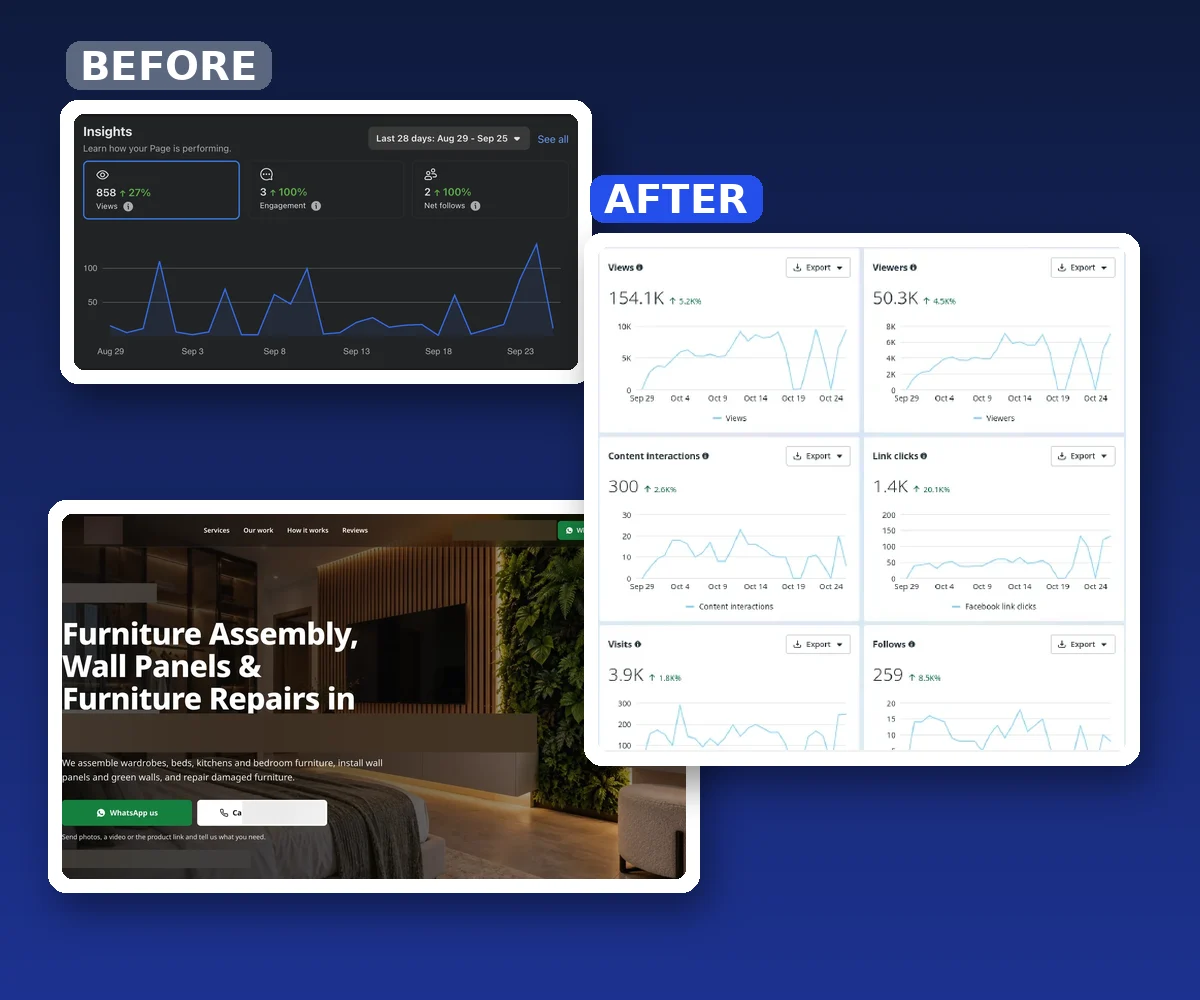
A furniture assembly and installation business needed a website, a social media presence and ads, all at the same time. Three suppliers would have meant three briefs and three invoices. One team did it instead.
We built a mobile website made for quote requests. We rebuilt their Facebook and Instagram with 75 unique images and three posts a day. Then we ran Meta ads that open a chat or a call. In the 28 days from 29 September to 26 October, Facebook views went from 858 to 154.1K, and 50.3K people were reached.
Want one team for your website and ads? Apply now for a website
Grants
Sometimes. Malta Enterprise’s Micro Invest scheme gives a tax credit on eligible costs, and our guide to website grants in Malta explains how it treats websites. One rule matters here: the agreement describing what will be built must be signed before work starts. Whoever you hire must be able to give you that in writing.
For bigger digital projects, the new 60% tax credit for AI and digitalisation is coming. Whether websites will count is not confirmed yet. We track it and update our guide as soon as the rules are out. Malta Enterprise decides who qualifies, so treat this as a guide, not advice.
Get started
Whichever route you pick, a clear brief saves time and money. Write down what your business does, who your customers are and the one thing the website must get them to do: call, book, buy or ask for a quote. List the pages you think you need. Say whether you have the words and photos. Add two or three websites you like, and why.
Send the same brief to everyone you ask, so you can compare like with like. Then put every quote into the website cost guide’s quote comparer to see the total over three years.
A few straight answers
Neither is better for everyone. A web designer suits a focused site when your words and photos are ready. An agency or team suits a site that must win enquiries, take bookings, run with ads or connect to other systems.
Yes, if the site is simple, you have the time and you are happy to keep it current. Count your own hours as a cost. Moving away from a builder later usually means rebuilding the design.
Prices Malta web designers published when we checked on 2 and 3 November 2026 start from about €500 for one page. €1,000 to €2,500 is common for a small business website, and full-service studios list €3,500 to €8,000.
Your business. NIC(Malta) calls the registered owner of a .mt domain the holder, the entity with the right to use it. Ask your designer to register it in your business’s name and give you the logins.
Ask to see live websites they built, who will do the work, what is included, what year two costs, who owns the domain and code, and who fixes things after launch. Walk away from anyone who promises first place on Google.
We are a small team, so you talk directly to the people who build your website. Our websites start from €990, €2,490 and €4,900, and we also run Meta ads and build custom systems. You own the domain and every line of code.
We start right away. For a straightforward website, the first version is targeted within 24–48 hours once the agreed content is ready. Revisions and launch checks can take longer.
Keep reading
What a good business website in Malta needs, what it costs and how to choose a web designer.

Speed, editing, upkeep, ownership, moving later, costs and SEO compared, and which fits which business.
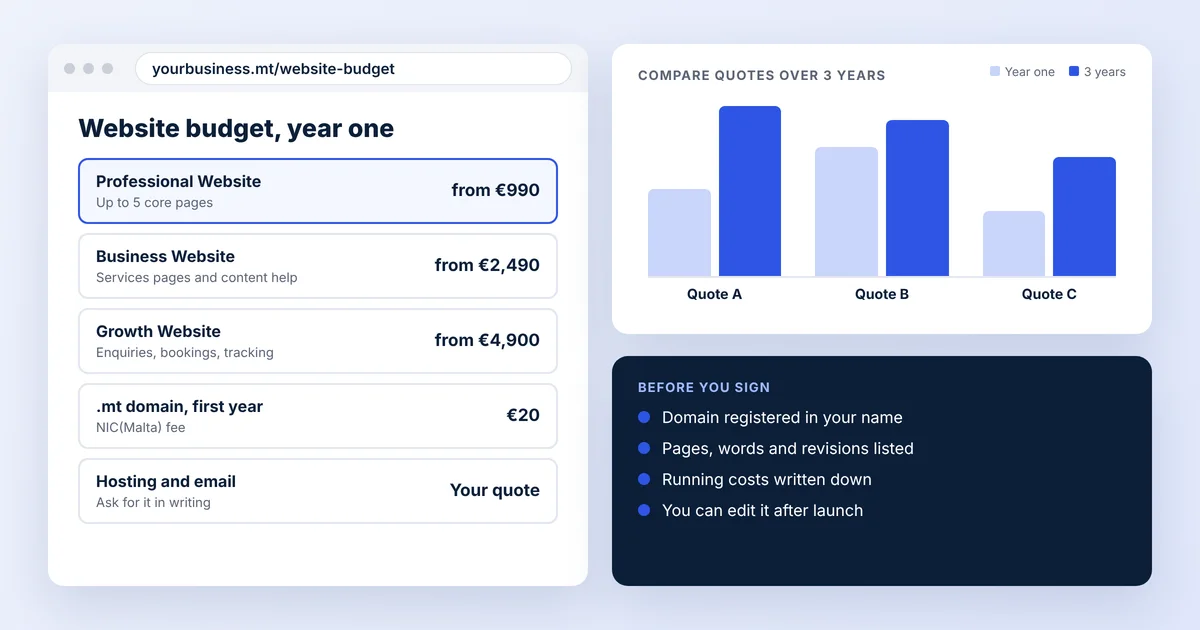
Price ranges by type of website, .mt domain fees, running costs, hidden extras and a free 3-year quote comparer.
A useful first step
Professional Website from €990, Business Website from €2,490 and Growth Website from €4,900. You talk directly to the people who build it, and the domain and code are yours.
Step 1 of 2
A few quick questions, about a minute. We usually reply within 2–3 hours.