
Malta business grants for digital projects (2026)
Malta business grants in 2026 for digital projects: Digitalise your SME, Micro Invest, Marketing Strategy and Gozo schemes, with official links and key rules.
Grants & funding · Websites
Yes, in a way. Malta Enterprise’s Micro Invest scheme lists website development and customisation as an eligible cost. It pays back as a tax credit of up to 65%, or up to 85% in Gozo, not as cash. The catch: the agreement that lists what the site will do must be signed before work starts. Planning a new site? See our web design in Malta packages.

Micro Invest can cover up to 65% of a new website’s cost (85% in Gozo) as a tax credit, for businesses with 1 to 50 staff. Sign a functionality agreement before work starts, keep invoices of €500 or more, and apply from 1 January 2027 for 2026 costs. Digitalise your SME does not list websites.
The scheme
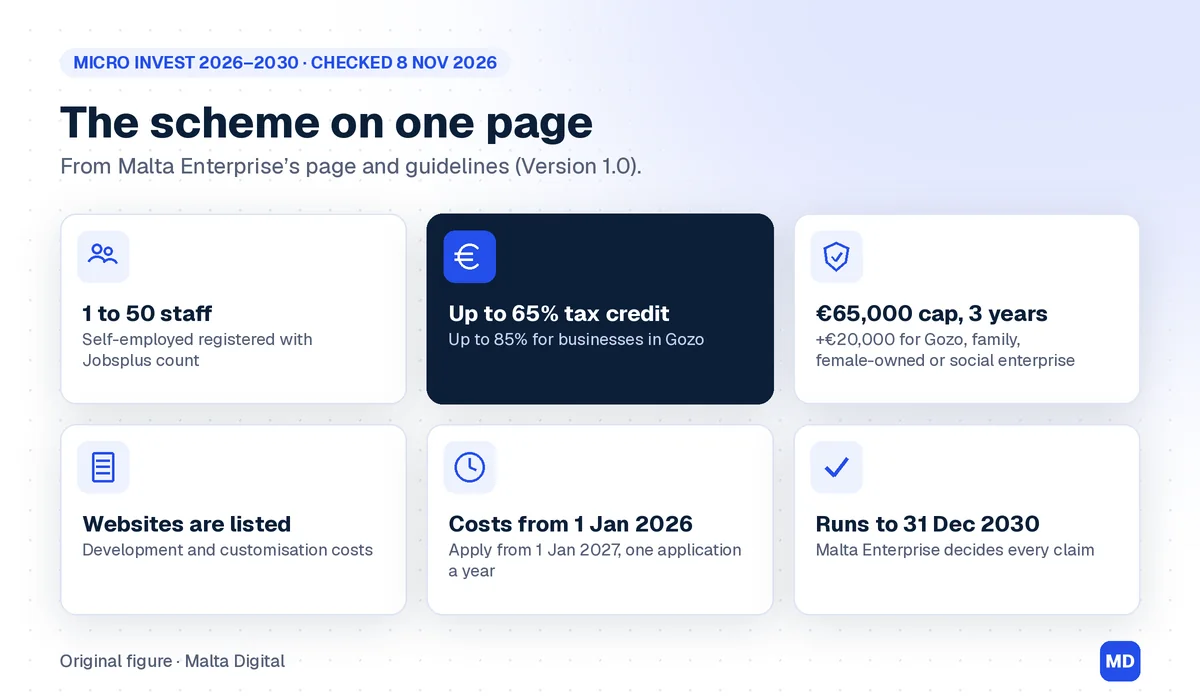
Micro Invest 2026–2030 is Malta Enterprise’s tax credit scheme for small businesses. For every rule, the CPA route and the client portal steps, see our complete Micro Invest guide. It is open to businesses that employ 1 to 50 people. A self-employed person registered with Jobsplus counts. You must also be eligible for de minimis aid, and in most cases be registered for VAT.
The guidelines list “development and customisation costs for software systems, websites and digital applications” as eligible. Hosting and maintenance agreements linked to a new site can count too. Hosting renewals and running costs on their own do not.
The credit is up to 65% of eligible costs, or up to 85% for a business operating from Gozo. It is capped at €65,000 over three years. Businesses in Gozo, family businesses, female-owned businesses and social enterprises get an extra €20,000 of room. Costs count from 1 January 2026, and you apply from 1 January 2027.
One more line is easy to miss. Work that makes an existing website more accessible for disabled people can also qualify. That work must be certified by FITA, the Foundation for Information Technology Accessibility.
The catch
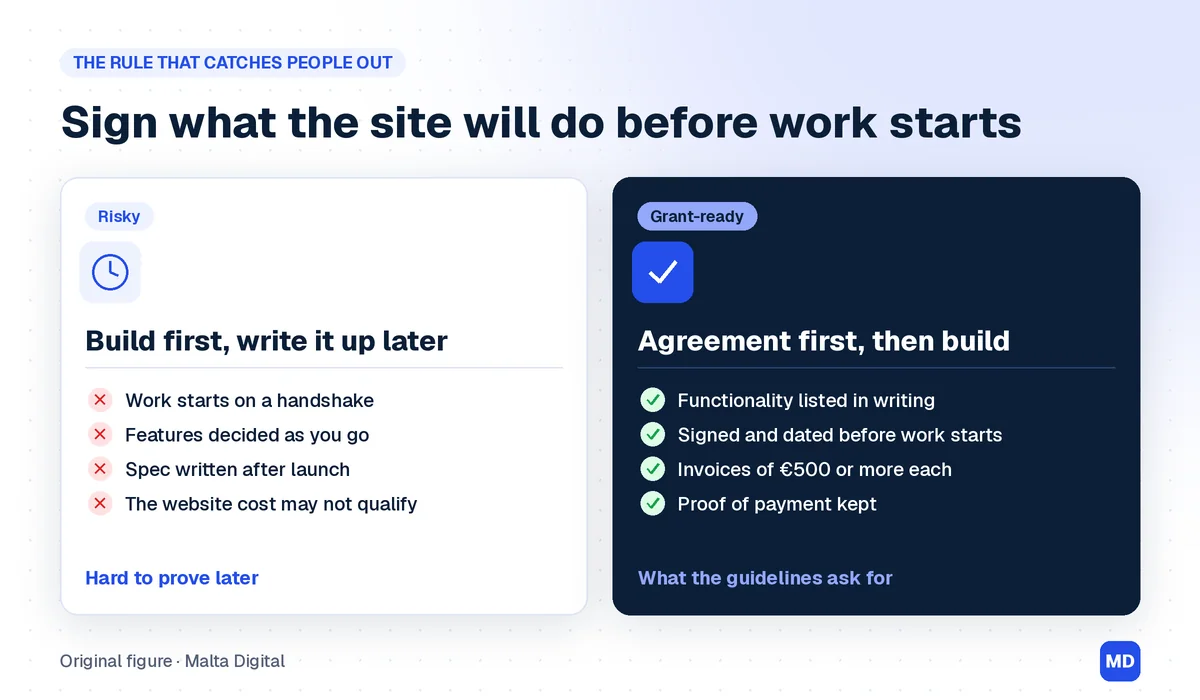
For website and software work, the guidelines ask for an agreement signed before the works start. It must list the functionality that will be built. A website built first and written up later may not qualify.
Example sceneA physiotherapy clinic in Birkirkara with six staff wants online booking and a new site. In March 2026 the owner and the web team sign a one-page agreement. It lists the pages, the booking form, reminder emails and the link to the clinic’s diary. Work starts the next week. In January 2027 the clinic’s accountant attaches that dated agreement to the claim.
Keep every invoice and proof of payment. Each invoice must be at least €500 before VAT, and VAT is taken off the eligible amount. Costs already paid for by another public scheme cannot be claimed again.
The agreement
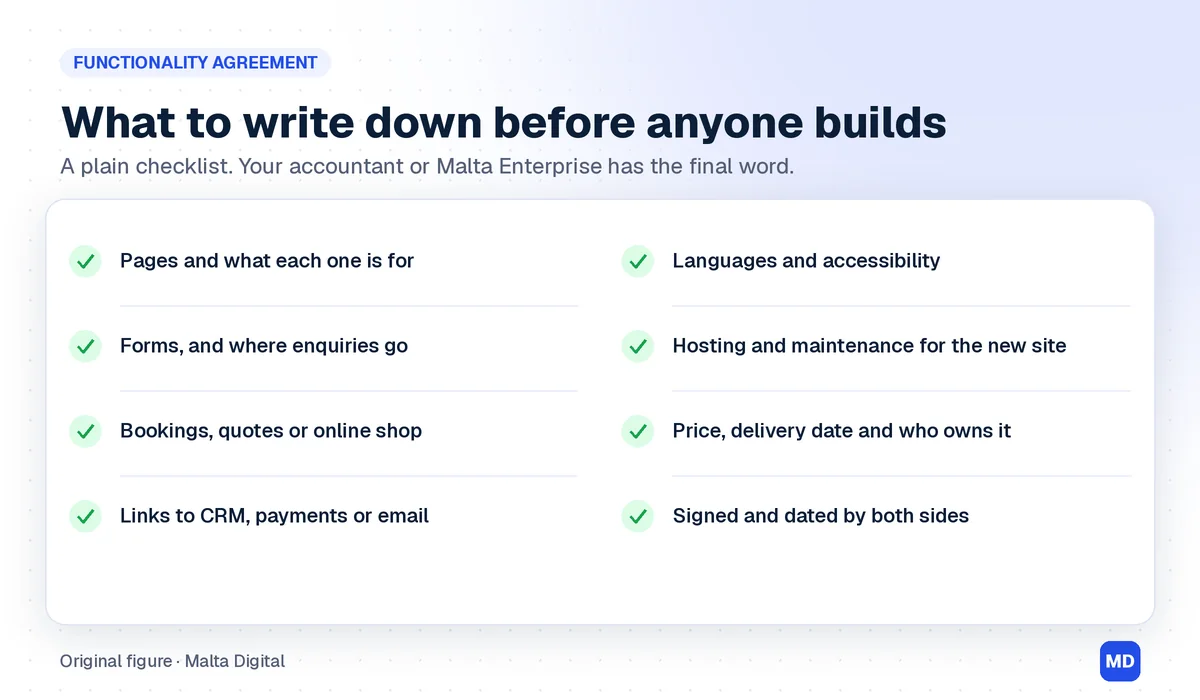
Write what the site will do, not how it will look. Name the pages and what each one is for. Say where each form sends its enquiries. List bookings, quotes, payments or an online shop. Selling online? Read our e-commerce grant guide too. Note links to a CRM, email or other tools.
Add the price, the delivery date and who owns the finished site. Then both sides sign and date it before any work begins. It does not need to be long. One clear page beats twenty vague ones.
Our websites start from €2,490 for a Business Website, €4,490 for a Growth Website and €6,490 for a Premium Website. Every quote comes with a written specification of the functionality. We do not decide eligibility or submit applications. Your accountant or Malta Enterprise does that.
Want the specification written before work starts? Apply now for grant support
In practice
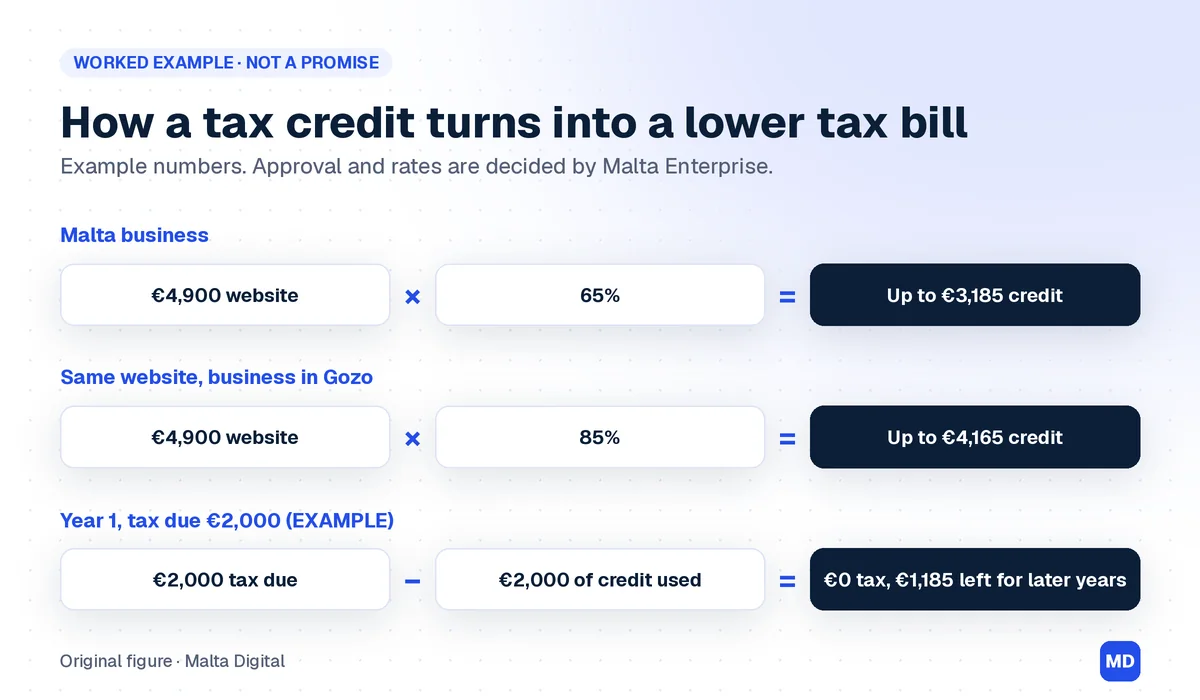
A tax credit is not cash in your bank. It lowers the tax your business pays on its profits. It gives no refund, and it cannot pay off old tax arrears. The newer scheme for AI and digitalisation is also a tax credit; see what is known so far about the 60% tax credit in Malta.
Say a Malta business spends €4,490 on a Growth Website. At 65%, that is up to €3,185 of credit, if Malta Enterprise approves it. The business owes €2,000 of tax in the first year, so that bill drops to zero. The other €1,185 waits for the next year’s tax.
The same maths on a €2,490 Business Website gives up to €1,618.50 at 65%.
The credit must be used by the fifth year of assessment shown on the certificate. So a business that pays very little tax may not use all of it. Try your own numbers below, then ask your accountant.
Type your own numbers to see your credit. Nothing you type is sent anywhere.
This estimator needs JavaScript.
Timeline
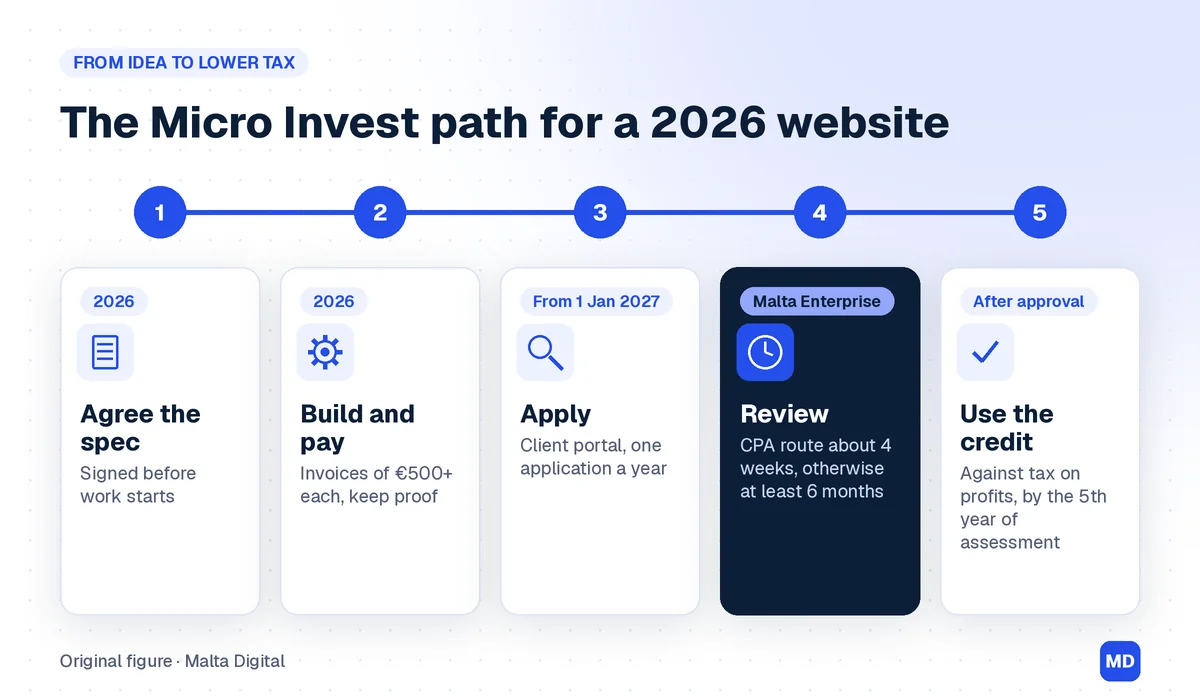
For a website built and paid for in 2026, you apply from 1 January 2027. Applications go through Malta Enterprise’s client portal, one a year. Each one can group costs from up to three years in a row.
Speed depends on who prepares it. Applications completed by a certified public accountant under the official technical guidance are processed within four weeks. Others need at least six months. On 2 November 2026 Malta Enterprise published the procedures accountants follow for this faster route.
Have costs from 2025? Those go under the older Micro Invest 2024 scheme. Malta Enterprise lists 25 November 2026 as the late submission date for 2025 costs. A late claim gets a certificate that starts from the 2027 year of assessment, not 2026. If that is you, speak to your accountant this week.
Apply now and tell us what the website must do. We’ll prepare a specification that lists the functionality clearly.
See it working
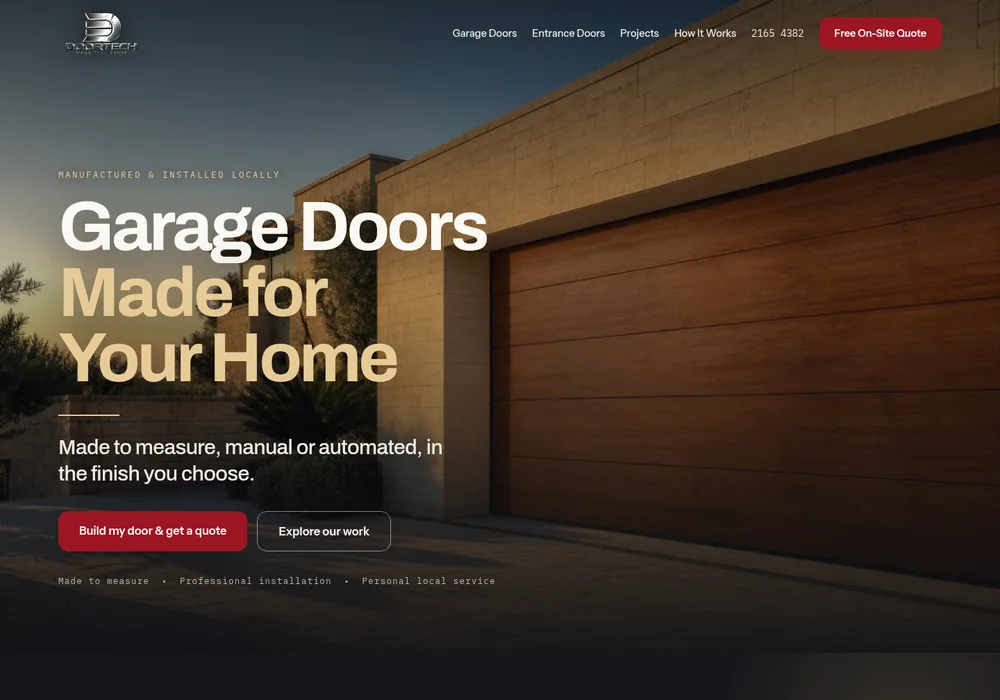
This interactive demo has a project gallery and a quote builder. Features like these are exactly what a functionality agreement lists: what the site does, not how it looks. We write that list into every quote.
Want a specification and quote ready before you start? Apply now for grant support
Other schemes
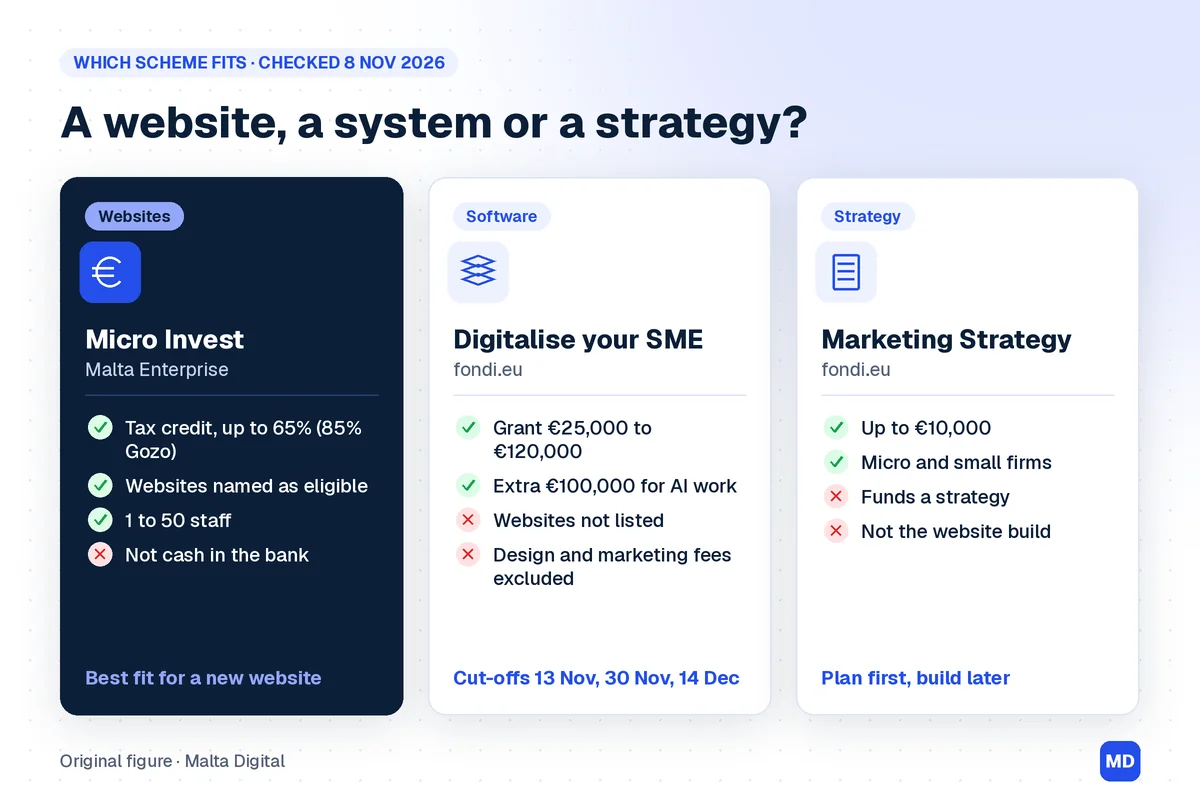
Digitalise your SME is a grant, not a tax credit. Grants run from €25,000 to €120,000, plus a 7% flat rate. Call 2 adds up to €100,000 more for AI work. Websites are not listed among its examples, and fees for design, marketing and consultancy are not eligible.
So it suits bigger software projects, such as booking systems, CRMs or connected business systems. The remaining 2026 cut-off dates listed on fondi.eu are 30 November and 14 December. For the new 60% tax credit and the other Budget 2027 measures, see what Malta Budget 2027 means for businesses going digital. Start with our Digitalise your SME grant in Malta guide and the AI grant in Malta page.
Marketing Strategy for Micro and Small Enterprises gives up to €10,000 towards a marketing strategy from an outside provider. It pays for the plan, not the website build. See our Marketing Strategy grant guide. For every scheme in one place, see Malta business grants in 2026.
Pick the scheme by what you are buying. For a website on its own, Micro Invest is the route. For a bigger system with bookings, a CRM or AI, look at Digitalise your SME, Malta’s digitalisation grant, and use our step-by-step application guide. Expanding with new premises or equipment? Read about the INVEST scheme and SME Enhance and the other Business Enhance grants. Still unsure? See which fits a website, Micro Invest or Digitalise your SME. See website packages and prices for the build itself.
| Scheme | Type | What it gives | Covers a website? | When |
|---|---|---|---|---|
| Micro Invest 2026–2030 | Tax credit | Up to 65% of eligible costs (85% in Gozo), capped at €65,000 over three years | Yes, website development is listed | From 1 January 2027, for costs from 1 January 2026 |
| Digitalise your SME (Call 2) | Grant | €25,000 to €120,000 plus a 7% flat rate, and up to €100,000 more for AI work | No, websites are not among its examples | Cut-offs on fondi.eu: 30 November and 14 December 2026 |
| Marketing Strategy for Micro and Small Enterprises | Grant | Up to €10,000 towards a strategy from an outside provider | No, it pays for the plan, not the build | See fondi.eu |
| No scheme | Your own budget | You pay the full price | Any website | Start when you are ready |
Say a Gozo shop with four staff signs a functionality agreement for a €2,490 Business Website in February 2026. At 85%, that is up to €2,116.50 of credit, if Malta Enterprise approves it. If the shop pays about €1,000 of tax a year, the credit covers roughly the next three years of that tax, well inside the five-year limit.
A few straight answers
Micro Invest lists development and customisation of websites as an eligible cost. It is a tax credit of up to 65%, or up to 85% in Gozo, for businesses with 1 to 50 staff. Malta Enterprise decides eligibility.
Websites are not listed among its examples, and fees for design, marketing and consultancy are not eligible. It suits larger software projects such as booking systems or CRMs.
You apply later, but the agreement listing the functionality must be signed before work starts. A site built first and written up afterwards may not qualify.
No. It is a tax credit that lowers the tax your business pays. It gives no refund and cannot be used to settle tax arrears.
No. VAT and other taxes are taken off the eligible amount, and each invoice must be at least €500 before VAT.
Applications completed by a certified public accountant under the official technical guidance are processed within four weeks. Others need at least six months, according to the guidelines.
Hosting and maintenance agreements linked to a new website can be eligible. Hosting renewals and other running costs on their own are not.
By the fifth year of assessment from the year shown on the tax credit certificate. If your business pays little tax, part of the credit may go unused.
For 2025 costs, the previous Micro Invest scheme accepts late submissions until 25 November 2026, with a certificate starting from the 2027 year of assessment. For costs from 1 January 2026, applications under Micro Invest 2026–2030 open from 1 January 2027.
For a website on its own, Micro Invest. It lists website development as an eligible cost and gives a tax credit of up to 65%, or 85% in Gozo. Digitalise your SME does not list websites and suits bigger software projects such as booking systems or CRMs.
Get a quote that lists what the site will do, then sign and date the functionality agreement with your web team before any work starts. Keep every invoice of €500 or more before VAT and the proof of payment for your claim.
Schemes change, and the funding body decides every claim. Ask your accountant before you apply.
Keep reading
Malta business grants in 2026 for digital projects: Digitalise your SME, Micro Invest, Marketing Strategy and Gozo schemes, with official links and key rules.
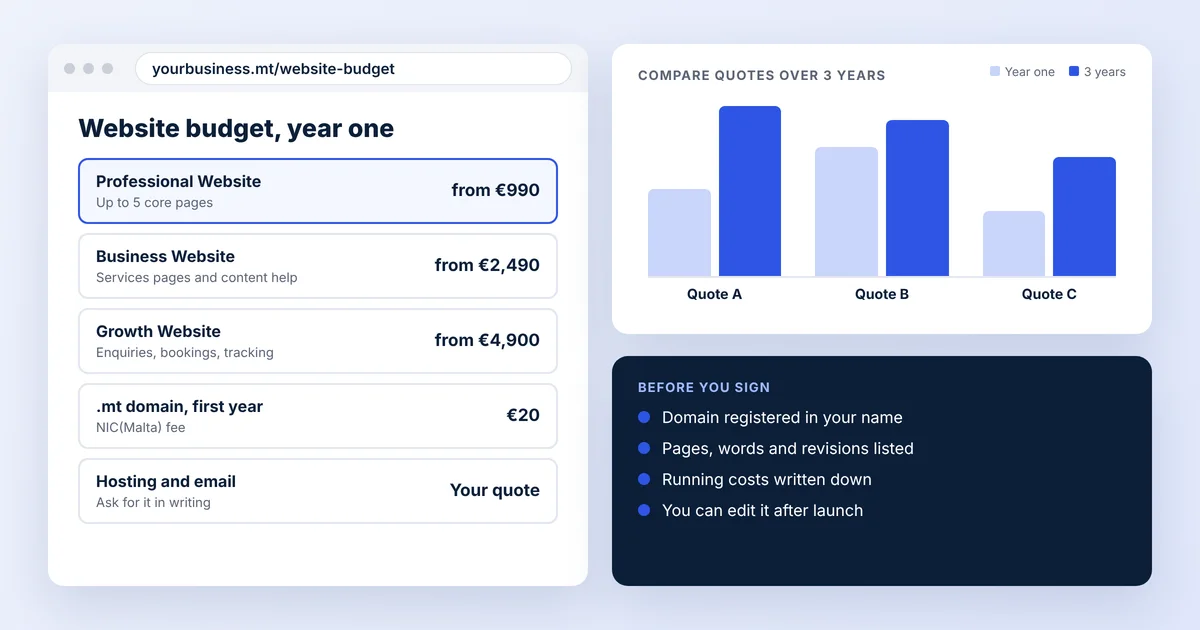
How much does a website cost in Malta in 2026? Real price ranges, .mt domain fees, running costs, hidden extras, a quote comparer and our prices from €2,490.
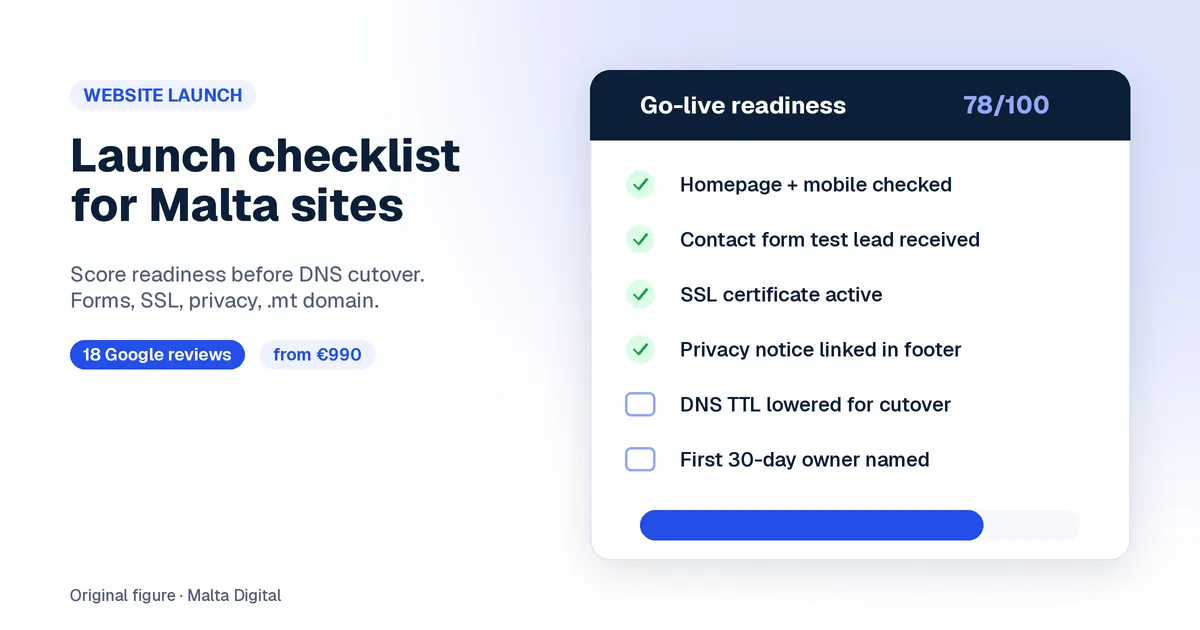
Website launch checklist Malta (2026): content, DNS, SSL, privacy, go-live day, first 30 days, plus a readiness score tool before you cut over.
If a closing date is close and you need the site itself live first, see getting a website ready before a grant deadline. That guide is about speed, not about whether the cost qualifies.
A useful first step
We’ll prepare a clear specification and quotation, signed before work starts.
Step 1 of 3
A few quick questions, about a minute. We usually reply within 2–3 hours.