
Is There a Grant for a Website in Malta? Micro Invest 2026
Is there a grant for a website in Malta? How Micro Invest 2026 treats websites as a tax credit, the agreement rule, eligible costs and other schemes.
Grants & funding · Micro Invest
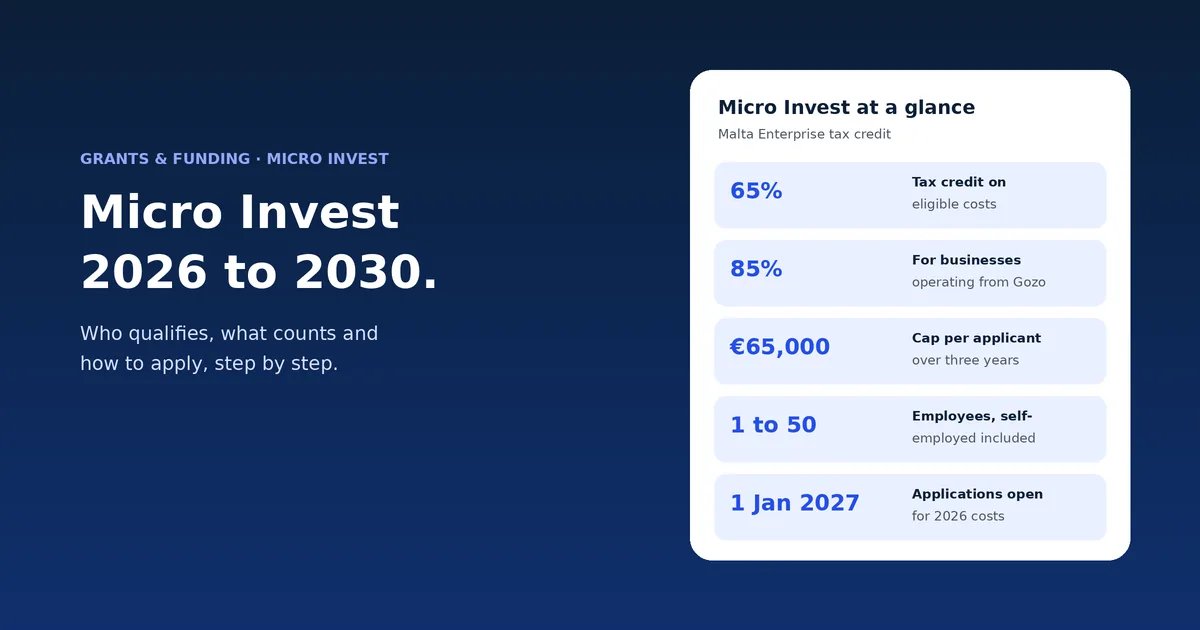
Micro Invest is Malta Enterprise’s tax credit for businesses with 1 to 50 employees. It covers up to 65% of eligible costs, or 85% in Gozo, including websites, software and digital systems. Applications for money you spend in 2026 open on 1 January 2027. Here is who qualifies, what counts, and exactly how to apply.
Micro Invest, answered
Answer: Micro Invest 2026-2030 is a Malta Enterprise tax credit of up to 65% of eligible costs (85% for businesses operating from Gozo), capped at €65,000 per applicant over three years. It is open to businesses and self-employed people with 1 to 50 employees. You apply on the Malta Enterprise client portal from 1 January 2027 for costs paid in 2026, once a year. With a CPA following the official procedures, processing takes about four weeks. Without one, at least six months.
The short version
Micro Invest has been around for years, but the 2026 to 2030 version is a new scheme with new rules. It came into force on 1 January 2026 and covers costs from that date. The table below is taken from the official guidelines and the scheme page, and every row links to its source.
| What the rules say | Source | |
|---|---|---|
| Run by | Malta Enterprise. Questions go to Business First on 144 or info@businessfirst.com.mt. | Guidelines, contacts |
| Type of support | A tax credit, not cash. It reduces the tax your business pays. | Scheme page |
| Who can apply | Businesses with at least 1 and no more than 50 full-time employees, including the self-employed registered with Jobsplus. VAT registration is needed unless you are exempt. | Guidelines 3.1 |
| How much | Up to 65% of eligible costs. Up to 85% for businesses operating from Gozo. | Guidelines 3.2 |
| Cap per applicant | €65,000 over any three years. Plus €20,000 if you operate from Gozo, are a registered family business, a female-owned business or a social enterprise. | Guidelines 3.3 |
| De minimis limit | All de minimis aid to your group of linked businesses must stay within €300,000 over three years. | Guidelines 5 |
| Eligible costs | Higher wage costs, new tangible assets, refurbishment of business premises and digital solutions, including websites and software. | Guidelines 4 |
| Smallest invoice | €500 excluding VAT. VAT and import duties are never counted. | Guidelines 4.2 |
| When to apply | From 1 January 2027 for 2026 costs. One application a year, covering up to three calendar years. The scheme ends on 31 December 2030. | Scheme page · Guidelines 1.2, 1.3 |
| Processing time | About 4 weeks when a CPA prepares it under the official procedures. At least 6 months otherwise. | Guidelines 1.3 |
| Where to apply | The Malta Enterprise client portal. First-time users register first. | Scheme page |
Two things trip people up. First, it is a tax credit, so it is worth most to a business that pays tax. It cannot be paid out as a refund or used to settle tax arrears (Guidelines 4.3). Second, it is claimed after you spend, so the invoices, payments and paperwork have to be right from day one.
Eligible costs
The guidelines list four groups of costs. Only the costs named there count (Guidelines 4).
What does not count: VAT and import duties, invoices under €500 before VAT, renewals of subscriptions, hosting and maintenance on their own, systems that produce alternative energy, and any cost that another public scheme already paid for, even in part. Malta Enterprise recovers aid with interest if a cost is funded twice (Guidelines 4.3).
Websites and software
For a website, software system or app, Micro Invest asks for something many businesses only think about afterwards: an agreement signed before the work starts, listing the functionality that will be built (Guidelines 4.2.3). The accountants’ procedures repeat it and add three more checks: an invoice that clearly describes the work, a VAT number on the invoice that matches yours, and a signed declaration that the system is used only for your business (agreed-upon procedures 36).
So the order matters. Agree the scope in writing, sign it, then start. A quote sent by WhatsApp and a single invoice that says “website” will make the claim harder.
Here is how it can work. Say a café in Mosta with six staff pays €9,000 in 2026 for a new website with online ordering and a stock system, with the functions listed in a signed agreement before work began. If all of it is accepted, 65% gives a tax credit of €5,850. The same café in Gozo, at 85%, would get €7,650. The credit is set against the tax the business pays, so your accountant should check how much you can use each year.
For software as a service, only the set-up and the first 12 months of a new subscription count, and you need proof it is your first subscription. Renewals never count (agreed-upon procedures 35).
Step by step
You apply online on the Malta Enterprise client portal. Applications for 2026 costs open on 1 January 2027, and the portal will be made available then (scheme page). These are the steps in the client portal’s own Micro Invest manual (client portal user manual). The screens for the 2026 to 2030 scheme may look a little different when it opens.
Before you press submit, check five things: every field is filled, every linked business is listed, every transaction is saved with its uploads, both declarations are signed and uploaded, and nothing else the portal asks for is missing.
The agreement has to be signed before work starts. Send us what you need and we will write the functionality down and quote it item by item.
CPA route
The biggest change in the new scheme is speed. Malta Enterprise and the Malta Institute of Accountants agreed a set of procedures that a CPA follows before signing the application. Applications completed this way are processed within four weeks. Applications not completed by a CPA, or only partly, take at least six months (Guidelines 1.3, agreed-upon procedures).
| With a CPA (accelerated route) | Without a CPA | |
|---|---|---|
| Processing time | Within 4 weeks of submission | At least 6 months |
| To have the certificate by 30 November | Submit by 30 October | Submit by 30 May |
| Wage cost claims | Required: a CPA must review them | Not possible without a CPA |
| What the CPA checks | Eligibility, invoices, VAT numbers, payments, signed agreements, asset ledger, Gozo or female-owned status | Malta Enterprise checks everything itself |
For most businesses the CPA route is the sensible one, and for wage claims it is required. The CPA checks your eligibility, every invoice and payment, the VAT numbers, the signed agreements for software and websites, and any Gozo or female-owned status. You stay responsible for what the application says.
Documents
Keep these together from the first invoice. You must keep the records for ten years after the certificate is issued (Guidelines 4.3).
Costs from 2025
The 2026 to 2030 scheme only covers costs from 1 January 2026. Costs from 2025 belong to the previous scheme, Micro Invest 2024. Malta Enterprise lists 25 November 2026 as the late submission date for 2025 costs, with the certificate usable from the 2027 year of assessment (MicroInvest 2024 page).
If you bought equipment, software or a website in 2025 and have not claimed it, speak to your accountant this week. The older scheme has its own guidelines and conditions, so check them before you count on the credit.
Compare
You cannot claim the same cost twice, but you can use different schemes for different costs (Guidelines 5.2). This is how they fit together for a digital project.
| Your project | Best first look | Why |
|---|---|---|
| A website, online shop or booking system up to about €50,000 | Micro Invest | Websites and software are listed costs, the rate is up to 65%, and you claim after you pay. |
| A digital or AI project of €50,000 or more, not started yet | Digitalise your SME | A cash grant, with cut-offs on 30 November and 14 December 2026. Work cannot start before the grant agreement. |
| Automation or AI in a bigger investment | The planned 60% tax credit | Planned in Budget 2027. Projects may qualify once the official rules are published, and we check fit with you. |
| A new site, production line or new line of business | INVEST | A six-month extension was announced. Malta Enterprise has not yet published new dates or reopened applications. |
For the full list of schemes and dates, see our guide to business grants in Malta, and for the latest budget measures, what Budget 2027 means for businesses going digital.
How we help
Malta Digital builds the websites, software and systems Micro Invest lists as eligible costs. We are a private company, not Malta Enterprise, and we do not decide eligibility. That stays with Malta Enterprise. Your accountant prepares and signs the application.
What we do: we write the functionality into a clear agreement before any work starts, and we issue itemised invoices that describe each part of the work, so your CPA has what the procedures ask for.
Websites. Our web design service in Malta starts with the Professional Website at €990, complete in 24 to 48 hours. The Business Website takes 2 to 4 days, the Growth Website 7 days, and the 24-Hour Premium Website is ready in 24 hours.
Systems and CRM. Custom business systems and CRM systems from €7,500, with the first working version of a custom system in 2 to 4 weeks.
AI and automation. AI automation that takes repetitive work off your team, scoped in writing before we start.
Tell us what you want to build. We have 18 Google reviews, and we reply to every enquiry by email.
A few straight answers
From 1 January 2027, on the Malta Enterprise client portal. That first round covers costs paid in 2026. After that you can apply once a year, grouping up to three calendar years of costs.
Yes, development and customisation of websites is a listed cost. You need an agreement signed before work starts that lists the functionality, an invoice of at least €500 before VAT that describes the work, and proof of payment.
Up to 65% of eligible costs, or 85% for businesses operating from Gozo. The cap is €65,000 per applicant over three years, plus €20,000 for Gozo businesses, registered family businesses, female-owned businesses and social enterprises.
Businesses with at least 1 and no more than 50 full-time employees, including the self-employed registered with Jobsplus, that are VAT registered unless exempt and can receive de minimis aid. Some farming and fishing activities are excluded.
Not always, but it is much faster. A CPA following the official procedures gets the application processed in about four weeks. Without one it takes at least six months. A CPA must always review wage cost claims.
No. It is a tax credit that reduces the tax your business pays. It cannot be refunded as cash or used to pay tax arrears.
Not under the 2026-2030 scheme. Costs from 2025 fall under Micro Invest 2024, which lists 25 November 2026 as its late submission date for 2025 costs.
Not for the same cost. A cost already supported by another public scheme, even in part, cannot be claimed again. Different costs in the same business can go to different schemes.
Sources
Malta Digital is a private company, not a government body. This guide summarises the official Micro Invest documents and is not tax advice. Your accountant and Malta Enterprise have the final word on any claim.
Keep reading
Is there a grant for a website in Malta? How Micro Invest 2026 treats websites as a tax credit, the agreement rule, eligible costs and other schemes.

Malta business grants 2026: Digitalise your SME (up to €128,400), Micro Invest, Xjenza vouchers and the 60% tax credit. Amounts, dates and how to apply.
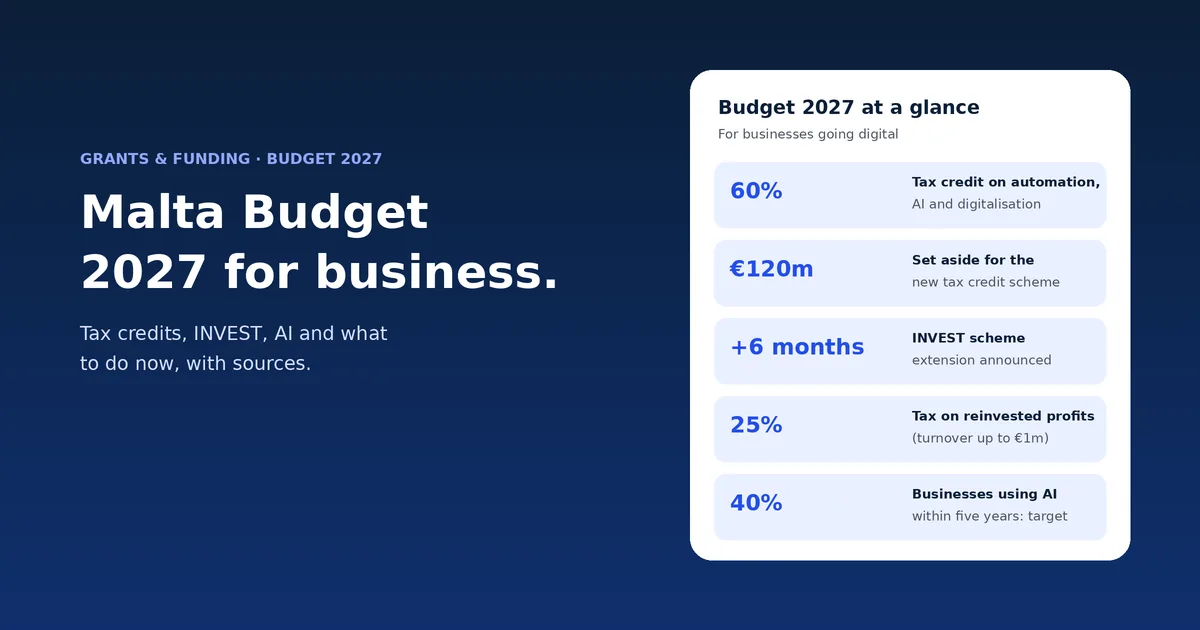
Malta Budget 2027 for businesses going digital: INVEST extension announced, the planned €120m 60% tax credit, 25% tax on reinvested profits and the 40% AI target, with sources.
A useful first step
Tell us what you want to build. We’ll put the functionality in writing before work starts and give you a clear, itemised quotation. You and your accountant handle the claim, and Malta Enterprise decides it.
Step 1 of 3
A few quick questions, about a minute. We usually reply within 2–3 hours.