
Business Grants Malta 2026: Amounts, Dates and How to Apply
Malta business grants 2026: Digitalise your SME (up to €128,400), Micro Invest, Xjenza vouchers and the 60% tax credit. Amounts, dates and how to apply.
Grants & funding · Budget 2027
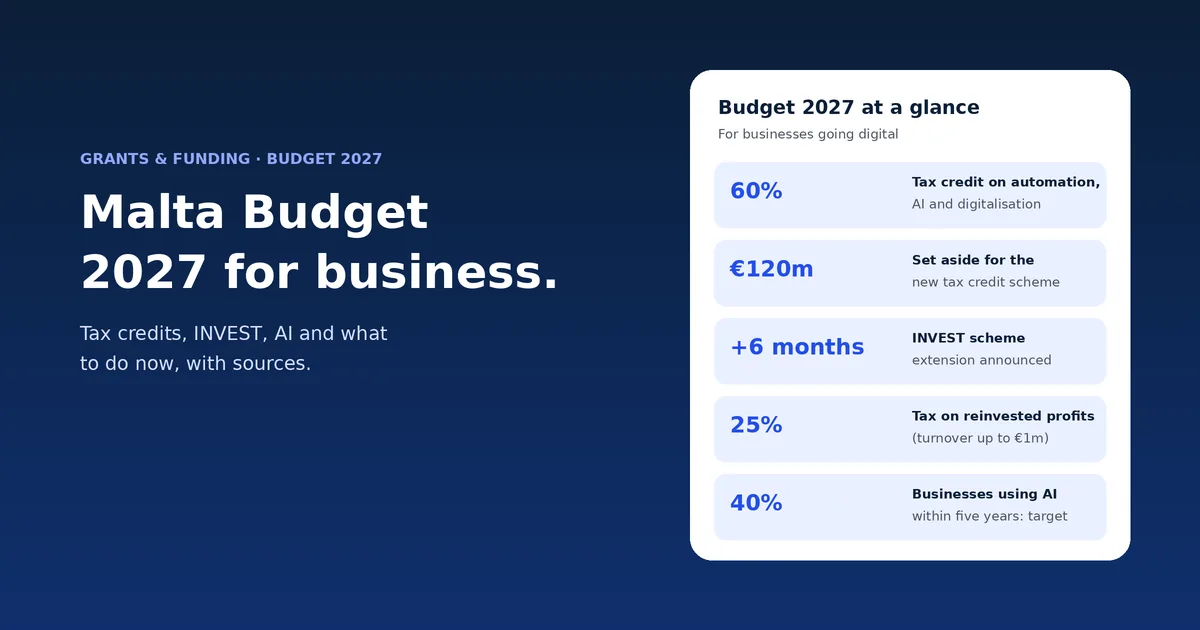
Budget 2027 gives Malta businesses four things to plan around: six more months of INVEST, a €120 million scheme with a 60% tax credit for automation, AI and digitalisation, 25% tax instead of 35% on reinvested profits for companies with turnover up to €1 million, and a national goal of 40% of businesses using AI within five years. Here is what is confirmed, what is still to come, and what to do now.
Malta Budget 2027, answered
Answer: Budget 2027 does not hand out cash for websites or apps. It changes the tax side: a 60% tax credit for automation, AI and digitalisation (€120 million, rules not published yet), 25% tax on reinvested profits for companies with turnover up to €1 million, and six more months for Malta Enterprise’s INVEST scheme. For a project you want now, Digitalise your SME (cut-offs 30 November and 14 December 2026) and Micro Invest are still the schemes with published rules.
The short version
Most of what matters for a business going digital was said in two places: the ten economic measures Economy Minister Silvio Schembri presented on 29 October 2026, and the debate on his ministry’s 2027 estimates in Parliament on 10 November 2026. We read the reports from both and kept only the figures that more than one source confirms.
| Measure | What was announced | Where it stands | Source |
|---|---|---|---|
| INVEST scheme | 200 applications worth €1.5 billion in proposed investment this year. The minister told Malta Enterprise to extend the scheme by a further six months. | Announced in Parliament on 10 November 2026. Malta Enterprise’s page still shows the 30 September 2026 deadline as closed. New dates are not published yet. | Times of Malta · TVM · Malta Enterprise |
| 60% tax credit | A €120 million scheme with a 60% tax credit on eligible investment in automation, AI and digitalisation. Up to €15 million per business, spread over four years. | Target: operational by the end of 2026. Official guidelines, eligible costs and the way to apply are not published yet. | MaltaToday · Malta Independent · MBR |
| Extra EU funds | A further €20 million in European funds next year for business transformation, including technology upgrades and digitalisation. | Announced. The scheme it will run through is not named yet. | Malta Independent · TVM |
| Digital sector | More than €100 million allocated to the digital sector in 2027. | Announced as a budget allocation, not a scheme you apply to. | TVM · Malta Independent |
| Tax on reinvested profits | 25% instead of 35% on profits kept or reinvested, for companies with turnover up to €1 million. Profits paid out as dividends stay at 35%. | From next year, as announced in the Budget speech on 26 October 2026. | MaltaToday · Malta Independent |
| AI adoption target | 40% of businesses using AI within five years, under an updated national AI strategy with more than 80 measures to 2030. | A national target, supported by AI for All, Skills Development and Get Qualified. Not a grant. | Malta Independent · Times of Malta · Lovin Malta |
| Micro Invest | Reported as being strengthened. The 2026 to 2030 scheme gives a tax credit of up to 65% (85% in Gozo). | Applications for costs from 2026 open on 1 January 2027. | Times of Malta · Malta Enterprise |
Two things are worth knowing before you read on. First, none of the new measures has published rules yet, so nobody can tell you today exactly which costs will count. Second, the schemes that already have rules, Digitalise your SME and Micro Invest, did not stop. If your project is ready, you do not need to wait for the budget measures to start.
INVEST
INVEST is Malta Enterprise’s scheme for initial investment projects: setting up a new establishment, adding capacity to an existing one, moving into a new line of business or changing a whole production process. It supports these with tax credits, cash grants, help with loan interest and, for SMEs, loan guarantees (Malta Enterprise). Aid is a share of the qualifying spend, from about 10% to 35% depending on the size of the business, the activity and where the project is (PwC tax summary).
Schembri told Parliament that Malta Enterprise received 200 applications this year, representing €1.5 billion in proposed investment, and that he had instructed the agency to extend the scheme by a further six months (Times of Malta, TVM). The current guidelines had an application deadline of 30 September 2026 and run until 31 December 2026 (INVEST guidelines). Malta Enterprise has not yet published the new dates, so treat the extension as announced, not yet open.
Who should care? INVEST suits bigger projects with real assets: a new workshop, production line, clinic or hotel wing, where software and systems are part of a wider investment. A small business that only needs a website or a CRM will usually do better with Micro Invest or Digitalise your SME. If you are planning an expansion, now is the time to get the plan, the costings and the digital side written down, so you can apply as soon as the extended window opens.
The 60% tax credit
This is the measure most businesses will feel. The government is setting aside €120 million for a tax credit of 60% on eligible investment in automation, artificial intelligence and digitalisation, with up to €15 million per business spread over four years (MaltaToday, Malta Independent). The stated target is to have it running by the end of 2026, and in Parliament on 10 November the minister said it would soon support businesses investing in digitalisation and automation (Times of Malta).
A tax credit is not cash in your bank. It lowers the tax your business owes, so it is worth most to a business that pays tax every year. Say a company invests €40,000 in an automated ordering and stock system. If all of it counted, the credit would be €24,000, taken off its tax over the years the rules allow. If the same company pays little tax, it may not be able to use the whole credit.
What we do not know yet: the official name, who runs it, which businesses can apply, which costs count (software, websites, hardware, training), whether you must apply before you spend, and what happens to credit you cannot use. Those details are still to be published. Our 60% tax credit guide tracks every confirmed point with its source, and we will add the official rules to it and to this page as soon as they are out.
Tax
From next year, companies with an annual turnover of up to €1 million will pay 25% tax instead of 35% on profits they keep in the business or reinvest. Profits paid out to shareholders as dividends stay at 35% (MaltaToday, Malta Independent). The aim is plain: keep money in small firms and push it into growth.
For a business planning a new system, that saving is real money you can put into the project. There is a catch worth a conversation with your accountant: a lower tax bill also means less tax for a tax credit to reduce. If you are counting on the 60% credit or Micro Invest, ask your accountant to look at both measures together, so you know how much credit you can actually use each year.
Send us what you want to build. We will tell you which scheme is worth a look, write the specification and give you a clear quote.
AI and digital
The government wants 40% of businesses using AI within five years, under an updated national AI strategy with more than 80 measures to 2030 (Malta Independent). In Parliament the minister described the goal as businesses making practical use of AI, backed by training through AI for All, Skills Development and Get Qualified (Times of Malta, Lovin Malta). He also pointed to more than €100 million going into the digital sector in 2027, and a further €20 million in European funds for business transformation (TVM).
Practical use means AI doing a real job inside your business, not a chat window nobody opens. Think of replies to common enquiries drafted in seconds, quotes put together from your price list, bookings confirmed and reminded automatically, or invoices read and filed without retyping. These are the projects the new tax credit and the Digitalise your SME AI top-up are aimed at. Our AI automation page shows what this looks like for Malta businesses, and our AI grant guide covers the top-up of up to €100,000 that is open now.
The minister also invited people to a run of events in the coming weeks, including MedTech, the Global Semiconductor Conference, PlayCon and Tech Expo (Times of Malta, TVM). They are a good place to see what other firms are building before you decide on your own project.
Open now
Budget measures take time to turn into rules. These are the routes with published rules that you can use while you wait:
| Your project | Scheme to look at | Type | Status |
|---|---|---|---|
| A new website or online shop | Micro Invest | Tax credit, up to 65% (85% in Gozo) | Open for 2026 costs from 1 January 2027 |
| A CRM, booking or ERP system of about €50,000 or more | Digitalise your SME (Call 2) | Cash grant, €25,000 to €120,000 plus 7% | Cut-offs 30 November and 14 December 2026 |
| AI tools inside that system | Digitalise your SME AI top-up | Up to €100,000 extra plus 7% | Same cut-offs |
| Automation, AI or digitalisation, any size | The new 60% tax credit | Tax credit, up to €15 million per business | Rules not published yet |
| A new site, more capacity or a new line of business | INVEST | Tax credits, grants, loan support | Extension announced, new dates not published |
Digitalise your SME is a cash grant through fondi.eu for systems such as CRM, ERP, booking and AI tools. Grants run from €25,000 to €120,000 plus a 7% flat rate, at up to 50% of eligible costs (60% in Gozo), and the remaining 2026 cut-offs are 30 November and 14 December (fondi.eu). Our Digitalise your SME guide and step-by-step application guide explain the pack you need.
Micro Invest 2026 to 2030 is a Malta Enterprise tax credit of up to 65% of eligible costs (85% in Gozo) for businesses with 1 to 50 employees, the self-employed included. Applications for costs from 2026 can be made from 1 January 2027 (Malta Enterprise). For a website, see is there a grant for a website in Malta?, and for every scheme side by side, Malta business grants 2026.
Checklist
How we help
Malta Digital builds the things these schemes are meant to pay for, and prepares the paperwork suppliers are asked for. We do not decide eligibility, and we are a private company, not a government body.
Websites. Our web design service in Malta starts with the Professional Website at €990, complete in 24 to 48 hours. The Business Website is ready in 2 to 4 days, the Growth Website in 7 days, and the 24-Hour Premium Website in 24 hours.
Systems and CRM. Custom business systems and CRM systems from €7,500, with the first working version of a custom system in 2 to 4 weeks. We write the specification and itemised quote a grant or tax credit application needs.
AI and automation. AI automation that takes real work off your team, built to match the kind of project the 60% credit and the AI top-up are aimed at.
Tell us what you want to build and we will tell you which scheme is worth looking at, and what the project would cost. We have 18 Google reviews, and we reply to every application by email.
A few straight answers
Four things: a planned 60% tax credit for automation, AI and digitalisation (€120 million), 25% tax instead of 35% on reinvested profits for companies with turnover up to €1 million, six more months for the INVEST scheme, and a goal of 40% of businesses using AI within five years.
Yes, by a further six months, Economy Minister Silvio Schembri told Parliament on 10 November 2026. Malta Enterprise had received 200 applications worth €1.5 billion this year. The new dates are not published yet, and Malta Enterprise’s page still shows the 30 September 2026 deadline as closed.
No. The government says the €120 million scheme should be running by the end of 2026. The official guidelines, eligible costs and way to apply are still to be published. We will add them to our 60% tax credit guide as soon as they are out.
Companies with an annual turnover of up to €1 million, on profits they keep in the business or reinvest, from next year. Profits paid out as dividends are still taxed at 35%.
Not directly yet. Micro Invest already lists website development as an eligible cost and gives a tax credit of up to 65%, or 85% in Gozo. Whether websites count under the new 60% credit is not published yet.
A national goal for 40% of businesses to be using AI within five years, set out in an updated national AI strategy with more than 80 measures to 2030. It is a target, not a grant.
If your project is about €50,000 or more and ready, the Digitalise your SME cut-offs on 30 November and 14 December 2026 have published rules. If you can wait a few weeks, prepare your specification and quotes now, and decide once the 60% rules are out.
Sources
Malta Digital is a private company, not a government body. This guide is a plain summary, not tax advice. When the official rules for the 60% tax credit and the INVEST extension are published, we will add them here.
Keep reading
Malta business grants 2026: Digitalise your SME (up to €128,400), Micro Invest, Xjenza vouchers and the 60% tax credit. Amounts, dates and how to apply.

Is there a grant for a website in Malta? How Micro Invest 2026 treats websites as a tax credit, the agreement rule, eligible costs and other schemes.

How a small business in Malta can start with AI automation: pick the first job, run a 30-day pilot, work out the value in euro, and stay within GDPR rules.
A useful first step
We’ll scope your website, system or AI project, write the specification and give you a clear quotation. We do not decide eligibility.
Step 1 of 3
A few quick questions, about a minute. We usually reply within 2–3 hours.