
AI agents for business
What AI agents do, where they fit in a small business and how to start safely.
AI & automation · Rules
What the law asks of a Malta business that uses AI, in plain words. Checked against official sources on 4 November 2026. For AI projects, see AI automation in Malta.
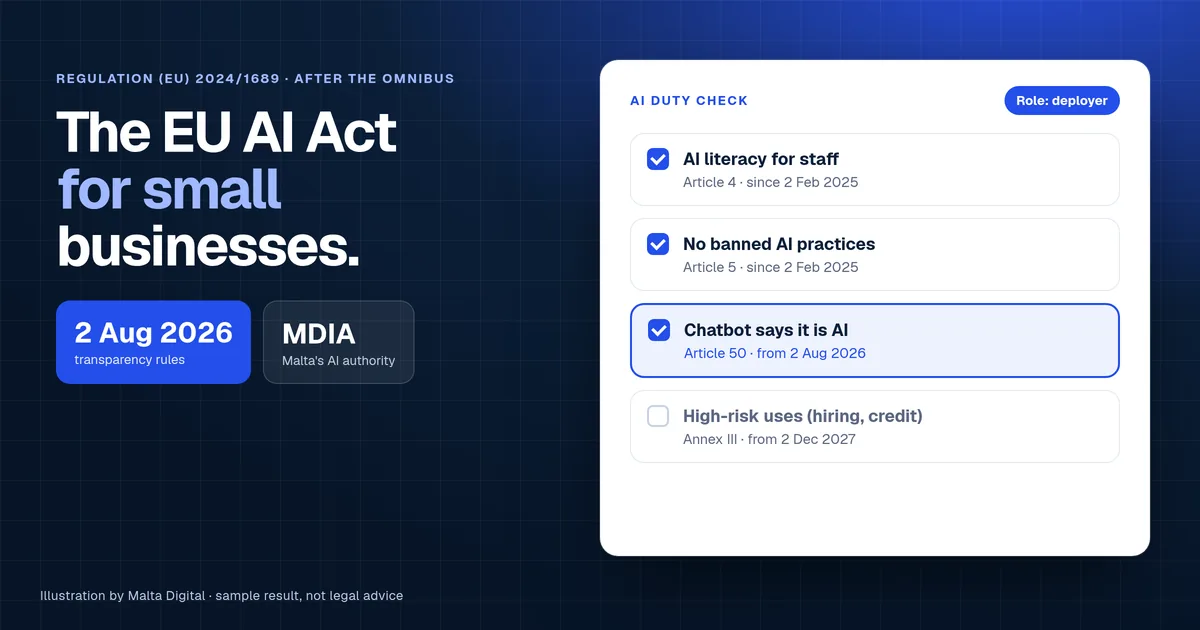
If your Malta business only uses AI tools made by others, the EU AI Act asks for basic AI training for staff and no banned uses. From 2 August 2026, people must also be told when they talk to a chatbot. Malta Digital builds AI assistants that say they are AI.
Your role
The AI Act sets different duties for different roles. Two matter for small businesses. The definitions are in Article 3, which we read on 4 November 2026.
A business that only uses ready-made AI tools is a deployer. But there is a catch. If you pay someone to build a chatbot and run it under your brand, you can count as the provider. That brings extra duties, so ask your supplier how they handle them.
| What you do | Your likely role | Why |
|---|---|---|
| Staff use a ready-made AI chat or writing assistant | Deployer | You use a tool someone else made |
| You turn on the AI features in your booking tool or CRM | Deployer | The software company is the provider |
| A custom chatbot is built for you and runs under your name | Can be provider | You had it built and put it into use under your name |
| You sell an AI product to other businesses | Provider | You place it on the market |
| You use AI only at home, not for work | Not covered | Personal use is outside the Act |
Key dates
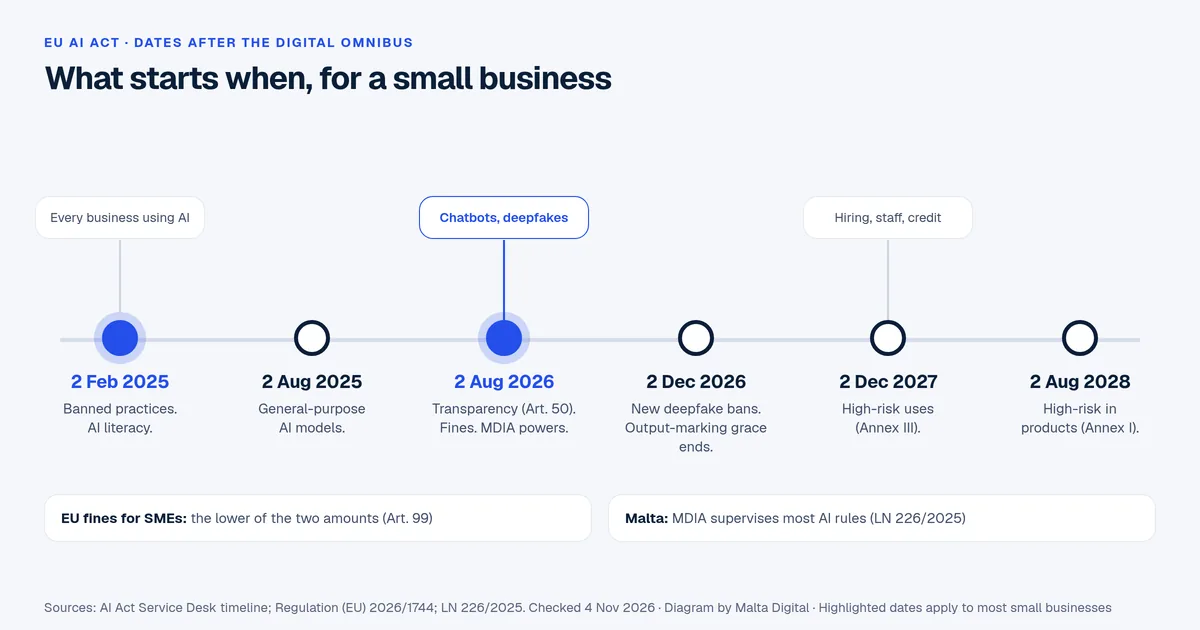
The AI Act became law in 2024. Its rules start in stages. In July 2026, a change called the Digital Omnibus moved some dates. It is Regulation (EU) 2026/1744, in force since 27 July 2026. The AI Act Service Desk timeline shows the current dates.
| Date | What starts | Does it touch a small business? |
|---|---|---|
| 2 February 2025 | Banned AI practices. AI literacy. | Yes. Every business that uses AI. |
| 2 August 2025 | Rules for general-purpose AI models. | Mostly the big model makers. |
| 2 August 2026 | Transparency rules (Article 50). Fines and national enforcement. | Yes, if you use chatbots or publish AI images, audio or video. |
| 2 December 2026 | New bans on AI sexual deepfakes. End of the grace period for AI output marking. | Providers of AI that generates content. |
| 2 December 2027 | High-risk rules for uses listed in Annex III, such as hiring and credit. | Only if you use AI for those decisions. |
| 2 August 2028 | High-risk rules for AI inside regulated products. | Rarely. |
Your duties
1. Build AI literacy. AI literacy means knowing what AI can and cannot do. Article 4, as changed by the Omnibus, says providers and deployers shall “take measures to support the development of AI literacy” of their staff. It sets no exam and no set level. A short briefing and a written AI policy are a sensible start.
2. Avoid the banned uses. Article 5 bans a short list of practices. Examples are AI that manipulates people, social scoring and emotion recognition at work. Few small businesses come close, but check before you try something new.
3. Be open about AI. Article 50 applies from 2 August 2026. People must be told when they talk to an AI system, unless it is obvious. That duty sits with the provider. Deployers must label deepfakes, which are AI images, audio or video that look real. AI text that informs the public on matters of public interest must be labelled too, unless a person reviews it and takes responsibility.
4. Keep following GDPR. GDPR is the EU law on personal data. The AI Act does not replace it. If your AI handles customer data, the usual rules still apply. In Malta, the regulator is the IDPC.
Want an AI assistant that says it is AI and hands over to a person? Apply now for AI automation
Free checker
Three questions. A starting point, not legal advice.
Three questions. It lists the duties that are likely to apply to you, with the date each one starts. It runs on your device. Nothing is sent anywhere.
1. How do you get your AI?
2. What do you mainly use it for?
3. Does AI help decide on hiring, staff, credit or access to services?
This checker needs JavaScript. In short: every business using AI needs AI literacy and must avoid banned uses. Chatbots and deepfakes have transparency rules from 2 August 2026.
Apply now and tell us what you want AI to do. We’ll reply with a first scope, how it tells people it is AI, and whether the AI grant could help.
High-risk AI
High-risk AI has the strictest rules. For a small business, it usually means AI that helps make decisions about people. Examples are sorting job applications, managing or rating staff, credit scoring and deciding who gets essential services.
The Omnibus moved these rules to 2 December 2027. That gives you time, but not forever. If you plan AI for hiring or staff, choose a supplier that already explains how it will meet the rules. Using AI to draft a job advert is not the same as using AI to rank applicants.
Malta
Malta set out its rules in Legal Notice 226 of 2025, which we read on 4 November 2026. It names the Malta Digital Innovation Authority (MDIA) as the main market watchdog and single point of contact. MDIA also runs the AI sandbox, a safe space to test AI with the regulator. A second notice, LN 227 of 2025, gives the IDPC this role for AI used in policing and for some biometric uses.
| Breach | Top fine | For small businesses |
|---|---|---|
| Banned AI practices | €35m or 7% of world turnover | Whichever is lower |
| Most other duties, including Article 50 | €15m or 3% | Whichever is lower |
| Wrong or misleading information to authorities | €7.5m or 1% | Whichever is lower |
| Malta: breach of LN 226 or the AI Act | €350,000 or 1% of turnover | Plus up to €12,000 a day while it lasts |
The key line for small businesses is in Article 99. For SMEs and start-ups, each EU fine is capped at the lower of the two amounts, not the higher. Fines are a last resort. The real risk is losing customer trust.
Free template
A short list of where you use AI is the easiest first step. It helps you train staff, answer customers and talk to the regulator if asked. Copy these columns into a spreadsheet:
Then write a one-page AI policy. Say which tools staff may use, what data must never go in and who checks AI output. Brief new staff on it.
Grants
Digitalise your SME has an extra AI threshold of up to €107,000. To use it, you need an Ethical AI and Societal Well-Being assessment. The Guidance Notes V2.0 say applicants “shall sign a declaration on the forecasted classification of the AI system in line with the EU AI Act”. So the AI Act is part of the grant application.
In practice, you say which risk level the AI is likely to fall under. You also explain human oversight, bias checks and how users will know it is AI. Our AI grant guide has a calculator for the grant itself.
Proof
Our WhatsApp chatbot page has a scripted demo for a made-up restaurant called Demo Kitchen. Its first message reads: “Hi! I’m the automated assistant for Demo Kitchen, a made-up restaurant. I’m AI, and a person can take over at any time.”
That one line does two jobs. It tells people they are talking to AI. It also tells them how to reach a person. Every option menu in the demo includes “Talk to a person”.
It is a demo, not a client result. It runs in your browser, is not connected to WhatsApp and books nothing.
See it for yourself. Try the scripted demo
Where we fit
We build AI automation in Malta: chatbots, AI receptionists and AI linked to booking systems and CRM. Every assistant we build says it is AI. A person can take over at any time. We agree data limits and the AI provider before go-live, with GDPR in mind.
We are not lawyers, and this guide is not legal advice. For a high-risk use, speak to a legal adviser or the MDIA. Want to go further? Read AI agents for business or our WhatsApp AI chatbot guide.
A few straight answers
Yes, if you use AI for work. A business that only uses AI tools made by others is a deployer. They need AI literacy, must avoid banned uses and have some transparency duties from 2 August 2026.
People must be told when they talk to an AI system, unless it is obvious. The provider must build this in. If a chatbot was built for you and runs under your name, you can be the provider.
AI literacy means knowing what AI can and cannot do. Article 4 says businesses shall take measures to support it. There is no exam or set level. A short briefing and an AI policy are a good start.
EU fines go up to €35m or 7% for banned uses and €15m or 3% for most other duties. For SMEs, the lower of the two applies. Malta’s own fines go up to €350,000 or 1%, plus up to €12,000 a day.
Partly. Regulation (EU) 2026/1744 moved high-risk rules to 2 December 2027 and 2 August 2028. The transparency rules still apply from 2 August 2026.
Keep reading
What AI agents do, where they fit in a small business and how to start safely.
How a WhatsApp AI chatbot works, what it costs to run and how it hands over to staff.
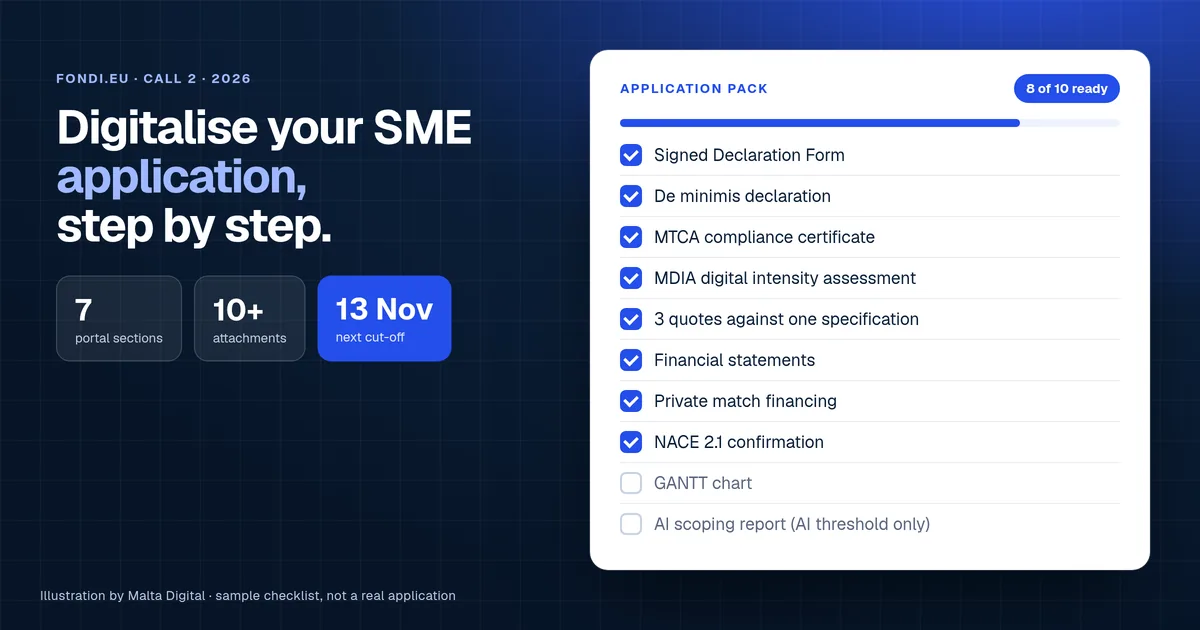
Each portal section, the documents you need and a free checklist.
A useful first step
Tell us what you want AI to do. We’ll scope it, show you how it tells people it is AI and how a person takes over.
Step 1 of 3
A few quick questions, about a minute. We usually reply within 2–3 hours.