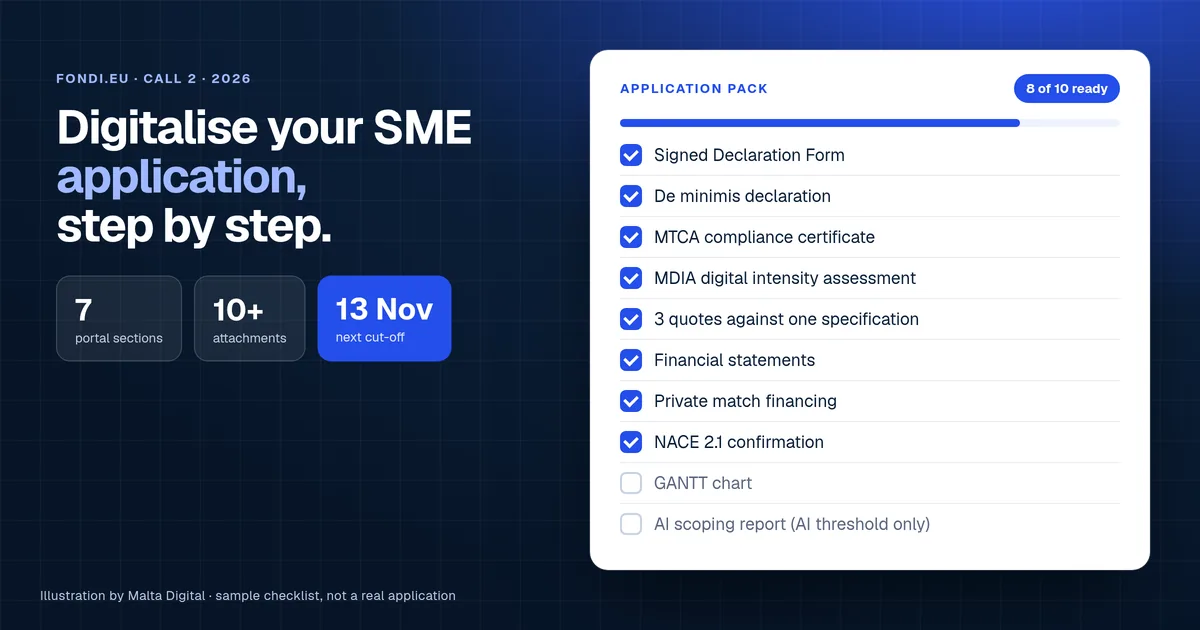
Digitalise your SME Application: Step-by-Step (2026)
How to apply for Digitalise your SME in Malta: each portal section, the documents you need, a free checklist, a worked example and the 2026 cut-off dates.
Grants & funding · Digitalise your SME
Every Digitalise your SME application needs it, and most businesses only hear about it when they open the form. Here are the 12 technologies MDIA checks, the evidence to bring, how the score can raise your grant, and the second check at the end of the project.
The assessment, answered
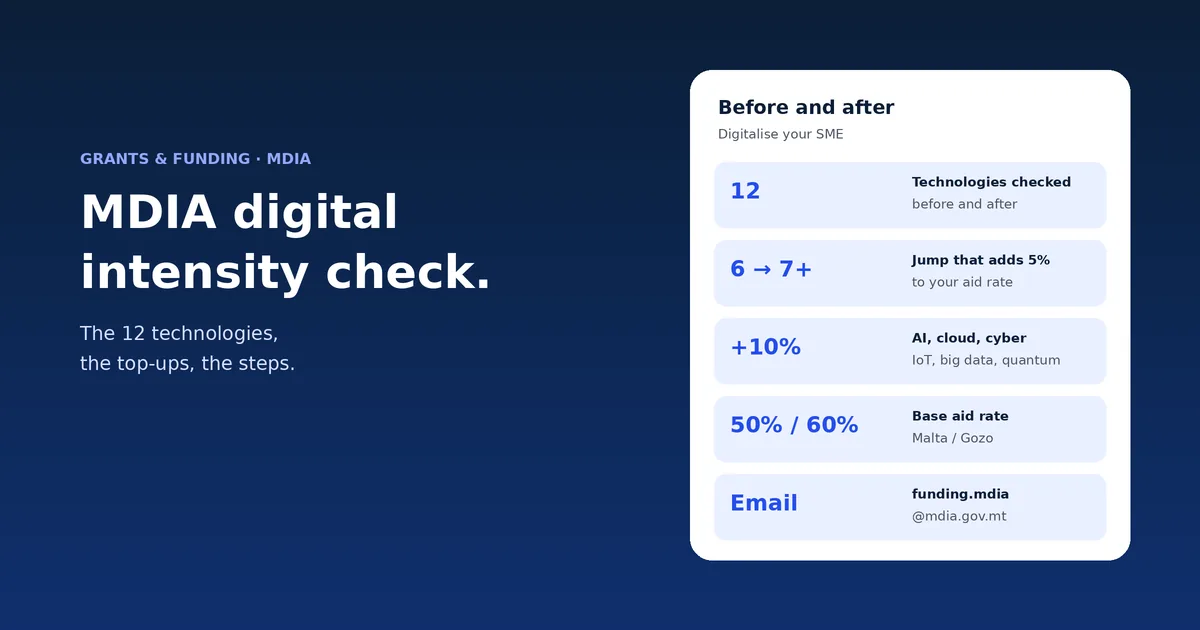
Answer: The MDIA digital intensity assessment is a check by the Malta Digital Innovation Authority, done with its Digital Maturity Assessment, that records which of 12 digital technologies your business uses before a Digitalise your SME project. You attach it to your application, and you need a second one after the project, with your final claim. Book it by email at funding.mdia@mdia.gov.mt. If you meet 6 or fewer of the 12 before and 7 or more after, the aid rate goes up by 5%.
The basics
Digitalise your SME is the main cash grant for software, systems and AI in Malta (scheme page). Before you apply, the Malta Digital Innovation Authority looks at how digital your business already is. It uses a list of 12 technologies and records which ones you have, with proof. It also notes any cyber security, IoT, AI, big data, cloud or quantum items in your plan, because those can get a higher aid rate (Guidance Notes 3.3(5)).
Think of it as a before photo. At the end of the project, MDIA takes an after photo, and the two are compared.
| Fact | What the official documents say | Source |
|---|---|---|
| Who does it | The Malta Digital Innovation Authority (MDIA), together with its Digital Maturity Assessment. | Guidance Notes 3.3(5) |
| When you need it | Before you apply: it is one of the documents in the application. A second, post-project assessment goes with the final claim. | Guidance Notes 3.3 and claim documents |
| How to book | By email to funding.mdia@mdia.gov.mt. | Guidance Notes, footnote 28 |
| What it records | Which of 12 digital technologies you use, with evidence, plus any cyber security, IoT, AI, big data, cloud or quantum items in your plan. | Guidance Notes 3.3(5) |
| 5% top-up | If you meet no more than 6 of the 12 before and at least 7 after the project, your aid rate goes up by 5%. | Guidance Notes 1.7, User Guide V2.1 |
| 10% top-up | Items in cyber security, IoT, AI, big data, cloud or quantum get a 10% higher aid rate, funded by MDIA and subject to budget. | Guidance Notes 1.7 |
| AI threshold top-up | On the extra AI threshold, the 10% is paid one year after the project ends, with a productivity gains report and an ethical AI report. | Guidance Notes 6.6.3 |
| After the project | MDIA re-checks the 12 technologies and confirms the AI, cloud and other items were done. The report must be dated before the final claim. | Annex VI |
| Base aid rate | 50% in Malta, 60% in Gozo, under de minimis. | User Guide V2.1 |
The checklist
These are the 12 items in the official template, with the details MDIA asks for. The last column is our own guide to the kind of project that could add each item. It is not an official list.
| Technology | What MDIA asks you to show | What a project could add |
|---|---|---|
| 1. Internet for at least 50% of employees | Share of staff and the type of connection | Already met by most offices |
| 2. Recourse to ICT specialists | Number of specialists, or the outsourced services you use | A support contract with an IT or software supplier |
| 3. Fast broadband (30 Mbps or more) | Type of connection and speed | A faster business line |
| 4. Mobile internet devices for at least 20% of staff | Share of staff and the devices the employer provides | Phones or tablets for field staff, often with a staff app |
| 5. A webpage or homepage | The URL | A professional website |
| 6. A website with sophisticated functions | The URL and a list of the functions | A website with booking, ordering, quotes or order tracking |
| 7. Social media | The URLs of your pages | Business pages linked from the website |
| 8. Paying to advertise on the internet | The type of online ads | Search or social ads |
| 9. Buying medium or high cloud computing services | The type of cloud service | A cloud CRM, ERP, accounting or hosted database |
| 10. Sending e-invoices suitable for automated processing | The type of e-invoicing | Invoices sent from your system in a structured format |
| 11. Online sales of at least 1% of turnover | Web sales and their share of turnover | An online shop or online booking with payment |
| 12. Consumer (B2C) web sales over 10% of web sales | B2C web sales and their share of web sales | An online shop for consumers |
The guidance does not define a "website with sophisticated functions". It asks for the URL and a list of the functions. Online booking, ordering, quotes and order tracking are typical examples, but ask MDIA what counts for your business.
A website with booking or ordering, e-invoicing from your system or a cloud CRM can each add one technology. Tell us where you are and we will scope it.
The top-ups
The normal aid rate is 50% of eligible costs in Malta and 60% in Gozo (User Guide V2.1). The assessment feeds two extras.
The 5% jump. If you meet no more than 6 of the 12 technologies before the project and at least 7 after it, your aid rate goes up by 5% (Guidance Notes 1.7). So a business at 5 of 12 that adds an online shop with consumer sales and e-invoicing could move to 8.
The 10% for advanced items. Items in cyber security, IoT, AI, big data, cloud computing or quantum technology get a 10% higher aid rate, paid by MDIA and subject to budget. On the extra AI threshold, that 10% is paid one year after the project ends, once you send a productivity gains report and an ethical AI and societal well-being report (Guidance Notes 6.6.3).
| Step | Without the 5% | With the 5% |
|---|---|---|
| Eligible project costs | €60,000 | €60,000 |
| 7% flat rate added | €4,200 | €4,200 |
| Total eligible | €64,200 | €64,200 |
| Aid rate in Malta | 50% | 55% |
| Grant | €32,100 | €35,310 |
This is an illustration using the published rates. The funding body works out the real figure, and top-ups depend on budget.
Free tool
Choose your answer for each of the 12 items. The check counts where you are now and where the project would take you, and tells you if the 5% jump could apply.
For each item, choose what is true today and what the project will add. This is a guide only: MDIA does the real assessment. Nothing you choose leaves this page.
Your result appears here when you choose your answers.
Where Malta stands
Eurostat measures digital intensity across the EU with a similar 12-item index. In 2025, 83.5% of Maltese businesses with 10 to 249 people reached at least a basic level, against 71.4% across the EU. 16.5% were still at a very low level (Eurostat isoc_e_dii).
About two in three Maltese firms of this size sit in the low or high bands, between 4 and 9 of 12. That is the range where a well-planned project can cross from 6 to 7. Eurostat's list is close to, but not the same as, the MDIA template, so always count against the template above.
Step by step
If AI is part of your plan, MDIA also offers a free AI Classification Guide to check whether a tool counts as an AI system (MDIA compliance tools). Our AI grant in Malta page explains the extra AI threshold.
The guidance notes do not mention a fee for the assessment. Ask MDIA when you book. Next cut-offs: see our Malta grant deadlines calendar.
After the project
When the project is finished, MDIA re-checks the same 12 technologies. It confirms the technologies you had before are still in place, looks at evidence for the ones you added, and confirms that any AI, cloud, cyber security or similar items in the grant agreement were done (Annex VI).
This post-project assessment goes with your final claim for reimbursement and must be dated before it (Guidance Notes, final claim documents). Keep screenshots, invoices and URLs from day one, so the second check is quick.
For the full claim process and every other document, read our Digitalise your SME application guide and the Digitalise your SME grant guide.
How we help
Malta Digital builds the websites, online shops, cloud systems and AI tools that can add technologies to your score. We are a private company. We do not do the assessment, decide eligibility or promise funding: MDIA and the Measures and Support Division do. You and your accountant handle the application.
Our part: we show which of the 12 items a project could add, write the technical specification, and give an itemised quotation that can be compared with other suppliers.
Websites and online shops. Our web design service in Malta starts with the Professional Website at €990, complete in 24 to 48 hours. The Business Website takes 2 to 4 days, the Growth Website 7 days, and the 24-Hour Premium Website is ready in 24 hours.
Systems, CRM and AI. Cloud CRM systems, custom business systems with e-invoicing, and AI automation, from €7,500, with the first working version of a custom system in 2 to 4 weeks.
We have 18 Google reviews, and we reply to every enquiry by email.
A few straight answers
A check by the Malta Digital Innovation Authority, done with its Digital Maturity Assessment, that records which of 12 digital technologies your business uses before a Digitalise your SME project. You attach it to your application.
Send an email to funding.mdia@mdia.gov.mt and ask for an appointment for the Digitalise your SME digital intensity assessment. Do it early, because you need the report before you apply.
Internet for at least 50% of staff, ICT specialists, fast broadband, mobile devices for at least 20% of staff, a webpage, a website with sophisticated functions, social media, paid online ads, medium or high cloud services, e-invoices, online sales of at least 1% of turnover, and consumer web sales over 10% of web sales.
If you meet no more than 6 of the 12 technologies before the project and at least 7 after it, your aid rate goes up by 5%. MDIA confirms the before and after position.
Yes. A post-project digital intensity assessment by MDIA goes with your final claim for reimbursement, and it must be dated before that claim.
A webpage is one of the 12 items and a website with sophisticated functions is another. Online sales and consumer web sales are two more, so an online shop can add several items.
No. The digital intensity assessment is part of the Digitalise your SME application. The AI Classification Guide is a separate free MDIA tool to check whether a system counts as AI.
No. It is one required document. The Measures and Support Division evaluates the whole application and decides, subject to budget.
Sources
Malta Digital is a private company, not a government body. This guide summarises the official Digitalise your SME documents and Eurostat data and is not advice. MDIA and the Measures and Support Division have the final word.
Keep reading
How to apply for Digitalise your SME in Malta: each portal section, the documents you need, a free checklist, a worked example and the 2026 cut-off dates.
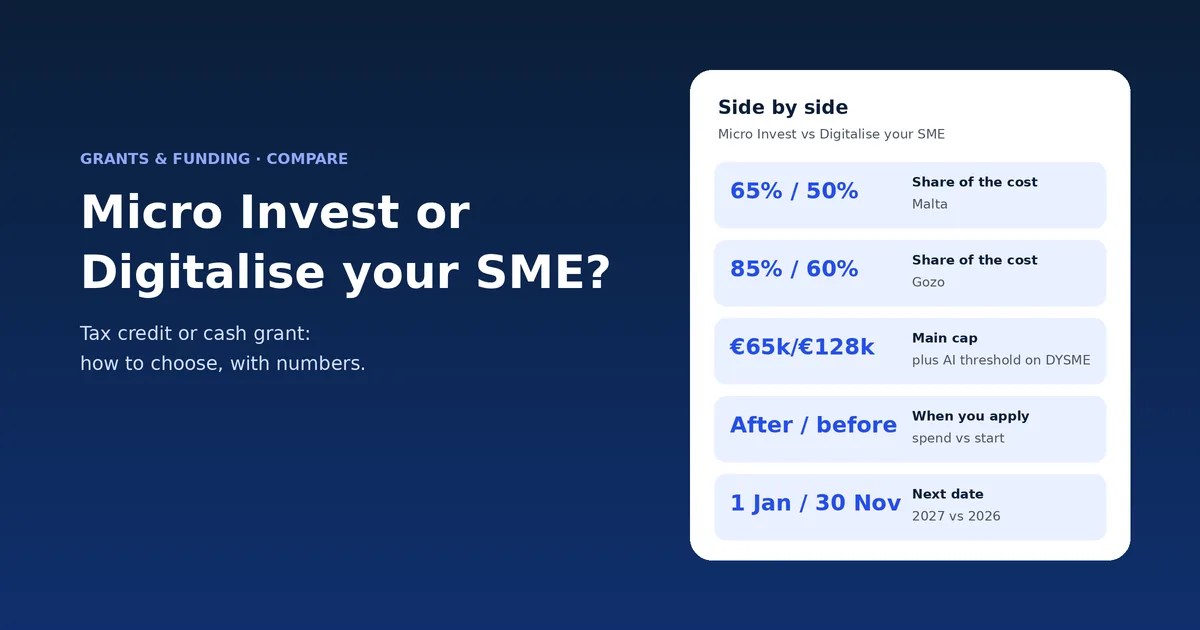
Micro Invest or Digitalise your SME? Tax credit vs cash grant compared: rates, caps, who qualifies, websites, timing and documents, with worked Malta examples.

Malta business grants 2026: Digitalise your SME (up to €128,400), Micro Invest, Xjenza vouchers and the 60% tax credit. Amounts, dates and how to apply.
A useful first step
Tell us which of the 12 technologies you have today. We will show which ones a website, online shop, cloud CRM or e-invoicing system could add, write the technical specification and give you an itemised quotation. You and your accountant handle the application, and MDIA and the funding body decide.
Step 1 of 3
A few quick questions, about a minute. We usually reply within 2–3 hours.