Staff rota software in Malta
Plan shifts inside the working time rules.
Systems · Payroll and HR
Malta payroll has more moving parts than most: weekly social security bands, four statutory payments a year, tax bands that depend on each FS4 and monthly FS5 deadlines. This guide sets out the 2026 figures, the deadlines and a free calculator for what one employee really costs.
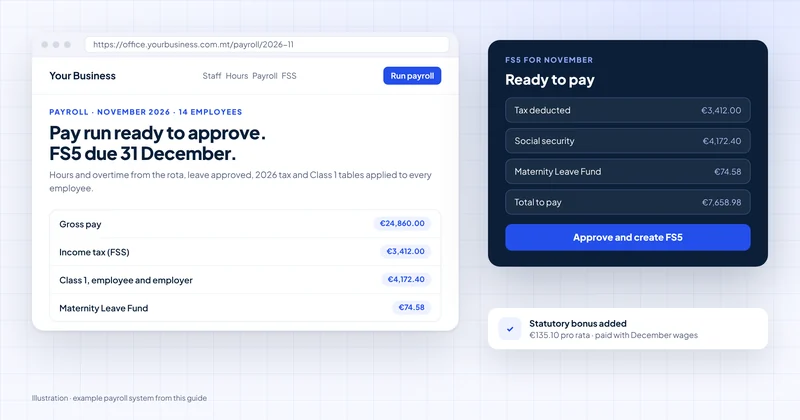
Malta payroll in 2026 means paying at least €229.44 a week at 18 or over, deducting tax under the FSS and Class 1 social security (10% each side, capped at €55.93 a week), paying 0.3% to the Maternity Leave Fund, the €135.10 bonus twice and the €121.16 allowance twice, and filing an FS5 by the last working day of the next month. We build payroll-ready systems as part of business systems in Malta.
The short version
Every month, a Malta employer pays wages, deducts income tax and social security, and sends both to the tax department with an FS5 by the last working day of the following month. On top of that come four statutory payments a year, and the FS3 and FS7 at year end.
Payroll software does this for you when it knows the 2026 rules: the minimum wage, the Class 1 social security table, the Maternity Leave Fund, the statutory bonus and weekly allowance, and the tax bands for each FS4 status. This guide sets them out, with a free calculator for what one employee really costs.
It is part of our work on business systems in Malta, where we build systems that turn hours, leave and bonuses into payroll-ready figures.
2026 figures
From 1 January 2026 the national minimum wage for a whole-time employee is €229.44 a week at 18 or over (L.N. 289 of 2025). The cost of living increase is €4.66 a week on every whole-time wage, not only on the minimum (L.N. 290 of 2025).
| Age | Per week | Per year (52 weeks) |
|---|---|---|
| 18 or over | €229.44 | €11,930.88 |
| 17 | €222.66 | €11,578.32 |
| Under 17 | €219.82 | €11,430.64 |
Part-timers get the same hourly rate as a comparable whole-time employee. Where no sector Wage Regulation Order applies, that is the weekly minimum divided by 40. Some sectors have their own higher minimums, so check the order for your trade.
Social security
Employer and employee each pay Class 1 social security on the basic weekly wage, which leaves out overtime, bonuses and allowances. Between the floor and the cap it is 10% each. The employer also pays 0.3% into the Maternity Leave Fund, which you must not deduct from the employee.
| Category | Basic weekly wage | Employee and employer, each | Maternity Leave Fund (employer) |
|---|---|---|---|
| A: under 18 | Up to €229.44 | €6.62 | €0.20 |
| B: 18 or over | Up to €229.44 | €22.94 | €0.69 |
| C: born from 1962 | €229.45 to €559.30 | 10% | 0.3% |
| D: born from 1962 | €559.31 or more | €55.93 | €1.68 |
| C: born up to 1961 | €229.45 to €490.38 | 10% | 0.3% |
| D: born up to 1961 | €490.39 or more | €49.04 | €1.47 |
Still working this out in a spreadsheet every month? Apply now for a business system
Free tool
Enter the basic pay, hours and age. The calculator applies the 2026 Class 1 table, the Maternity Leave Fund and the statutory bonus and weekly allowance, then shows your yearly cost and what goes on the FS5 each month.
Use your own figures. Nothing you type is sent anywhere.
Your result appears here as you type.
Income tax is not an employer cost, but you must deduct it and pay it over with the same FS5, so your payroll needs the right tax table for every employee.
Income tax
Tax under the Final Settlement System depends on the status on each employee’s FS4. From 2026 parents with children under 18, or under 23 in full-time education, have more generous bands, so eligible staff should give you an updated FS4.
| Status | 0% | 15% | 25% | 35% |
|---|---|---|---|---|
| Single | Up to €12,000 | €12,001 to €16,000 | €16,001 to €60,000 | Over €60,000 |
| Married | Up to €15,000 | €15,001 to €23,000 | €23,001 to €60,000 | Over €60,000 |
| Married, one child | Up to €17,500 | €17,501 to €26,500 | €26,501 to €60,000 | Over €60,000 |
| Married, two or more children | Up to €22,500 | €22,501 to €32,000 | €32,001 to €60,000 | Over €60,000 |
| Parent | Up to €13,000 | €13,001 to €17,500 | €17,501 to €60,000 | Over €60,000 |
| Parent, one child | Up to €14,500 | €14,501 to €21,000 | €21,001 to €60,000 | Over €60,000 |
| Parent, two or more children | Up to €18,500 | €18,501 to €25,500 | €25,501 to €60,000 | Over €60,000 |
Two special rates matter for payroll. Qualifying overtime is taxed at 15 cents in every euro under rule 7A of the FSS Rules. Without an FS4, you must deduct at the highest rate, 35%, until one arrives.
Deadlines
| What | When | Rule |
|---|---|---|
| Register as an employer | Within 15 days of the first wages | Rule 4 |
| FS4 from a new employee | Within 7 days of starting | Rule 3 |
| FS5 with tax and social security | Last working day of the following month | Rule 15 |
| FS3 to each employee | By 31 January | Rule 21 |
| FS7 and FS3s to the tax department | By 15 February | Rule 22 |
Miss a deadline and the tax department can issue a default notice with additional tax, to be put right within 10 days. Each further notice for the same default doubles the additional tax (rule 24), and tax not paid on time also carries interest.
Employers with 10 employees or more must file the year end FSS documents online. A payroll system that produces the FS5, FS3 and FS7 figures from the same records saves the January scramble.
Choosing
| Spreadsheet | Payroll software | Custom business system | |
|---|---|---|---|
| 2026 tables and bonuses | You type them in | Kept current by the provider | Built in, and changed for you |
| Hours, rota and leave | Copied by hand | Imported, if it connects | Taken straight from your rota and clocking |
| FS5, FS3 and FS7 figures | Worked out by you | Produced for you | Produced, or sent to your payroll software |
| Sector rules and allowances | Easy to miss | Standard options | Your Wage Regulation Order and contracts |
| Who owns the data | You | The provider holds it | You own the code and the data |
For a handful of staff on simple pay, good payroll software is usually enough. A custom system pays off when hours come from shifts, sites or several branches, when allowances are complex, or when payroll should sit inside the rest of your operations, such as staff rota software and job costing.
Want payroll figures that come straight from your rota? Apply now for a business system
Mistakes
Most of these come from retyping figures. Our guide to business process automation shows how to stop copying data between tools.
How we help
We build business systems that collect hours, overtime, leave and allowances from your rota or clocking, apply your contracts and the 2026 rules, and hand clean payroll figures and FS5 totals to your accountant or payroll software. Managers approve, staff see their payslips, and you keep one record.
We have 18 Google reviews from Malta businesses. See what else a system can run on our business systems in Malta page, or read what custom software costs in Malta.
Ready for payroll that adds itself up? Apply now for a business system
A few straight answers
€229.44 a week for a whole-time employee aged 18 or over, €222.66 at 17 and €219.82 under 17 (L.N. 289 of 2025). Part-timers get the same hourly rate, and some sector Wage Regulation Orders set higher minimums.
Under Class 1 the employer pays the same as the employee: 10% of the basic weekly wage between €229.45 and €559.30 for people born from 1962, with a maximum of €55.93 a week. The employer also pays 0.3% to the Maternity Leave Fund, up to €1.68 a week.
By the last working day of the month after the month in which you paid the wages. Tax and social security deducted from January pay are due with the FS5 by the end of February.
Each employee must receive their FS3 by 31 January. The FS7 annual reconciliation, with the FS3s, must reach the tax department by 15 February of the following year.
A statutory bonus of €135.10 at the end of June and between 15 and 23 December, and a weekly allowance of €121.16 at the end of March and the end of September. Part-timers and leavers get a pro rata amount. Their leave works the same way; our guide to leave entitlement in Malta works it out in hours for 2027.
Yes. The tax bands depend on the FS4 status, and from 2026 parents with qualifying children have their own bands, so the payroll must switch tables when an employee hands in an updated FS4.
Malta Digital builds custom business systems from €7,500, with a first working version in 2 to 4 weeks and bigger systems within 2 to 3 months at most. You own the code and the data.
Keep reading
Plan shifts inside the working time rules.
Hand repetitive work to a system.
What a system built for you costs.
A useful first step
Custom business systems from €7,500, with a first working version in 2 to 4 weeks. Tell us how you pay people today and we reply with what we would build.
Step 1 of 2
A few quick questions, about a minute. We usually reply within 2–3 hours.