
Business Grants Malta 2026: Amounts, Dates and How to Apply
Business grants in Malta for 2026: every scheme with its status, amounts, cut-off dates, documents and how to apply, from Digitalise your SME to Micro Invest.
Grants & funding · Smart systems
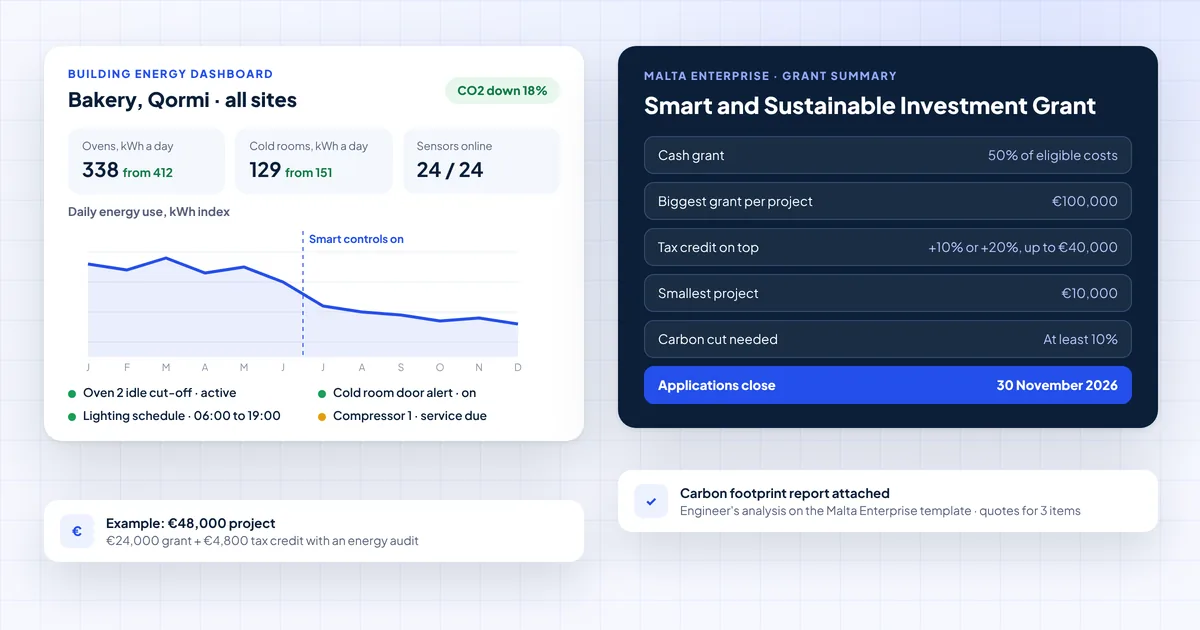
Malta Enterprise pays half the cost of an investment that cuts your carbon footprint, up to €100,000, and can add a tax credit on top. It covers smart building systems and IoT, not only machines. Applications close on 30 November 2026.
The short answer
Answer: The Smart and Sustainable Investment Grant is a Malta Enterprise cash grant of 50% of eligible costs, up to €100,000 per project, for investments that cut your carbon footprint by at least 10%. It covers waste, materials, energy, water and "sustainable digitisation", such as IoT and building management systems. A tax credit of 10% or 20% more, up to €40,000, can be added. The project must cost at least €10,000, you need at least one full-time employee, and applications close on 30 November 2026. Nothing bought before approval counts.
The basics
This Malta Enterprise scheme helps businesses invest in greener, more efficient ways of working. It pays half the cost of plant, machinery, equipment and technology that lowers CO2 emissions (Guidelines 1.3, 4.1).
The first guidelines came out in April 2024. The current ones, Version 1.1, accept applications until 30 November 2026 (scheme page).
| Fact | What the official sources say | Source |
|---|---|---|
| Who runs it | Malta Enterprise, under the Smart and Sustainable Investment Grant Regulations (S.L. 463.45). | Guidelines 1.4, S.L. 463.45 |
| Budget | €2,000,000 a year. | Guidelines 1.4 |
| Cash grant | 50% of eligible expenditure, up to €100,000 per project, decided case by case. | Guidelines 3.1 |
| Extra tax credit | Up to €40,000: 10% more (to 60%) if the project meets one bonus criterion, 20% more (to 70%) if it meets two. | Guidelines 3.2 |
| Smallest project | An investment of at least €10,000. | Guidelines 2.1(a) |
| Who can apply | Limited companies registered with the Malta Business Registry, partnerships and the self-employed, working from a licensed commercial property. | Guidelines 2.1, scheme page |
| Staff | At least one full-time employee registered with Jobsplus. A full-time self-employed person counts. | Guidelines 2.1(c) |
| Carbon rule | The investment must cut CO2 emissions by at least 10%, shown in a carbon footprint report by a warranted engineer or other competent person. | Guidelines 4.1 |
| Not eligible | Software licences, SaaS, routine services, servicing and maintenance. Replacing worn-out equipment. Costs before approval. | Guidelines 2.2, 4.5, 4.6 |
| Deadline | Applications through the Malta Enterprise client portal until 30 November 2026. | Guidelines 6, scheme page |
| Aid ceiling | De minimis: €300,000 of de minimis aid per single undertaking over three years, counting all such aid. | Guidelines 3.3, 8, EU 2023/2831 |
What it pays for
The guidelines list five areas. A project fits if it brings a real, measured cut in CO2 of at least 10% for that process (Guidelines 4.1, 4.7).
IoT that makes equipment run more efficiently, smart HVAC, system monitoring and building management systems for heat, light and power.
Lower power use by machines and lighting, better insulation, double glazing, solar film and solar tubes, cogeneration.
Closed-cycle water systems, water purification and recycling, and tanks to store rainwater.
Less waste per unit made, less packaging, longer-lasting products, refill and bulk selling systems.
Pilots to switch to greener or non-toxic materials, and greener, certified supply chains.
Making your own power, such as solar panels, is not covered here. The guidelines point to the schemes run by the Regulator for Energy and Water Services instead.
The digital side
This is the part most guides skip. "Sustainable digitisation" means electronic devices and systems that modernise a process and make it more efficient for the environment (Guidelines 4.7).
So a one-off system that you own, with sensors, controls and a dashboard, fits better than a monthly app. Measuring tools and technical services can count, but only inside a real sustainability project, from an unrelated supplier, and only the first 12 months of the contract (Guidelines 4.2).
We scope the dashboard, sensors and controls item by item, keep subscriptions on separate lines, and never start work before Malta Enterprise approves.
How much
Every approved project gets up to 50% as a cash grant, capped at €100,000. Malta Enterprise looks at each project and its plan, so the final rate can be lower (Guidelines 3.1).
Including an expansion of what you already have there.
Registered less than three years before.
By an independent, qualified energy auditor or engineer.
Shown in the carbon footprint report sent with the application.
A tax credit is not cash. It lowers the tax your business pays, so it is worth most to a business that makes a profit.
Free tool
Enter your project cost and four facts. The tool applies the published 50% rate, the €100,000 and €40,000 caps, and the bonus criteria.
Enter your project cost and a few facts. The estimate applies the published rates and caps, and flags anything that rules the project out. Malta Enterprise decides the real amount. Nothing you enter leaves this page.
Your result appears here.
Worked examples
Say a Qormi bakery spends €48,000 on smart meters and controls for its ovens and cold rooms, and has an energy audit done. A Gozo hotel spends €150,000 on a building management system for cooling, lighting and hot water, also with an audit.
| Project | Cash grant (50%) | Tax credit on top | Total support |
|---|---|---|---|
| Qormi bakery: smart meters and oven controls, €48,000 | €24,000 | €4,800 with an energy audit (10%) | €28,800, about 60% |
| Gozo hotel: building management system, €150,000 | €75,000 | €30,000 for Gozo plus an energy audit (20%) | €105,000, about 70% |
Both businesses must keep the investment for at least three years. If they do not carry out what the Letter of Approval says, Malta Enterprise can take back all or part of the support.
These figures use the published rates. Malta Enterprise decides the real amount after looking at each plan.
Who can apply
Registered and working from a licensed commercial property.
Registered with Jobsplus. A full-time self-employed owner counts.
Dues over €1,000 rule you out, unless you keep to a repayment agreement.
Fishing, farming production and the other sectors the de minimis rules exclude.
The scheme is de minimis aid. All de minimis aid your business group gets from any source is capped at €300,000 over three years, so tell your accountant about other grants (Guidelines 8, EU 2023/2831).
Documents
The investment plan, how long it takes, and every cost.
Energy and environmental savings, on the Malta Enterprise template.
Today's footprint and the CO2 cut you expect after the project.
For each item you will buy.
Tax compliance certificate and audited accounts.
All de minimis aid you got in the last three years.
Malta Enterprise may also ask for a cost-benefit analysis that shows your choice is the best option, and for permits (Guidelines 5.2, overview). Our tax compliance certificate guide explains how to get that certificate quickly.
Step by step
Help with the form is free from Business First on 144 or info@businessfirst.com.mt (Guidelines 9). Check every other date in our Malta grant deadlines calendar.
Other routes
If your project is about digitalising the business rather than cutting carbon, look at Digitalise your SME, which accepts software subscriptions and has a 14 December cut-off too. New equipment to grow the business fits SME Enhance.
| Question | Smart and Sustainable | Digitalise your SME | SME Enhance |
|---|---|---|---|
| Run by | Malta Enterprise | Measures and Support Division (fondi.eu) | Measures and Support Division (fondi.eu) |
| Main goal | Cut carbon by at least 10% | Digitalise how you work | Expand, diversify or innovate |
| Cash rate | 50%, plus a 10% or 20% tax credit | 50% in Malta, 60% in Gozo, plus 7% flat rate | 50% in Malta, 60% in Gozo under de minimis |
| Size | Project of €10,000 or more, grant up to €100,000 | Grant of €25,000 to €120,000, more for AI | Grant of €10,000 to €128,400 |
| Software subscriptions | Not eligible | Two years of a subscription count | Two years of a subscription count |
| Deadline left in 2026 | 30 November | 30 November and 14 December | 30 November and 14 December |
For smaller projects, Micro Invest gives a tax credit of up to 65% and opens for 2026 costs on 1 January 2027. See every scheme in our Malta business grants 2026 guide.
How we help
Malta Digital builds dashboards, monitoring systems and the software that connects sensors and controls. We are a private company, not a government body. We do not decide eligibility or promise funding.
Our part: we write the technical specification and an itemised quotation for the system side, with hardware, set-up and any subscription on separate lines. Your engineer writes the carbon report. You and your accountant handle the application.
Dashboards and controls that you own, with business systems from €7,500. First working version in 2 to 4 weeks.
Alerts when energy use spikes, with AI automation.
Customer records in a CRM, and a site that shows your green work, from web design in Malta at €990 in 24 to 48 hours.
We have 18 Google reviews. Want help with the other paperwork? Read our guide to grant-ready quotes first.
A few straight answers
It is a Malta Enterprise cash grant of 50% of eligible costs, up to €100,000 per project, for investments that cut CO2 emissions by at least 10%. A tax credit of 10% or 20% more, up to €40,000, can be added. Applications close on 30 November 2026.
Yes, until 30 November 2026. Applications go through the Malta Enterprise client portal. There is no published date for after that.
Limited companies, partnerships and the self-employed who work from a licensed commercial property, have at least one full-time employee registered with Jobsplus, and plan a project of at least €10,000. A full-time self-employed person counts as the employee.
Yes. "Sustainable digitisation" lists IoT that makes equipment more efficient and building management systems for heat, light and power. The project still needs a carbon report showing a CO2 cut of at least 10%.
No. Software licences, SaaS, routine services, servicing and maintenance are not eligible. Devices and set-up that measure your carbon footprint can count, up to 20% of the approved amount.
No. Any cost before Malta Enterprise approves the project is not eligible. Wait for the Letter of Approval before you order or pay.
It is de minimis aid, so all your de minimis aid is capped at €300,000 over three years. It cannot be added to other State aid for the same costs above the highest allowed rate. Check with your accountant.
Smart and Sustainable is about cutting carbon and is run by Malta Enterprise, with a 30 November deadline. Digitalise your SME is about digitalising the business, is run on fondi.eu, needs a grant of at least €25,000, and has cut-offs on 30 November and 14 December 2026.
Sources
Malta Digital is a private company, not a government body. This guide summarises the official scheme documents and is not advice. Malta Enterprise decides eligibility and amounts.
Keep reading
Business grants in Malta for 2026: every scheme with its status, amounts, cut-off dates, documents and how to apply, from Digitalise your SME to Micro Invest.
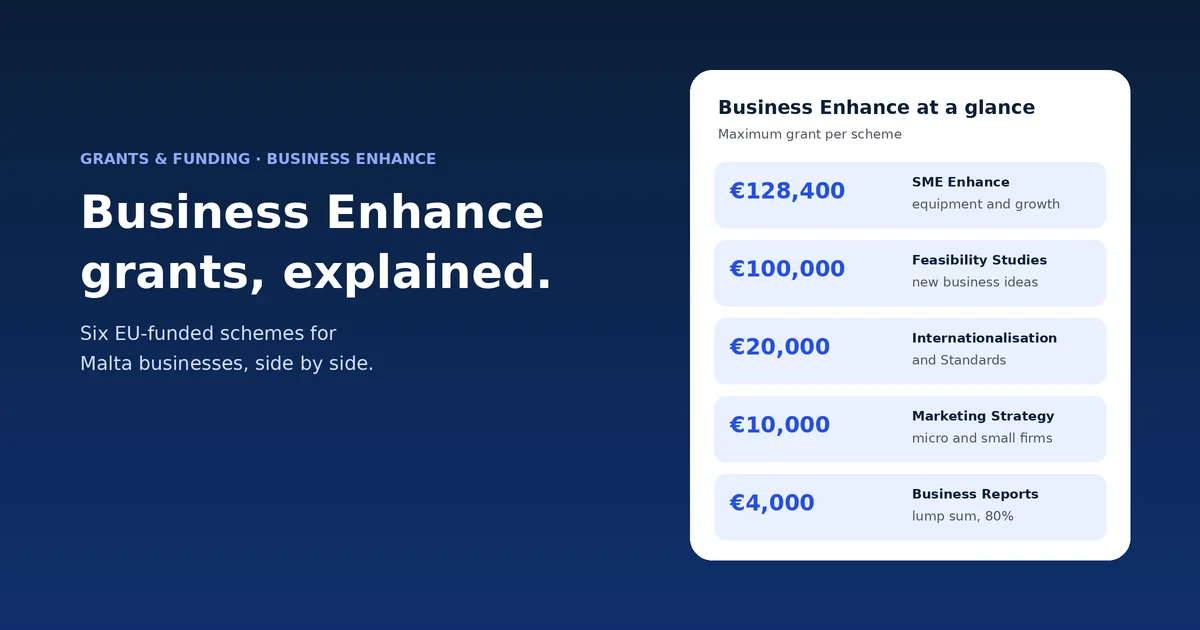
Business Enhance grants in Malta: SME Enhance, Marketing Strategy, Internationalisation, Business Reports, Feasibility and Standards. Caps, rates, cut-offs.
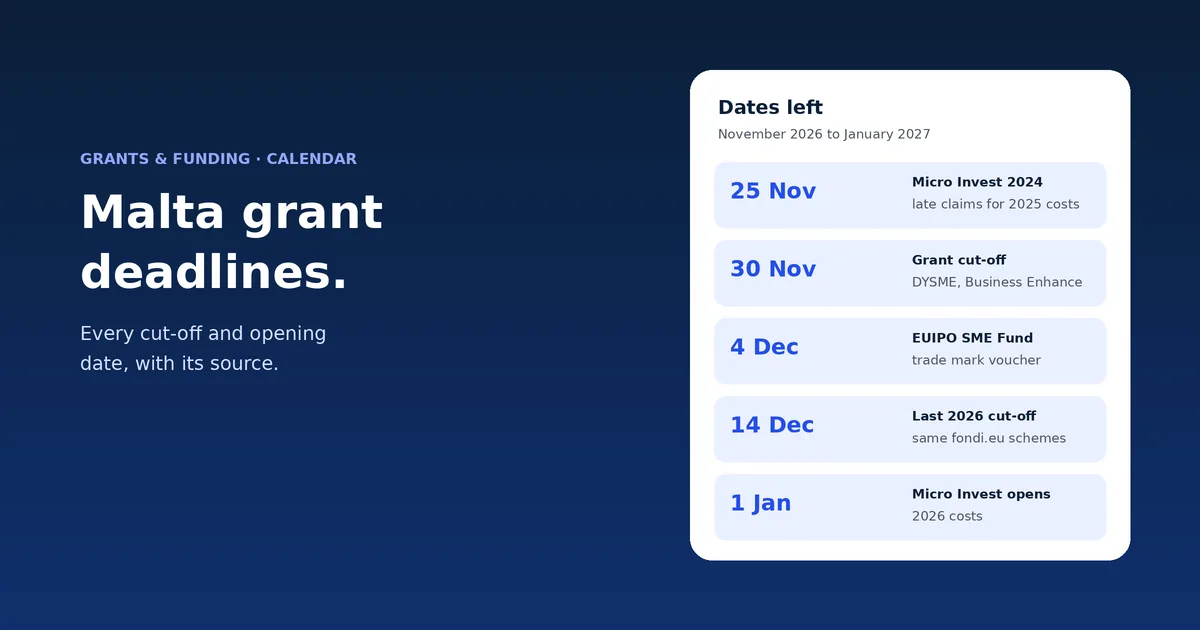
Every Malta grant deadline left in 2026 and the first 2027 dates: Digitalise your SME, Business Enhance, Micro Invest, INVEST, the 60% tax credit, EU vouchers.
A useful first step
Tell us what you want to measure or control: energy, lighting, cooling, water or machines. We write the technical specification and an itemised quotation for the system side. Your engineer writes the carbon report, you and your accountant handle the application, and Malta Enterprise decides.
Step 1 of 3
A few quick questions, about a minute. We usually reply within 2–3 hours.