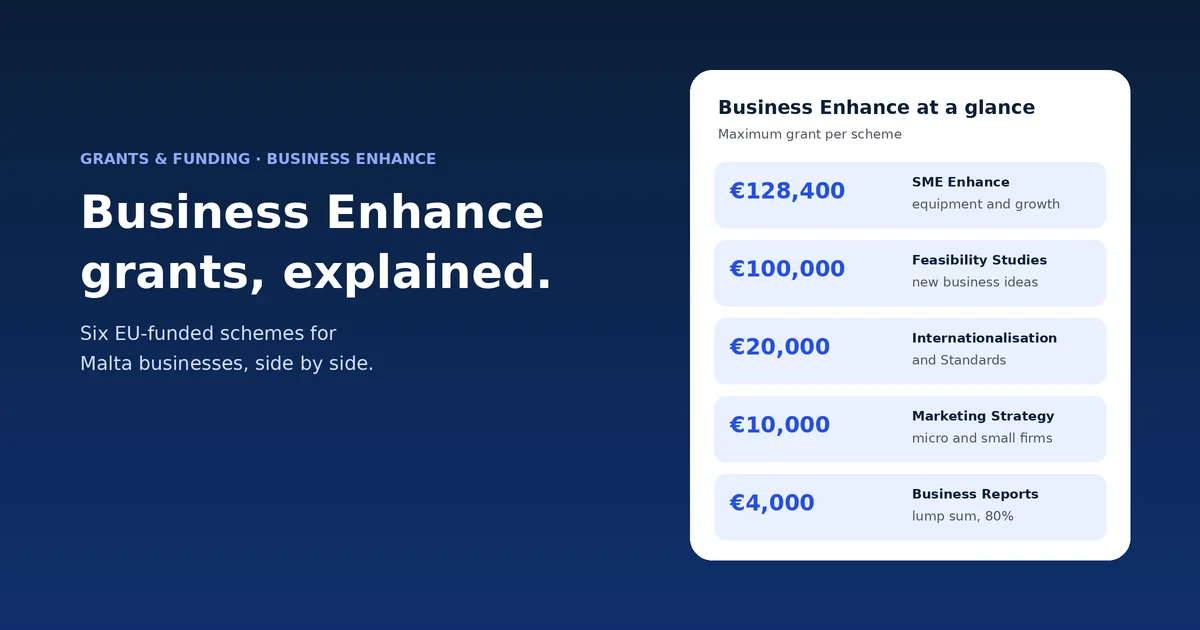
Business Enhance Grants Malta 2026: All 6 Schemes Explained
Business Enhance grants in Malta: SME Enhance, Marketing Strategy, Internationalisation, Business Reports, Feasibility and Standards. Caps, rates, cut-offs.
Grants & funding · Equipment
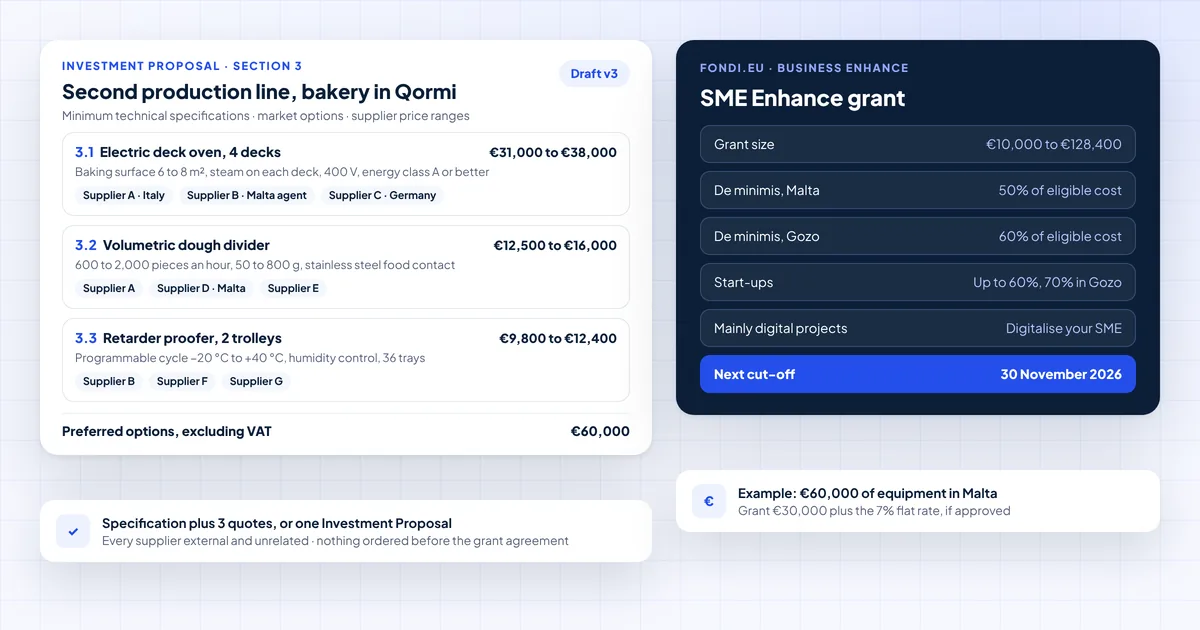
SME Enhance is a fondi.eu cash grant for small and medium businesses that invest in equipment, machinery, IT equipment, furniture and fittings. It usually pays 50% in Malta and 60% in Gozo, from €10,000 to €128,400. The next cut-off is 30 November 2026.
The short answer
Answer: SME Enhance is an EU-funded cash grant run by the Measures and Support Division on fondi.eu. It part-pays equipment, machinery, IT equipment, furniture and fittings, plus up to two years of premises lease, for micro, small and medium businesses in Malta and Gozo. Most applicants use the de minimis route: 50% in Malta, 60% in Gozo. The grant runs from €10,000 to €128,400, including a 7% flat rate. Projects that are mainly software or digitalisation go to Digitalise your SME instead. The next cut-off is 30 November 2026, and fondi.eu also lists 14 December 2026.
The basics
SME Enhance part-pays productive investment: new equipment, machinery, IT equipment, furniture and fittings, for expansion, new products or better operations (Guidance Notes 1.2, 2.2).
It is one of the Business Enhance grants, and it is a cash grant, not a tax credit. You pay suppliers first and claim afterwards.
| Fact | What the official sources say | Source |
|---|---|---|
| Who runs it | The Measures and Support Division, with EU regional development funds (ERDF), through fondi.eu. | Guidance Notes 1.1 |
| Who can apply | Micro, small and medium businesses with an economic activity, any legal form. The start-up route is for micro and small businesses up to five years old. | Guidance Notes 2.1 |
| Grant size | At least €10,000 and at most €128,400, including the 7% flat rate for indirect costs. | Guidance Notes 1.7 |
| Rates | De minimis 50% Malta, 60% Gozo. Investment aid 20% micro and small, 10% medium. Regional aid up to 35% in Gozo. Start-up 60% Malta, 70% Gozo. | Guidance Notes 1.7 |
| What it pays for | Equipment and machinery, IT equipment (tangible and intangible), furniture, fixtures, some vehicles, ancillary items up to 10%, premises lease for 2 years. | Guidance Notes 2.3 |
| Not for | Projects focused on digitalisation that fit Digitalise your SME. Design, marketing and consultancy fees. Mobile phones, cabling, used equipment, VAT, repairs. | Guidance Notes 2.4, 2.6 xvi |
| Quotes | An Investment Proposal, or a technical specification plus 3 quotations from unrelated suppliers for each item. | Guidance Notes 2.6 v, 3.3 |
| Time to finish | 6, 12, 18 or 24 months from the grant agreement. All projects must end by 30 June 2029. | Guidance Notes 1.8 |
| Budget and end | €6,000,000. The scheme runs until 31 December 2026, subject to funds. | scheme page, Guidance Notes 1.4, 1.5 |
| Cut-offs left | Next cut-off 30 November 2026. The scheme page also lists 14 December 2026. | scheme page |
Rates
You choose a route when you apply. Each has its own rate and its own EU rule (Guidance Notes 1.7, GBER).
| Route | Malta | Gozo | Who it suits |
|---|---|---|---|
| De minimis | Up to 50% | Up to 60% | Most small businesses. Counts towards the €300,000 de minimis limit over 3 years. |
| Investment aid (GBER Art. 17) | 20% micro and small, 10% medium | Same, or regional rates | Businesses near their de minimis limit. |
| Regional aid (GBER Art. 14) | 30% micro and small, 20% medium, assisted areas only | 35% micro and small, 25% medium | Initial investment in Gozo or an assisted area of Malta. |
| Start-up (GBER Art. 22) | Up to 60% | Up to 70% | Micro and small businesses up to 5 years old that have not paid out profits. |
Under de minimis, a business may get at most €300,000 of de minimis aid from all public sources over any 3 years. Every application includes a de minimis declaration (Regulation 2023/2831).
Assisted areas of Malta are listed in Annex VI of the Guidance Notes. Check your locality there before you pick the regional route.
What it pays for
Everything must be bought new, from outside unrelated suppliers, after the grant agreement, and kept working for at least 3 years after the final payment (Guidance Notes 2.3, 2.6).
Training is only covered when it is part of the equipment price, from the same supplier (Guidance Notes 2.3 a, 2.4).
Then the scheme to read is Digitalise your SME, not SME Enhance. We prepare the specification and comparable quotes, then build it. Websites from €990 in 24 to 48 hours. Custom systems are scoped first.
Worked examples
These examples use the published rates. Your own figure depends on the route, your accounts and the Division's assessment.
| Project | Eligible cost | Grant + 7% | Result |
|---|---|---|---|
| Bakery in Qormi: deck oven, dough divider, proofer (de minimis, Malta) | €60,000 | €30,000 + €2,100 = €32,100 | Within the limits |
| Restaurant in Victoria, Gozo: kitchen line and furniture (de minimis) | €40,000 | €24,000 + €1,680 = €25,680 | Gozo rate 60% |
| Gym in Mosta, 2 years old: equipment €50,000 + lease €10,000 (start-up) | €60,000 | €36,000 + €2,520 = €38,520 | Lease capped at 20% of equipment |
| Shop in Birkirkara: €18,000 of shelving and tills (de minimis) | €18,000 | €9,000 | Below the €10,000 minimum: look at Micro Invest |
The €128,400 cap covers all your ongoing grants across SME Enhance and Digitalise your SME together, including linked businesses. Only the extra AI amount under Digitalise your SME sits outside it (Guidance Notes 2.6 xvii, xviii).
Free tool
Enter your figures. The tool shows the grant, the 7% flat rate, your own share and any rule that would cut the amount.
Enter the eligible cost of your equipment project and a few facts. The estimate applies the published rates, the €10,000 minimum, the €128,400 cap and the net assets rule. The Division decides the real amount. Nothing you enter leaves this page.
Your result appears here.
Net assets rule
If your net assets are below 40% of the eligible cost, the eligible cost is capped at 250% of your net assets, unless you give a guarantee for the gap. Start-ups have a 20% test and a 500% cap (Guidance Notes 2.6 xix, xx).
Net assets €20,000, project €60,000. 40% of €60,000 is €24,000, so the cost is capped at €50,000.
You can keep the full cost by giving a guarantee for the missing net assets.
A financial viability check looks at liquidity, autonomy, solvency and profit.
No closed accounts usually means a low rating, though the Division may waive conditions.
Ask your accountant to run this check before you collect quotes. It decides how big the project can be.
Scoring
A selection committee scores each complete application out of 100. You need at least 50. Money then goes in order of the date the application became complete (Guidance Notes 5.3).
Projected extra turnover divided by the cost of the items. Up to 10 points.
A Gantt chart, risks and fixes, permits in hand. Up to 10 points.
Who runs the project, their experience, an organigram. Up to 5 points.
Market research and figures behind every claim. Up to 10 points.
Quotes
Every item needs a technical specification. You then choose one of two ways to show the price is fair (Guidance Notes 3.3).
What you need and why, the specification, what the market offers, which suppliers and their price range, and which options meet your needs.
For up to 3 distinct items: a minimum specification and 3 similar quotes from 3 unrelated suppliers, with a short profile of each.
Suppliers must be independent of you and of each other, with no family ties. Our grant-ready quote guide shows what each quote must contain.
Documents
Signed declaration form, plus the de minimis declaration on that route.
MTCA certificate no older than 3 months: income tax, VAT and social security.
Audited accounts for 2 years, or CPA-certified accounts, tax returns for the self-employed, projections for young start-ups.
Planning permits if needed. Approval can wait up to 6 months for them.
Proof you can pay your part. On the GBER routes, at least 25% from funds free of public support.
A Gantt chart or schedule, and your NACE code from the VAT information sheet.
Missing papers get a letter and up to 2 months to fix them (Guidance Notes 3.3). Our tax compliance certificate guide explains the slowest document.
Step by step
Questions on the rules go to fondi.eu@gov.mt. Every other date is in our Malta grant deadlines calendar.
Payments
Send the final claim within 3 months of the project end date. Each late month costs 0.5% of the grant (Guidance Notes 6.6.2).
Which scheme
The two schemes share rates and dates, but not purpose. A mainly digital project is not eligible for SME Enhance (Guidance Notes 2.6 xvi, Digitalise your SME).
| Question | SME Enhance | Digitalise your SME |
|---|---|---|
| Main purpose | Equipment, machinery, furniture, premises | Software, systems, cloud, cyber security, AI |
| Smallest grant | €10,000 | €25,000 |
| Biggest grant | €128,400 incl. 7% | €128,400 incl. 7%, plus up to €100,000 more for AI |
| Rate (de minimis) | 50% Malta, 60% Gozo | 50% Malta, 60% Gozo |
| Mostly digital project? | Not eligible (rule 2.6 xvi) | The right scheme |
| Next cut-off | 30 Nov 2026 | 30 Nov 2026 |
Below €20,000 of equipment, the €10,000 minimum rules SME Enhance out. Micro Invest, a tax credit, opens for 2026 costs on 1 January 2027 (Malta Enterprise). Compare every scheme in our Malta business grants guide.
How we help
We do not sell ovens or machines. We handle the digital parts around them. We are a private business, not a government body, and we never promise approval or funding.
Minimum specifications and comparable quotes for IT equipment and systems in your project.
Business systems and a CRM that put the new capacity to work.
AI automation for quotes, orders and follow-ups, usually under Digitalise your SME.
A website for the new product or service, from €990 in 24 to 48 hours.
You and your accountant handle the forms, the accounts and the claims. We have 18 Google reviews.
A few straight answers
SME Enhance is an EU-funded cash grant on fondi.eu for micro, small and medium businesses that invest in equipment, machinery, IT equipment, furniture and fittings. It is run by the Measures and Support Division and pays 50% in Malta and 60% in Gozo on the de minimis route.
The grant is at least €10,000 and at most €128,400, including a 7% flat rate for indirect costs. The rate is 50% in Malta and 60% in Gozo under de minimis, and up to 60% in Malta and 70% in Gozo for start-ups.
Yes. fondi.eu shows the next cut-off as 30 November 2026 and also lists 14 December 2026. The scheme runs until 31 December 2026, subject to funds.
Only as part of an equipment project. IT equipment and 2 years of a software subscription can count, but projects focused on digitalisation are not eligible and belong in Digitalise your SME. Design, marketing and consultancy fees are excluded.
SME Enhance is for equipment, machinery, furniture and premises. Digitalise your SME is for software, systems, cloud, cyber security and AI, with a €25,000 minimum grant. Both pay 50% in Malta and 60% in Gozo on de minimis.
Yes. Micro and small businesses up to five years old that have not paid out profits can use the start-up route: up to 60% in Malta and 70% in Gozo, with premises lease up to 20% of the equipment cost.
You need either an Investment Proposal or, for up to 3 distinct items, a minimum technical specification plus 3 similar quotations from 3 unrelated suppliers for each item.
No. Work and orders may only start after the aid is granted, and costs must fall inside the project period in the grant agreement.
Yes, as separate projects, as long as all your ongoing grants across both schemes stay within €128,400. The extra AI amount under Digitalise your SME does not count towards that limit.
Malta Digital is a private business, not a government body. This guide summarises the official scheme documents and is not advice. The Measures and Support Division decides eligibility and amounts.
Keep reading
Business Enhance grants in Malta: SME Enhance, Marketing Strategy, Internationalisation, Business Reports, Feasibility and Standards. Caps, rates, cut-offs.
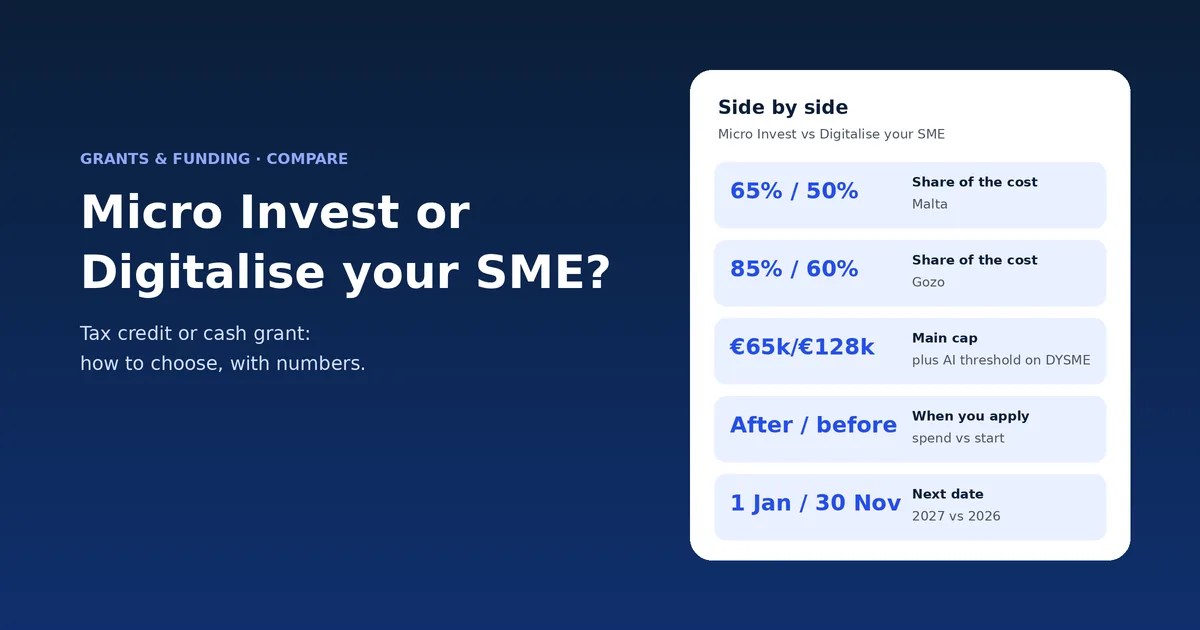
Micro Invest or Digitalise your SME? Tax credit vs cash grant compared: rates, caps, who qualifies, websites, timing and documents, with worked Malta examples.
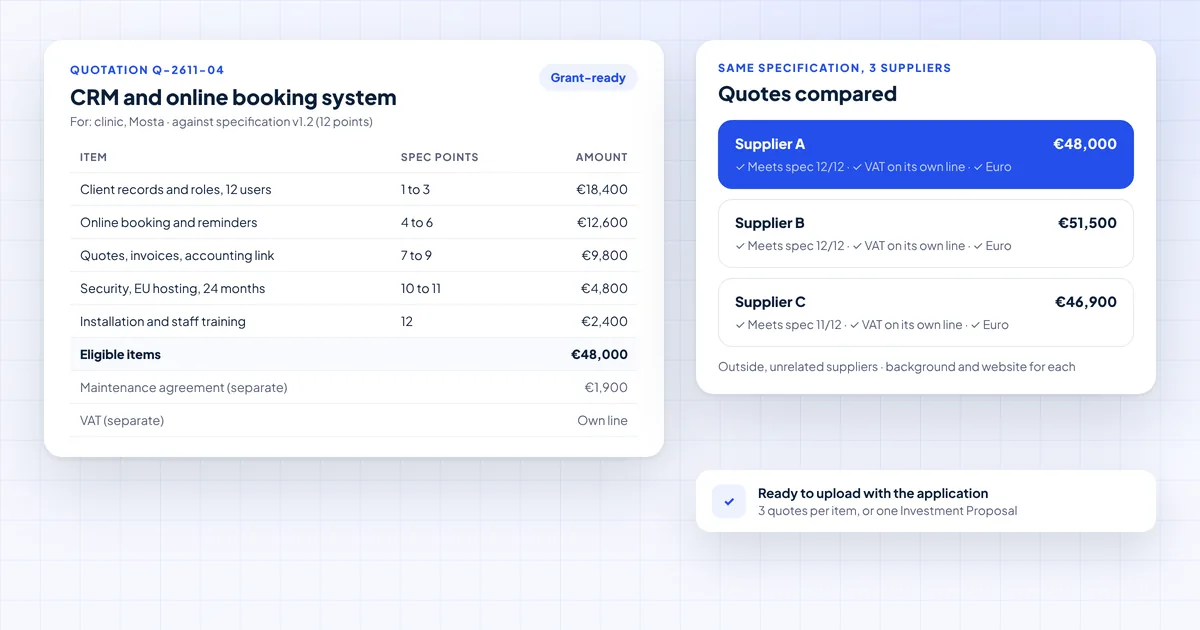
What a quote and spec must show for Digitalise your SME, SME Enhance and Micro Invest: 3 quotes or an Investment Proposal, line layout and a checker.
A useful first step
Tell us what the investment includes. If it needs IT equipment, a booking or stock system, or software to run new equipment, we write the technical specification and give an itemised quote. You and your accountant handle the forms and the accounts.
Step 1 of 3
A few quick questions, about a minute. We usually reply within 2–3 hours.