Staff Rota Software in Malta: Rules, Leave and Checker
Staff rota software for Malta businesses: rest, break and 48-hour rules, 2026 leave of 216 hours, notice for variable hours, buy or build, and a free checker.
Systems & AI · Childcare centres
Malta Digital builds custom business systems in Malta, including software for childcare. This guide shows what childcare management software must do in a Maltese centre. It covers sign-in, room ratios, Free Childcare Scheme hours, parent updates and the records the national standards expect. There is a free room ratio checker, and an honest view of when a ready-made app is enough.
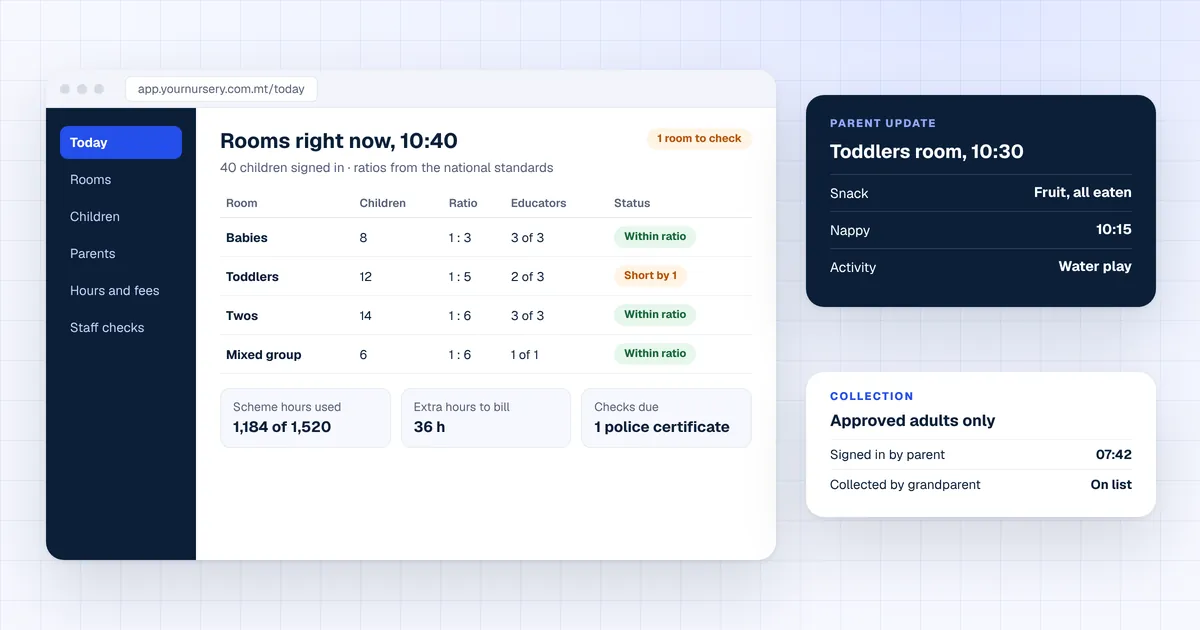
Childcare management software runs the daily work of a nursery: sign-in and sign-out, room ratios, parent updates, fees and child records. In Malta it should follow the national 0 to 3 standards, where one qualified educator can care for 3 babies, 5 children aged 13 to 24 months or 6 aged 25 to 36 months. Malta Digital builds custom childcare systems from €7,500 when a ready-made app does not fit.
The short version
A nursery runs on small tasks that repeat all day. Who came in, who collected them, who ate, who slept, and who is in which room. Software keeps each of those on one record.
Arrival and collection times, and who collected the child. Only people on the approved list.
How many children are in each room right now, and if the staff on shift is enough.
Meals, naps, nappies and activities, sent to parents during the day.
Admission form, consents, allergies, medication and injury reports, kept together.
Scheme hours used, extra hours, outings and food, billed without a spreadsheet.
POMA clearance, police conduct certificates and training, with expiry reminders.
Good software does not add work for educators. Each update should take a tap or two on a tablet, not a typed report at the end of the day.
Malta facts
Centres for children aged 0 to 3 in Malta follow the National Standards for Early Childhood Education and Care Services, published by the Ministry for Education in October 2021. The quality checks are run by the Directorate for Quality and Standards in Education (DQSE).

A mixed group also runs at 1 : 6, with no more than one child under 18 months. With an assistant to the childcare educator, the standards allow larger groups, set out in a table called Appendix 1. Trainees do not count towards the ratio at all.
Ratios change during the day. A room that is fine at 09:00 can be short at 15:30, when one educator goes on a break and late children are still there. Software that knows who is signed in can warn the manager before that happens.
Free Childcare Scheme
Most Maltese centres take part in the Free Childcare Scheme. It covers children from 3 months to 3 years whose parents work or study. Jobsplus runs it and pays the centre directly, not the parent.
In October 2023, 186 childcare centres and 7,912 children used the scheme, according to Jobsplus data reported by Eurydice. Parents pay nothing for the hours the scheme covers. Extra hours, outings, food and hygiene items are charged at the centre’s own rate.
| Item | Who pays | What the software tracks |
|---|---|---|
| Scheme hours for working parents | The scheme, paid to the centre | Hours booked per child, based on the eligible parent’s working hours plus 10% |
| Scheme hours for parents in education | The scheme, paid to the centre | 20 hours a week for part-time study, 40 for full-time |
| Hours above the entitlement | The parent, at the centre’s rate | Extra hours, from real sign-in and sign-out times |
| Outings, food and hygiene items | The parent | Items billed on top, on the same invoice |
| Children not on the scheme | The parent | Fees and receipts the parent can use for the tax deduction |
That split is where spreadsheets break. Software should track each child’s booked scheme hours, the hours used, and anything billed on top, on the same record. Parents of children not on the scheme may claim an income tax deduction of up to €2,000 a year per child, so clear receipts help them too.
For the parent-facing side, such as explaining the scheme on your website, read our guide to a childcare centre website in Malta.
Apply now and tell us how many rooms and children you have, and what you use today. We reply with what we would build first, or which ready-made app fits better.
Free tool
Put in the children in each room and the qualified educators on shift. The checker uses the ratios in Standard 1.3 of the national standards and shows which rooms are short. Nothing you type leaves this page.
Starting numbers match the worked example below. Replace them with yours.
Your result appears here as you type.
This checks qualified educators only. With an assistant to the childcare educator, Appendix 1 of the standards allows larger groups. Trainees do not count.
Records
The standards ask each centre to keep a manual of policies and procedures. Its appendices include an admission form, a fee structure, consent forms, an injury report and a complaint form. Each one maps to a screen in the software.
| Record | Where it comes from | What the software does |
|---|---|---|
| Admission form | Manual of policies, appendix | Online form, filled in by the parent before day one |
| Parental consent forms | Data protection, medication, outings | Signed in the app, with a date, and easy to withdraw |
| Injury report | Accident management policy | Logged on a tablet, shown to the parent, signed at collection |
| Child’s records | Data protection policy | One file per child, open only to the staff who need it |
| Staff POMA clearance | Standard 1.2 | Saved per employee, with a check before the first shift |
| Police conduct certificate | Presented every year | Expiry date with a reminder a month before |
| Complaint form | Complaints policy | Logged with a date, owner and outcome |
Children’s data needs extra care. Allergies, medication and health notes are health data, a special category under GDPR article 9. Only the staff who need them should see them, and every view should be logged. Photos need parent consent first.
A normal day
Here is how one day looks when the centre runs on one system.
Messages to parents should come from the centre’s own app or email, so nothing lives only in an educator’s phone. Our guide to staff rota software covers planning shifts around your ratios.
Worked example
Here is an example centre, not a client. It has 40 children in four rooms and runs sign-in, updates and billing on paper and WhatsApp. These are the ratio checker’s starting numbers, so you can change them.
| Room | Children | Qualified educators needed at 1 : ratio | Rostered | Result |
|---|---|---|---|---|
| Babies, 0 to 12 months | 8 | 3 (at 1 : 3) | 3 | Within ratio |
| Toddlers, 13 to 24 months | 12 | 3 (at 1 : 5) | 2 | Short by 1 |
| Twos, 25 to 36 months | 14 | 3 (at 1 : 6) | 3 | Within ratio |
| Mixed group | 6 | 1 (at 1 : 6) | 1 | Within ratio |
The biggest gain is not the time. It is knowing, at any minute, that every room is within its ratio and every adult who collected a child was on the approved list.
Your options
A monthly fee per site, quick to start. Sign-in, parent updates and billing are usually included. You follow its way of working.
Best for: One or two centres with a standard day.
Keep the app for the rooms, and connect it to your accounts, website forms or payroll where it allows.
Best for: Centres that like their app but retype data elsewhere.
Built around your rooms, rules, fees and reports, connected to your website and accounts. You own the system and the data.
Best for: Groups, agencies and services the apps do not cover.
Many single centres are well served by a ready-made app, and we will tell you if that is your case. Custom pays off for groups with several sites, nanny and babysitting agencies, and centres that also run clubs, classes or transport. Compare the costs in our guide to custom software vs off the shelf.
Proof
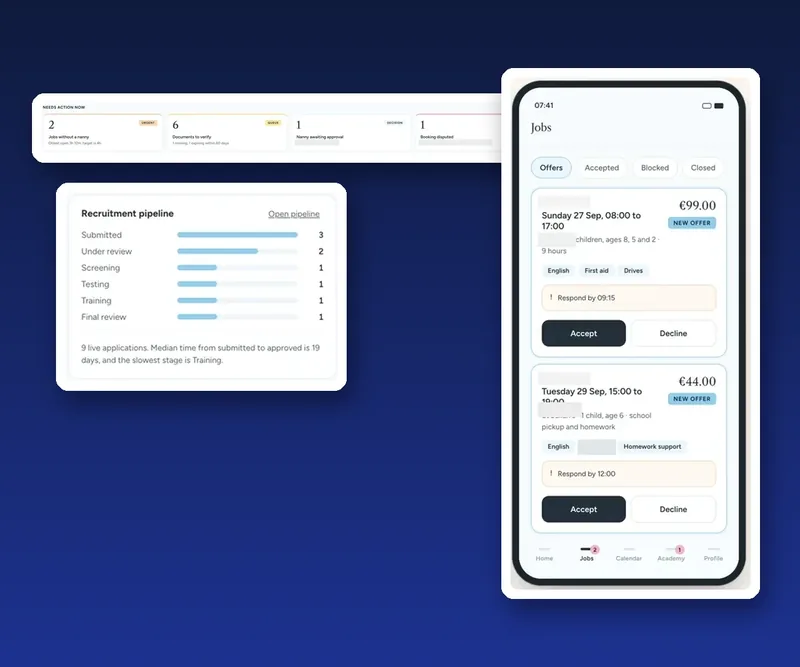
For a childcare and nanny agency we built one platform with three parts: an office screen that opens with what needs action, a staff portal from application to payout, and a booking app for parents. Documents are tracked with expiry dates, and every change is saved in an audit log. A centre needs the same shape: rooms and ratios at the top, staff checks before the first shift, and one record per child. The case study shows the screens.
A few straight answers
Software that runs the daily work of a nursery: sign-in and sign-out, room ratios, parent updates, child records, staff checks, hours and fees, on one system.
One qualified educator for 3 babies aged 0 to 12 months, 5 children aged 13 to 24 months, or 6 aged 25 to 36 months. A mixed group is 1 to 6, with no more than one child under 18 months.
Yes. It can hold each child’s booked scheme hours, count the hours used from sign-in times, and bill extra hours, outings and food to the parent on the same record.
With an assistant to the childcare educator, the standards allow larger groups, set out in Appendix 1. Trainees on placement do not count towards the ratio.
It should be. Health notes and allergies are special category data under GDPR article 9, so access must be limited by role and logged. Ask where the data is hosted and who can see it.
Often, yes. A ready-made childcare app suits one or two centres with a standard day. Custom pays off for groups, agencies and services the apps do not cover.
Malta Digital builds custom childcare systems from €7,500, depending on your rooms, rules and the tools it connects to. You get a written quote first.
Ministry for Education: National Standards for Early Childhood Education and Care Services (0-3 years), October 2021, Standards 1.2, 1.3, 2.6 and Appendix 2 · Eurydice (European Commission): Malta, early childhood and school education funding, Free Childcare Scheme · GDPR, Regulation (EU) 2016/679, articles 5, 8 and 9 (EUR-Lex)
Keep reading
Staff rota software for Malta businesses: rest, break and 48-hour rules, 2026 leave of 216 hours, notice for variable hours, buy or build, and a free checker.
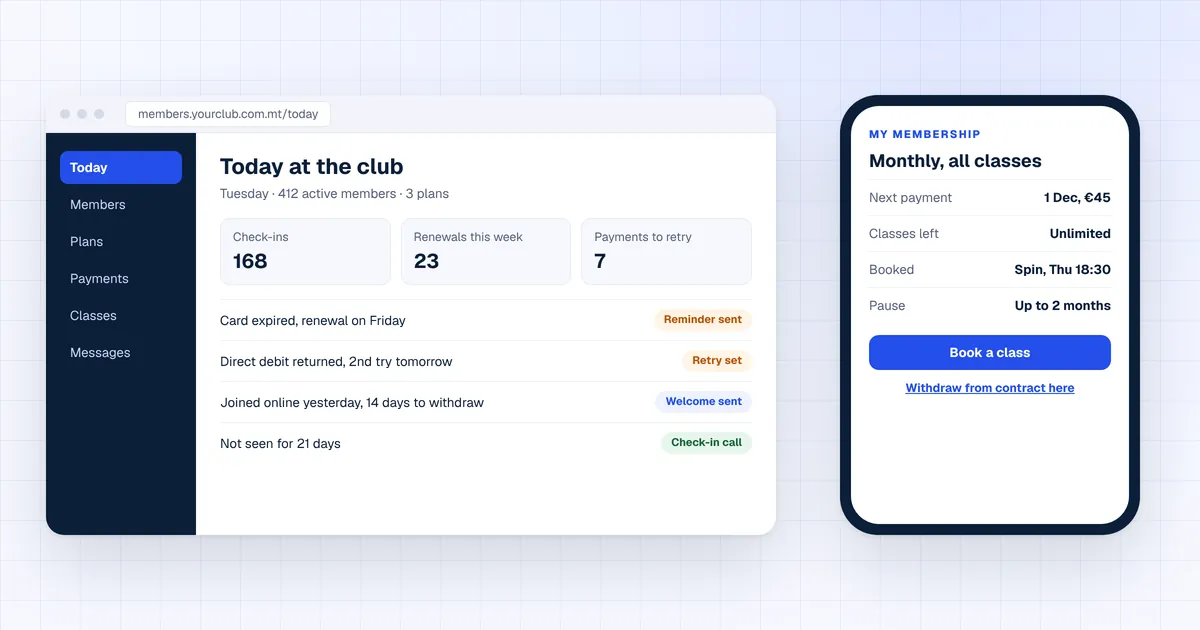
What a membership management system does for a gym, club or studio in Malta: online sign-up, payments, renewals and the 2026 withdraw button rule.
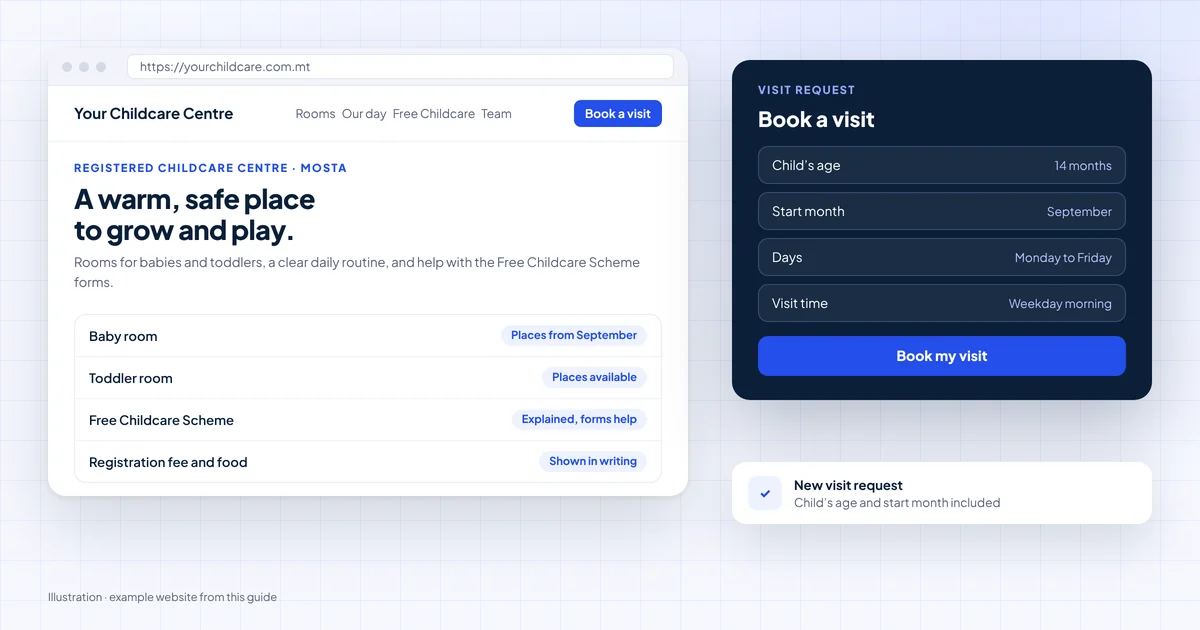
What a childcare centre website in Malta needs: the Free Childcare Scheme explained, rooms, fees, photo consent, a visit form and an hours calculator.
A useful first step
Tell us how many rooms and children you have, what you use today and what takes the most time. We reply with what we would build first, or which ready-made app would fit better.
Step 1 of 3
A few quick questions, about a minute. We usually reply within 2–3 hours.