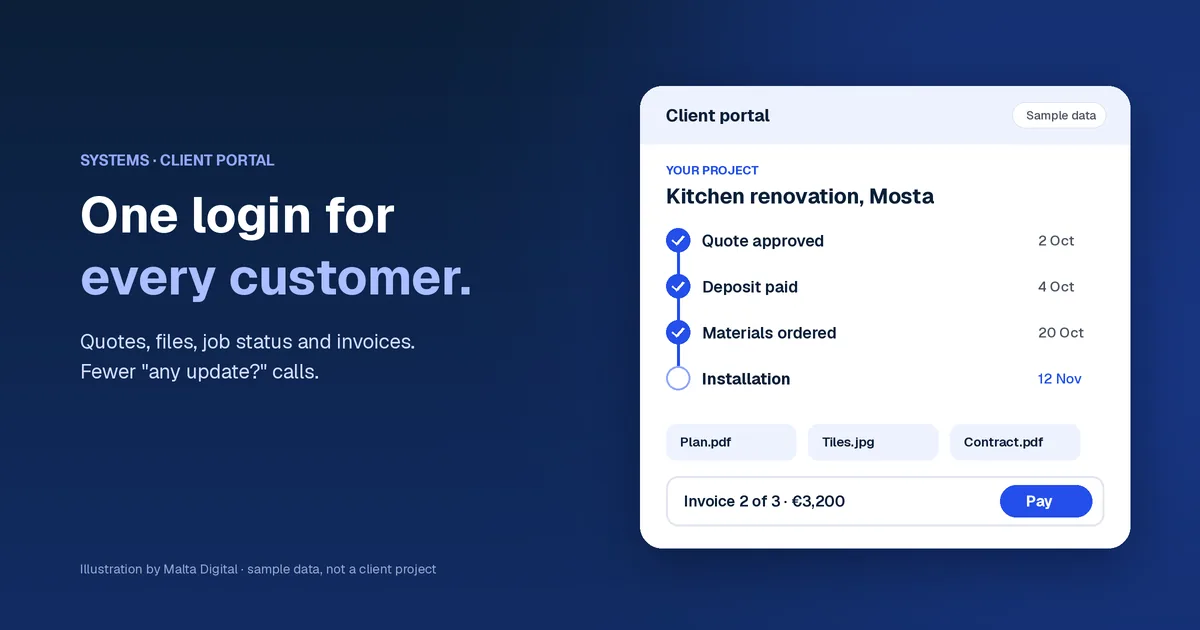
Client Portal for Service Businesses: A Malta Guide
What a client portal does for a service business: quotes, files, job status and invoices in one login, Malta data, a free time-cost calculator and costs.
Systems & AI · Memberships
Malta Digital builds custom business systems in Malta, and membership systems are one of the most useful. Gyms, sports clubs, studios and associations all run on the same loop: people join, pay, book, renew or leave. This guide shows what a membership system should do, the new 2026 rule for online sign-ups, a worked example and a free planner.
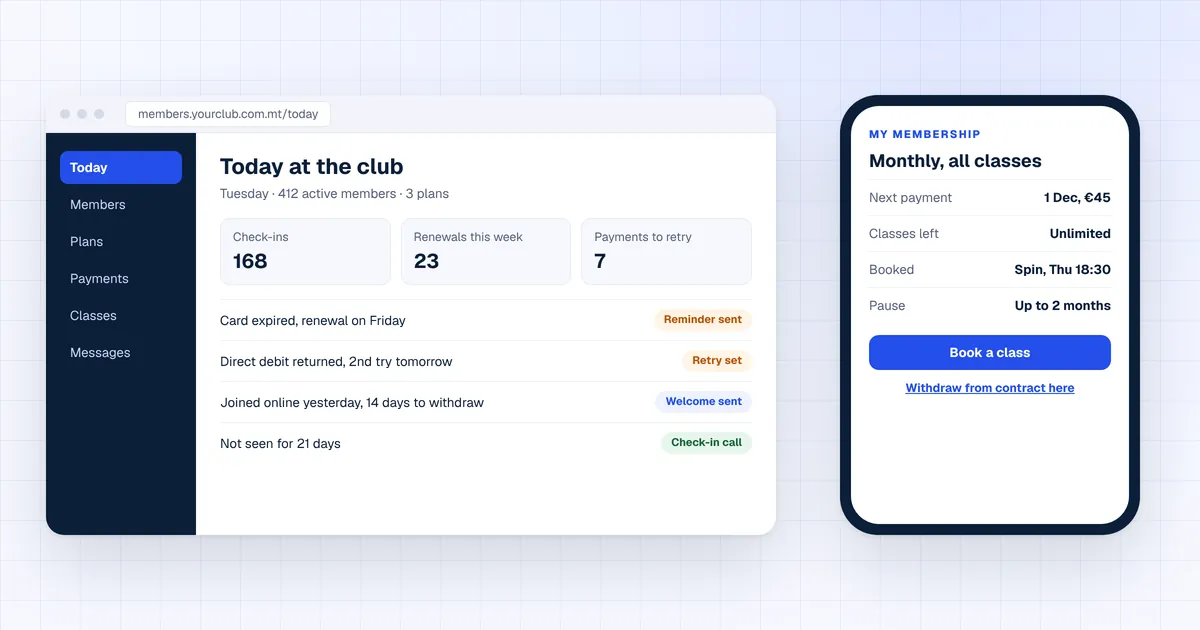
A membership management system keeps every member, plan, payment, booking and renewal on one record. Members join and pay online, book classes, pause or renew, and your team sees who is due, who failed to pay and who has gone quiet. Since 19 June 2026, Malta’s Consumer Rights Regulations also ask for a “withdraw from contract here” button when people join online. Malta Digital builds these systems around how your club already works, from €7,500.
The short version
Most clubs start with a spreadsheet, a card machine and a group chat. It works until there are a few hundred members. Then renewals slip, failed payments go unnoticed and nobody knows who stopped coming.
People pick a plan, accept the terms and pay in one go, on their phone.
Monthly, yearly or class packs, with failed payments retried and flagged.
Classes, courts or sessions with limits, waiting lists and check-in.
Reminders before a plan ends, and a simple way to renew or pause.
Members see their plan, bookings, invoices and messages without calling you.
Active members, new joins, leavers and income, all from the same data.
It does not replace your accounts or your door system. It connects to them, so the same member record drives the payment, the booking and the door.
Malta data
Eurostat’s 2025 survey shows that 71.4% of people in Malta aged 16 to 74 bought something online in the last 12 months. That is up from 67.6% in 2022. The EU average was 73.6%.

People who book flights and food on their phone expect to join a gym the same way. If joining means a paper form and a bank transfer, some of them simply go elsewhere.
The rules
Selling a membership online is a distance contract under Malta’s Consumer Rights Regulations (S.L. 378.17). A few of those rules are really system rules. Your sign-up flow either follows them or it does not.
| Rule | What it says | What the system does |
|---|---|---|
| S.L. 378.17, regulation 10 | People who join at a distance can withdraw within 14 days. For a service, the 14 days start on the day the contract is made | Stores the sign-up date and shows the last day to withdraw on the member record |
| Regulation 13A (added by L.N. 145 of 2026, from 19 June 2026) | A clear “withdraw from contract here” function, a “confirm withdrawal” step and a receipt with date and time | Shows the button in the member area for the whole 14 days and sends the receipt by email at once |
| Regulations 9(8) and 16(3) | If a member asks to start during the 14 days and then withdraws, they pay for what they used | Records the request to start early and works out the part to charge |
| Regulation 18(l) | Leisure services booked for a set date or period can fall outside the withdrawal right | Treats a one-off class or event booking differently from an open monthly plan |
| S.L. 586.01, regulation 9 | Marketing emails and texts need prior consent, with a narrow exception for existing customers | Keeps a consent flag per channel and an opt-out in every message |
New since 19 June 2026: the withdraw button. L.N. 145 of 2026 added regulation 13A. When people join through a website or app, they must be able to withdraw using a function labelled “withdraw from contract here”, shown clearly for the whole withdrawal period. After they confirm, you must send a receipt with the date and time without undue delay.
Member records are personal data under the GDPR. Health questions before a first session are health data, so ask only what you need and limit who can see the answers. Our guide to CRM and GDPR covers access and retention.
Apply now and tell us how many members you have, which plans you sell and what you track today. We reply with what we would build first.
Free tool
Put in your members, fee, failed payments and leavers. The planner works out the income a membership system could protect each year and the desk time it could free. Nothing you type leaves this page.
Starting numbers match the worked example below. Replace them with yours.
Your result appears here as you type.
The member journey
Here is the path a member takes through a good system. Each step adds to the same record, so anyone at the desk can help.
Payments
Most clubs do not lose members in one big moment. They lose them to expired cards, returned direct debits and plans that end without a reminder. A system catches each one on the day it happens.
A reminder goes out before the next payment date, with a link to update the card.
A failed payment is retried on set days, and the desk sees it on the today screen.
Members on holiday or injured can freeze the plan for an agreed time.
No check-in for three weeks starts a friendly message or call.
Worked example
Here is an example club, not a client: 400 members paying €45 a month. These are the planner’s starting numbers, so you can change them to your own.
| Item | Today | With a system | Difference |
|---|---|---|---|
| Failed payments | 6% of 400 a month, €1,080 at risk | 60% recovered by retries and card reminders | about €648 a month, €7,776 a year |
| Members who leave | 4% a month, 16 people | 15% kept by renewal and quiet-member steps | about 29 members a year |
| Value of kept members | Lost when they leave | 29 members at €45 for 8 more months | about €10,368 a year |
| Desk time on payments | 8 hours a week | 60% handled by the system | about 21 hours a month |
The two biggest numbers come from payments that fail quietly and members who leave without anyone noticing. Neither needs more marketing, only a system that pays attention.
Your options
Good at classes, plans and payments for a monthly fee per site or member.
Best for: Clubs whose rules match the app and who need little else.
Good at contacts and email. Plans, bookings and the door must be added and kept in sync.
Best for: Associations with simple yearly fees and few bookings.
Built around your plans, rules and sites, connected to the tools you keep. You own the code.
Best for: Multi-site clubs, mixed plans, courts and classes, or your own rules on pauses and family plans.
Compare running costs first with our guide to custom software vs off the shelf, and see how bookings fit in the best booking systems in Malta.
Proof
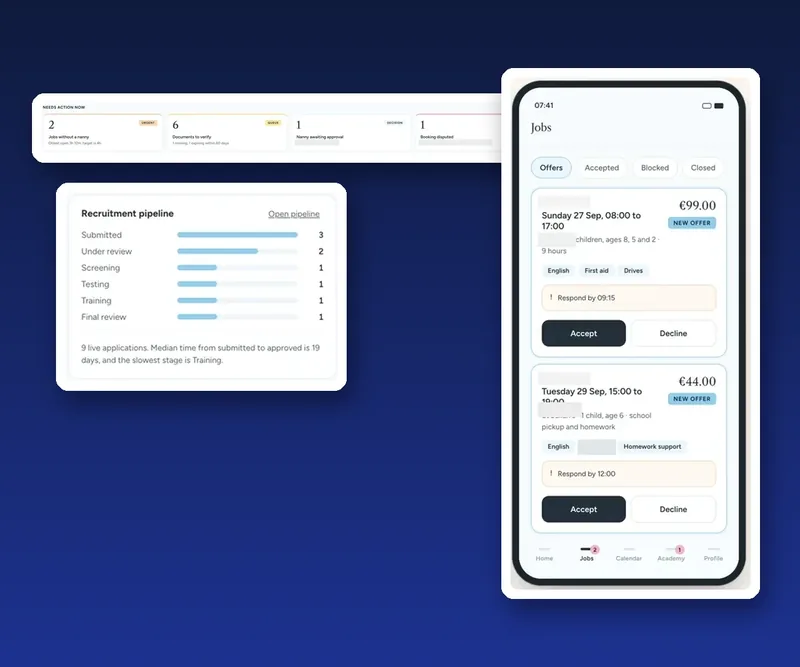
For a childcare agency we built a platform where parents book through a guided app, staff accept work in their own portal and the office sees what needs action first. A club has the same shape: members in an app, coaches with their own screen, and the desk with one view of who is due, booked or behind. The case study shows the problem, what we built and how it works.
A few straight answers
Software that keeps every member, plan, payment, booking and renewal on one record, with an app or web area where members join, pay, book and manage their plan.
Usually, yes. Under S.L. 378.17, people who join at a distance have 14 days to withdraw, and for a service the 14 days start on the day the contract is made.
Since 19 June 2026, regulation 13A asks traders who sell online to offer a clearly labelled withdraw function for the whole withdrawal period, then a confirm step and a receipt.
Yes. It retries on set days, sends a link to update the card and shows every failed payment on the desk’s screen the same day.
Yes, if your rules allow it. The system can freeze a plan for an agreed time and restart billing on its own when the pause ends.
Only those who agreed, or recent customers under the narrow exception in S.L. 586.01, regulation 9, with an opt-out in every message.
Malta Digital builds custom systems from €7,500. The price depends on your plans, sites, bookings and the tools it connects to, with a written quote first.
Sources
Keep reading
What a client portal does for a service business: quotes, files, job status and invoices in one login, Malta data, a free time-cost calculator and costs.
What a gym or studio website in Malta needs: prices, timetable, a free-trial form, online joining with the 14-day rule, health-data care and a free planner.
How gyms and personal trainers in Malta get new members from Facebook and Instagram ads: the trial offer, lead forms, Meta’s health ad rules and budget.
A useful first step
Tell us how many members you have, which plans you sell and which tools you use for payments and bookings. We reply with what we would build first and what a system that fits would cost.
Step 1 of 3
A few quick questions, about a minute. We usually reply within 2–3 hours.