
Facebook ads for beauty salons in Malta
Offers, Reels, WhatsApp bookings, Meta’s beauty ad rules and rebooking for salons.
Facebook & Instagram ads · Gyms & fitness
Facebook and Instagram ads work for gyms in Malta when they sell one easy first step, such as a free class, a trial week or an intro session with a coach, to people who live or work within a short drive. The ad shows your real space and coaches, an instant form or WhatsApp collects the enquiry, and someone replies within minutes to book the visit. Malta Digital runs these campaigns for fitness businesses, measures trial bookings and new members rather than likes, and keeps every ad within Meta’s health and wellness rules.

Sponsored · Mosta
Try 3 classes free
Full namePhone or WhatsAppBest time: Morning · EveningBook my free classFacebook and Instagram ads bring gyms in Malta new members when they sell one easy first step, such as a free class or trial week, to people nearby, and every enquiry gets a reply within minutes. Malta Digital runs these campaigns and measures trial visits and new members, not likes.
The short answer
Yes, and for most gyms they are the most direct way to reach new members. Almost everyone in Malta who might join a gym spends time on Facebook or Instagram every day, and the island is small enough that a campaign can reach most of the people within fifteen or twenty minutes of your door. A gym in Birkirkara, a CrossFit box in Mosta or a Pilates studio in Sliema can all put a clear offer in front of the right people for a modest daily budget.
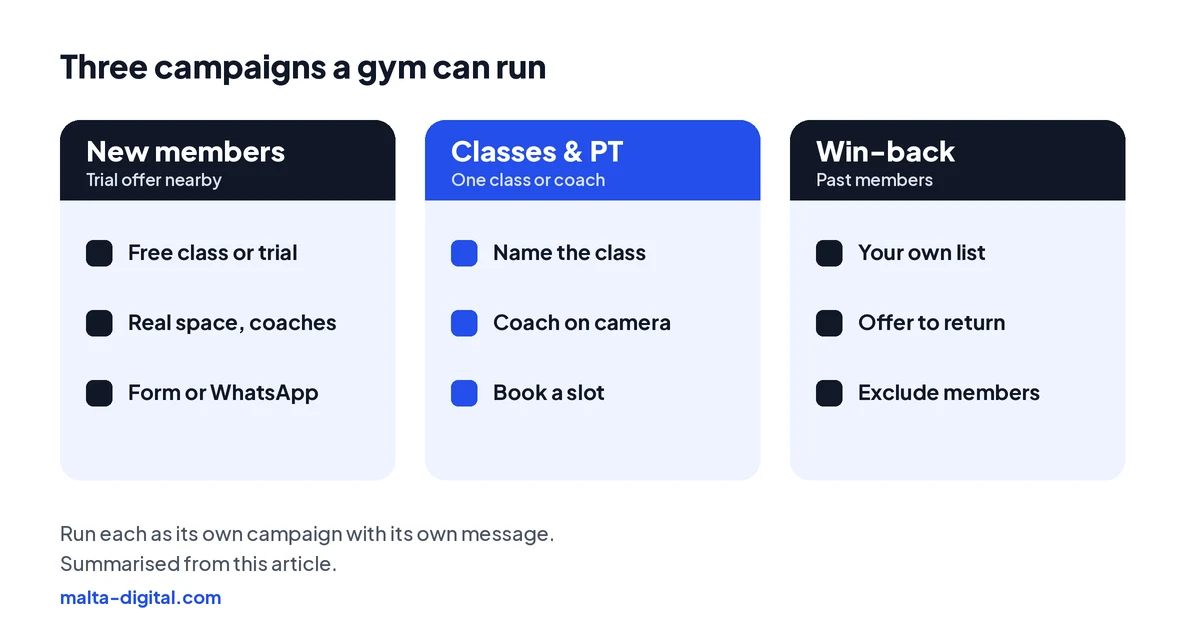
What works is narrower than many owners expect. People rarely buy a yearly membership from an ad. They take a first step: a free class, a seven-day pass, a body composition check or a first session with a personal trainer. The ad’s job is to get that first visit booked; your team’s job is to turn the visit into a member. When both parts work, ads become a predictable source of new members instead of a monthly gamble.
The problem
The most common gym ad in Malta is a boosted post: a nice photo of the weights area, “Join now!” and a phone number. It collects likes from existing members and friends, reaches a few hundred people, and brings almost no new sign-ups. Boosting optimises for engagement, so Meta finds people who like and comment, not people who book a visit.
The second problem is the offer. “Membership from €X a month” asks a stranger to commit before they have seen the place. Someone new to Malta, who just moved to St Julian’s for a job, wants to know whether the gym is busy at 18:00, whether the coaches speak English and whether they will feel comfortable on day one. A trial answers all of that; a price list does not.
The third problem is speed. A lead who filled in a form at 21:30 and hears nothing until the next afternoon has often already booked a trial somewhere else. Many fitness businesses lose more members after the form than before it, and then decide that ads “don’t work” for gyms.
The offer
Pick one first step and build the whole campaign around it. A free group class suits studios with a timetable. A trial week suits open gyms, because people can come at their own times. An intro session with a coach suits personal trainers and small-group training, where the coach is the product. Whatever you choose, say exactly what is included, what happens after it and where membership prices start, so people know what they are saying yes to.
Timing matters in Malta. January and September are natural moments, when people return from the holidays or from a long, hot summer and want a routine again. Students arriving at the University in Msida, people moving here for work in Gżira, Sliema and St Julian’s, and residents in Gozo who want a gym close to home all respond to different messages, so write ads for each group rather than one ad for everyone.
The common mistake is a vague offer such as “special prices this month”. Specific beats clever: “Try 3 classes free in Mosta this week, no contract” tells people what to do, where and when. If you have a genuine reason to act now, such as limited places in a new class, say so honestly.
The rules
Gym ads sit close to Meta’s health and wellness policy. Ads that promote weight loss products or services must be shown only to people aged 18 or over, and they must not attack people’s appearance, use close-ups of pinched fat or promise a specific result in a specific time without qualification. “Lose 10 kg in 2 weeks” is the kind of line that gets ads rejected, and it also attracts the wrong customers.
A second rule catches many fitness ads: Meta does not allow ads that assert or imply personal attributes of the viewer, including physical health. “Are you overweight?” or “Tired of your belly?” speaks to the person about their body and breaks the rule. Talk about what your gym offers instead: “Strength classes for beginners, coaches who show you every move”.
Before-and-after images of members are an area Meta has changed over time, so check the current policy before you use them, get written permission from the member and never imply a guaranteed result. In practice, the ads that perform best for gyms rarely need them: real footage of a class, a coach explaining a move or a member describing their first month usually does the job better.
Making the ads
Show your real space, at a real time of day. A 15–30 second vertical video filmed on a phone, walking from the entrance through the floor to a class, answers the questions newcomers have before they ask them: how big it is, how busy it is, what the people look like. Add captions, because most people watch with the sound off, and put the offer and the locality on screen in the first two seconds.
Coaches sell gyms. A short clip of a coach saying who the class is for, in plain English (and Maltese, if your members speak it), builds trust faster than any graphic. Testimonials work too, when they are real members speaking in their own words and you have their permission to use them.
Keep separate versions for Reels and Stories, where the screen is full height, and for the feed. Refresh the ads every few weeks: on an island this size the same people see them quickly, and a tired ad becomes more expensive before it stops working.
Proof
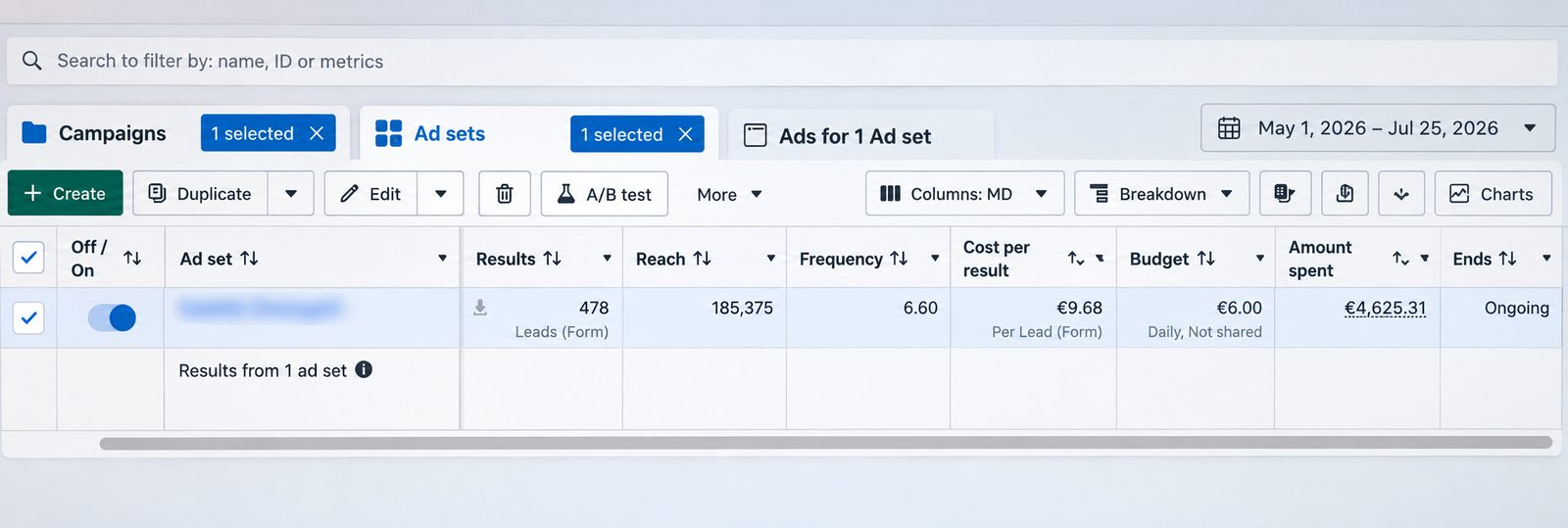
This is a lead generation campaign we ran on Facebook and Instagram from 1 May to 25 July 2026. It brought 478 form leads from €4,625.31 of ad spend, which is €9.68 per lead, on a €6.00 daily ad set budget. The screenshot is straight from Meta Ads Manager, with the ad set name blurred.
Want trial sign-ups like this for your gym? Message us on WhatsApp
Apply now and tell us about your gym, studio or PT business. We’ll reply with the offer, ads and follow-up we’d run, or send your page on WhatsApp for a free check.
Where the lead goes
There are three good places to send people from a gym ad. An instant lead form keeps them inside Facebook or Instagram with their name and phone already filled in, so it brings the most enquiries. Click-to-WhatsApp opens a chat with you straight away, which suits Malta well, because many people would rather message than fill in a form. A booking page on your website lets people choose a class slot themselves, which suits studios with a fixed timetable.
Each one needs something behind it. A lead form needs two qualifying questions, such as which goal fits them best and when they want to start, plus instant delivery to the phone of the person who will call. WhatsApp needs someone who replies within minutes during opening hours and a clear first message. A booking page needs a fast mobile page and the Meta Pixel and Conversions API, so Meta can learn who actually books.
Many gyms run more than one: a lead form for people ready to leave their number, and WhatsApp for those who want to ask a question first. Judge them on trial visits and new members, not on cost per lead, because a cheap lead that never visits is the most expensive kind.
| Instant lead form | Click-to-WhatsApp | Booking page | |
|---|---|---|---|
| Where people go | A form inside Facebook or Instagram | A WhatsApp chat with you | A class slot on your website |
| Best for | Most enquiries, trial offers | People who want to ask first | Studios with a fixed timetable |
| What it needs | Two qualifying questions, instant delivery to a phone | Replies within minutes in opening hours | A fast mobile page, Pixel and Conversions API |
| Judge it on | Trial visits and new members | Trial visits and new members | Bookings that turn up and join |
Follow-up
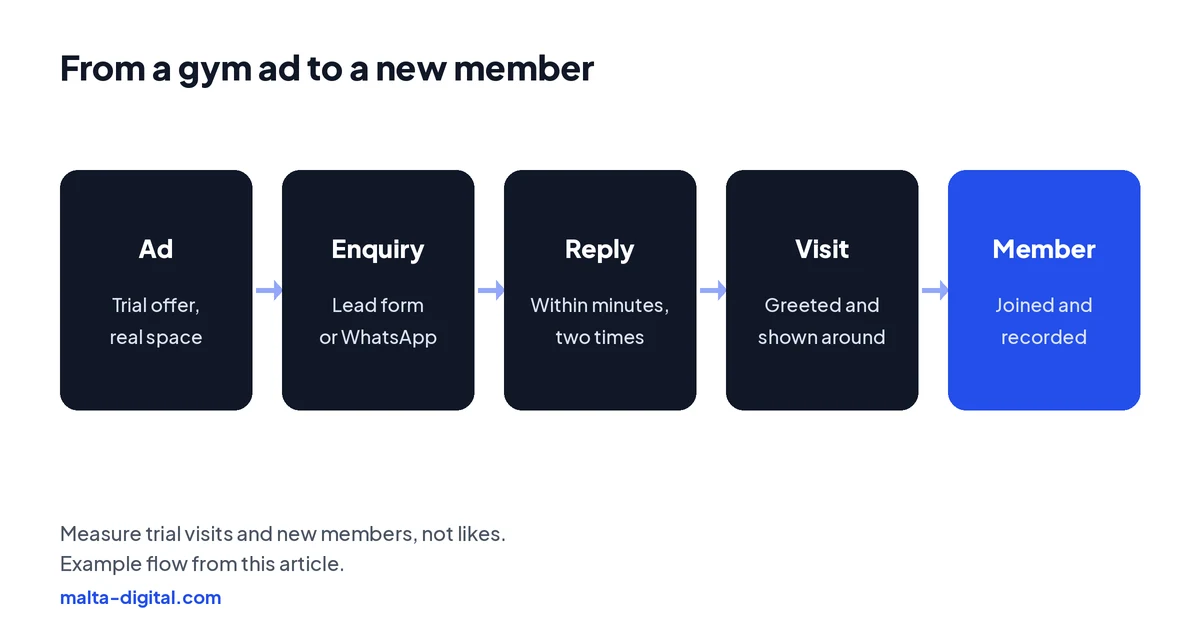
Reply within minutes, by WhatsApp or phone, and offer two specific times: “Thursday at 7:00 or Saturday at 10:00 for your free class?” People say yes to a choice far more often than to “when would you like to come?”. Send a reminder the day before, with your address, parking tips and what to bring, because a first visit to a new place is easy to skip.
On the day, the visit is a sales moment. Someone should greet the new person by name, show them around and, at the end, explain the membership options without pressure. Ask everyone who does not join yet whether you can follow up in a few days, and do it.
Write down what happened to every lead: reached, trial booked, visited, joined. After a month you can see which ads bring members, not just enquiries, and move the budget there. A simple sheet or a CRM is enough to start; automated replies can come later.
Targeting and budget
Start with location and keep the rest broad. Draw a radius around your gym that covers a realistic drive or walk, often a few kilometres in the Sliema and St Julian’s area and wider in the north or in Gozo, then let Meta’s Advantage+ audience find people likely to respond. Detailed interests such as “fitness” rarely add much on an audience this small, and the ad itself does the filtering when it names the class, the area and the offer.
Exclude current members by uploading your member list as a custom audience, where your privacy notice and consent allow it, so you do not pay to show a trial offer to people who already pay you. Run a small retargeting campaign for people who watched your videos or visited your timetable page, and a win-back campaign for past members with an offer to return.
For budget, start with an amount that brings enough enquiries to judge within a few weeks, rather than a tiny daily spend spread over many ads. Our Meta ads management starts from €1,249 a month plus ad spend, excluding VAT, and we agree the ad budget with you based on how many trials you can handle and what a new member is worth to you.
How we do it
We start with your offer and your capacity: which classes have space, which coaches have slots, and what a new member is worth. Then we plan the campaigns, film or brief the videos, write the ads within Meta’s health rules, build the lead form or WhatsApp flow, and connect the Pixel and Conversions API before any money is spent.
Every week we look at trial bookings and new members with you, not just clicks and leads, and move the budget to what brings people through the door. Our case studies show the kind of results we report, straight from Ads Manager.
A few straight answers
Yes, when they sell one easy first step, such as a free class or trial week, to people nearby, and someone replies to every enquiry within minutes.
A specific first visit: a free class, a trial week or an intro session with a coach, with clear details and where membership prices start.
Yes, but weight loss ads must target people aged 18 or over and must not attack appearance, show pinched fat or promise specific results in a set time.
Both can work. Lead forms bring more enquiries; WhatsApp suits people who want to ask first. Judge each on visits and new members.
Cover a realistic drive or walk, often a few kilometres in busy areas and wider in the north or Gozo, and keep interests broad.
Malta Digital’s Meta ads management starts from €1,249 a month plus ad spend, excluding VAT.
Keep reading
Offers, Reels, WhatsApp bookings, Meta’s beauty ad rules and rebooking for salons.

Form setup, follow-up and judging cost per customer, not just cost per lead.

Setup, the first message, cost and the free 7-day window, examples and measuring chats that become sales.
A useful first step
We plan the trial offer, make the ads within Meta’s health rules, set up the lead form or WhatsApp flow and track visits and new members. Meta ads management from €1,249 a month plus ad spend, excluding VAT.