Facebook Ads for Retail Shops in Malta: Get More Walk-Ins
How shops in Malta use Facebook and Instagram ads to bring people in: setup without store traffic, price reduction rules, counting sales and a break-even tool.
Facebook & Instagram ads · Pharmacies
Malta Digital runs Facebook and Instagram ads for Maltese businesses as a Meta ads agency in Malta. This guide is for community pharmacies. It covers what Malta’s medicines advertising rules allow, what Meta blocks, which ads bring people to your counter, what Facebook ads cost in Malta on a pharmacy budget, and a free ad rules checker.
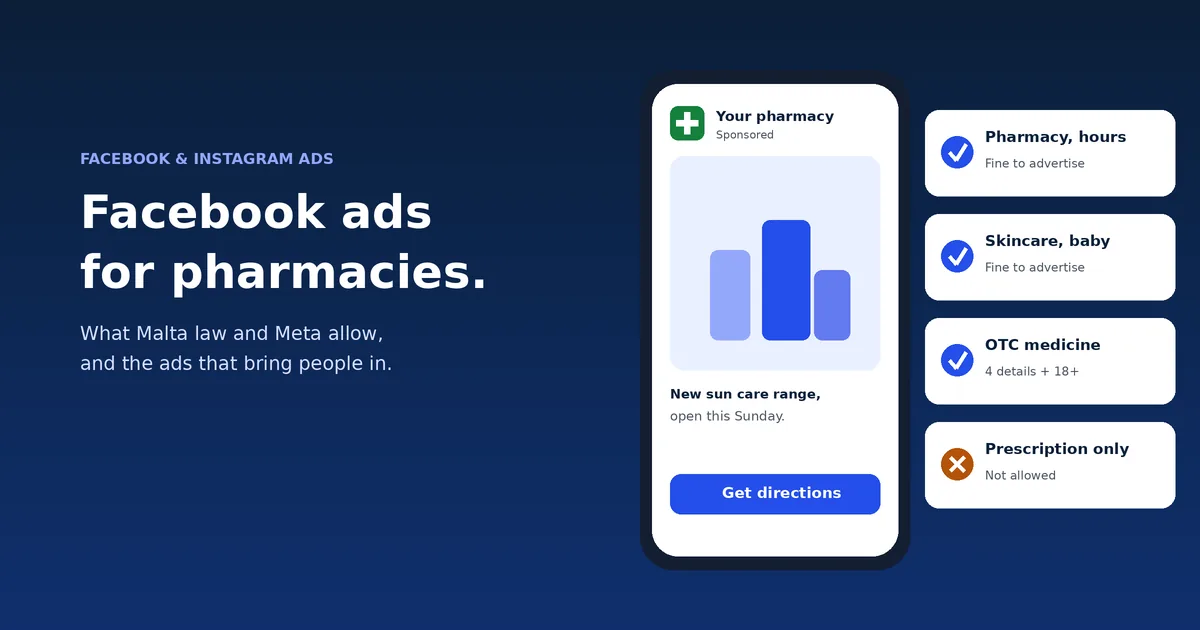
Yes, a pharmacy in Malta can advertise on Facebook and Instagram. You can promote the pharmacy, its services, opening hours and non-medicine ranges such as skincare and baby care. Non-prescription medicines can be advertised with four required details. Prescription-only medicines cannot be advertised to the public, under Malta law and Meta’s rules. Malta Digital builds pharmacy campaigns that stay inside both.
The short answer
Yes, with care. Most of what a pharmacy sells can be advertised. That includes your shop, your services, your opening hours, and ranges like skincare, sun care, baby care and beauty.
Medicines are different. Malta’s Medicinal Products (Advertising) Regulations, 2005, known as S.L. 458.32, ban adverts for prescription-only medicines to the general public. Non-prescription medicines, called OTC (over the counter), can be advertised to the public, but each ad needs certain details.
Meta adds its own layer. Its drugs policy lets prescription drug ads run only in the United States, Canada and New Zealand, with extra checks. So a Malta pharmacy cannot run prescription medicine ads on Facebook at all.
That still leaves plenty to sell. The best pharmacy ads in Malta usually promote the visit, not a medicine.
The numbers
Eurostat’s 2025 survey found that 70.8% of people aged 16 to 74 in Malta looked for health information online in the last three months. The EU average was 60.3%. So your customers search before they come in.
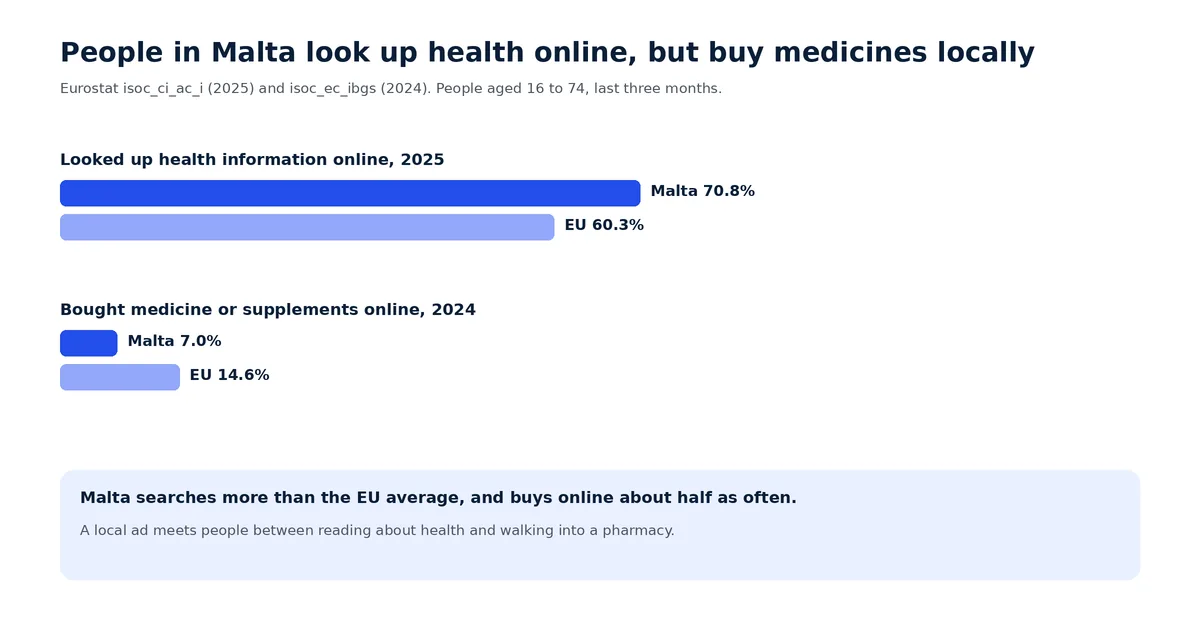
But few buy medicines online. In 2024, only 7.0% of people in Malta bought medicine or supplements such as vitamins online in the last three months. The EU figure was 14.6%. Most people in Malta still buy at a pharmacy they can walk into.
That gap is the opening. People read about health on their phones, then buy close to home. A local ad that shows your range, your hours and your town meets them at that moment.
The rules
The Medicines Authority explains the rules in its advertising guidelines, last updated in June 2024. They apply to websites and social media, not only to print. The system is self-regulation. The Medicines Authority does not check ads before they go out, but it monitors ads and handles complaints.
For OTC medicines, the guidelines list four details every public ad must carry. These are the product name as authorised, all active ingredients, the information needed for correct use, and a clear line telling people to “always read the leaflet”.
| Item | Allowed? | Note |
|---|---|---|
| Prescription-only medicines | No | Banned in all public ads, including social media |
| Non-prescription (OTC) medicines | Yes | Must show name, active ingredients, correct use and “always read the leaflet” |
| Doctor, scientist or celebrity endorsement | No | Applies to medicine ads, so no influencers for medicines |
| Ads aimed at children under 16 | No | Medicine ads must not be addressed to children |
| Free samples of medicines to the public | No | Selling or giving samples to promote is banned |
| “Guaranteed” results or “better than” claims | No | Ads must be objective and not exaggerate |
| Pharmacy, hours, skincare, baby care | Yes | Normal consumer rules apply |
Two rules matter a lot on social media. Ads for medicines must not use recommendations from health professionals, scientists or celebrities. That rules out influencer posts for medicines, so our partnership ads guide applies to your skincare and beauty ranges, not to medicines. And medicine ads must not be aimed at children under 16.
Services are a grey area the guidelines speak to. Ads for treatment services fall outside S.L. 458.32. But they should not name prescription-only medicines. The Medicines Authority gives Botox as its example: it is prescription-only in Malta, so public ads must not mention it by name.
Apply now and tell us your town, your ranges and your hours. We’ll reply with the ads and budget we’d run, inside the rules.
Meta’s rules
Meta has its own ad standards on top of Malta law. Three matter for pharmacies.
First, prescription drugs. Meta only allows these ads in the United States, Canada and New Zealand, for certified advertisers, and only to people aged 18 and over.
Second, personal attributes. Meta’s policy says ads must not assert or imply a person’s physical or mental health, including medical conditions. Meta’s own examples allow “New diabetes treatment available” but block “Do you have diabetes?”. Talk about the product or the service, never about the reader’s body.
| Fails | Passes |
|---|---|
| “Struggling with your eczema?” | “New range for dry and sensitive skin, now in store” |
| “Do you have hay fever?” | “Our spring care corner is now open” |
| “Worried about your blood pressure?” | “Free blood pressure checks this Saturday” (if you offer them) |
| “Losing your hair?” | “Hair care brands now stocked in Mosta” |
Third, age. Keep any medicine ad to people aged 18 and over. Meta does not allow under-18 targeting for prescription drugs, and Malta’s guidelines say medicine ads must not be aimed at children. Setting 18+ on medicine ads keeps you clear of both.
Free tool
Pick what the ad promotes and answer six quick questions about the ad. The checker flags anything that breaks Malta’s medicines advertising rules or Meta’s ad standards, and tells you what to fix. It is a first check, not legal advice. Nothing you pick leaves this page.
Answer for one ad at a time.
Your result appears here when you pick your answers.
What to advertise
Promote the visit. A pharmacy ad works best when it gives people a reason to come in this week. Good examples are a new skincare or sun care range, a baby care corner, a gift set before Christmas, or a free skin consultation if you offer one.
Use your hours. When your pharmacy is open on a Sunday or a public holiday, people search for exactly that. An ad aimed at your town that says “Open this Sunday, 9am to 12pm” is simple and useful. Use the hours on your own roster, and change the ad when they change.
Show your services. If you offer health checks, delivery or click-and-collect, say so plainly with the day, the price and the town. Do not name a prescription medicine in the ad.
Keep the area tight. Most people walk or drive a short way to a pharmacy. Target your town and the next few towns. Our guide to Facebook ads for retail shops shows how to set a small area and judge foot traffic.
Worked example
This is an example to show the maths, not a result or a benchmark. Say a pharmacy in Birkirkara spends €300 a month on ads. Half goes on a new sun care range, and half on Sunday opening reminders.
Say each message or saved offer costs €4. That gives 75 people a month who reach out or save the offer. If one in three comes in and buys, that is 25 sales. At an average basket of €28, that is €700 in sales from €300 of ads.
The real gain is often later. A customer who finds a pharmacy they like tends to come back. So judge the first three months on new faces, not just first baskets. If the numbers do not work for your town, change the offer before you raise the budget.
How we run it
Malta Digital manages Facebook and Instagram ads from €1,249 a month plus ad spend, paid to Meta in your own ad account. Your pharmacist stays the final check on any medicine ad, because you hold the licence. We follow the rules in this guide on every ad we write. If an ad is turned down, our guide to a rejected Facebook ad explains the fixes.
Proof
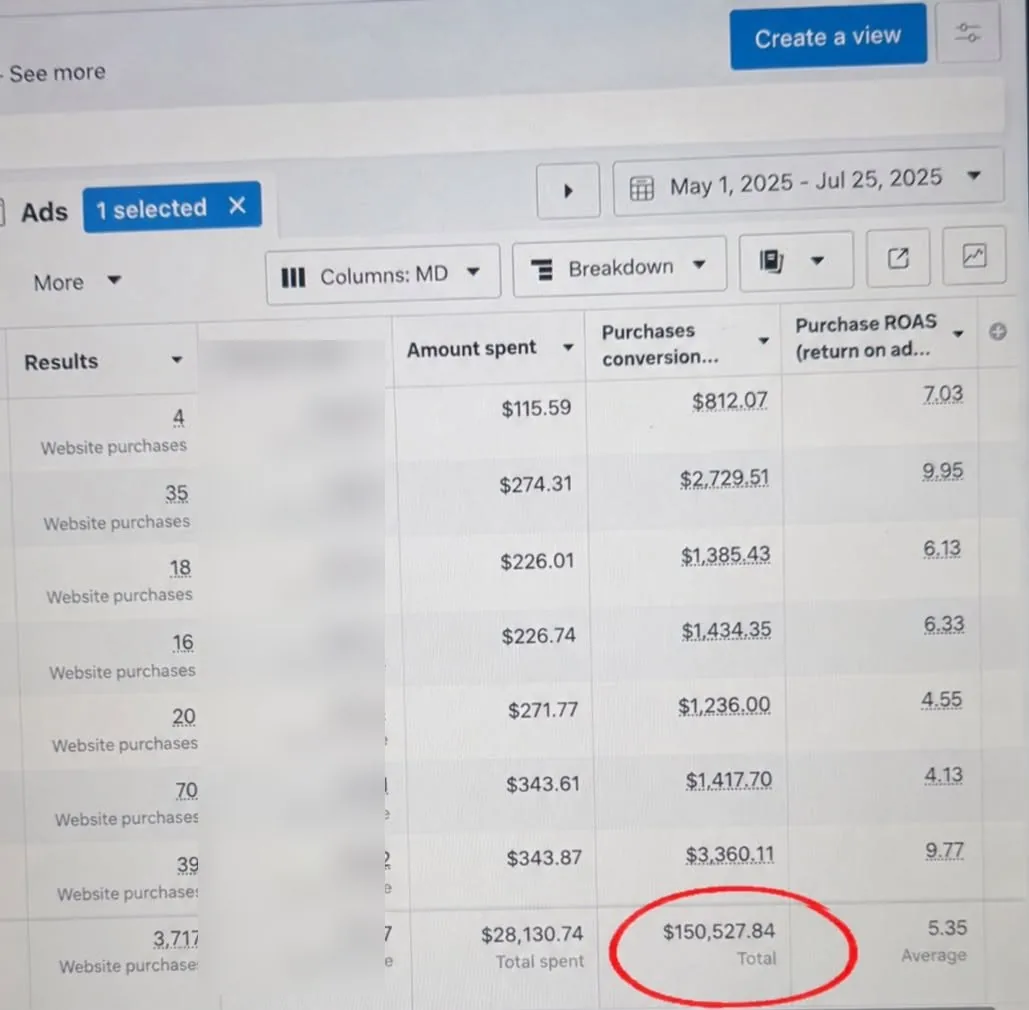
Many pharmacies now sell skincare and beauty online as well. When every sale is tracked, Meta ads can be judged in euro. One online store we ran ads for tracked $150,527.84 in sales from $28,130.74 of spend, a 5.35 return on ad spend, from 1 May to 25 July 2025.
A few straight answers
Yes. You can promote the pharmacy, its services, opening hours and non-medicine ranges. Non-prescription medicines can be advertised with the required details. Prescription-only medicines cannot be advertised to the public.
No. S.L. 458.32 bans public adverts for prescription-only medicines, and Meta only allows prescription drug ads in the United States, Canada and New Zealand.
The Medicines Authority lists four items: the product name as authorised, all active ingredients, the information for correct use, and a clear line to “always read the leaflet”.
For skincare, beauty and other non-medicine ranges, yes, with a clear #ad label. For medicines, no: the guidelines ban endorsements by health professionals and celebrities.
Often because the copy implies the reader has a health condition, such as “Do you have hay fever?”. Talk about the product or service instead.
No. Malta uses self-regulation. The Medicines Authority does not review ads before they go out, but it monitors ads and handles complaints.
Many start with a few hundred euro a month on a small area. Malta Digital manages ads from €1,249 a month plus ad spend.
Sources
Keep reading
How shops in Malta use Facebook and Instagram ads to bring people in: setup without store traffic, price reduction rules, counting sales and a break-even tool.
How clinics in Malta get consultation requests from Facebook and Instagram ads within Meta’s health ad rules and Malta’s medical advertising rules.
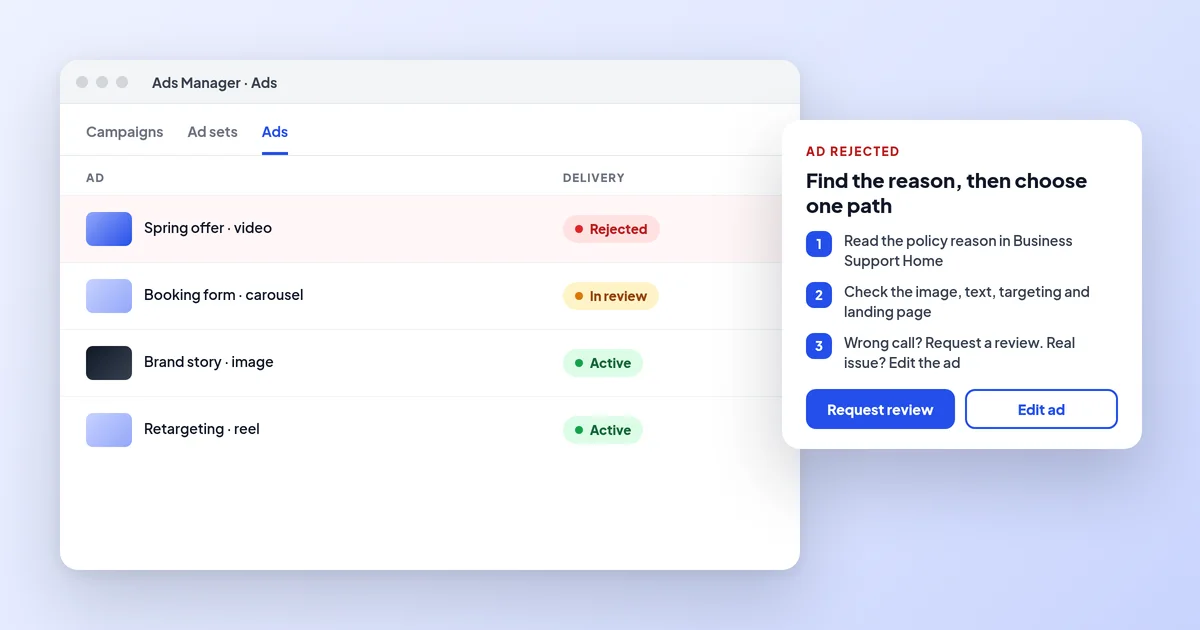
Why Facebook and Instagram ads get rejected, where to find the reason, when to request a review or edit, and how Malta businesses write ads that pass.
A useful first step
Tell us your town, what you want to promote and your opening hours. We’ll reply with the ads and budget we’d run, inside Malta’s rules.
Step 1 of 2
A few quick questions, about a minute. We usually reply within 2–3 hours.