Instagram Reels Ads: Size, Safe Zones, Length and Tips
Instagram Reels ads for Malta businesses: 9:16 size, safe zones in pixels, length limits, what to avoid, a creative checklist and a free safe-zone checker.
Instagram & Facebook ads · Creators
Malta Digital runs Instagram and Facebook ads for local brands as a Meta ads agency in Malta, and that includes partnership ads with creators. This guide explains how they work, which permissions you need, what Malta’s consumer rules say about labels, what a creator deal costs in a worked example, and a free deal checker. For the wider picture, see Instagram ads in Malta.
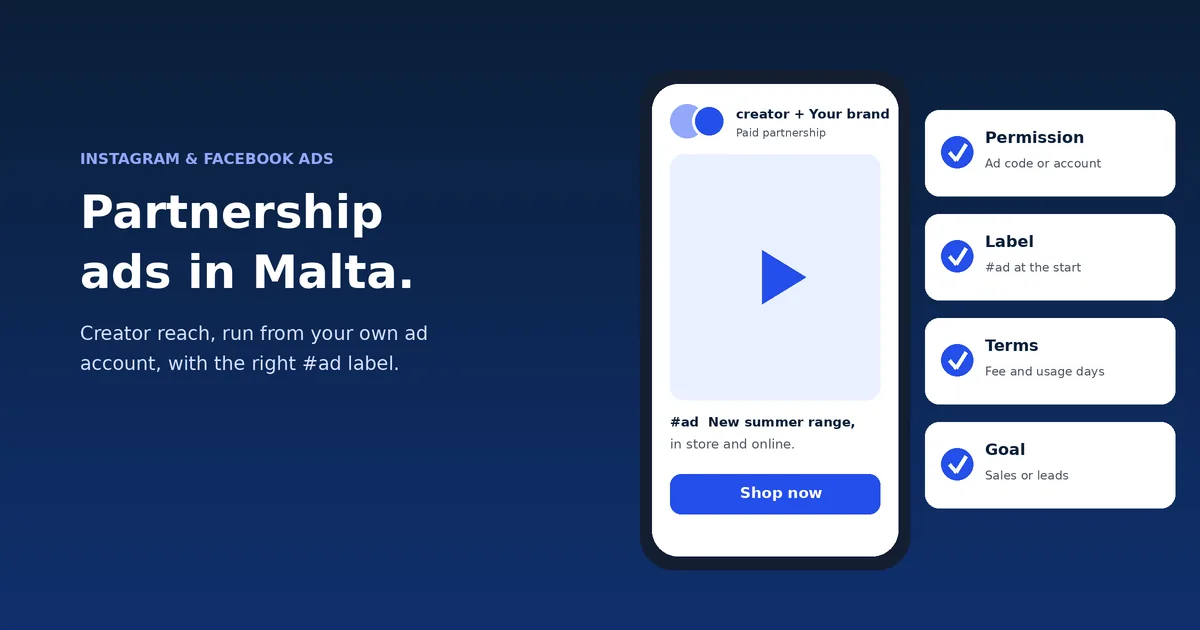
A partnership ad is a paid ad that shows a creator’s name and your brand’s name together in the header. You run it from your own ad account, with your own budget, goal and audience. The creator gives permission with an ad code or an account-level request. In Malta, the post must say it is an ad at the start, under MCCAA guidelines. Malta Digital sets these up and judges them on sales or leads, not likes.
The short answer
Partnership ads are ads that run with a partner. The partner can be a creator, another brand or another business. Both account names show in the ad’s header. Meta used to call them branded content ads, and the help pages now use the new name.
The key point is control. A partnership ad takes a creator’s post, or new content made for you, and runs it as a paid ad from your ad account. You set the goal, the budget, the audience and the dates.
Meta says these ads use signals from both accounts. So Meta can learn from the creator’s followers as well as your own customers. A weak offer stays weak with a famous face on it, though, so judge the ad on what it sells.
How it works
There are three steps. First, the creator makes the content and posts it, or sends it to you. Second, the creator gives you permission. Third, you build the ad in Ads Manager and pick their content.
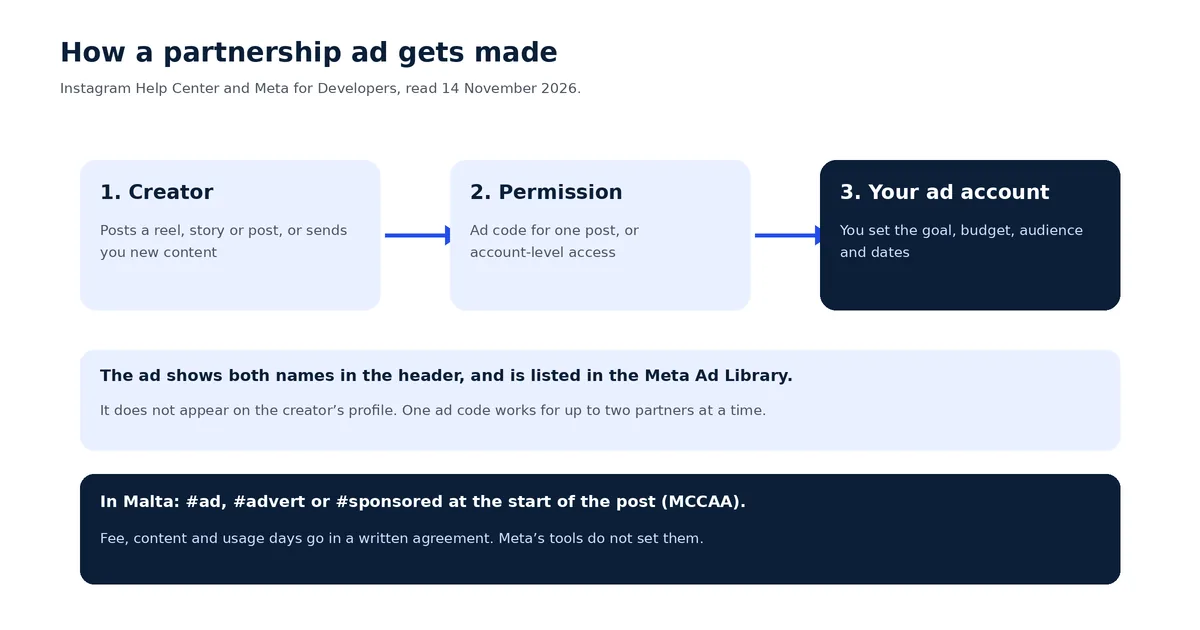
Permission comes in two kinds. Content-level permission covers one post, reel or story. The creator turns on “Allow brand partner to boost” on a post that tags you as the paid partner, or shares a partnership ad code. Meta’s developer guide says one code can be used by up to two partners at a time.
Account-level permission is wider. You send a request from Meta’s partnership tools, and the creator accepts it in the app. You can then run ads from their handle, even without an existing post. Either side can remove permission at any time.
| Content-level | Account-level | |
|---|---|---|
| How it is given | Ad code, or “Allow brand partner to boost” on a post that tags you | Creator accepts your request in the app |
| What you can run | That one post, reel or story | Ads from their handle, with or without an existing post |
| Best for | A single campaign or a test | An ongoing creator partnership |
| Can it be removed? | Yes, the creator can turn it off | Yes, either side can remove it |
| Payment and usage terms | Not covered: put them in writing | Not covered: put them in writing |
Two details catch brands out. The ad does not show on the creator’s profile, but it does appear in the public Meta Ad Library. And once boosted as an ad on Instagram, a post can no longer be edited.
Malta rules
The Malta Competition and Consumer Affairs Authority (MCCAA) has published guidelines for influencer marketing, based on the Consumer Affairs Act, Cap. 378. Followers must be able to tell paid content from normal posts.
The MCCAA says a post counts as commercial when it aims to sell, when money, commission or gifts are given, or when someone promotes their own range. Acceptable labels include #ad, #advert, #advertisement and #sponsored. #gifted fits goods given for free so the creator mentions them.
Where the label goes matters as much as the word. The MCCAA says it must be at the start of the post or story, on every related post, and visible without extra clicks. Hiding #ad at the end, among other hashtags, is not enough.
| Situation | Acceptable | Not enough |
|---|---|---|
| Paid post or reel | #ad, #advert, #advertisement or #sponsored at the start | #sp, #spon, #collab or #prom |
| Free product given to mention | #gifted at the start | Only tagging the brand |
| Discount or affiliate code | #ad plus the code | A code with no business link shown |
| Thanking a brand | A clear paid label as well | “Thank you” or “made possible by” alone |
| Where the label sits | First line, visible without a tap | At the end, among other hashtags |
The MCCAA says it is the legal duty of influencers, marketing agencies and brands to follow consumer law. So put the label in the written agreement, and check the post before you put money behind it.
Apply now and tell us what you sell and who you want to reach. We’ll reply with the creator brief, label and budget we’d run.
Formats and goals
Meta’s help pages list the formats. In Feed, you can use a single image, a video or a carousel of up to 10 cards. In Stories, you can keep up to five stickers. An existing story used as a partnership ad should be 60 seconds or less. Reels work too, and Instagram notes that partnership ads can also show in WhatsApp Status.
Most goals are supported: awareness, traffic, engagement, leads, app promotion and sales. One gap matters for local firms. Meta’s table shows that traffic campaigns that send people to a phone call are not supported. So if you want calls, send people to a form or a message instead.
Free tool
Enter the creator fee, your ad spend, what a sale costs in ads and your average order. Then answer four questions about the deal. The checker shows sales, the return on ad spend and on the full cost with the fee, and flags anything that breaks Malta’s labelling rules or leaves you exposed. Nothing you enter leaves this page.
Starting numbers match the worked example below. Replace them with yours.
Your result appears here as you type.
Choosing a creator
Malta is small, so audience location matters more than follower count. A creator with 40,000 followers may have most of them abroad. Ask for a screenshot of their audience insights, showing top countries and towns. You want a large share in Malta, or in the countries you sell to.
Look at their past paid work in the Meta Ad Library, and check how they labelled it.
Then agree the deal in writing. Meta’s permission tools control access, not payment or usage terms. So write down the fee, what content you get, how many days you may run it as an ad, and who owns the raw files. Our Instagram Reels ads guide covers what makes a reel work as an ad.
Worked example
This is an example to show the maths, not a result or a benchmark. Say a Malta skincare shop pays a creator €400 for one reel, with the right to run it as an ad for 60 days. It puts €800 of ad spend behind the reel over those two months.
Say each sale through the ad costs €16 in ad spend. The €800 then brings 50 sales. At an average order of €45, that is €2,250 in sales. On ad spend alone, that is a return of about 2.8 times.
Now count the creator fee. Total cost is €1,200, so the return on everything is about 1.9 times. That is the number to judge. If the reel keeps selling, extend the usage rights. The checker above starts with these numbers.
How we run it
Malta Digital manages Facebook and Instagram ads from €1,249 a month plus ad spend, paid to Meta in your own ad account. The creator fee is agreed between you and the creator. For the costs of the ads themselves, see what Instagram ads cost in Malta.
Proof
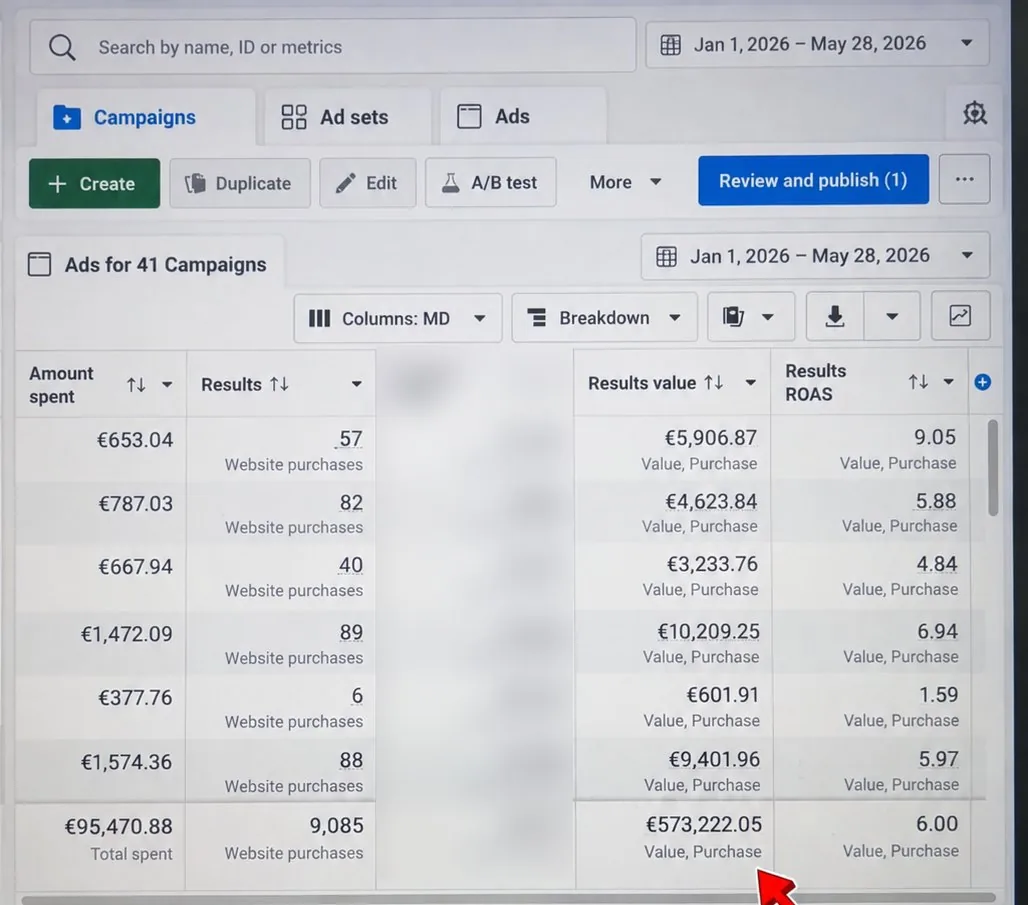
A creator ad is still an ad, so we judge it the same way as every other ad: on tracked sales. One online store we manage turned €95,470.88 of ad spend into €573,222.05 in tracked sales from 1 January to 28 May 2026, a 6.00 return on ad spend.
A few straight answers
It is a paid ad that shows a creator’s or partner’s name and your brand’s name together in the header. You run it from your own ad account, with your own goal, budget and audience.
Yes. Meta renamed branded content ads to partnership ads. Organic branded content posts need a separate permission.
The creator turns on the partnership ad code in the post’s settings and sends it to you. You paste it into Ads Manager. Meta says one code can be used by up to two partners at a time.
Yes, for commercial content. The MCCAA guidelines accept #ad, #advert, #advertisement and #sponsored, and #gifted for free products. The label must be at the start of the post and on every related post.
The MCCAA says influencers, marketing agencies and brands all have a legal duty to follow consumer law. So check the label before you run the post as an ad.
Not with a traffic goal, according to Meta’s table of supported objectives. Use a form, a message or your website instead.
You pay the creator’s fee, agreed with them, plus the ad spend paid to Meta. Malta Digital manages the ads from €1,249 a month plus ad spend.
Sources
Keep reading
Instagram Reels ads for Malta businesses: 9:16 size, safe zones in pixels, length limits, what to avoid, a creative checklist and a free safe-zone checker.

How to advertise on Instagram step by step: professional account, boost vs Ads Manager, costs, avoiding the Apple fee on iPhone, formats and targeting.

Use the Facebook Ad Library to see any business's current Facebook and Instagram ads in Malta, plus age, location and reach on ads delivered in the EU.
A useful first step
Tell us what you sell, who you want to reach and any creators you have in mind. We’ll reply with the brief, label and budget we’d run.
Step 1 of 2
A few quick questions, about a minute. We usually reply within 2–3 hours.