
Facebook lead ads in Malta
Form setup, follow-up and judging cost per customer, not just cost per lead.
Facebook & Instagram ads · Tutors and tuition
Facebook and Instagram ads work for tutors and tuition centres in Malta when they speak to the person who decides, usually a parent, about one subject and level at a time, at the right point in the school year. Show who teaches, where and when lessons happen and how to book a first lesson, then follow up on WhatsApp the same day. Ads aimed at students under 18 can only use age and location, so most campaigns aim at parents. Malta Digital runs Meta ads for tutors and tuition centres around the places they actually have free.

Hi, do you have a place for Form 4 SEC Maths in Mosta?
Yes, our Thursday afternoon group has a place. Shall we book a first lesson?
Facebook ads work for tutors and tuition centres in Malta when each ad speaks to parents about one subject and level, at the right point in the school year, with an easy way to book a first lesson by form or WhatsApp. Ads to under-18s can only use age and location. Malta Digital plans tutoring campaigns around the places you have free.
Do they work
Yes, if you plan them around how families in Malta choose a tutor. Private lessons are part of school life here, and most parents find a tutor through a recommendation, a school WhatsApp group or a search for “maths private lessons” or “chemistry private lessons” near them. Facebook and Instagram add something those channels cannot: you can put your lessons in front of parents in Naxxar, Birkirkara or Żabbar at the exact moment they start worrying about a subject.
What makes tutoring different from most local services is that one student can stay for years. A Form 3 student who starts Maths with you may stay until their SEC exams, and a younger brother or sister often follows. That makes a new student worth far more than one month of lessons, and changes how much you can afford to pay for an enquiry.
Ads struggle when they try to sell everything at once: “all subjects, all levels, primary to university, online and in person”. A parent looking for help with Form 4 Physics wants to know you teach exactly that. The tutors and centres that do well choose one subject and level per ad and say it in the first line.
Who decides
For primary and secondary school, the person who pays and books is a parent, and that is who the ad should speak to. They want to know who will teach their child, whether you know the syllabus and the exam, where and when lessons happen, how many students are in a group and what it costs. A short video of you explaining how you teach a topic does more than any slogan.
Meta also limits how you can reach younger users. Ads shown to people under 18 can only be targeted by age and location; interests, gender and activity cannot be used. In practice most tutoring campaigns aim at adults in the localities you serve and let the ad make clear who it is for (“SEC Maths for Form 4 and 5, small groups in Mosta”). Older students, sixth form and university students, can be reached directly with ads about A-level, intermediate or university subjects.
Adults learning for themselves are a separate audience: Maltese lessons for people who have moved to Malta, English for work, or a subject for a career change. They decide and pay themselves, often prefer evenings or online, and need a different ad.
Timing
Demand for tutoring in Malta moves with the school year. Families look for weekly lessons when the new year starts, look again after the half-yearly exams, and rush for revision in the spring. The SEC main session written papers started on 23 April in 2026, results came out in July, and the supplementary session for resits ran from late August into September. Each of those moments is a different ad.
Plan your campaigns a few weeks ahead of each peak, not on the day. Parents start asking around before the new school year begins, and revision groups fill well before the exams. Ads launched when everybody else is already full get attention; ads launched when every tutor on the island is advertising cost more and convert less.
In summer, think about who needs you. Students preparing for September resits need a short, intensive plan, and some parents want a head start before a difficult year. Those are small, specific audiences, so a focused ad with dates and places left works better than a general “summer lessons” post.
| When | What families are thinking | What to advertise |
|---|---|---|
| Late August to October | New school year, new subjects, last year’s results | Weekly lessons and group places by subject and level |
| November to February | Half-yearly exams and the first worries | Catch-up lessons and exam preparation, a few places left |
| March to May | SEC and A-level exams getting close | Revision courses and past-paper groups |
| July to August | Results, resits and the next year | Resit preparation for the September session, summer courses |
The offer
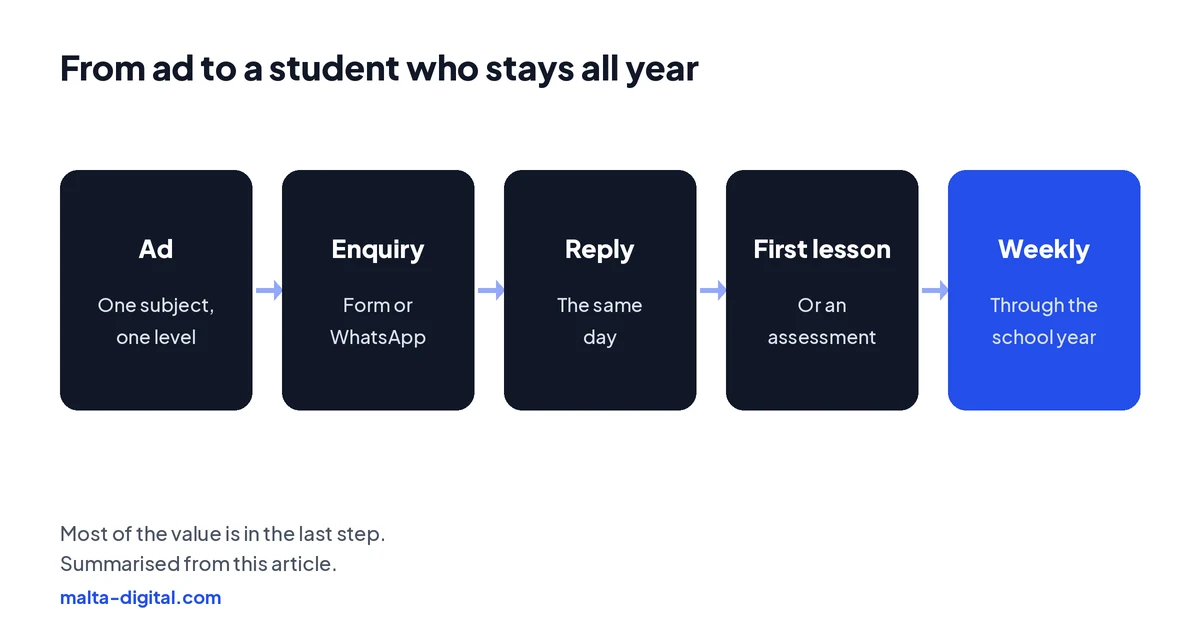
Few parents commit to a full year from an ad. They book a first lesson or an assessment, see how their child gets on with you and then continue. So the ad should sell that first step, clearly: subject, level, one-to-one or group, at home, at your centre or online, and the days and times you have free. If you publish prices, say what they cover, such as the length of the lesson and the group size.
Never promise grades. You cannot guarantee a result, and claims like “pass guaranteed” can get ads rejected and put off careful parents. What you can say is what you do: how you follow the syllabus, how you use past papers, how you keep parents informed and how small the groups are. If parents have written reviews on Google or Facebook, mention them and link to them, but never invent testimonials.
For tuition centres with several teachers, give each subject its own ad and, ideally, its own teacher. A parent wants to know who will teach Chemistry, not that the centre has fifteen tutors. Group places are a good message too, when it is true: “Two places left in the Thursday SEC Biology group” is concrete and honest.
Proof
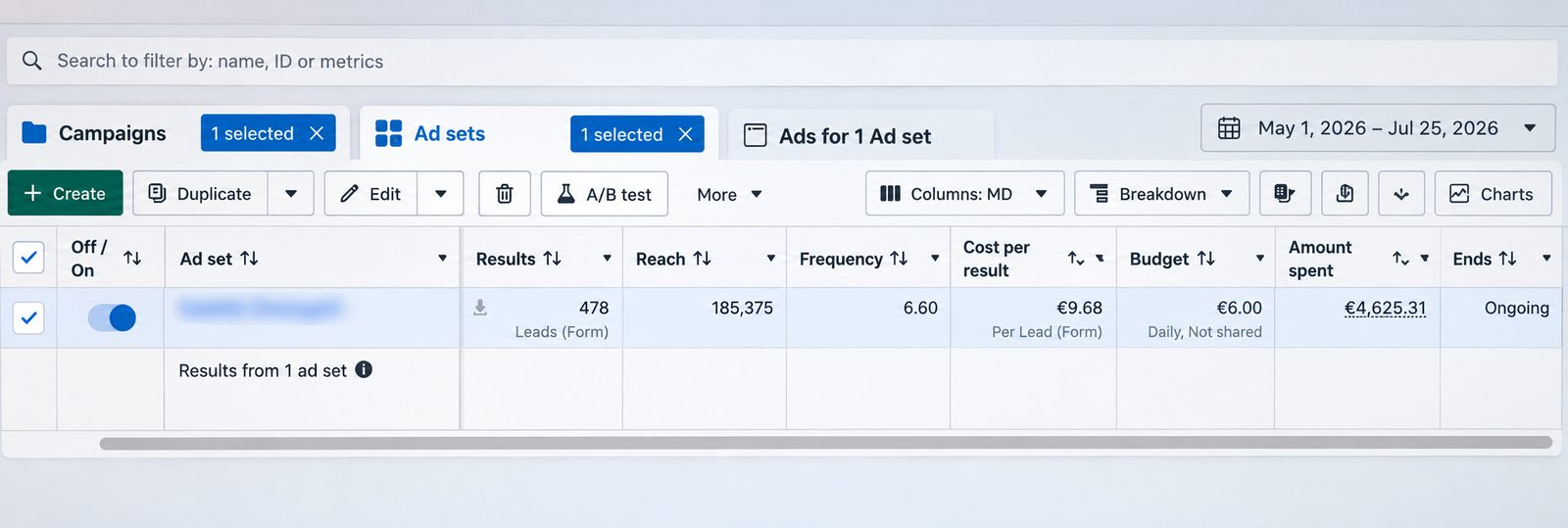
This is a lead generation campaign we ran on Facebook and Instagram from 1 May to 25 July 2026. It brought 478 form leads from €4,625.31 of ad spend, which is €9.68 per lead, on a €6.00 daily ad set budget. The screenshot is straight from Meta Ads Manager, with the ad set name blurred.
Want enquiries like this for your lessons? Message us on WhatsApp
Apply now and tell us which subjects and levels you teach, where and how many places you have. We’ll reply with the ads, timing and form we’d run, or message us on WhatsApp.
Form or WhatsApp
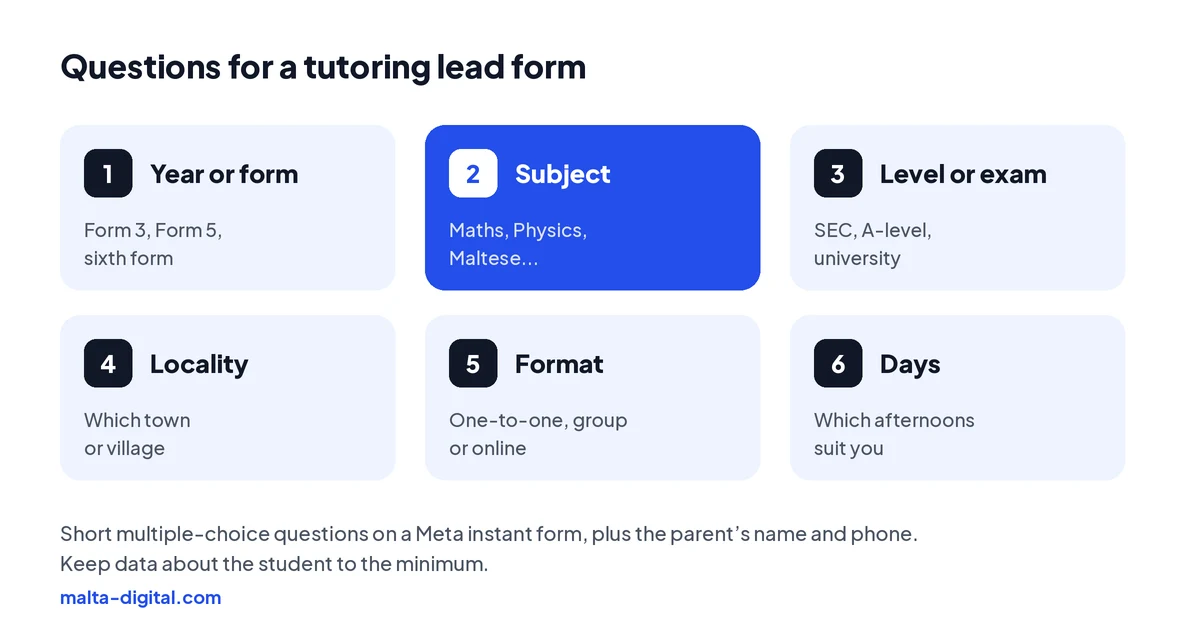
A good tutoring enquiry tells you enough to place the student without a long call. On a Meta instant form, ask a few short questions: the student’s year or form, the subject, the level or exam, the locality, one-to-one or group, and which days suit. Add the parent’s name and phone number. Do not ask for more about the child than you need; it is a minor’s data and should be kept to the minimum.
Many parents in Malta would rather send a WhatsApp message, especially if they have a quick question about times or prices. A click-to-WhatsApp ad lets them do that in one tap, and you can reply between lessons. Use forms when you need the details to fill groups by level, and WhatsApp when you teach alone and want a conversation. Our guides to Facebook lead ads and click-to-WhatsApp ads cover the setup.
Then reply the same day. Parents often message two or three tutors at once and choose the one who answers clearly first. If you teach all afternoon, an automatic first reply that says when you will call back keeps the enquiry warm.
Photos and privacy
The best creative for tutoring is you: a short video explaining a topic, a photo of your teaching room or your whiteboard with a worked example, or a screen recording of an online lesson with no student visible. These show how you teach, which is what parents want to see, and they cost nothing to make.
Do not use photos or videos of students in your ads unless you have clear written consent from their parents, and even then think twice. Children’s images and names are personal data under GDPR, and many parents in a small country would rather their child did not appear in an ad that half their town will see. Avoid stock photos of smiling students too; they look like every other ad.
If you also teach in a school, follow your employer’s rules about private lessons, and keep the ads about your own lessons, not the school. Keep the tone calm and helpful rather than playing on exam fear; it builds more trust with parents and keeps the ads within Meta’s rules.
Capacity and budget
A tutor’s limit is hours in the afternoon and seats in a room. Before you raise a budget, count the places you can actually fill: which subjects, which levels, which days. When a group is full, pause its ad and start a waiting list, rather than paying for enquiries you will have to turn away. When a group has two places left, say so.
Target the localities students can reach. Most families want lessons close to home or school, so an ad aimed at a few neighbouring towns, naming them, usually works better than one aimed at all of Malta. Online lessons are the exception and can reach the whole island, including Gozo. Our guide to Facebook ads targeting explains the location settings.
Work the budget backwards from what a student is worth over a school year and how many enquiries become students. Our Facebook ads calculator does the maths with your own numbers. Ad spend is paid to Meta directly. Meta ads management from Malta Digital starts from €1,249 a month plus ad spend, excluding VAT, which makes most sense for tuition centres and tutors with several teachers or groups to fill, not for a single tutor with a full week.
How we do it
We start with your timetable: which subjects and levels have places, which localities your students come from and what a student is worth to you over a year. Then we plan campaigns around the school calendar, make ads that show who teaches and how, set up a short form or a WhatsApp flow with the right questions and make sure every enquiry reaches you straight away. Each month you get a report of spend, enquiries and cost per enquiry from Ads Manager, and we ask how many became students.
If you also need help replying to parents, booking first lessons or keeping track of groups and payments, we build simple systems for that too. Apply now and tell us about your lessons.
A few straight answers
Yes, when each ad sells one subject and level to parents in the localities you serve, at the right time of the school year, with a quick way to book a first lesson.
Only by age and location. Meta does not allow interests, gender or activity for under-18s, so most tutoring campaigns speak to parents and say clearly who the lessons are for.
A few weeks before each peak: the start of the school year, after the half-yearly exams, before the SEC and A-level exams in spring, and in summer for September resits.
If you publish a price, say what it covers, such as lesson length and group size. Never promise grades.
Only with clear written consent from their parents, and it is usually better not to. Show your teaching, your room or your worked examples instead.
Forms help when you fill groups by level and subject. WhatsApp suits single tutors and parents with quick questions. Reply the same day either way.
Meta ads management starts from €1,249 a month plus ad spend, excluding VAT. Ad spend is paid to Meta directly.
Keep reading
Form setup, follow-up and judging cost per customer, not just cost per lead.

Setup, the first message, cost and the free 7-day window, examples and measuring chats that become sales.

Location, age, interests, custom and lookalike audiences, and why broad usually beats narrow on a small island.
A useful first step
We plan campaigns around the school year and exam calendar, make ads that show who teaches and send every parent’s enquiry to you at once. Meta ads management from €1,249 a month plus ad spend, excluding VAT.