
Landing page for Facebook ads
What a campaign page has to match when the traffic is paid.
Websites · Landing pages
A landing page takes one offer to one audience. A website gives people several rooms to walk through. Here is how Malta businesses should choose, with a three-question tool and our published prices.
Use a landing page when one campaign has one offer and one next step. Use a full website when people will search your name or compare more than one service. Many businesses need both. Malta Digital builds them as part of web design in Malta, from €990, and explains campaign pages in the landing page for Facebook ads guide.
The choice
A landing page has one job: take one offer to one audience and ask for one action. A website has rooms (services, proof, contact and legal pages) so people who arrive from search, a referral or a saved link can find what they need.
Malta businesses often get offered a cheap one-pager when what they actually need is a site people can trust, or the reverse: a ten-page brochure when the next step is a single Facebook campaign. Both have a place. This page helps you pick, then points you to web design in Malta if you need the pages built, from €990, and to our guide on a landing page for Facebook ads if the page is for a campaign.
We do not name other studios here. We use our own published prices and the jobs each format is good at.
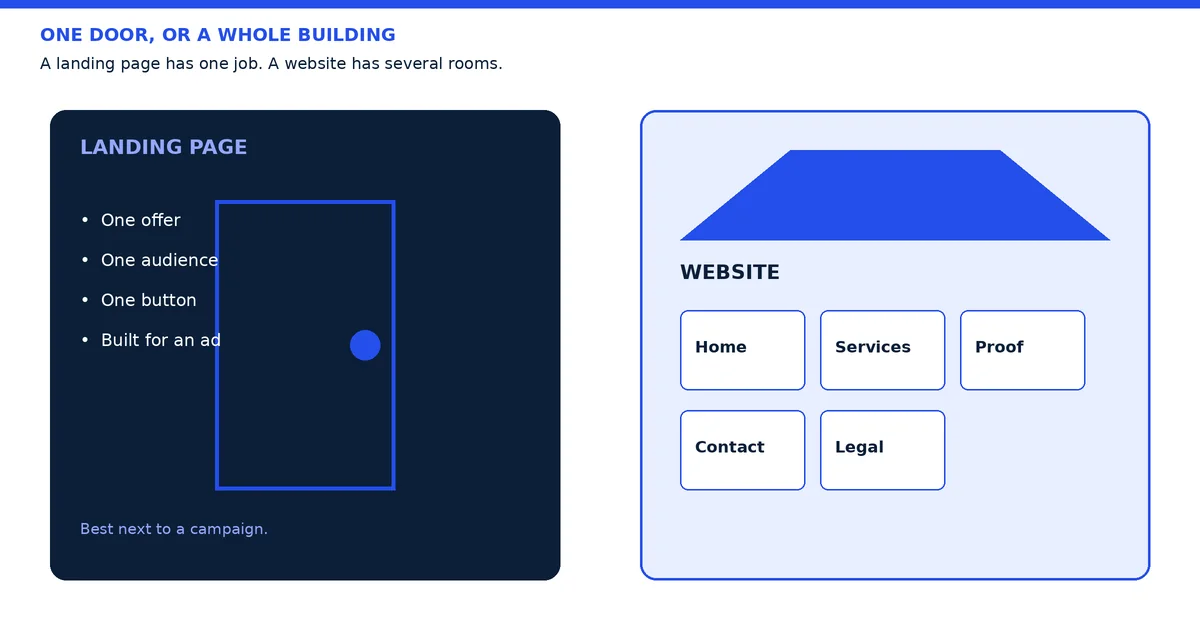
Side by side
| Question | Landing page | Website |
|---|---|---|
| Main job | One offer, one audience, one button | Explain the business, show proof and take different kinds of enquiry |
| Typical traffic | A paid campaign or a single promotion | Search, referrals, repeat visits and campaigns |
| Pages | Usually one, sometimes with a thank-you page | Home, services, about, proof, contact, legal, and extras you actually need |
| Navigation | Little or none, so people are not pulled away from the offer | Clear links, because visitors arrive with different questions |
| When it fails | When someone needs more than the offer: opening hours, other services, who you are | When a campaign dumps people onto a busy home page with no matching message |
Many of the better set-ups we build use both: a website people can find and trust, and a landing page that matches a specific ad. The landing page can sit on your own domain, which is why this is a website decision as well as an ads decision.
When a landing page is enough
Choose a landing page when you already know the offer, the audience and the action. A clinic promoting a named treatment, a retailer with a seasonal bundle, a course with a fixed start date: those are landing-page jobs. The page should repeat the promise in the ad, show the price or the next step, answer the objections that stop a click from becoming a lead, and send the form somewhere you will actually reply.
If the campaign is on Facebook or Instagram, the page still has to load quickly on a phone in Malta and keep the same wording as the creative. That is the work described in the landing-page-for-ads guide. A page that looks pretty but talks about a different service will waste the spend.
When you need a website
Choose a full website when someone might arrive without seeing a specific ad: they search your name, they are sent a link, or they want to compare two services you offer. A trades business covering several localities, a restaurant with a menu and bookings, a professional firm that needs policy pages: those are website jobs.
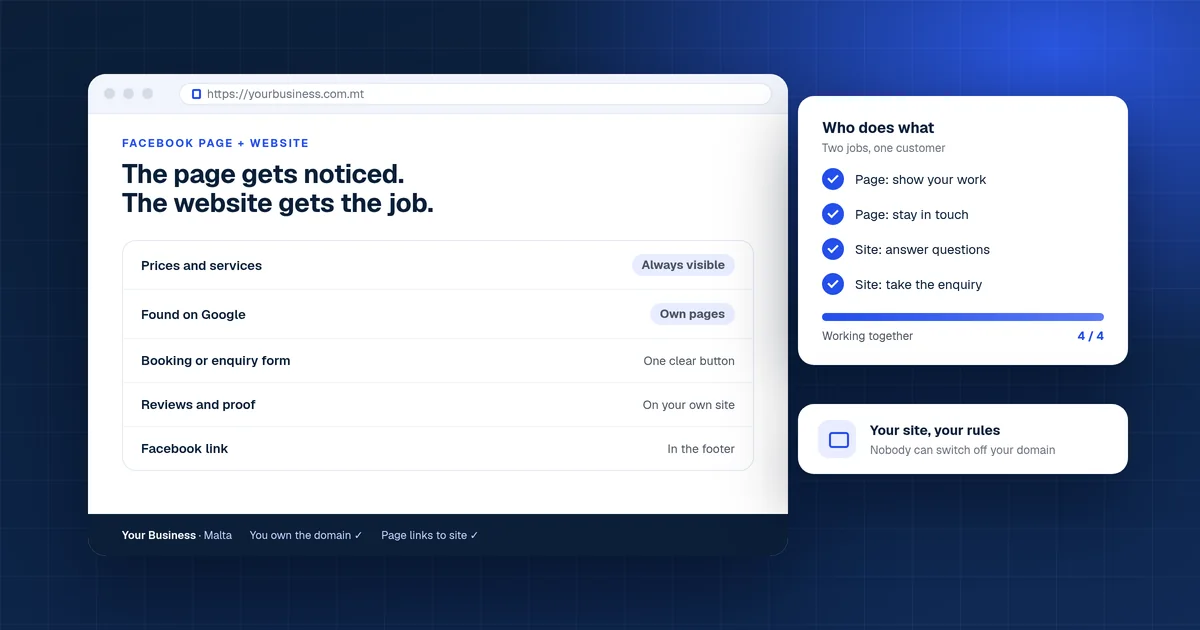
A Facebook Page is not a substitute for that, which we explain in website or Facebook page. You do not control the layout, and people who search your name still expect an address that belongs to you.
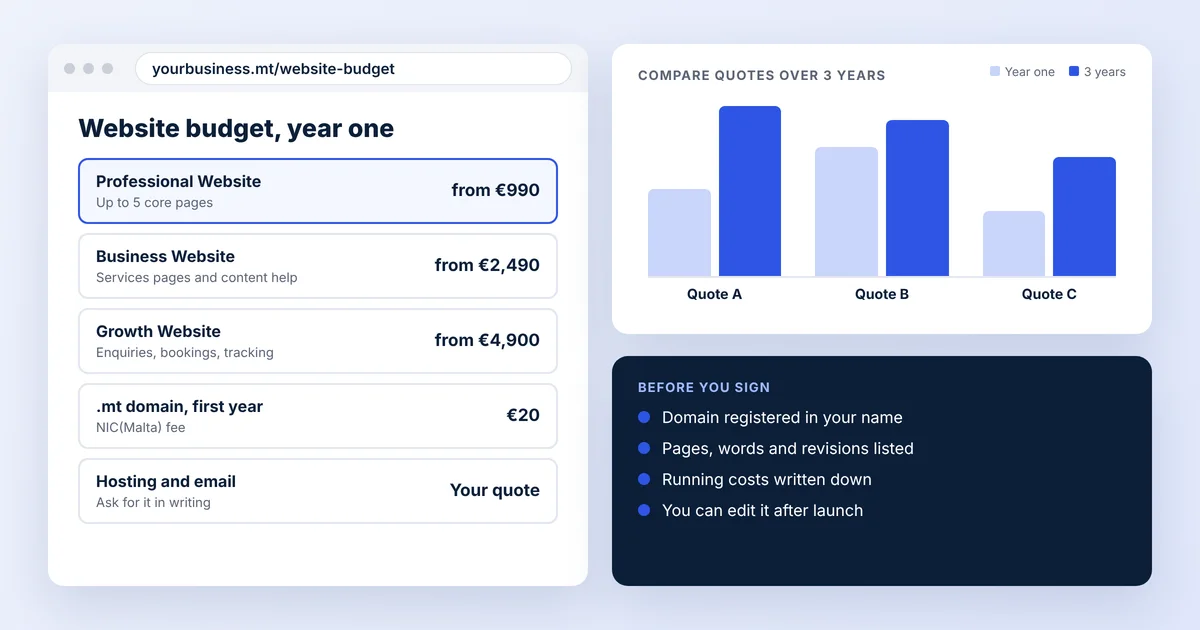
A Professional Website starts from €990, a Business Website from €2,490 and a Growth Website from €4,900. Those are published starting points for brochure sites with the pages you need, not a one-line tease that leaves legal pages and contact details as extras.
Rules for both
A one-page site does not get a lighter rulebook. If it offers a service in Malta, it must carry the same basic details as a full website. The ad platforms also look at it before and after your ads go live.
| What the page needs | What that means in plain words | Where it comes from |
|---|---|---|
| Who you are | Your business name, the address where you are set up and an email address, easy to find and always there | Electronic Commerce Act (Cap. 426), art. 8C(1)(a) to (c) |
| Register and VAT details | Your registration number if you are in a trade register, and your VAT number if your work is subject to VAT | Cap. 426, art. 8C(1)(d) and (g) |
| A privacy notice | The form collects names and emails, so the page must say who gets them and why | GDPR, art. 13 |
| Consent before pixels | Ad pixels and analytics cookies need a yes from the visitor before they load | S.L. 586.01, see our website legal requirements in Malta guide |
| A page that matches the ad | Meta's ad review can include the landing page or other destination, and is usually done within 24 hours | Meta Advertising Standards |
| A useful, relevant page | For Google search ads, landing page experience is one of the three parts of Quality Score, compared with other advertisers on the same search over the last 90 days | Google Ads Help |
So a cheap one-pager that skips these lines is not really cheap. You either pay to add them later, or you send paid clicks to a page that people and platforms trust less. Every landing page and website we build includes them from day one.
Tell us how people find you today and what you want them to do next. We reply with whether we would build a landing page, a website, or both.
Free tool
Answer as things stand now, not as you hope they will be next year. Nothing is sent anywhere.
Three questions. The note is a recommendation, not a quote.
Answer the three questions to see whether we would start with a landing page, a website, or both.
Proof
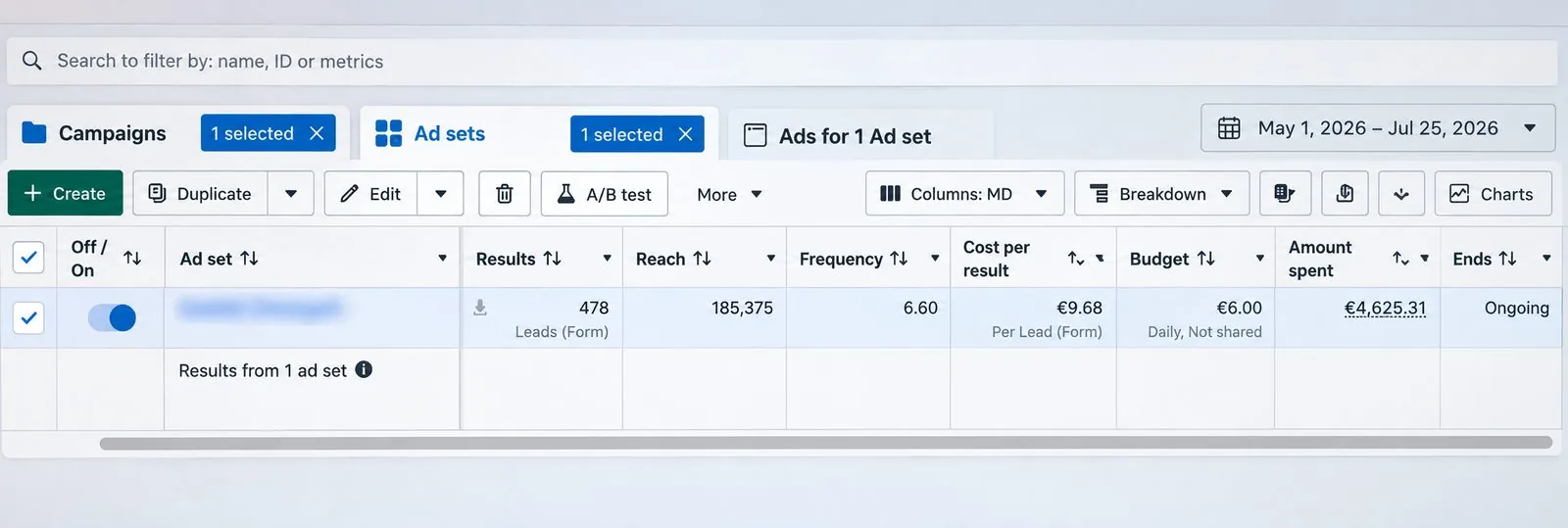
When we run ads, the destination is part of the system, not an afterthought. One campaign set we managed brought 478 leads at €9.68 each. That figure is from the ad account, not a promise that a landing page or a website produces a number on its own. It is a reminder that the form, the reply time and the page have to be ready before you spend.
If you already have a website and only need a campaign page, say so on the form. If you have neither, we will tell you whether a Professional Website from €990 is enough to start, or whether the campaign needs its own landing page as well.
Want pages that match how people actually find you? Apply now for a website
A few straight answers
A landing page has one offer, one audience and one action, usually for a campaign. A website has several pages (services, proof, contact, legal) so people arriving from search or a referral can find what they need.
You still need a destination you control. That can be a landing page on your own domain. If people also search your name, add a full website so they do not land nowhere.
A Professional Website starts from €990, a Business Website from €2,490 and a Growth Website from €4,900. A campaign landing page is scoped against those packages, or alongside them, once we see the offer.
Yes, and that is often the better set-up: a website people can trust, plus a landing page that matches a specific ad so paid traffic is not dumped onto a busy home page.
No. You do not control the layout, and people who search your name still expect an address that belongs to you. See our website-or-Facebook-page guide.
Yes. In Malta a page that offers a service must show your name, address and email and, where they apply, your registration and VAT numbers (Cap. 426, art. 8C). If it has a form, it also needs a privacy notice under GDPR art. 13.
Only when you will send a distinct campaign to that service. Otherwise a clear service page on the main website is enough.
Yes. The page should repeat the promise in the creative, show the next step and send the form somewhere you will reply.
Sources
Keep reading
What a campaign page has to match when the traffic is paid.
When a page is enough, and when you need an address you own.
Published prices and what belongs in a quote.
A useful first step
Professional Website from €990, Business Website from €2,490 and Growth Website from €4,900. Tell us whether you need a campaign page, a full site, or both, and we reply with what we would build.
Step 1 of 2
A few quick questions, about a minute. We usually reply within 2–3 hours.