
Facebook ads targeting in Malta
Location, age, interests, custom and lookalike audiences, and why broad usually beats narrow on a small island.
Facebook & Instagram ads · Landing pages
A good landing page for Facebook ads is one page built for one ad’s promise: the headline repeats what the ad said, the offer and price are clear, there is real proof, and there is one obvious next step, such as a short form, a booking button or WhatsApp. It loads fast on a phone inside the Facebook and Instagram app, and the Meta Pixel and Conversions API record what people do. For a Malta business, sending ad clicks to the homepage is the most common reason paid clicks do not turn into enquiries or sales.
Landing page · from your ad
Get your free quote
Full namePhone or WhatsAppGet my quoteThe short answer
A landing page is the page someone lands on after clicking your ad. It can be a page on your existing website or a separate page, but it has one job: turn the interest the ad created into an enquiry, a booking or a sale. It is not your homepage, which has to serve everyone, and it is not your services page, which explains everything you do.
People who click an ad on Facebook or Instagram were scrolling a minute ago. They clicked because one line or one image caught their attention, so the page must continue that exact thought. If the ad said “Aircon servicing in Malta and Gozo, book a visit this week”, the page should open with that service and a way to book this week, not with a slideshow about your company history.
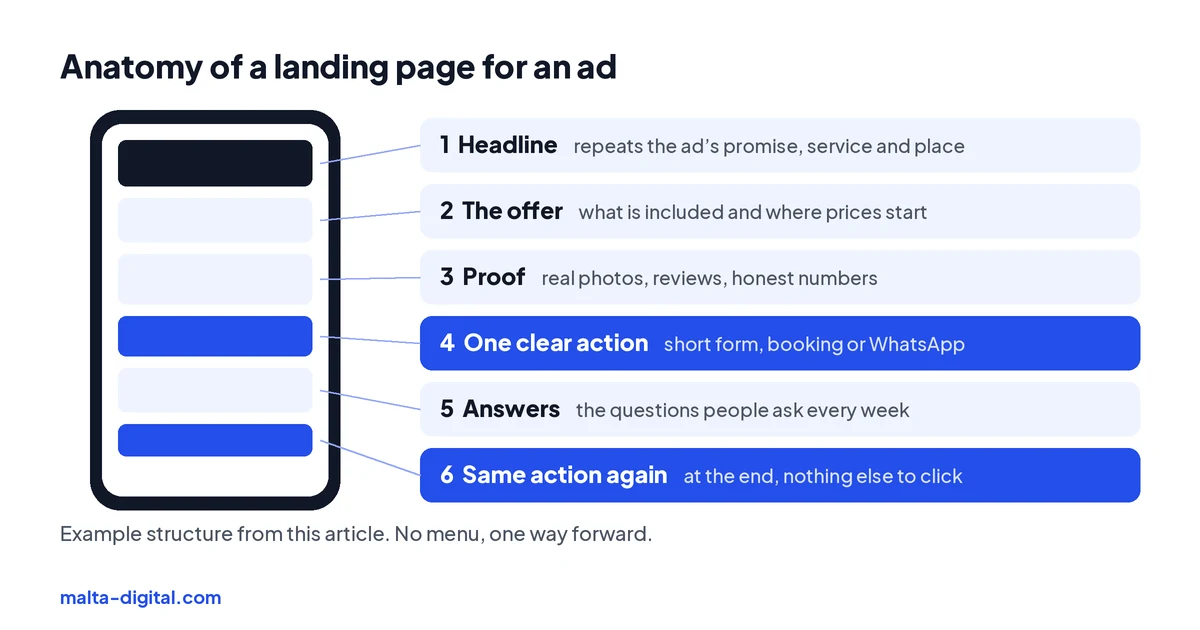
Most good ad landing pages follow the same order: a headline that matches the ad, the offer explained simply, proof that you deliver, one clear action, and short answers to the questions that stop people from acting. Everything else is optional.
The problem
In Ads Manager, a click is not a visit. Meta reports “landing page views” separately: the number of times your page actually loaded after someone clicked. Comparing link clicks with landing page views shows how many people gave up before your page even appeared. A big gap usually means a slow page, a broken link or a page that does not work well in the app’s built-in browser.
When the page does load, the usual problem is mismatch. A clinic in Sliema advertises a teeth whitening offer and sends people to the homepage, where they have to find the right treatment, the price and the booking form on their own. A few do; most press back and keep scrolling. The ad did its job, the page did not, and the owner concludes that “Facebook ads don’t work”.
The third problem is the ask. A contact form with ten fields, a “call us” button outside office hours, or no price at all makes a warm visitor wait. In Malta, where many people would rather send a WhatsApp than fill in a form, the easiest action is often a message, and pages that hide it lose enquiries.
Do you need one?
A landing page is not the only place to send ad clicks. Meta’s instant lead forms keep people inside Facebook or Instagram and are pre-filled, so they usually bring more leads at a lower cost, but often less considered ones. Click-to-WhatsApp ads open a chat straight away, which suits businesses that sell in conversation, such as salons, trades and restaurants.
A landing page is the better choice when people need information before they act: a price list, photos of the work, the details of a course, a property or a treatment. It is also the only option when you sell online, because the purchase happens on your website. And it builds something you keep: tracked visitors you can retarget, and a page that can also rank on Google.
Many of our campaigns use more than one route. A lead form for people ready to leave their number, a landing page for people who want to read first, and WhatsApp on the page for those who prefer to ask. The common mistake is choosing on cost per lead alone, without checking how many of those leads became customers.
| Landing page | Instant lead form | Click-to-WhatsApp | |
|---|---|---|---|
| Where people go | Your website | A form inside Facebook or Instagram | A WhatsApp chat with you |
| Best for | Offers people read about first, and online sales | Simple offers, quick enquiries | Businesses that sell in conversation |
| Lead volume and quality | Often fewer, better-informed leads | Usually more, cheaper, less considered leads | Depends on how fast you reply |
| What you keep | Tracked visitors to retarget, a page that can rank on Google | Contact details in Leads Center | The chat history |
What goes on the page
Start with the headline. It should repeat the promise of the ad in plain words, ideally with the same service, offer and place: “Kitchen renovations in Malta and Gozo, free quote in 48 hours”. Below it, one short paragraph and the action button, so someone who already decided can act without scrolling.
Then explain the offer the way a customer would ask about it: what is included, what it costs or where prices start, how long it takes and what happens after they enquire. Hidden prices are one of the most common reasons people in Malta message “how much?” and then disappear; even a “from” price filters out the wrong people and reassures the right ones.
Proof comes next: photos of real work, reviews from your Google profile, before-and-after pictures where they are allowed, and any numbers you can honestly show. Finish with short answers to the questions people ask on WhatsApp every week, then the same action button again. Remove the full menu and links to unrelated pages; a landing page should have one way forward.
Proof
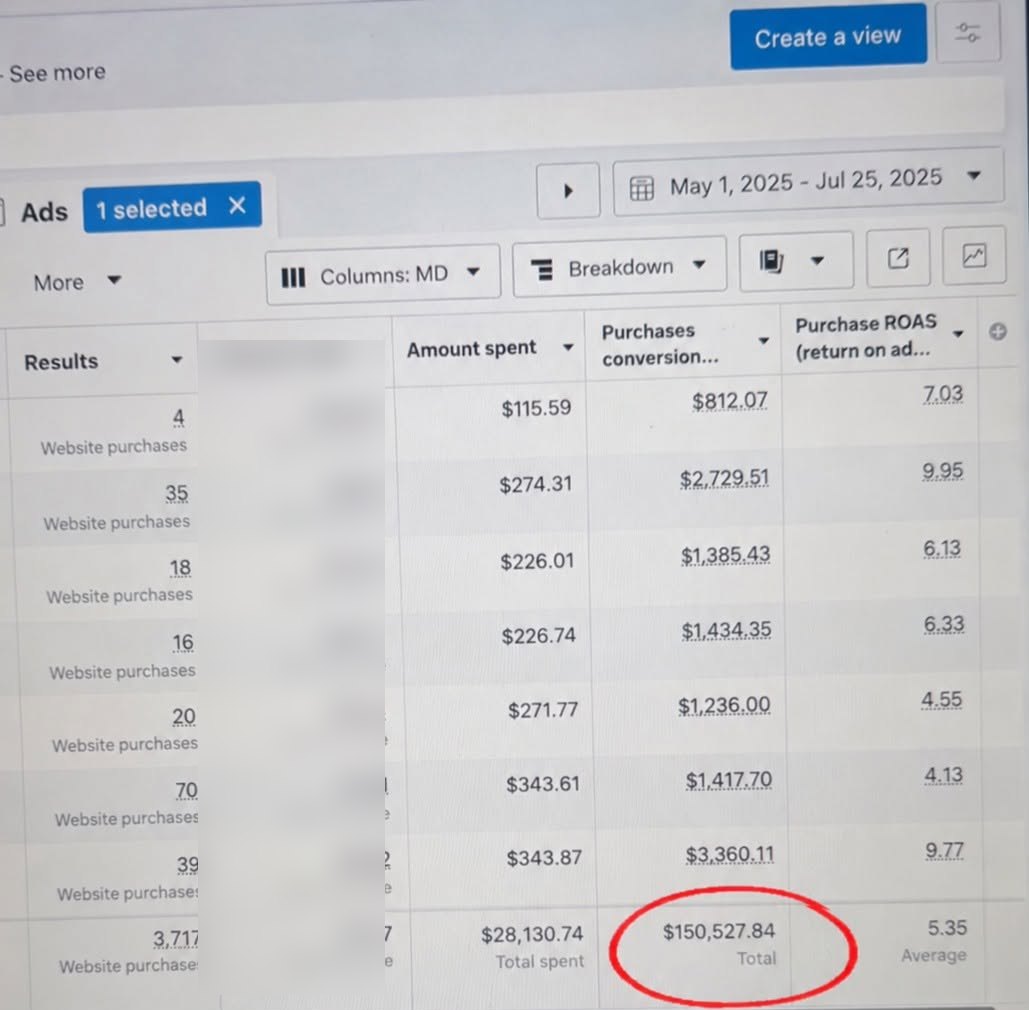
This is an online store we ran Facebook and Instagram ads for, from 1 May to 25 July 2025. Every click went to the store’s own pages, so the pages had to do the selling. Meta Ads Manager tracked 3,717 website purchases worth $150,527.84 from $28,130.74 of ad spend, an average purchase ROAS of 5.35.
The screenshot is straight from Ads Manager. Ad names are cropped and cost per purchase is blurred. Tracked purchase value is not profit, and past results are no guarantee of future ones.
Want ad clicks that land on pages built to sell? Free Meta Ads audit on WhatsApp
Send us your ad account or the page your ads point to on WhatsApp. We’ll check the message match, speed and tracking and tell you what we’d fix first. Free, no obligation.
Speed and mobile
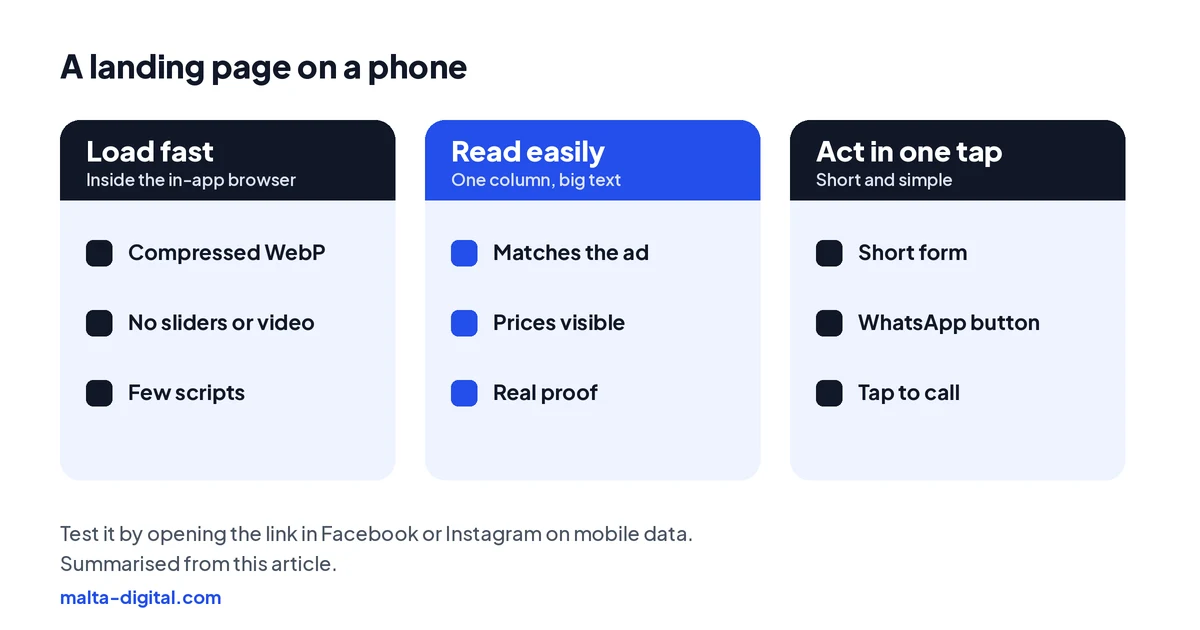
Almost all clicks from Facebook and Instagram come from phones, and the page opens inside the app’s own browser, not in Chrome or Safari. Test your page that way: send the link to yourself on Messenger or Instagram, open it on mobile data rather than office Wi-Fi, and see what a customer sees in the first seconds.
Speed comes from small things. Compress images and serve modern formats such as WebP, avoid video backgrounds and image sliders, and remove scripts and plugins the page does not need. Google’s Core Web Vitals give useful targets: the main content should appear within about 2.5 seconds, the page should react to a tap quickly, and nothing should jump around while it loads.
Make it easy to act on a small screen. One column, text large enough to read without zooming, buttons that are easy to tap, and a form with only the fields you truly need: name, phone or WhatsApp and one qualifying question is often enough. Every extra field is a reason to stop.
Tracking
Without tracking, Meta cannot learn who is likely to enquire or buy, and you cannot tell which ad or page brought results. Install the Meta Pixel and, ideally, the Conversions API, which sends the same events from your server and fills gaps caused by browsers and ad blockers. Set up the events that matter: a lead when the form is sent, a purchase with its value, and a contact when someone taps WhatsApp.
Send people to a thank-you page or show a confirmation after the form, and fire the lead event there, so you only count real submissions. Then test it: fill in the form yourself and check that the event appears in Events Manager before the campaign goes live.
In the EU, the Pixel and similar tracking need cookie consent before they run. Use a proper consent banner and the Conversions API so you respect people’s choices and still measure as much as the rules allow.
Testing
Once the page works, improve it with tests. The changes that usually matter most are the headline, the offer, the first image and the length of the form. Button colours rarely matter. Change one thing at a time so you know what made the difference.
Malta is a small market, so tests need patience. Let each version collect enough visits and results before you decide, and judge by enquiries or sales, not by clicks or time on page. A version that brings fewer but better leads can be the winner if more of them become customers.
Keep a simple log of what you changed and when. After a few months it becomes the most useful document you have about what your customers respond to, and it makes the next campaign faster to launch.
How we do it
We start from the ad, not the page: who it is for, what it promises and what we want people to do. Then we write and build the page around that promise, with the offer, real proof, one clear action, WhatsApp where it helps and a fast mobile layout, and we connect the Pixel, Conversions API and consent before any money is spent.
Meta ads management starts from €1,249 a month plus ad spend, excluding VAT. Our Customer Acquisition System package adds landing pages and conversion improvements to the ad management, so the ads and the pages are planned, tested and improved together. Our case studies show the kind of results we report, straight from Ads Manager.
A few straight answers
Not always. Lead forms or WhatsApp can work for simple offers. You need a landing page when people must read details before acting, and when you sell online.
You can, but it usually converts worse. A homepage serves everyone; a landing page continues one ad’s promise with one clear action.
A headline that matches the ad, the offer and price, real proof, one clear action such as a short form or WhatsApp, and short answers to common questions.
Meta counts a landing page view when your page loads after someone clicks the ad. Comparing them with link clicks shows how many people left before it loaded.
As fast as you can make it on mobile data. Google’s Core Web Vitals aim for the main content within about 2.5 seconds.
Lead forms usually bring more, cheaper leads; landing pages often bring better-informed ones. Compare how many of each become customers.
Keep reading
Location, age, interests, custom and lookalike audiences, and why broad usually beats narrow on a small island.

Create a business portfolio, add your assets, give agencies partner access, stay secure and verify your business.

How to search competitors’ ads, what EU ads reveal about targeting and reach, and what the Library cannot show.
A useful first step
We plan the ad, write and build the page, connect the Pixel and Conversions API and keep testing. Meta ads management from €1,249 a month plus ad spend, excluding VAT.