Restaurant booking system
One live diary for website, Google, Instagram and WhatsApp bookings, with reminders, deposits for big groups and fewer no-shows.
Systems & automation · Online ordering
An online ordering system lets customers order food from your own website, Instagram, Google profile or a QR code, pay online or on collection, and sends each order straight to your kitchen with no retyping. For a restaurant, takeaway or café in Malta it sits next to Wolt and Bolt Food rather than replacing them: the apps bring new customers, while your own ordering page brings your regulars back without a platform commission on every order. Most places should start with a good ready-made tool; a custom system pays off when you run several outlets, complex menus or your own delivery.
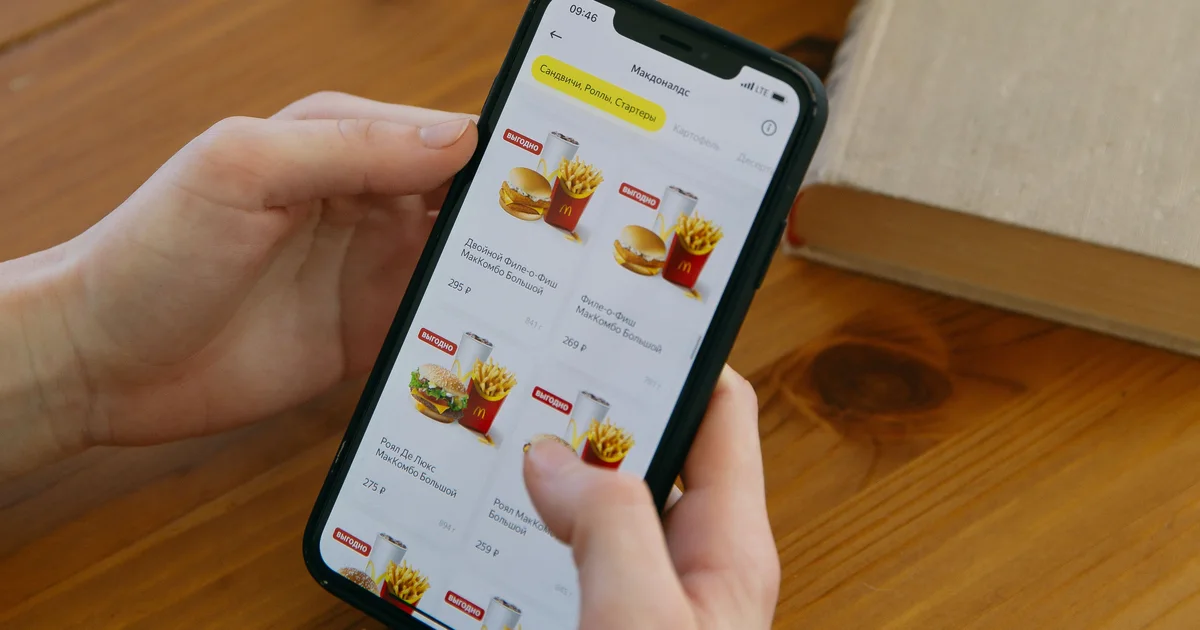
Order online · collection
Ready at 19:30
2 × Pizza margheritaAllergens shown per dishPlace orderAn online ordering system lets customers order and pay from your own website, Instagram, Google profile, QR code or WhatsApp link and sends every order straight to the kitchen, next to Wolt and Bolt Food rather than instead of them. Malta Digital sets up ready-made ordering tools when they fit and builds custom online ordering systems for restaurants and takeaways in Malta and Gozo when they do not.
The short answer
An online ordering system is your menu, turned into a shop. Customers open a link, see what is available right now, choose items and options such as size, extras or “no onions”, pick collection or delivery and a time, and pay. The order lands on a screen or printer in the kitchen, already itemised, and the customer gets a confirmation with an estimated time.
A good system also handles the boring parts that cause mistakes on the phone. It hides items when they sell out, closes ordering outside your hours, checks the delivery address against your zones and minimum order, adds the delivery fee, and keeps a record of who ordered what. Over time it gives you a customer list and simple numbers: orders per day, average basket, best sellers and busy hours.
The goal is not to fight the delivery apps. It is to own the relationship with the people who already know you, so the customer who orders from you every Friday does so on your page, not through an app that takes a cut and shows them three competitors first.
The problem
Many takeaways in Malta still run on the phone and WhatsApp. On a busy Friday night in Birkirkara or Ħamrun that means one person writing orders on a pad, reading them back over the noise, missing calls while the kitchen waits, and a WhatsApp chat full of “same as last time” that someone has to decode. Wrong orders, forgotten extras and long hold times all cost repeat business.
The usual fix is to move everything onto Wolt and Bolt Food. That solves taking the order, but every order pays a commission, the customer belongs to the app as much as to you, and the app decides how you rank next to the place down the road. For a takeaway with thin margins, paying a commission on regular customers who would have ordered anyway is the real leak.
Tourists add another layer. A visitor staying in St Julian’s or Buġibba wants to order in English from their phone without calling a number they cannot pronounce. If your Instagram or Google profile has no ordering link, they open an app and pick whoever shows up first.
How it works
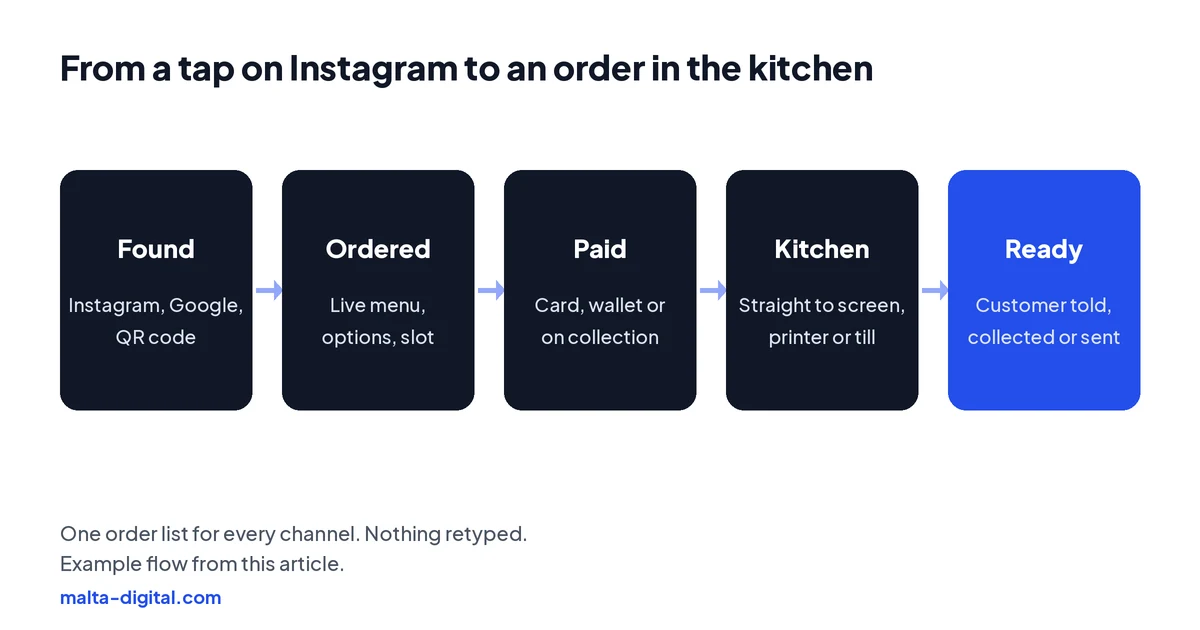
The customer starts wherever they found you. An Order online button on your website, your Google Business Profile, your Instagram bio and a QR code on the counter, the table or the flyer all open the same ordering page. The menu shows what is available now, with photos, prices, options and allergen information, so the customer builds the order themselves instead of reading it to someone.
At checkout they choose collection or delivery and a time slot. Delivery addresses are checked against the localities you cover, with a fee and minimum order per zone, so you never accept an order to Mellieħa when your driver only covers Sliema and Gżira. Payment is online by card, Apple Pay or Google Pay, or on collection if you allow it.
The kitchen sees the order straight away on a tablet, a printer or your till, with every option spelled out. When it is ready, or when the driver leaves, the customer gets a message. Nothing is retyped, nothing depends on someone’s handwriting, and every order is in one list you can search later.
Features that matter
A menu that stays true. The most common complaint about online ordering is ordering something that is not available. The system should let staff mark items sold out in two taps, schedule breakfast, lunch and dinner menus, and pause ordering when the kitchen is overloaded. If you also sell on delivery apps, the ideal is one menu that updates every channel, so prices and sold-out items match everywhere.
Options and combos done properly. Pizza sizes, half-and-half, extra toppings, meal deals, “ftira with or without tuna”: the menu builder must handle your real options, with prices that add up correctly. Bad option handling is where most orders go wrong, so test it with your most complicated dishes before you go live.
Time slots and kitchen capacity. Let customers order ahead for a time, and limit how many orders the kitchen accepts per slot. That stops twenty orders landing at 19:30 on a Saturday and every customer waiting an hour. It also lets offices order lunch in the morning for 12:30.
Delivery zones or collection only. If you deliver yourself, set zones by locality with a fee and minimum each, and send the driver a clear list with addresses and phone numbers. Many places start with collection only, which is simpler, and keep the apps for delivery.
Channels
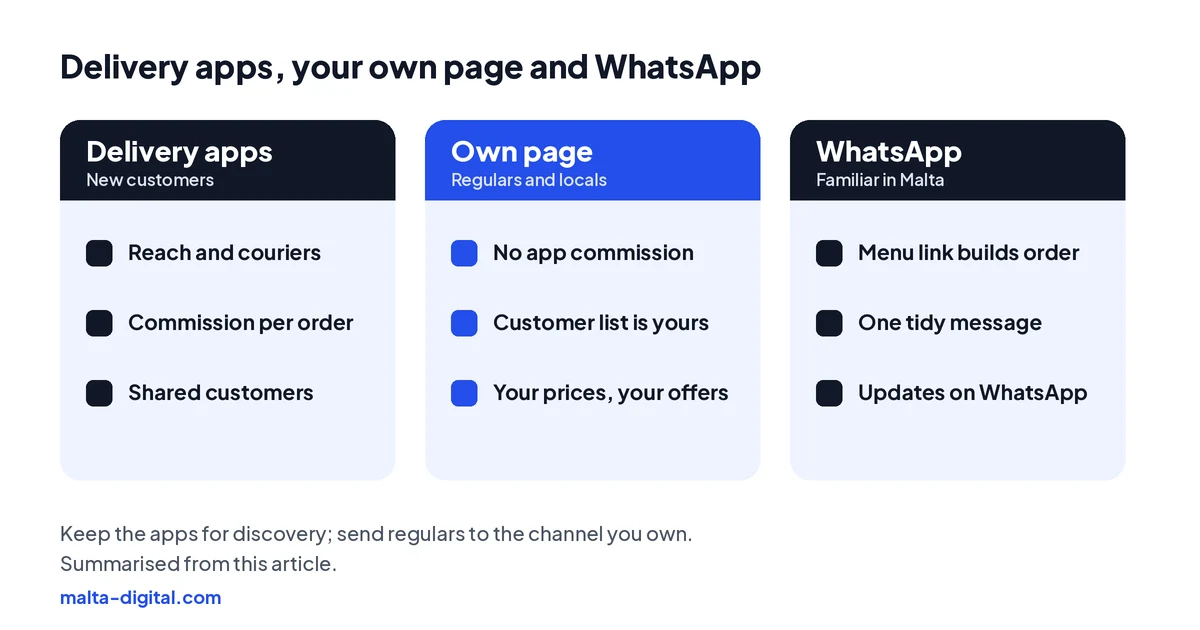
Delivery apps are good at one thing: putting you in front of people who do not know you yet, and handling the couriers. Keep them for that. Price your menu on the apps to cover the commission, and make sure every bag that leaves your kitchen carries a card or sticker with your own ordering link or QR code, so the next order can come direct.
Your own ordering page is where regulars, offices and locals should end up. Give them a reason: a slightly better price than on the apps, a loyalty stamp, free collection, or a dish that is only on your own menu. A short WhatsApp or email to past customers when you launch it usually does more than any advert.
WhatsApp ordering feels natural in Malta, but free-text orders are slow to read and easy to get wrong. The better way is a menu link that builds the order and sends it to your WhatsApp as one tidy message with the items, address and total, or an ordering page that sends updates on WhatsApp. If you want an assistant to answer questions like “do you have gluten-free pizza?”, our guide to a WhatsApp AI chatbot explains how to do it without losing control.
Apply now and tell us how your restaurant or takeaway takes orders today. We’ll tell you honestly whether a ready-made ordering tool fits or a custom system is worth it, or message us on WhatsApp.
See it working
An ordering button only works if the website around it is clear and fast on a phone. This demo shows a café site with the menu, opening hours and a clear route to visiting, the kind of page an Order online button sits on.

Want an ordering page like this for your restaurant or takeaway? Message us on WhatsApp
Ready-made or custom
For most single restaurants and takeaways, a ready-made online ordering tool is the right start. Several are used in Malta, some connect to delivery apps and tills, and pricing ranges from a flat monthly fee to a fee per order. Before you sign, check four things: whether there is a commission or fee per order, whether you get the customer list if you leave, whether it connects to your till or kitchen printer, and whether it handles your real menu options.
A custom ordering system makes sense when your setup does not fit a template: several outlets with different menus and stock, a central kitchen that supplies other venues, catering and office orders with invoices, your own delivery fleet with zones and drivers, or ordering tied to a loyalty scheme and a customer app. It also helps when you want ordering, bookings and your customer list in one place. Custom business systems from Malta Digital start from €7,500, excluding VAT, and larger projects may qualify for Digitalise your SME co-funding, subject to eligibility and approval.
The middle path is common: keep your till and the delivery apps, add a ready-made ordering page, and connect the pieces so orders and customers end up in one place.
| Delivery apps | Your own ordering page (ready-made) | Custom ordering system | |
|---|---|---|---|
| Best for | Reaching new customers and using couriers | Regulars, locals and offices ordering direct | Several outlets, central kitchens, catering accounts, your own delivery fleet |
| Customer details | Shared with the platform | Yours, if the tool lets you export them | Yours |
| Check before you sign | Commission per order and how you rank in the app | Fee per order, till or printer connection, menu options, data export | Hosting, ownership and support terms in the proposal |
| Price | Commission on each order | Monthly fee or fee per order, depending on the tool | From €7,500, excluding VAT; may qualify for Digitalise your SME co-funding |
Rules and payments
Online card payments in the EU use strong customer authentication, so customers confirm with their bank app or a wallet such as Apple Pay. A good ordering system handles that inside the checkout. Decide your rules for refunds and wrong orders before launch, and write them on the ordering page.
Food sold online still needs allergen information. Under the EU rules on food information to consumers, people ordering at a distance must be able to see allergen information, and it must be available when the food is delivered. The simplest way is to show the allergens on each dish in the online menu and train staff to check special requests. Keep the menu text accurate; an out-of-date allergen list is worse than none.
Customer data falls under GDPR. Collect what you need to deliver the order, say in your privacy notice how you use it, and ask separately, with a box that is not pre-ticked, before sending offers. If a chatbot takes orders or answers questions, the EU AI Act requires it to tell customers they are talking to an AI.
How we do it
We start with how orders come in today: phone, WhatsApp, apps, walk-ins, and how they reach the kitchen. We look at your menu, your busiest hours and what goes wrong. Then we recommend the simplest setup that works, which is often a ready-made ordering tool, set up properly with your real menu and connected to your website, Google profile, Instagram and WhatsApp.
When a ready-made tool does not fit, we build a custom ordering system around your outlets, menus, delivery zones and till, test it with real orders before launch and train the team. We can also run the Facebook and Instagram ads that send people to it. See our case studies for real results from our work, and our business systems page for how projects are priced.
A few straight answers
A menu customers can order and pay from online, through your website, Instagram, Google profile or a QR code, with each order sent straight to the kitchen and a confirmation sent to the customer.
Usually not. Keep the apps for new customers and couriers, and move regulars and locals to your own ordering page, where you avoid a commission and keep their details.
Yes. The best way is a menu link that builds the order and sends it to your WhatsApp as one clear message, or an ordering page that sends updates on WhatsApp, rather than free-text orders.
Yes. Under EU food information rules, customers ordering at a distance must be able to see allergen information, and it must be available on delivery. Show allergens on each dish in the online menu.
Yes. Most systems let customers order ahead for a time slot and let you cap how many orders the kitchen accepts per slot, which stops everything landing at once.
Malta Digital’s custom business systems start from €7,500, excluding VAT. For a single outlet with a standard menu, a ready-made ordering tool set up properly is often enough.
Keep reading
One live diary for website, Google, Instagram and WhatsApp bookings, with reminders, deposits for big groups and fewer no-shows.
The free app, the WhatsApp Business Platform, templates, opt-in and connecting to your CRM.
Goals, targeting, ad ideas and how to track bookings and walk-ins for restaurants in Malta.
A useful first step
We set up or build your online ordering, connect it to your website, Google, Instagram, WhatsApp and kitchen, and help move regulars off the apps. Custom systems from €7,500, excluding VAT.