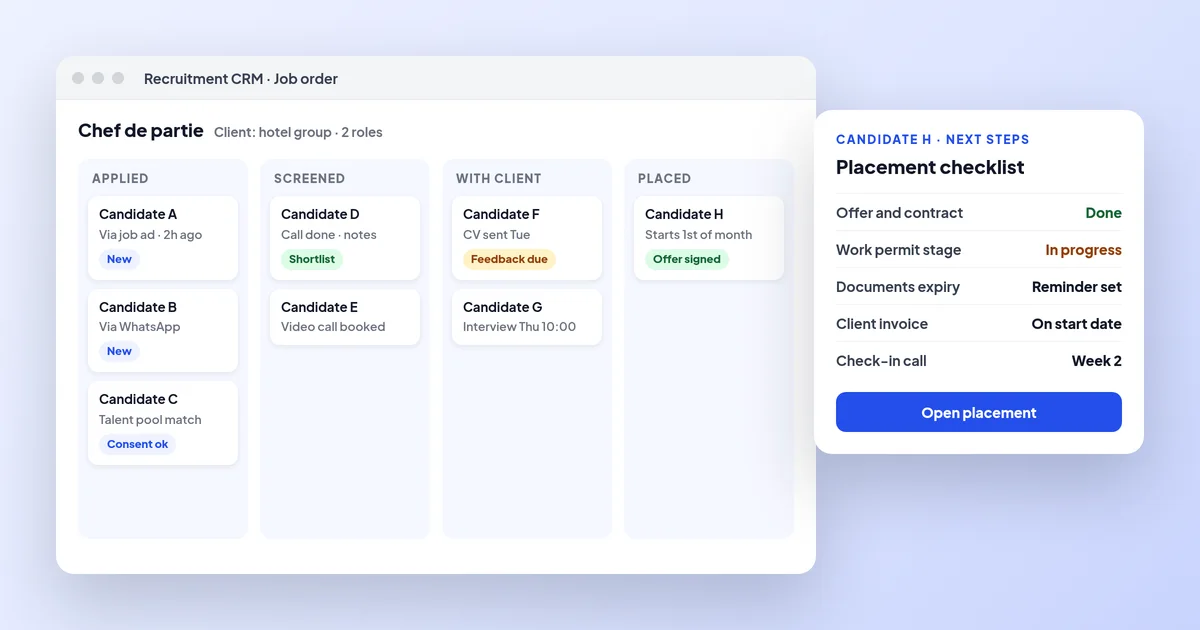
CRM for recruitment agencies
Track candidates and vacancies.
Websites · Recruitment
Candidates want real jobs and a quick way to apply. Employers want proof you can send the right people. This guide shows the pages, job page layout and Malta licence rules a recruitment website needs, with a free applications planner.
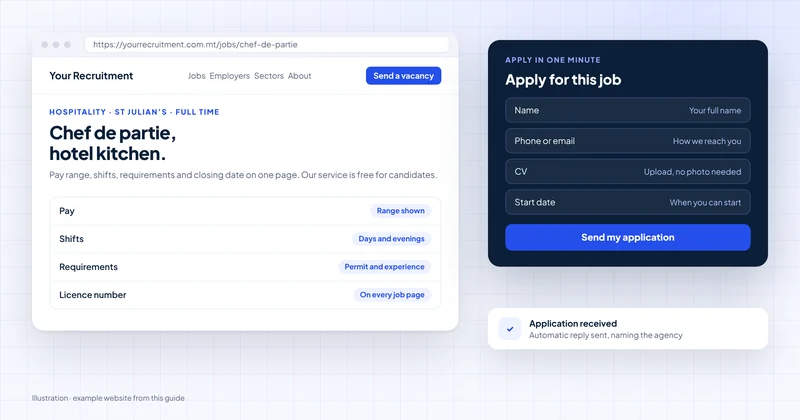
Need the website built? Our web design Malta packages: Professional €990 ready in 24 to 48 hours, Business €2,490 in 2 to 4 days, Growth from €4,900 in 7 days. See real websites we built.
A recruitment agency website in Malta needs a page for every vacancy (pay, hours, locality, requirements and a five-field apply form), an employer page with a vacancy form, and the licence details S.L. 452.130 asks for: the licence shown on the site, the licence number on every advert and “free for candidates”. We build these in our web design in Malta packages, from €990.
The short version
A recruitment agency website in Malta needs two front doors: job pages that candidates can trust and apply to in a minute, and an employer page that shows the sectors you fill and how fast you send people. It also has to carry the details Malta’s Employment Agencies Regulations ask for, such as your licence shown on the site and your licence number on every advert.
Most agencies lose people in the gaps: a job advert on social media that links to a home page, an apply form that asks for everything, and no reply for weeks. This guide shows the pages, the job page layout, the rules that apply to your website and adverts, and a free planner that works out how many applications you need each month.
It supports our web design in Malta service, where we build websites for recruitment and staffing agencies in Malta and Gozo.
The market
Recruitment in Malta has grown quickly. Eurostat counts 189 employment placement agencies (NACE N78.1) in Malta in 2024, up from 122 in 2021, and they employed 2,641 people in 2024. Counting temporary work agencies and other staffing firms too (NACE N78), the total went from 276 to 429 businesses.
More agencies means candidates and employers both compare before they pick one. A hotel in St Julian’s looking for kitchen staff, or a nurse in Manila looking at jobs in Malta, will open several agency websites. The one that shows real vacancies, clear terms and a quick way to apply gets the call and the CV.
The rules
Recruitment agencies in Malta are licensed under the Employment Agencies Regulations (S.L. 452.130), issued under the Employment and Industrial Relations Act. A first licence costs €3,000. Several of the rules are about what you publish, so they belong in the plan for your website, not only in your office files.
| What the regulations say | What it means for your website |
|---|---|
| Reg. 9(3): the licence must be displayed on the premises and prominently on any website used for the agency | Show the licence clearly, for example in the footer and on the About page, not hidden in a PDF |
| Reg. 11(a): the licence number goes on every advert and any publicity for the agency | Add the licence number to every job page, job advert and social post template |
| Reg. 10(1): no payment or charge may be demanded from any applicant | Say plainly that your service is free for candidates, on job pages and the apply form |
| Reg. 13(1): every applicant who applies in writing to an advert gets a written reply within one month, naming the employer or the agency | Send an automatic acknowledgement as soon as someone applies, then a real update |
| Reg. 13(2): an anonymous advert may not ask applicants for a photo, or a document with a photo | On jobs where the employer is not named, do not ask for a photo or a CV with a photo |
| Reg. 13(3): an advert placed with no specific vacancy in view must say so | Label general sign-up forms, such as “Join our talent pool”, so they are not mistaken for a live job |
Job adverts must also avoid discrimination, for example on sex, age, religion, disability or race, under Malta’s equal treatment rules. Our guide to website legal requirements in Malta covers the general details every business site must show.
Want a website that follows the rules and still sells? Apply now for a recruitment website
Your pages
Candidates and employers want different things, so give each its own path from the home page. A candidate should reach the jobs in one tap. An employer should reach a page that explains how you work and a short form to send a vacancy.
| Page | Who it is for | What it shows |
|---|---|---|
| Jobs | Candidates | Live vacancies, filtered by sector, locality and type of contract |
| One page per job | Candidates and Google | Title, pay or pay range, hours, locality, requirements, how to apply, closing date |
| For employers | Employers | Sectors you fill, how the process runs, how fast you shortlist, your terms, written simply |
| Sectors | Both | A page per sector you really fill, such as hospitality, healthcare, finance or construction |
| Working in Malta | Candidates from abroad | Your role, the employer’s role and the official permit steps, with links to official sites |
| About and licence | Both | Who you are, your licence shown clearly, your team and how to reach you |
Do not create a sector page for every industry in Malta. Three or four sectors you really fill, each with real roles and a short case, do more than fifteen empty pages. Our guide to website copywriting shows how to write each page in your readers’ words.
Job pages
A job page is where the application happens, so it needs to answer every question a candidate has before they apply: what the job is, where, the hours, the pay, what they need and what happens next. Pages that hide the pay or the locality get fewer and weaker applications.
Add JobPosting structured data to each job page. Google lists the required details as the date posted, a full description, the hiring organisation and the job location, and it allows the value “confidential” as the hiring organisation when an agency is recruiting for an employer who is not named. That fits Malta’s rules on anonymous adverts.
| Google’s rule | What to do |
|---|---|
| Required: datePosted, description, hiringOrganization, jobLocation | Fill these on every job page; the description must be complete, not just the title |
| Anonymous employer: the name may be “confidential” | Use it when the client is not named, instead of inventing a name |
| Expired jobs must be removed in time, or the site risks a manual action | Close the page, set validThrough in the past, or remove the markup the day a job is filled |
| Salary (baseSalary) is optional but supported | Show pay where you can; candidates filter by it |
One honest note: Google’s own list of countries where its job search experience is available does not include Malta yet. It does include countries many Malta agencies recruit from, such as Italy, Spain, the Philippines and India. Clean job pages with the right markup are ready for that, and they help ordinary Google results here too.
Applying
A long form on a phone loses good candidates. Ask only what you need to decide whether to call, and collect the rest later.
| Field | Why you need it |
|---|---|
| Name, email and phone | Reply the way they prefer |
| The job, or the talent pool | Know what they applied for (and label the pool as general) |
| CV upload | Read their experience; never require a photo on anonymous jobs |
| Right to work, or a permit needed | Plan the steps before you shortlist |
| When they can start | Match urgent roles first |
| Consent to keep their CV for other roles, with how long | Keep the CV only as long as you said you would |
Under the GDPR, tell candidates who you are, why you keep their details and for how long, and delete CVs when that time is up. Do not ask for health, religion or other special category data on an apply form. Our guide to website enquiry forms covers layout and spam protection, and our guide to CRM for recruitment agencies shows how to track candidates and vacancies after they apply.
Free tool
Enter the placements you want each month, your average fee and your own rates. The planner shows how many applications you need, how many written replies you owe, and how long those replies take if they are typed one by one.
Use your own figures. Nothing you type is sent anywhere.
Your result appears here as you type.
Most agencies find the gap is not the number of applications but the share that fit. Clearer job pages raise that share, which means fewer CVs to read for the same placements.
Worked example
Say an agency in Birkirkara places hospitality and care staff. It wants six placements a month at an average fee of €1,800. It gets 120 applications a month, 12% make the shortlist and a quarter of those are hired. Every job advert on social media links to the home page, and the apply form is one long page.
With the planner’s defaults, the agency needs 24 shortlisted candidates and 200 applications a month, so it is 80 short, and it owes 200 written replies, about 10 hours of typing. The new site gives every vacancy its own page with pay, shifts and locality, the licence number and a “free for candidates” line, a five-field apply form and an automatic acknowledgement.
| Before | After | |
|---|---|---|
| Job adverts link to | Home page | The exact job page |
| Pay and locality shown | Sometimes | On every job page |
| Licence on site and adverts | Footer only | Footer, About page and every advert |
| First reply to applicants | By hand, when there is time | Automatic, naming the agency, the same minute |
If clearer pages lift the shortlist rate from 12% to 20%, the same 120 applications give 24 shortlisted candidates, enough for the six placements, worth €10,800 in fees that month. The numbers are examples; use the planner above with your own figures.
How we help
We build websites for recruitment and staffing agencies in Malta and Gozo: job pages with the right structured data, a jobs list you can update yourself, an employer page and vacancy form, a short apply form with CV upload and an automatic first reply, and your licence shown the way the regulations ask. You own the site, the domain and every candidate record, and every application comes straight to you.
| Package | Price | Ready in |
|---|---|---|
| Professional Website | From €990 | Complete in 24 to 48 hours |
| Business Website | From €2,490 | 2 to 4 days |
| Growth Website | From €4,900 | 7 days |
| 24-Hour Premium Website | €2,990, up to 15 pages | 24 hours |
If you also want more candidates to see your jobs, our Facebook and Instagram ads start at €1,249 a month plus ad spend, and our guide to Facebook job ads explains the rules for job adverts. We have 18 Google reviews from real clients. See our website design packages for what each one includes.
Ready for a website that fills your vacancies? Apply now for a recruitment website
A few straight answers
A jobs list with one page per vacancy (pay, hours, locality, requirements, closing date), a page for employers with a vacancy form, pages for the sectors you really fill, a short apply form with CV upload, and your licence shown clearly with the licence number on every job page.
Yes. Regulation 9(3) of the Employment Agencies Regulations (S.L. 452.130) says the licence must be displayed prominently on any website the agency uses, and regulation 11(a) says the licence number goes on every advert and any publicity.
No. Regulation 10(1) of S.L. 452.130 says no payment or charge may be demanded from any applicant for employment services, and no deductions may be made from wages for the agency’s services.
Under regulation 13(1), an agency recruiting for a vacancy must send a written reply within one month to every applicant who applied in writing to an advert, naming the employer or the agency. An automatic acknowledgement makes this easy.
No. Regulation 13(2) says an agency placing an anonymous advert may not ask applicants to send a photo or any document that includes a photo.
Google’s list of countries where its job search experience is available does not include Malta yet, but it includes countries many Malta agencies recruit from, such as Italy, Spain, the Philippines and India. Job pages with JobPosting structured data are ready for it and still help normal search results.
Our Professional Website starts from €990 and is complete in 24 to 48 hours. The Business Website starts from €2,490 in 2 to 4 days, the Growth Website from €4,900 in 7 days, and the 24-Hour Premium Website is €2,990 for up to 15 pages.
Sources
Keep reading
Track candidates and vacancies.

The rules for job adverts.
Forms people actually finish.
A useful first step
Professional Website from €990, Business Website from €2,490 and Growth Website from €4,900. Tell us the sectors you fill, and we reply with what we would build.
Step 1 of 2
A few quick questions, about a minute. We usually reply within 2–3 hours.